

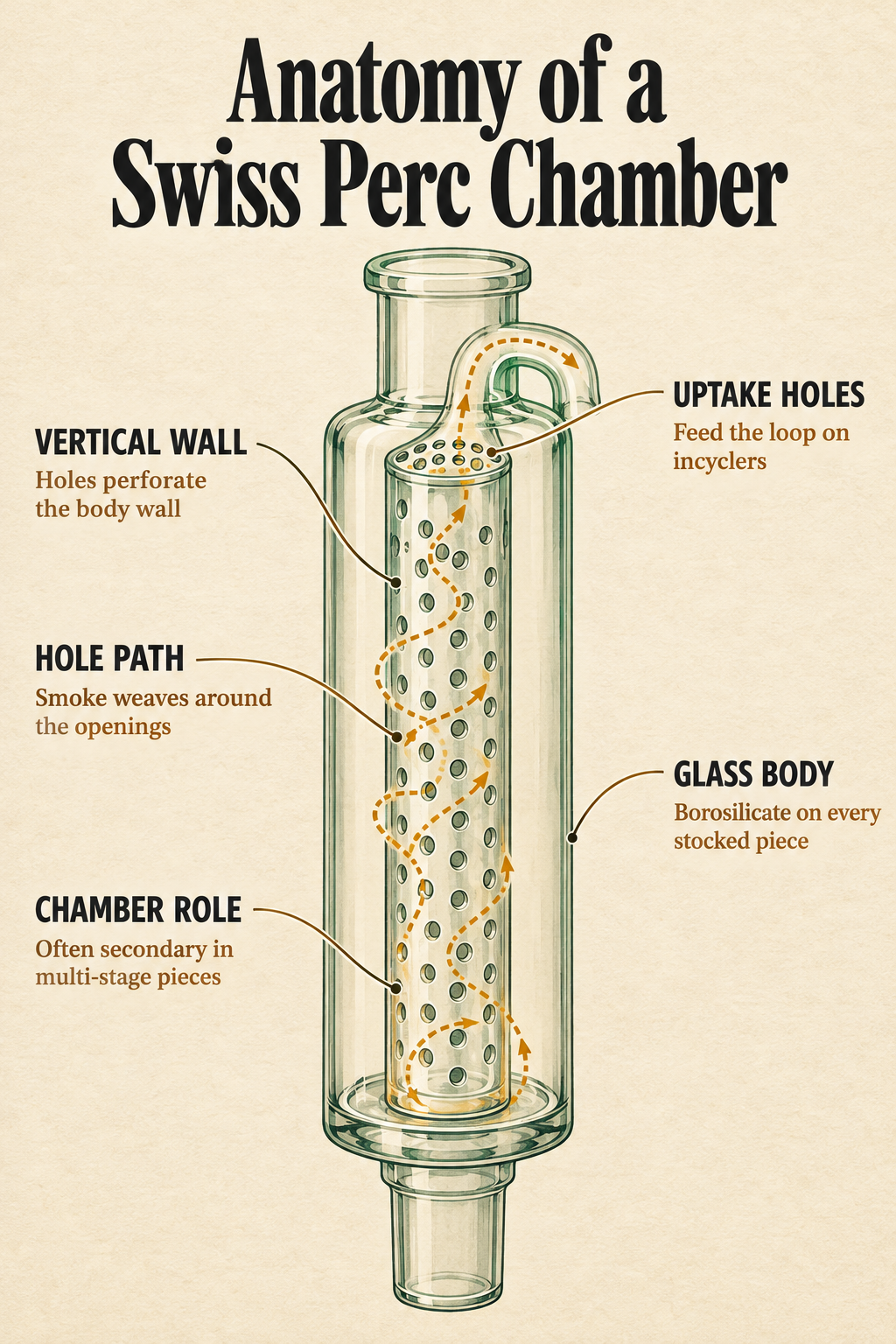
A swiss perc is a percolator drilled into the wall of the glass itself: a vertical disc or chamber wall full of holes, so smoke weaves around the openings instead of passing straight through them [1]. The holes are larger than a honeycomb grid, so the pull is easier and the openings clog less. The name covers several builds, so check the listing before you buy.
What Is a Swiss Perc and How Does It Filter Smoke?
In the strict definition, a swiss perc is a vertical disc perforated with holes in the body of a bong or rig, with smoke forced around the openings [1]. The holes are cut into the wall itself, not into a separate disc that floats inside the tube. That single detail decides how you fill the piece, how you clean it, and why there is no part to replace.
The layout is the whole mechanism. Smoke cannot pass straight through the openings, so it routes around them, which lengthens its trip through the water [5]. The design does not shred a draw into a cloud of very small bubbles the way a fine grid does. It stretches the path instead, and a longer path is a different thing from more bubbles.
Placement matters as much as geometry. A swiss perc usually works as a secondary percolator in a multi-stage piece, similar in role to a donut perc, and water plus bubbles commonly climb about halfway up the swiss chamber during a draw [7]. That is why the working water line is not the one you would guess by looking at the outside of the tube.
One limit is worth naming up front. Perforated glass changes how smoke travels; it does not change what is in the smoke. The CDC notes that smoked cannabis can harm lung tissue and damage small blood vessels, and that cannabis smoke carries many of the same toxins and irritants as tobacco smoke [13].
If you are still comparing shapes, browse the Percolator Bongs collection for drilled walls and chamber designs, or the Recycler Bongs collection if you would rather have a loop built into the piece.
- The hole wall: a vertical band of glass with many drilled openings, worked into the body rather than dropped in as a separate part.
- The path: smoke weaves around the openings instead of pushing through them, so it stays in contact with the water longer.
- The chamber: on a multi-stage piece the swiss section usually sits below the mouthpiece as a second stage, with bubbles rising roughly halfway up it.
- The fit: there is no removable part, so nothing to swap, upgrade, or lose down the drain.
- The material: every swiss piece in our current line is listed as borosilicate glass [15].
Is a Swiss Perc Better Than a Honeycomb Perc?
The two designs differ by orientation and hole size, not by which one wins in the abstract. A honeycomb disc sits horizontally inside the body, while the holes on a swiss perc are part of a vertical wall. Swiss holes are larger, so the design diffuses with less resistance and the openings clog less often than a fine honeycomb grid [3].
Past that, the published ratings disagree with each other, and the disagreement is the most useful thing to hand a shopper. No single number is the truth here, because four writers are describing different pieces and grading different things.
The pattern underneath those ratings is simple enough. A finer grid buys more bubbles and charges for them in pull and in cleaning time [2]. Swiss holes trade some of that bubble count for an easier draw and a wall you can rinse out.
So pick by how much diffusion you actually want rather than by a star rating. Each nearby style already has its own guide. What Is a Percolator Bong and How Does It Work? explains the percolator family from the ground up, What Is a Recycler Bong and How Does It Work? covers the looping designs, and What Is a Showerhead Perc and Which One Should You Buy? handles the finer-diffusion end of the range.
For a design that spins water instead of stretching the path, What Is a Spinner Perc and How Does It Actually Work? is the one to read. New to water pipes entirely? Start with What Is a Bong and How Does It Work? before you spend money on a perc count you do not need.
- Orientation: a honeycomb disc sits horizontally inside the body, while swiss holes are drilled through a vertical wall.
- Hole size: swiss openings are larger, so the design diffuses with less resistance and clogs less often than a fine grid.
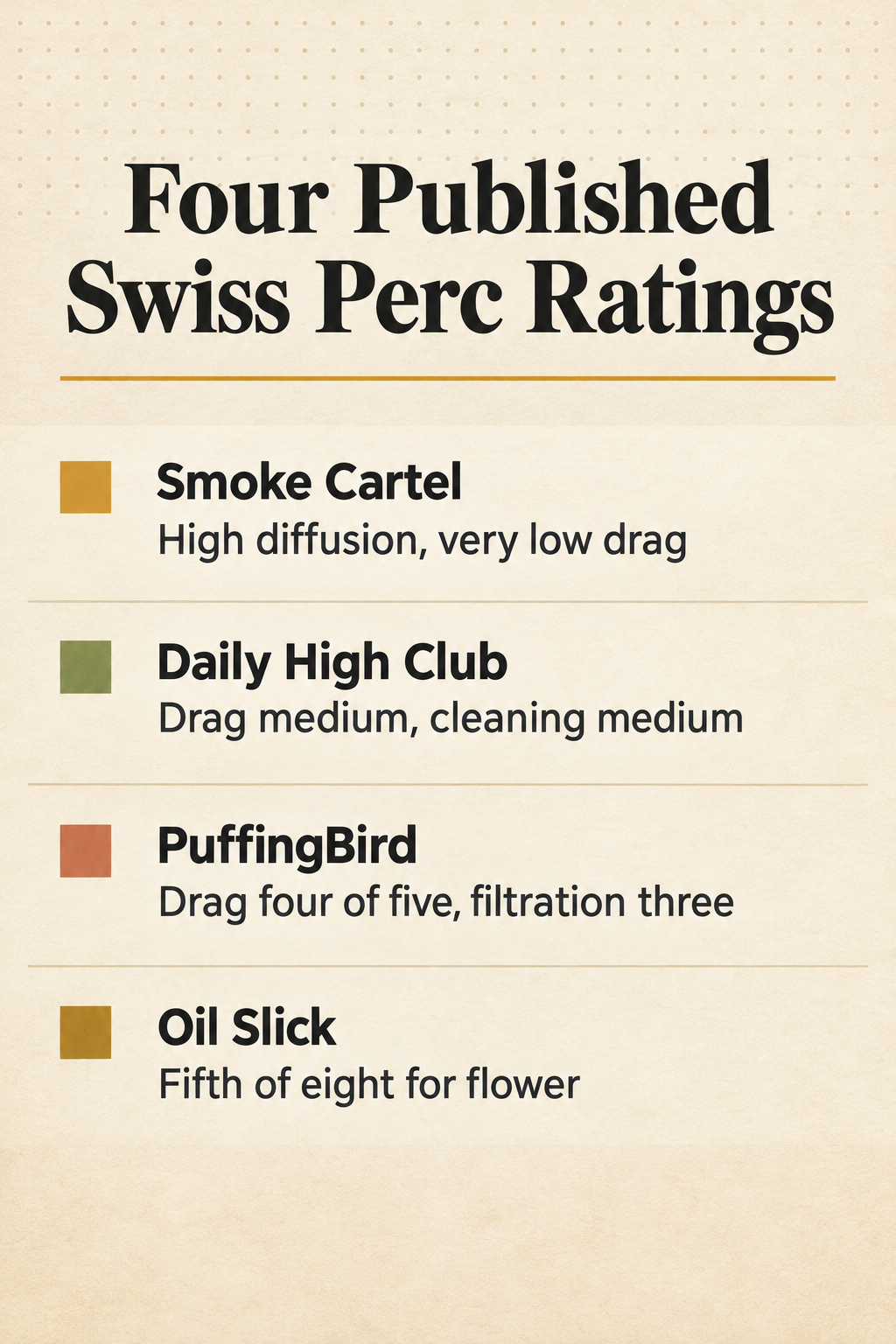
- Smoke Cartel: rates swiss high for diffusion and very low for drag [5].
- Daily High Club: rates drag medium and cleaning medium, and advises covering the disc by about a quarter inch [3].
- PuffingBird: gives swiss four of five for drag and three for filtration, and says it makes fewer bubbles than other percs [4].
- Oil Slick: ranks swiss fifth of eight perc types for flower use, with a cleaning difficulty of one out of five [8].
| Source | Diffusion | Drag | Cleaning |
|---|---|---|---|
| Smoke Cartel | High | Very low | Not rated |
| Daily High Club | Not rated | Medium | Medium |
| PuffingBird | 3 of 5 | 4 of 5 | Not rated |
| Oil Slick | 5th of 8 for flower | Not rated | 1 of 5, easiest |
How Much Water Do You Put in a Swiss Perc Bong?
Fill advice depends on which construction the piece actually uses, which is why the sources hand out different numbers. Daily High Club says to cover a swiss disc by about a quarter inch [3]. HEMPER’s note that bubbles reach roughly halfway up the swiss chamber describes a wall-perforated piece that fills differently from a flat disc [7].
Instead of chasing one magic line, use a method you can repeat on any piece. The hard limit is easy to state: the fill has to cover the diffusion holes and must not reach the neck or the mouthpiece. Everything between those two points is a judgment call you make at your own sink.
Multi-chamber designs are where people get into trouble. Pour slowly, because a second chamber fills later than the first and the level you see at the top is not the level sitting in the bottom section. If you overfill, do not tip the piece upside down with water in the neck. Pour a little out at the joint, then draw again and watch where the bubbles break.
- Rinse the piece and set it on a level surface, so the water line means something.
- Fill through the joint until the diffusion holes are just covered, then stop.
- For a flat swiss disc, aim for roughly a quarter inch of water over the disc.
- For a wall-perforated swiss chamber, expect the working level to sit lower than the chamber’s full height, with bubbles climbing partway up it on a draw.
- Draw once with the bowl empty, watch where the bubbles break, then add or pour off in small amounts.
- Stop before the water reaches the neck or the mouthpiece, whatever the piece looks like it wants.
- If a second chamber floods, pour off at the joint and re-check rather than tipping the piece.
Why Do Swiss Perc Bongs Cost More Than Other Percs?
Price tracks how hard the part is to make. PuffingBird says swiss percolators are among the hardest percs to make, that the defective rate is very high, and that the glass has to be thick and sturdy, which it names as the main reason swiss perc bongs sit among the most expensive on the market [4]. AFM Smoke independently reports that they are more expensive to produce [2].
A drilled wall is more work than a slotted downstem, and every hole is a chance to crack a piece that is nearly finished. That is the part of the price you cannot inspect in a photo. The part you can inspect is the glass itself: thickness at the base, a reinforced foot, and clean, even holes with no chips at the rims.
On our shelf all five in-stock pieces are listed as borosilicate, and Vitae specifies 5 mm laboratory-grade glass with a reinforced 20 mm base on its Swiss base [11]. That base detail is the one to check when a taller piece has to survive being set down on a table a few hundred times. Sizes across the Bongs range compare side by side if you want to see what the extra money buys at each height.
- Drilling: many holes through a glass wall, each one a chance to crack the piece late in the build.
- Defect rate: PuffingBird calls the failure rate very high, and that cost lands in the retail price.
- Glass thickness: sturdy walls are a requirement of the design, not an upsell.
- Borosilicate body: every swiss piece we stock is listed as borosilicate glass.
- Base: look for a reinforced foot, such as Vitae’s 20 mm base under 5 mm laboratory-grade glass [11].
- Hole rims: even openings with no chips, which is what keeps a wall from cracking at a drilled edge.
What Is a Swiss Incycler, and How Is It Different From a Recycler?
A recycler pulls water and vapor from a first chamber into a second and drains it back in a continuous loop for as long as the draw lasts [9]. An incycler is the same loop with the second chamber built inside the main body instead of on external arms [10].
Incyclers are consistently described as the sturdier, more portable version of the idea. Puffco says the internal loop makes them easier to clean, less likely to break, and better for travel [10]. DankStop frames the recycler-versus-incycler choice as mostly a question of how the piece looks and how easy it is to reach when you clean it [9].
Here is the naming catch that makes this section worth reading. On our Human Grade 11.5-inch and 8.5-inch Swiss Incyclers, swiss does not mean a swiss disc. Both listings describe a showerhead percolator with Swiss-style uptakes, so the swiss element is the uptake holes that feed the loop, and the 8.5-inch listing’s spec block names the percolator type as showerhead [15].
That is loose trade language rather than a marketing trick. Before you buy, check which percolator does the first stage of work, and do not assume the word swiss tells you.
- Plain recycler: water and vapor travel out to a second chamber on external arms, then drain back, looping for as long as you draw.
- Swiss incycler: the same loop, with the second chamber built inside the main body so nothing sticks out.
- Handling: an internal loop is described as easier to clean and less likely to break, which is why incyclers get recommended for travel.
- Cleaning access: with a recycler the question is how easily you reach the outer arms; with an incycler it is how well you can rinse the inner chamber.
- Naming: on our Human Grade incyclers, swiss refers to the Swiss-style uptake holes feeding the loop, and the 8.5-inch spec block lists a showerhead percolator.
| Feature | Recycler | Swiss incycler |
|---|---|---|
| Second chamber | On external arms | Built inside the body |
| Cleaning | Reach around the outer arms | Rinse the inner chamber |
| Handling | More exposed glass | Described as sturdier and better for travel |
| Silhouette | Visible looping plumbing | Compact and self-contained |
Are All Swiss Percs the Same Design?
No. Swiss describes a hole pattern, not one shape. Leafly and AFM describe a vertical, wall-perforated chamber [1] [2]. Daily High Club describes a flat disc with larger, evenly spaced holes that you submerge, which is honeycomb geometry wearing a different name [3]. Roots Glass hedges outright, calling it a flat disc or a disc inside a tube [6]. Two listings that both say swiss may be showing you two unrelated builds.
Our own shelf shows how far the word stretches. The Vitae 18-inch Swiss UFO Bong is a Swiss Sphere base paired with a UFO mouthpiece module, not a swiss disc, and Vitae sells a separate Mini UFO Percolator module alongside a Swiss Sphere percolator on the sibling base [11]. The Pulsar Double Swiss Perc Blocks uses matrix plus two-tier cube swiss diffusers [15]. The Croia Triple Stack runs three vertically stacked chambers of swiss holes behind a fixed showerhead perc on a recycler pathway [15].
UFO is a second loose term stacked on top of the first. AFM describes a UFO perc as a saucer-shaped chamber with slits cut around the bottom edge that sits horizontally in the tube [2]. HEMPER describes a UFO perc as sitting in an isolated chamber above the main water level with its own water reservoir [7]. Same name, different plumbing, and the two descriptions do not describe the same part.
The cautionary example is worth the thirty seconds it takes to read. Pulsar’s own Swiss Perc Kink Neck listing says Swiss and inline percolators with a U-bend neck and donut diffuser in the description, while the same page’s spec block labels the percolator simply Inline Percolator [14]. A shopper reading only the spec table would never learn the piece has a swiss perc at all.
- Vertical wall: a chamber wall drilled with holes, which is what Leafly and AFM describe.
- Flat submerged disc: larger, evenly spaced holes in a horizontal disc, which is the honeycomb-shaped version of the name.
- Modular base: a Swiss Sphere base combined with a separate mouthpiece or percolator module, as on the Vitae 18-inch Swiss UFO.
- Cube diffusers: stacked tiers and matrix blocks, as on the Pulsar Double Swiss Perc Blocks.
- Triple stack: three vertically stacked swiss chambers behind a fixed showerhead perc, as on the Croia Triple Stack.
- What to read: the description text, not only the spec block, and the words showerhead, uptake, disc, or cube wherever the listing mentions its perc.
Which Swiss Perc Bong Should You Buy?
Match the piece to how it will be used rather than to a headline spec. Height decides where you can put it and how much water it holds, perc construction decides how the draw feels, and glass thickness decides how long it survives. Work down the list below and take the first piece that fits the room you actually smoke in.
Five of the six swiss pieces in our catalog are in stock, and they run from a compact 8-inch rig to an 18-inch modular tube. A sixth, the Pulsar Swiss Perc Kink Neck 18-inch at $119.90, is listed but out of stock, so it will not show up on the shelf. That is worth knowing before you go hunting for a page with nothing to sell you today.
For flower, AFM Smoke puts the sweet spot at one or two percs total, which is a practical ceiling rather than a rule [2]. For concentrates the math shifts: Oil Slick ranks swiss fifth of eight perc types for flower, yet names swiss and turbine among the designs built to preserve flavor, warning that heavy diffusion can dull terpene-rich concentrates [8]. A short loop suits a rig; a taller tube with a single swiss stage suits flower.
- Vitae Glass 18-inch Swiss UFO Bong, $329.00: a Swiss Sphere base with a UFO mouthpiece module in 5 mm laboratory-grade borosilicate on a reinforced 20 mm base. The tallest and most modular piece we stock, and the one to pick if it will live in one spot [11].
- Pulsar Double Swiss Perc Blocks, 12.5-inch, $99.99: matrix plus two-tier cube swiss diffusers in a mid-size tube. The middle of the lineup and the natural fit for flower on a table.
- Human Grade 11.5-inch Swiss Incycler Water Pipe, $96.00: a showerhead perc with Swiss-style uptake holes feeding an internal loop at full height. A daily driver if you want the loop and the taller body.
- Human Grade 8.5-inch Swiss Incycler Rig, $76.00: the same internal loop in a shorter body, sized for concentrate use on a desk.
- Croia Glass 8-inch Triple Stack Swiss Perc Recycler Dab Rig, $64.99: three stacked swiss chambers behind a fixed showerhead perc on a recycler path. The compact option and the least expensive way into a swiss build.
How Do You Clean a Swiss Perc Bong Without Breaking It?
Work through the procedure in order rather than improvising. AFM’s routine is to empty and rinse the piece, remove the bowl and downstem, fill with 91% or higher isopropyl alcohol until the percolator is submerged, then rinse thoroughly [2]. For daily use it recommends a full soak every 7 to 10 days, with a fresh-water rinse after each session [2].
Set expectations by chamber count, not by the perc name. Oil Slick gives swiss its easiest cleaning rating because the big holes flush out with a quick rinse [8]. Daily High Club calls it medium [3]. Roots Glass lists swiss percs among the pieces that take 30 to 45 minutes plus pipe cleaners [6]. All three can be right: a single swiss wall rinses fast, and a triple stack with three chambers adds surface area that offsets the big holes.
The solvent deserves its own paragraph. Isopropyl alcohol is flammable, and NIOSH lists a flash point of 53 degrees Fahrenheit with a Class IB flammable liquid classification [12]. Keep it away from flame, pilot lights, and hot glass, work somewhere ventilated, and let the piece air-dry completely before it is used again.
- Empty the water and give the piece a plain warm-water rinse before anything else.
- Remove the bowl and the downstem so the solvent can reach the percolator.
- Fill with 91% or higher isopropyl alcohol until the percolator is fully submerged.
- Let it sit long enough for the residue to soften, then agitate gently rather than shaking a tall piece by the neck.
- Rinse thoroughly with fresh water until no solvent smell remains.
- Air-dry fully before use, and keep the alcohol away from flame and hot glass throughout.
- On a multi-chamber piece, work section by section so you are not lifting a full, heavy tube.
Frequently Asked Questions
What is a swiss perc?
A swiss perc is a percolator made by perforating the glass itself: a vertical disc, or a chamber wall, drilled with many holes so smoke routes around the openings instead of straight through them [1]. Leafly credits glassblower Nate Dizzle with the design and dates it to the late 2000s. Because the holes are part of the body, it is not a removable or swappable part, and HEMPER notes it usually serves as a secondary perc in a multi-stage piece [7].
Is a swiss perc better than a honeycomb perc?
Not in general. They are different geometries. A honeycomb disc sits horizontally inside the body, while swiss holes are part of a vertical wall, and the swiss holes are larger, so the design diffuses with less resistance and clogs less often than a fine grid [3]. Published ratings disagree on the rest: Smoke Cartel calls swiss drag very low [5], Daily High Club calls it medium [3], PuffingBird gives four of five [4], and Oil Slick ranks it fifth of eight for flower use [8].
How much water goes in a swiss perc bong?
Enough to cover the diffusion holes without reaching the neck or mouthpiece. For a flat swiss disc, Daily High Club advises covering the disc by about a quarter inch [3]. On a wall-perforated piece, HEMPER notes bubbles commonly climb about halfway up the swiss chamber, so the fill line sits differently [7]. Fill, draw, watch where the bubbles break, then adjust in small amounts. The right level is per piece, not per name.
What is a swiss incycler?
An incycler is a recycler with the second chamber built inside the main body instead of on external arms, so water and vapor loop continuously while you draw [10]. Incyclers are described as the sturdier, more portable variant: easier to clean, less likely to break, better for travel. On our Human Grade 11.5-inch and 8.5-inch Swiss Incyclers, swiss refers to Swiss-style uptake holes feeding the loop, and the 8.5-inch spec block names the percolator as a showerhead [15].
Is a swiss perc better for flower or for dabs?
The sources split, so read it as a fit question. Oil Slick ranks swiss fifth of eight perc types for flower use, yet names swiss and turbine among the designs built to preserve flavor, warning that heavy diffusion can dull terpene-rich concentrates [8]. AFM Smoke puts the sweet spot for most flower smokers at one or two percs total [2]. On a rig, the short loop of an incycler or the 8-inch Croia triple stack keeps the path tight; for flower, the 12.5-inch Pulsar Double is the mid-size option in our lineup [15].
Why are swiss perc bongs more expensive?
Production difficulty. PuffingBird says swiss percolators are among the hardest percs to make, with a very high defective rate, and that the glass has to be thick and sturdy, which it names as the main reason swiss perc bongs are among the most expensive on the market [4]. AFM Smoke independently reports they are more expensive to produce [2]. You are paying for the drilled wall and the glass it needs, not for a label.
What Should You Take Away Before You Buy a Swiss Perc?
A swiss perc is a perforated wall, not a drop-in disc, and that single detail explains the water line, the price, and the cleaning routine. It also explains why the word gets used so loosely: what is being sold is a hole pattern, and four different glass constructions all answer to the same name.
So read the listing before you trust the label. Look for words like vertical, disc, cube, uptake, or showerhead, check that the body is borosilicate, and look at the base if the piece is tall. Then pick by use: one stage for flower in a mid-size tube, a short internal loop for a rig, and a second perc only if you want the extra stage enough to clean it every week.
Clean it on a schedule rather than when it looks bad, since a single swiss wall rinses quickly but a stack of chambers does not. Keep the isopropyl away from flame, dry the piece before use, and remember that a longer path through water changes how smoke travels, not what is in it. If you are picking up a piece and a cleaning kit together, we offer free shipping on orders $150+.
Sources
- Leafly: What is a Swiss perc? — Cannabis Glossary
- AFM Smoke: Percolator Bongs Explained: Types, Benefits, and How to Clean Them
- Daily High Club: Types of Percs: Bong Percolators Explained (Visual Guide)
- PuffingBird: Water Bong Percolators Explained
- Smoke Cartel: Advanced Filtration: How Percolators Actually Improve Your Hits
- Roots Glass: Types of Bong Percolators: 10 Percs Ranked & Explained
- HEMPER: Understanding Different Types of Percs: From Simple to Complex
- Oil Slick: Percolator Types Explained: Which Perc Gives You the Smoothest Hit?
- DankStop: What Is a Recycler Rig? Beginner-Friendly Guide
- Puffco: Guide to Recycler Dab Rigs
- Vitae Glass: 18" Swiss UFO Bong
- CDC / National Institute for Occupational Safety and Health: NIOSH Pocket Guide to Chemical Hazards — Isopropyl alcohol
- Centers for Disease Control and Prevention: Cannabis and Lung Health
- Discreet Smoker (Pulsar retail listing): Pulsar Swiss Perc Kink Neck Glass Water Pipe – 18" / 14mm F
- Treehouse Lifestyle (WooCommerce Store API): Treehouse Lifestyle catalog — swiss-perc product search, pulled 2026-11-09