

A bent neck bong angles the neck away from your body so the mouthpiece comes back to you. A straight neck keeps the opening above the chamber, so you lean forward. That is the whole difference. At equal chamber volume and percolation the airflow is essentially identical [1] [5]. Buy the neck that matches how you sit, then spend the rest on wall thickness and a good downstem [2] [4].
What Is a Bent Neck Bong, and Why Do People Call It a Kickback?
A bent neck bong has a neck that turns near the mouthpiece. Instead of pointing straight up, the opening angles back toward the person using it [6]. The turn can sit high on the neck or just above the water chamber, and the angle can be gentle or sharp [11].
Bent neck is not the only name for the shape, and the naming is genuinely messy. The same geometry is sold as a kickback bong, a bent tube, or a slanted neck, and plenty of listings just say the mouthpiece is angled without using any of those words [5] [15]. A sharp zig-zag version with more than one turn is usually called a zong [8].
Because the words vary, the reliable check is the shape itself. Follow the neck up from the chamber and see whether it turns before the mouthpiece. If it turns, you are looking at a bent neck, whatever the product page decides to call it [6] [11].
The other thing to get straight early is that the bend is not tied to a base shape. Retailers list bent necks on beaker bongs, on straight tubes, on percolator bongs and on mini pieces, because the bend is about the neck and not the base [6] [3].
You can see that range on the Treehouse shelf without leaving the category. Angled-neck beakers sit next to taller tubes and short rigs, and the angled opening is the one feature they share Beaker Bongs. Percolator builds in the same aisle, like SeshGear Golf Ball Perc Glass Water Pipe | 10" | 14mm F | Colors Vary, show how the neck, joint and chamber stack up on a different body, which is a useful reminder that neck style is one part of a piece and not the whole category.
- Bent neck, kickback, bent tube and slanted neck all describe the same shape: a neck that turns so the mouthpiece points back toward the user [5] [11].
- A sharp multi-turn version of the same idea is usually sold as a zong [8].
- The shape, not the product title, is the reliable check: follow the neck up and see whether it turns before the opening [6].
- Bent necks show up on beaker bongs, straight tubes, percolator bongs and mini pieces, so the bend tells you nothing about the base [6] [3].
- Treehouse lists bent-neck pieces across beakers, dab rigs, recyclers and bubblers, so this is a common feature rather than a niche one [14].
Is a Bent Neck a Bong Type or Just a Feature?
It is a feature. One manufacturer’s own shape guide calls a bent neck a feature rather than a type, which is the most useful sentence in this whole comparison [3].
That matters because shoppers tend to compare a bent neck bong against a straight neck bong as if they were two products on the same shelf. In practice you make two separate choices: the body first, then the neck [3] [6].
The clearest proof is sitting in the catalog. The SeshGear Lean Back Bent Tube is listed as a 9-inch straight-tube water pipe with an ergonomic bent neck, a 14mm female joint and a 3-pinch ice catcher at $34.99 [15]. It is a straight tube and a bent neck at the same time, because those words describe different parts of the piece.
So the order of decisions goes like this. Pick the base and chamber you want, then pick the neck that fits how you sit. If the body shape is still open, the guide to bong types covers beakers, tubes, round bases and percolator builds What Are the Different Types of Bongs?. If you are weighing build quality and joints overall, the glass bong buying guide walks through that How Do I Choose the Right Glass Bong for My Needs?. If height is the open question, the bong size guide handles it as its own decision What Bong Size Should You Get?.
Once the body is settled, neck style becomes a smaller and much clearer choice. A taller piece in the same family, like SeshGear Winding Path Ombre Glass Water Pipe – 12.75" / 14mm F / Colors Vary, is a good reminder of how much the base, chamber and perc do on their own before the neck enters the picture at all.
- Base shape: beaker, straight tube, round base, or a percolator build [3].
- Neck style: bent, straight, or a sidecar mouthpiece offset at 45 degrees [2].
- Joint size and gender: 10mm, 14mm or 18mm, with 14mm the easiest size to find accessories for [2].
- Downstem: fixed or removable, which changes how you clean the piece more than the neck does [16].
- Ice catcher: whether the glass pinches sit above the bend or across it [16].
Bent Neck vs Straight Neck Bong: What Is the Real Difference?
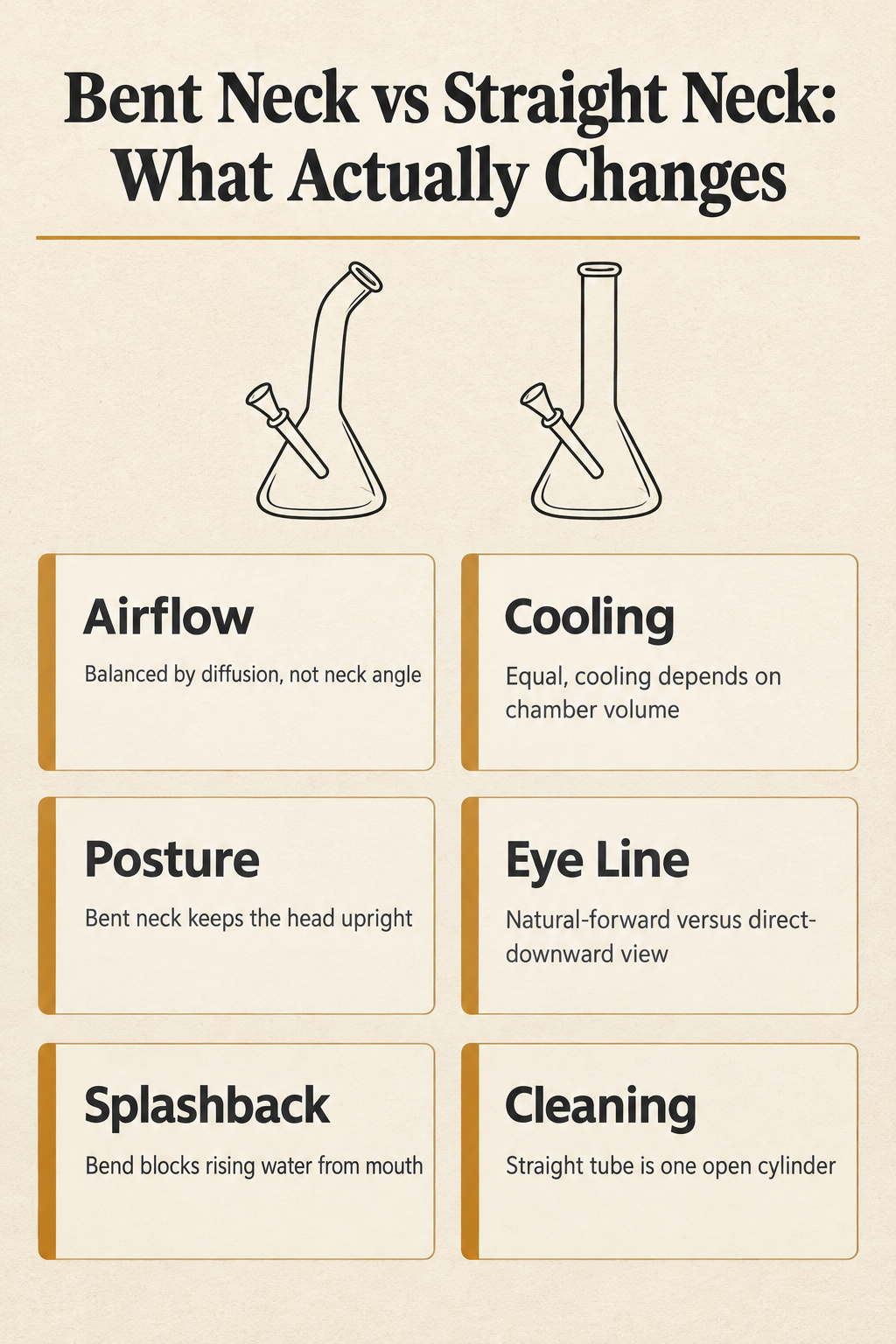
Set the two neck styles side by side and most of the differences people expect turn out to be a wash. Airflow is the first one. A manufacturer’s comparison guide states that smoothness is governed by airflow balance, diffusion and pressure rather than neck angle, and that with equal chamber volume and percolation the airflow behaves the same way in both [1].
Cooling is the second. The same comparison rates cooling as equal for both styles and volume-dependent, because a longer neck gives smoke more travel time but also adds internal volume [1] [2].
Posture is where the split is real. A straight neck keeps a vertical axis and asks you to tilt your head forward over the piece. A bent neck lets your head stay upright, which manufacturers tie to less neck and shoulder strain, especially on tall pieces and when you are seated [1] [3]. Eye line follows the same logic: direct-downward on a straight neck, natural-forward on a bent one, and the bend also keeps your face further from the bowl [1] [3].
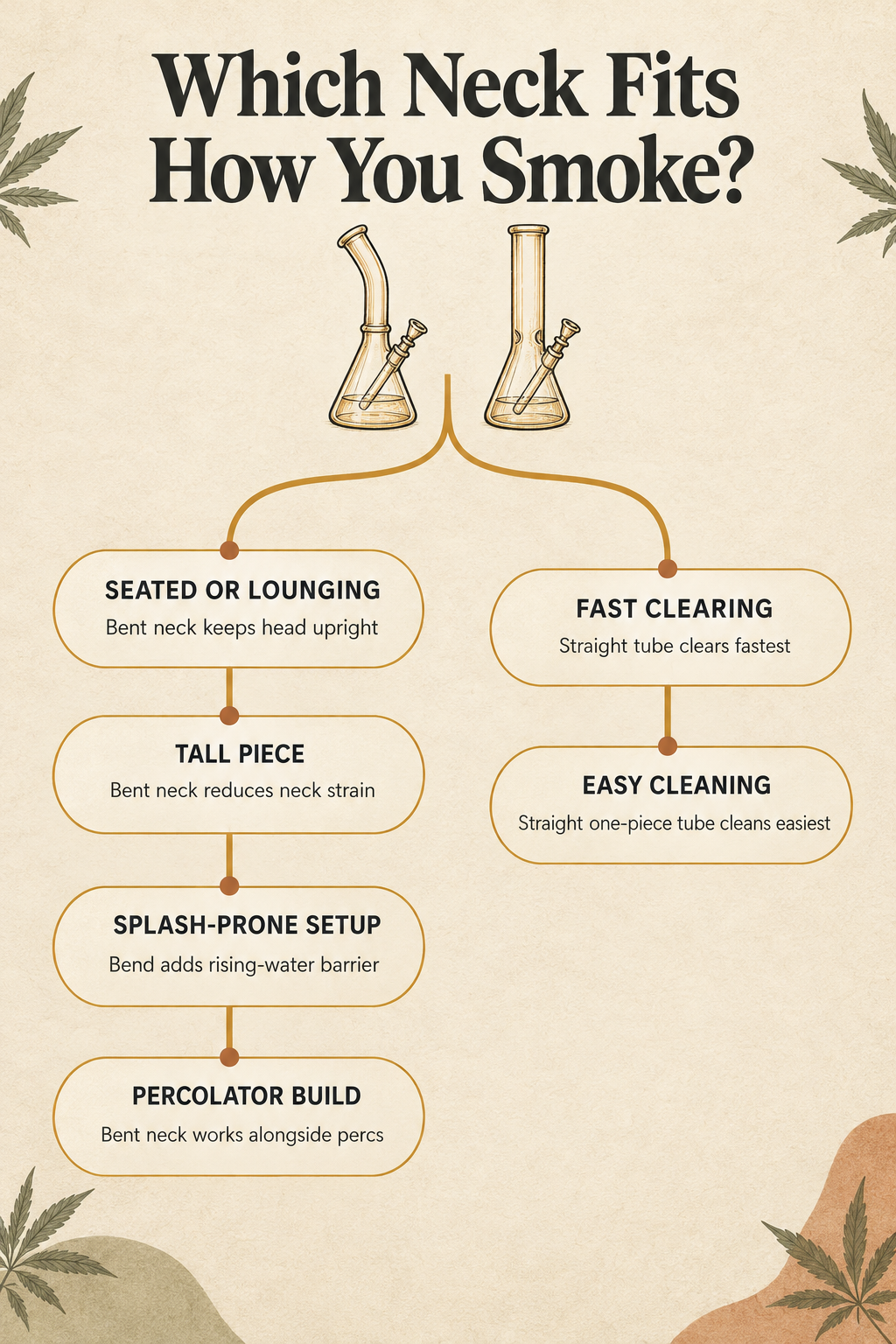
Who each style suits is a better question than which one is better. A straight neck suits someone who wants a simple, fast-clearing piece and does not mind leaning over it. A bent neck suits someone who smokes seated, uses a tall piece, or wants their face further from the heat [2] [6]. Neither is universally better, and the comparison guides say so outright [6] [11]. The same logic explains why a small bubbler and a full-size bong feel different even with similar joints What Is the Difference Between a Bubbler and a Bong?.
- Airflow: effectively equal at the same chamber volume and percolation [1] [5].
- Cooling: rated the same for both styles and driven by volume and path length, not angle [1] [2].
- Posture: a real difference, since a straight neck tilts the head forward and a bent neck keeps it upright [1] [3].
- Splashback: a real difference, since the bend adds both distance and a barrier between water and mouth [7] [11].
- Cleaning: a real difference, since a straight tube is one open cylinder and a bent neck adds an angled pocket [4] [8].
- Clearing: a small difference, since a straight path clears fastest and a multi-bend neck takes marginally more pull [3] [8].
| Aspect | Straight neck | Bent neck |
|---|---|---|
| Airflow | Same at equal volume | Same at equal volume |
| Cooling | Volume-dependent | Volume-dependent |
| Posture | Head tilts forward | Head stays upright |
| Eye line | Direct downward | Natural forward |
| Splashback | Short direct path | Bend blocks rising water |
| Cleaning | One open cylinder | Angled pocket |
Does a Bent Neck Bong Hit Smoother, or Does It Just Feel Different?
This is the question behind most searches for bent neck bong benefits, so it deserves a direct answer. Smoothness comes from airflow balance, diffusion and pressure. Neck angle is not on that list, and with equal chamber volume and percolation the two neck styles behave the same way [1].
Retailers agree. One buyer guide says the neck shape alone does not affect filtration or hit strength, and that neither design inherently hits harder than the other [5]. What changes is comfort and daily usability.
The confusion comes from blending two different experiences. The pull itself is the same. The physical ease of taking that pull is not, because your head, neck, shoulders and arms are doing different work in each case [1] [2].
Here is what the angle genuinely changes, in the order you notice it during a session:
Notice what is missing from that list: the pull. Nothing about the angle changes how the piece moves air, which is why the honest answer is that a bent neck feels different to use rather than different to draw from [1] [5]. If smoothness is your main concern, spend the difference on diffusion and a well-fitted downstem instead of on neck geometry.
- Reach: with a bent neck the mouthpiece comes to you, so your arms and wrists do less work holding the piece at an angle [5].
- Head position: your head stays upright instead of tilting forward over the chamber [1].
- Neck and shoulder load: upright head position is what manufacturers tie to less strain in longer sessions [2] [3].
- Eye line: you look naturally forward rather than straight down, which keeps the bowl and the lighter in view [1].
- Face-to-heat distance: the bend keeps your face further from the bowl than a vertical neck does [3].
- Splash margin: the extra distance between water and mouth is felt most on a hard pull [9].
Do Bent Neck Bongs Really Stop Splashback?
This is the most consistently cited practical benefit, and it is real as far as it goes. A bent neck puts more distance between the waterline and the mouthpiece, and the bend itself is a wall that rising water has to climb [1] [8]. A straight tube gives water a short, direct path to your mouth instead [7] [11].
It is a margin, not a fix. Two setup guides agree that the main causes of splashback are too much water, too hard a draw and restricted airflow, and that a taller neck or an angled mouthpiece will not rescue an overfilled bong [9] [7]. Work through the causes in this order before you blame the neck:
Published water-level advice conflicts, and the conflict is worth naming because it is not about neck style at all. One manufacturer says to submerge the bottom of the downstem by about an inch, a splashback guide says half an inch to an inch over the openings, another guide says about 1.5 inches above the downstem tip, and a zong guide says just cover the slits [2] [7] [10] [8]. Every one of those rules is set by the diffusion openings, so read any single number as a starting point for your piece and adjust from there.
If you are shopping the category, most Bongs in stock list a water capacity or a recommended fill, and neck style is a separate line in the spec sheet. That separation is the point: the neck is a margin on top of the water level, not a replacement for it.
- Start with the water level. Overfilling is the most common cause, and the usual target is about half an inch to an inch of water over the downstem openings [7].
- Check the diffusion openings themselves. Some pieces want just enough water to cover the downstem slits, and one straight-tube guide puts the level about 1.5 inches above the downstem tip [8] [10].
- Ease the draw. A sharp pull creates turbulence that throws water up the neck [7].
- Look for restricted airflow, since a clogged downstem or a packed bowl with no room to breathe creates the same turbulence [9].
- Only then look at the geometry. A taller neck gives water more runway to fall back down, and a bend keeps the mouth area farther from the action in the base [9].
Which Neck Is Easier to Clean and Clear?
These are two different chores with two different answers, and the straight neck wins both by uneven margins.
Cleaning clearly favors the straight neck. A one-piece straight tube is described as the easiest bong to clean because tools go straight in, the interior is a single open chamber, and there are no angles where resin collects [4]. A bent neck adds an angled pocket that brushes reach less easily, and a multi-bend neck is the worst case because resin sits in every corner [8]. One comparison guide softens this to slight differences, which is fair for a gentle single bend and less fair for a sharp zig-zag [1].
Clearing favors the straight tube too, but by a smaller margin than most people expect. A straight tube gives smoke a direct vertical path and clears fastest [3]. More neck length means more air to move, and a multi-bend neck takes marginally more pull than a straight tube of the same volume [2] [8].
Height and chamber size matter more here than the neck does. Wider or taller pieces hold more air above the water, so they take more air to clear no matter which way the neck points [3] [10].
For most riders the clearing difference is not noticeable. If you chase a hard, fast pull, or you clear the same tall piece several times in a session, you will feel the extra effort on a multi-bend neck and you will notice the brush struggling in the corners.
- Straight-line tool access: a straight tube lets a brush pass end to end with no turns [4].
- Open interior: a single chamber has fewer surfaces where residue collects [4].
- Angled pockets: a single bend adds one hard-to-reach corner, and every extra bend adds another [8].
- Resin in corners: multi-bend necks collect residue in each turn, which is why they are the worst case to keep clean [8].
- Clearing effort: more neck length means more air to move, so tall bent pieces take a little more pull to finish [2] [10].
- Perceived difference: most riders do not notice the clearing gap, but hard-pull chasers do [8].
Is a Bent Neck Bong More Fragile Than a Straight Neck?
The honest answer is narrower than the worry. A bend is a stress concentration, because the glass is worked hardest exactly where the shape changes. Sharply kinked necks can snap from knocks that a straight thick-walled tube would survive, and wall thickness matters more on a bent piece [8].
That warning is written about sharp multi-bend zong necks, and sellers of single-bend pieces do not repeat it [8] [5]. Read it as a caution about sharp bends rather than a claim that every bent neck is weak. A gentle single bend with good wall thickness is not the same object as a zig-zag with four turns.
The practical consequences are less about the glass and more about the table. A bent neck shifts weight off the vertical axis, so a wider or heavier base matters more than it does on a straight tube [2] [3]. A piece that cannot stand unattended is a piece you set down carefully every single time.
Worth knowing too: some straight tubes use flat, level joints and are not meant to be tilted back toward your face. You lean over the piece and keep it vertical [10]. That one constraint is a large part of why a bent neck appeals to people who smoke seated.
- Stress at the bend: glass is worked hardest where the shape changes, so the turn is the vulnerable point [8].
- Wall thickness: it matters more on a bent piece than on a straight tube of the same price [8].
- Base width: an off-axis neck puts more tipping load on the base, so a wider foot helps [2].
- Standing stability: a bent piece is harder to leave standing unattended and should be set down deliberately [3].
- Handling habit: lift by the base rather than the neck, since the bend is the part with the least margin [8].
What Should You Check Before Buying Either Neck Style?
The list below turns the whole comparison into a purchase check. Run it against any product page before you add to cart, and the neck question answers itself.
Two Treehouse pieces show the range. The Classic Bent Neck Beaker is a 14mm female borosilicate beaker with a removable downstem diffuser and a 3-pinch ice catcher, offered in 7.75, 9.5, 13.75 and 17.5 inch sizes at $25.90 [16]. The SeshGear Lean Back Bent Tube is a 9-inch straight-tube piece with an ergonomic bent neck, a 14mm female joint and a 3-pinch ice catcher at $34.99 [15].
The scale of the choice is bigger than it looks. A live catalog sweep on 2026-11-18 covered 888 products: 27 SKUs mention a bent neck in the name or description and 21 of those are in stock, running $25.90 to $199.99, while 49 mention a straight tube or straight neck with 39 in stock, running $20.00 to $193.90 [14]. Bent-neck mentions turn up on beaker bongs, dab rigs, Klein recyclers and bubblers, so this is not a niche shape you have to hunt for.
Free shipping applies on orders $150+, which is worth factoring in if you are pairing a tube with an ash catcher, a spare downstem or a cleaning kit in the same order.
- Base shape and chamber volume first, because no neck can rescue a body that does not suit your session [3].
- Where the bend lands relative to your mouth when you are seated, which is the entire point of the angle [2].
- Whether the ice catcher sits above the bend or across it, since pinches that cross the bend are harder to load [16].
- Joint size and gender: 10mm, 14mm or 18mm, with 14mm the easiest for accessories [2].
- Joint angle, if you plan to add an ash catcher, because a bend changes the clearance around the joint [5].
- A removable downstem, which makes cleaning easier on any shape and is the upgrade worth paying for [16].
- Wall thickness at the bend, which matters more there than anywhere else on the piece [8].
Frequently Asked Questions
Does a bent neck bong hit harder than a straight neck?
No. Retailers and manufacturer guides agree that the neck shape alone does not affect filtration or hit strength, and that neither design inherently hits harder [5]. With equal chamber volume and percolation, airflow behavior is essentially identical [1]. What the bend changes is your posture, your eye line, and how much room there is between the water and your mouth.
Can a straight tube bong have a bent neck?
Yes, and it is common. Neck style and body shape are independent choices: you pick a beaker, straight tube or round base, then pick a neck [3]. Treehouse’s own SeshGear Lean Back Bent Tube is listed as a 9-inch straight-tube water pipe with an ergonomic bent neck, a 14mm female joint and a 3-pinch ice catcher [15].
Which neck is easier to clean?
The straight neck. A one-piece straight tube gives cleaning tools straight-line access, the interior is a single open chamber, and there are no tight curves where resin collects [4]. A bent neck adds an angled pocket that brushes reach less easily, and a multi-bend neck is the worst case because resin sits in every corner [8].
How much water should a bent neck bong have?
Fill it based on the diffusion openings, not the neck. Published guidance ranges from just covering the downstem slits to about an inch, or about 1.5 inches above the downstem tip, depending on the piece [8] [2] [10]. Start low, then add a little at a time until the water sits just over the openings and stop there.
Do bent neck bongs still work with percolators and ash catchers?
Yes. Bent necks appear alongside percolators as a normal configuration, and the extra path length gives filtration systems more time before the smoke reaches you [5] [3]. If you plan to add an ash catcher, check the joint size and joint angle first, since a bend can change the clearance around the joint [2].
Is a bent neck bong more fragile?
Only where the bend is sharp. A bend is a stress concentration because the glass is worked hardest where the shape changes, so sharply kinked necks can snap from knocks a straight thick-walled tube would survive, and wall thickness matters more on a bent piece [8]. That warning is written about sharp multi-bend zong necks, not about every single-bend piece.
So Which Neck Should You Buy?
Buy the neck that matches how you actually sit. If you smoke standing at a table, want the fastest clear you can get, and would rather spend five minutes less on cleaning each week, a straight neck is the simpler piece and it is easier to keep clean [4] [3].
If you smoke seated, use a tall piece, or want your head upright and your face further from the bowl, a bent neck pays for itself in daily use [2] [3]. It also gives you a little more margin against splashback on a hard pull, as long as you keep the water level honest [9] [7].
What you should not do is pay a premium for a bend on the belief that it changes the pull. It does not. With equal chamber volume and percolation, the airflow is essentially the same, and the neck shape alone does not affect filtration or hit strength [1] [5]. Put that money into wall thickness, a removable downstem, and a joint size you can actually find accessories for.
One last point that applies to both styles. The CDC notes that cannabis can be smoked in bongs, that health and safety risks exist for each of the different ways of using cannabis, and that scientists do not have enough evidence to say that using cannabis in one way is safer than another [12]. Health Canada adds that water can lower the temperature of the smoke, but says plainly that this doesn’t make pipe smoking safe, and that water pipes can produce greater levels of second-hand smoke than tobacco cigarettes [13]. No source establishes that a bent neck or a straight neck removes risk, so read the neck choice as a comfort and usability decision.
Sources
- Croia Glass: Bent Neck vs Straight Neck: Comfort vs Performance
- Thick Ass Glass (TAG): Parts of a Bong: Every Bong Part Explained, With Joint Sizes
- Thick Ass Glass (TAG): Types of Bongs: Every Shape Explained
- Thick Ass Glass (TAG): What Type of Bong Is Easiest To Clean?
- Smoke Cartel: Best Bent Neck Bongs: 4 Top Picks (2026)
- Encore Collection: What Is a Bent Neck Bong? Why It’s Comfier
- Encore Collection: How to Stop Bong Splashback (No More Mouth Water)
- AFM Smoke: What Is a Zong Bong? The Z-Shaped Neck Explained
- Vitae Glass: How to Stop Bong Splashback Without Killing Flow
- Mood: What Bong Height Does To Airflow In Straight Tube Designs
- Billymart: Bent Neck vs Straight Tube Bongs | Which Is Better?
- Centers for Disease Control and Prevention (CDC): Cannabis Frequently Asked Questions
- Health Canada: Cannabis accessories for inhalation: Minimizing your risk when smoking, vaping and dabbing
- Treehouse Lifestyle: WooCommerce Store API – full product catalog sweep (all pages, 888 products)
- Treehouse Lifestyle: WooCommerce Store API – SeshGear Lean Back Bent Tube Colored Glass Water Pipe, 9 inch, 14mm F
- Treehouse Lifestyle: WooCommerce Store API – Classic Bent Neck Beaker Glass Water Pipe, 14mm F