

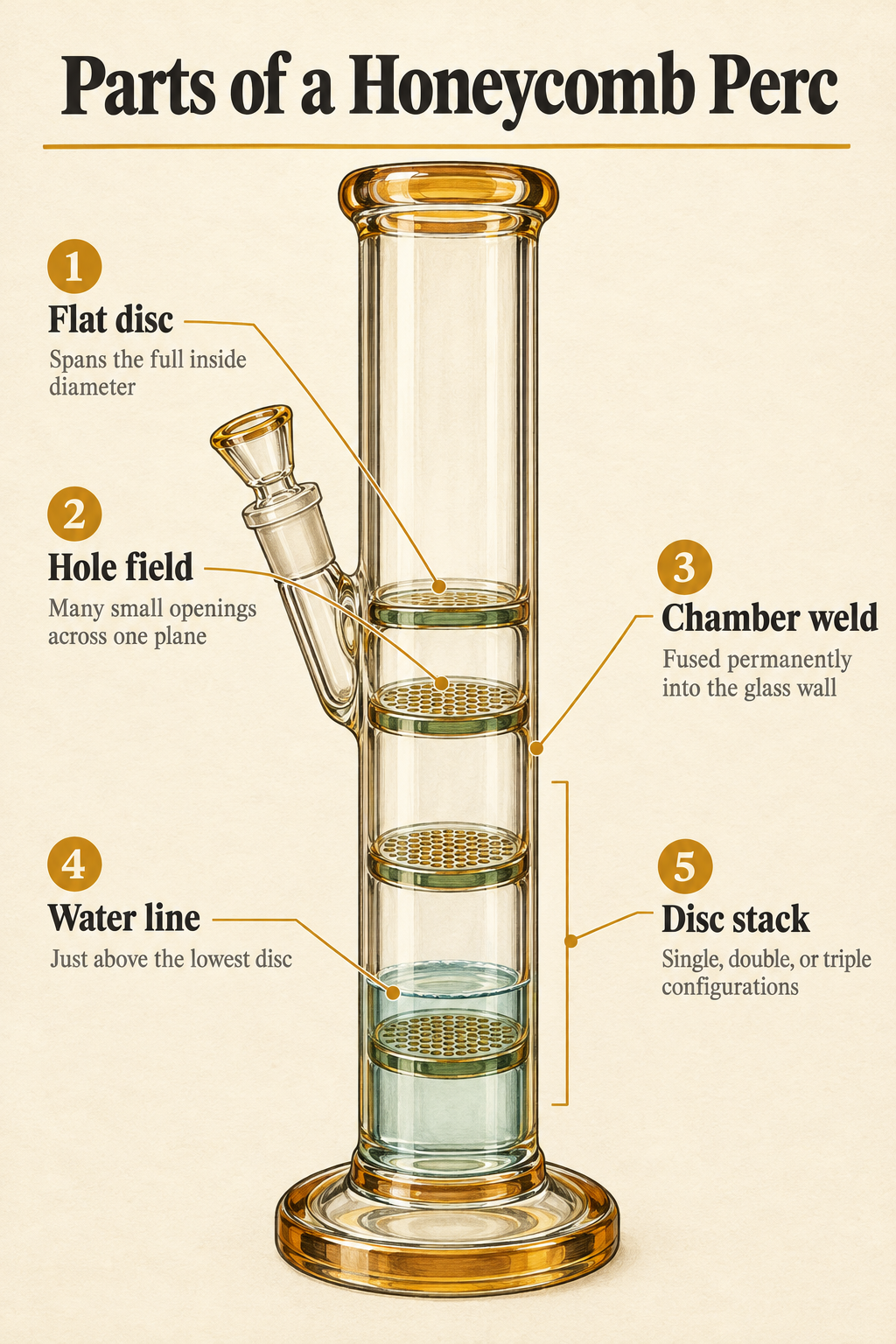
A honeycomb perc is a flat glass disc drilled with many small holes and mounted horizontally across the water chamber so it spans the full inside diameter of the tube. Smoke rising from the downstem must pass through every hole at once, so it leaves the disc as a wide sheet of small bubbles rather than a few large ones. [1]
Every perc uses that same trick. Split one pull into many small bubbles and more smoke surface meets water during the short trip up the tube. [9] What separates a honeycomb from other designs is the shape of the part: a flat plate fused to the chamber wall rather than a bundle of tubes or a dome. That is what makes it easy to stack, hard to break, and fussier to clean than an open showerhead. [4]
So who does it suit? Someone who wants a consistent, stackable diffusion stage in a piece that can take a knock, and who will actually soak the glass on a schedule. It suits flower in a straight tube. It suits you less if the most open pull is the priority, or if you already know you will not keep up with small holes.
What exactly is a honeycomb perc, and how does it work?
Start with the geometry, because everything else follows from it. A honeycomb disc is a single flat plate of glass pierced with a field of small holes and welded across the inside of the water chamber, at a right angle to the tube. [1] Published numbers on the part are loose: one source counts twenty to forty small holes, another counts thirty to over one hundred in a hexagonal pattern on a plate two to four millimeters thick. [5] [2] The shape is the same either way.
Because the plate meets the chamber wall on all sides, there is no way around it. Everything that rises from the downstem has to cross the hole field. That is the difference between a honeycomb and a plain chamber, where the path up the tube is far less constrained.
Here is the path one pull takes, in order:
You will find this disc across Bongs generally, and most often among Glass Bongs, where the same flat plate turns up as a single disc, a double, or a three-high stack. [2]
- Air leaves the bowl, travels down the downstem, and enters the water at the base of the chamber.
- Pressure pushes the smoke up against the underside of the plate, which blocks the straight path upward.
- The only route through is the hole field, so one pull becomes dozens of small bubbles at once instead of a few large ones. [1]
- The bubbles leave the top face as a wide, even sheet that spans the plate rather than a single column. [4]
- That sheet travels up the rest of the tube, crossing any higher discs on the way if the piece stacks them. [10]
Why does the honeycomb name get applied to so many different products?
Search for honeycomb glass and most of the results have nothing to do with percolation. The word describes a shape, and plenty of unrelated hardware borrows that shape for decoration, texture, or a different job entirely. The percolator term is not standardized either: the same part sells as a honeycomb perc, a honeycomb percolator, a honeycomb disc, or a stacked honeycomb. [3] [8]
That matters while shopping, because the words on a product page are not a reliable signal by themselves. Two examples from our own shelves make the point. We list a spoon pipe whose design is called Honeycomb Pattern, which is a molded surface finish on a silicone body, not a plate inside a water chamber. [15] We also list a honeycomb carb cap, a spinner-style cap with a honeycomb interior texture sized for flat top bangers. [16] Neither is a percolator, and both surface in a search for the term.
These are the lookalikes worth knowing, each with the quickest way to tell it apart:
Once the distinction is clear, the rest of the perc family sorts out more easily. What Is a Percolator Bong and How Does It Work? covers the general anatomy, What Is a Showerhead Perc and Which One Should You Buy? walks through the dome-style diffuser, and What Does a Triple Perc Bong Actually Do? explains what changes when you run several stages in a row. A standard bubble base like the Pulsar USA Top Hat Bubble Base Glass Water Pipe – 13.25" / 14mm F is also a useful reminder that a good water pipe does not need a disc in it at all.
- Honeycomb-pattern decorative glasswork. The hexagons are a design on the outside of the piece, so there is no horizontal plate with holes inside the water chamber. [3]
- Honeycomb bowl screens. A small screen that sits in the bowl and holds material, which is a bowl part rather than a diffusion stage. [8]
- Honeycomb-textured silicone. A molding pattern pressed into the body of the pipe itself, as on a spoon pipe with a honeycomb finish. [15]
- Honeycomb wax or crumble. A concentrate, so no hardware is involved at all, only a shared name. [8]
- Honeycomb carb caps. A spinner cap with a honeycomb interior texture, built for a banger rather than a water chamber. [16]
How does a honeycomb perc compare to a tree perc?
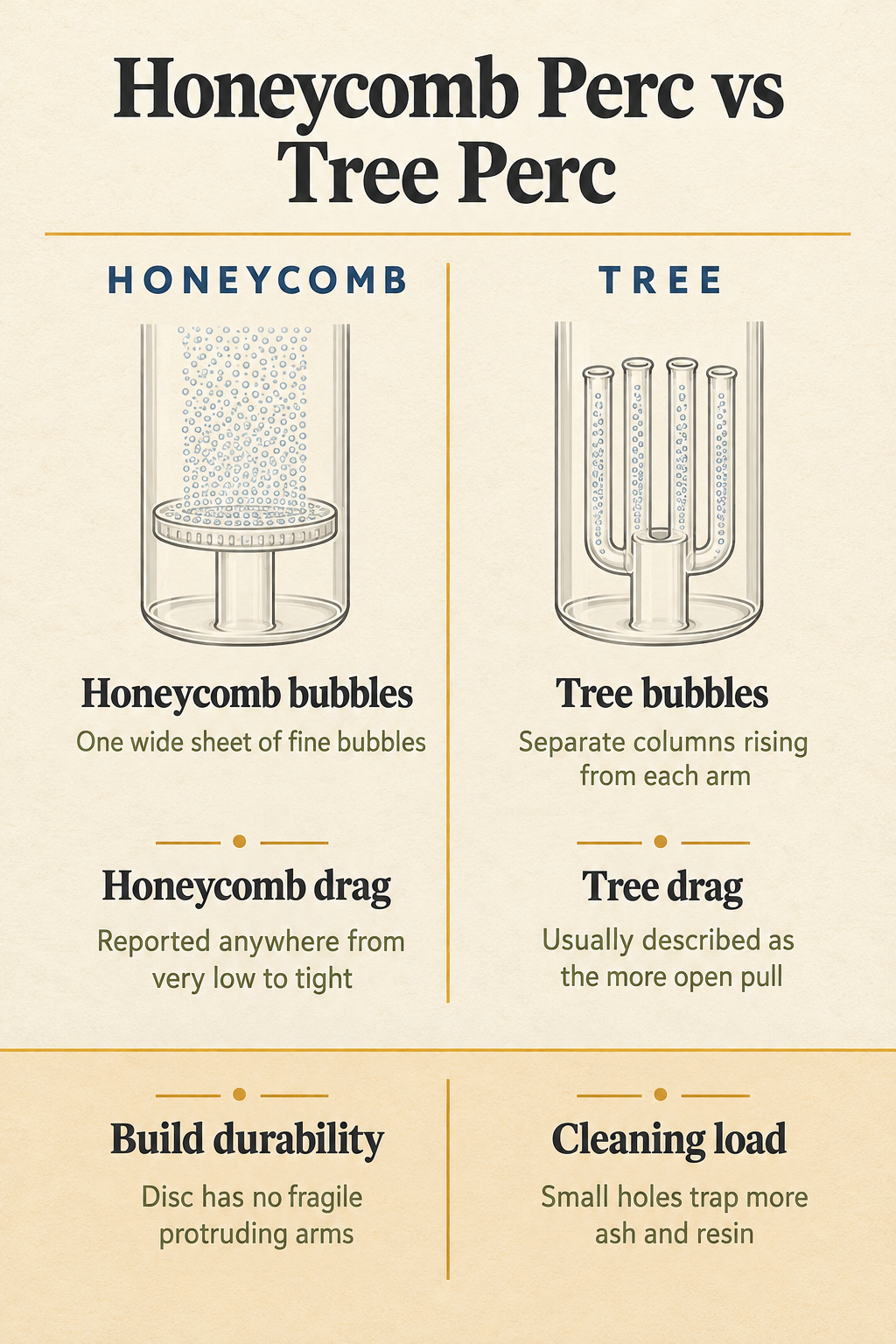
The difference is in how each design spreads the airflow. A honeycomb sends everything through one flat plane, so bubbles come off as an even sheet. A tree splits the same airflow into separate arms, and each arm releases its own bubble column. [4] That single structural difference explains most of the practical comparisons.
The drag question is where the comparison stops resolving cleanly. Sources land on both sides of it, and the split is wide enough to change what you should buy, so it gets its own section below rather than a verdict here. [1]
One more structural note belongs in this comparison. Honeycomb percs are usually fused permanently into the glass, so you cannot lift the disc out to clean it or swap it. [7] Modular pieces work around that by making each perc its own section, while a one-piece straight tube stays a single object for life. [10]
Set side by side, the two designs differ like this:
The same flat-versus-tubular logic runs through other designs too, and What Is a Spinner Perc and How Does It Actually Work? covers a perc that sets water spinning instead of pushing it through a field of holes at all.
- If you want the same hit every time, the flat plate has the advantage: one plane of holes behaves the same way on pull one and pull fifty. [6]
- If the lightest possible pull is the goal, the tree is often described as the more open design, and the honeycomb as the tighter one once it stacks. [6]
- If the piece will travel or live in a shared room, the fused disc has no arms to snap and bubbles more quietly than a tree. [5] [2]
- If you clean on a schedule, the disc is no trouble; if you clean only when the pull changes, a honeycomb will show it sooner than an open dome. [3]
- If you are weighing more than two designs, the flat-plane idea repeats across the family in different shapes, so learn the plane once and the rest follows. [4]
| Trait | Honeycomb perc | Tree perc |
|---|---|---|
| Bubble field | One wide sheet from a single plane | Separate columns from each arm |
| Sound while pulling | Quiet fizz from many small bubbles | Livelier, percussive bubbling |
| Durability | Solid disc fused to the wall, nothing protruding | Thin arms that can crack and are rarely repairable |
| Consistency | Same pattern pull after pull | Shifts with water level and how level the piece sits |
| Cleaning | Disc soaks easily, but small holes hold resin | Arms rinse out, though the gaps are awkward |
| Drag | Disputed, from very low to medium-high | Usually described as the more open pull |
How much drag does a honeycomb perc actually add?
This is the most argued-about property of the honeycomb, and the honest answer is that the sources do not agree. It is not a case of one side being wrong. It is a case of one label being applied to very different pieces. Encore Collection calls the drag very low, Azarius puts it low to moderate, and AFM Smoke lands on low to medium. [1] [2] [5] Thick Ass Glass frames the flat disc as diffusing across a single plane for a steadier, more open draw. [4]
Then there is the other camp, and it is not a small one. Badass Glass states that a honeycomb adds more resistance than a tree perc and feels tighter, enough that someone with less capacity to pull may struggle to clear the chamber. Oil Slick rates honeycomb drag medium to high. Vitae Glass describes noticeable drag once the disc is stacked or the water level sits high. [6] [9] [10]
The way to read that split is to stop treating drag as a property of the design and start treating it as a property of the individual piece. These are the variables that move it:
For a buyer, the practical version of all of that is short. A single disc in a clean piece with water just above the lowest plate is a different pull from a three-high stack with the discs buried. Repeated small holes in series add more resistance than one plate. If an open pull is the priority, a single disc or a different design is the better bet. If the even bubble sheet is what you want, two discs is usually where the visible difference stops and the extra upkeep starts. [9]
- Hole size and hole density. A plate with fewer, larger openings passes air more freely than one drilled with a dense field of tiny holes. [8]
- Disc thickness. A thicker plate means a longer channel through each opening, and the published range runs two to four millimeters. [2]
- Stack count. Each added disc breaks up the bubbles from the one below it, and every plate in series adds its own resistance. [9]
- Build quality. Alignment, how cleanly the holes were cut, and how well the plate meets the wall all change the result from one piece to the next. [8]
- Water level. Water sitting high enough to bury the upper discs adds resistance and interferes with bubble stacking. [10]
- Resin buildup. Drag climbs fast as a honeycomb gets dirty, to the point that a clogged disc pulls nothing like a clean one. [2]
How much water should go in a honeycomb perc bong?
Water level is the most common setup mistake on this perc, and it comes from a wrong assumption about how the higher discs get wet. People assume every plate has to sit underwater to do anything. It does not. The draw lifts water upward, so higher plates are activated as water collects on them. [3]
Submerging every disc at rest is the specific mistake the sources call out. It adds resistance, interferes with the bubble stacking the design is built around, and can throw splashback toward the mouthpiece. [3] The right level is lower than most people expect.
The fill-and-check sequence:
The same dry-pull check works whether the piece carries one disc or three, and it costs nothing to run. [2] Body shape changes the answer too, because a wide base holds more water at the same visible level than a narrow straight tube, so one pouring habit will not produce the same result in both. If you are sizing by body shape rather than by disc count, the Beaker Bongs line is worth a look before you settle on a number.
- Fill to just above the lowest disc. That is the starting point, not the finish line. [3]
- Take a dry pull with an empty bowl. No material, no heat. You are watching water behavior and nothing else.
- Watch the disc during the pull. Bubbling should be even across the whole plate rather than pooled on one side.
- Add a small amount and repeat the dry pull only if the upper discs stay dry through a full pull. Small additions, one at a time.
- Stop when the bubbling is even and the pull still feels free. If resistance climbs or water starts jumping toward the mouthpiece, you have overshot, so pour a little out.
- Re-check the level before each session, since water shifts in the piece between uses and rarely sits where you left it.
How do you keep honeycomb holes from clogging?
Cleaning is where the honeycomb pays for its even bubble sheet. Those many small openings catch ash, plant particles, and resin more aggressively than an open dome does, and resin left to accumulate does two things at once: it narrows the holes and it raises drag. [3] A perc that felt open when it was new turns into a tight one by degrees, and the change is gradual enough that people blame the piece instead of the buildup. [2]
The answer is a routine rather than a stronger cleaner.
The order that works:
The design constraint that shapes this whole routine is that a honeycomb is usually fused permanently into the piece, so the disc cannot come out for scrubbing. [7] That is the practical argument for modular glass, where each section separates and can be cleaned on its own. [10] As for frequency, expect to work more often than you would with an open dome. Read any change in the pull as a cleaning alarm rather than a sign the piece has worn out. [9]
- Dump the water as soon as the session ends. Water left standing lets material settle into the openings instead of rinsing past them.
- Rinse with warm water while the resin is still soft, working water through the disc from below and from above.
- Soak the piece so the resin lets go. Isopropyl with coarse salt is the standard combination, and a flat disc soaks and rinses with nothing protruding to block the solution. [5]
- Run fresh water through the disc in both directions. Pushing from the underside first moves loosened material back out the way it came in; a top-down flush then clears what settled on the upper face.
- Clear stubborn openings one at a time instead of forcing anything through under pressure. A blocked hole is usually a softened plug, not permanent damage.
- Rinse until the water runs clear, then let the piece dry before storing it so nothing sits in the holes between sessions.
What should you check before buying a honeycomb perc bong?
Most honeycomb listings look alike in a photograph and differ a lot on the spec sheet. These are the specs that actually change what you get, and the trade each one represents:
Stack count is the choice buyers get wrong most often, because more looks like better. Two plates is normally where the visible difference stops and the extra upkeep begins. [9]
To see those specs on real listings rather than in the abstract, our catalog carries the SeshGear Triple Honeycomb Perc Straight Tube Water Pipe at 67.99 USD: 15 inches tall, borosilicate glass, a 14mm female joint, triple stacked honeycomb diffusion, three ice pinches, a straight tube body, and a 14mm male herb slide included. [13] If you already own a piece and want a honeycomb stage ahead of the main chamber, the HITTN Stacked Honeycomb with Showerhead Perc Ash Catcher runs 24.99 USD with a 14mm female joint at 90 degrees and a description that fits most 14mm and 18mm setups. It was out of stock when this research was recorded, so check availability before you plan an order around it. [14]
If you are pairing a piece with an ash catcher, a spare slide, or cleaning supplies in one order, the free shipping on orders $150+ threshold is easy to reach with glass in the cart.
- Joint size and angle. 14mm and 18mm are the two standards, and the angle decides whether an accessory sits upright or leans. Check both before buying anything that has to mate with the piece. [8]
- Disc count. Single, double, or triple. Each added disc breaks up the bubbles from the plate below, but drag and cleaning effort climb with every plate and the returns flatten out after two. [9]
- Hole count and disc thickness. Published figures run from twenty to forty holes up to a dense hexagonal field on a plate two to four millimeters thick. Since neither number is standardized, compare within one listing rather than across brands. [5] [2]
- Body material and wall thickness. Borosilicate is the baseline, and heavier walls cost weight but tolerate handling better.
- Ice pinch. A separate pinch above the perc gives you the option of stacking ice, since ice rests on the flat disc. A piece without one cannot offer that. [8]
- Removable downstem. A downstem you can pull out cleans more easily and replaces more cheaply than one fused in place.
- Overall height. Height buys more travel above the water line, which also means more chamber to clear on each pull.
Frequently Asked Questions
Can you add a honeycomb perc to a bong you already own?
Not by fitting a disc to the piece itself. The perc is welded in during the build, so there is nothing to swap later. What you can do is put a honeycomb ash catcher between the bowl and the joint, which adds the stage ahead of the main chamber. Match the joint size and angle to your piece first, since 14mm and 18mm are the common standards. [1] [7]
Do you need to fill every disc on a double honeycomb perc?
No. Filling just above the lowest plate is enough, because the pull lifts water and wets the higher discs as it climbs. Trying to cover them all at rest is the mistake that makes a stacked piece feel tight, muddles the bubble layers, and sends water toward the mouthpiece. [3]
Is a honeycomb perc good for dabs?
The sources split on it. Some describe honeycomb discs as common in dab rigs, on the basis that concentrate vapor arrives hot and gains from the extra surface area. Others keep honeycomb for flower and put inline or showerhead percs on dab rigs, arguing that heavy diffusion costs flavor. If flavor leads your list, choose the lighter stage. [5] [9]
Can you put ice in a honeycomb perc bong?
Only where the glass was built for it. Ice rests on the flat plate, so the disc has to carry the weight and the tube needs a way to hold the cubes, usually a dedicated ice pinch. A triple stack with three pinches gives you that room; a plain tube without a pinch does not. [8]
Is a honeycomb perc loud or quiet to use?
On the quiet side. The bubble sheet reads as a soft fizz, where a tree’s separate arms bubble in a sharper, more percussive way. In a shared apartment that gap matters more than most spec differences on the listing. [5]
How often does a honeycomb perc need cleaning?
So Is a Honeycomb Perc Right for You?
The honeycomb perc is one of the simpler ideas in glassware: a flat plate with a field of small holes, welded across the tube, turning one pull into a wide sheet of small bubbles. [1] What makes it worth choosing is consistency and structure, meaning the same even bubble field on every pull and a disc with nothing protruding to break. [4] What makes it worth avoiding is upkeep, because every one of those openings is a place for resin to collect. [3]
Buy one if you want a stackable diffusion stage in a piece you plan to use hard and handle without ceremony, and you are willing to soak it on a schedule. Skip it if the most open pull matters more than an even one, or if you know you will not keep up with cleaning. A clogged honeycomb is a tight honeycomb, and the difference shows up well before the glass looks dirty. [2]
One thing no percolator changes: adding stages does not make smoke risk-free. A study summarized by the UCSF Center for Tobacco Control Research and Education found that bubbling smoke through water removes some water-soluble compounds and larger particles, yet still lets most of the smoke chemicals and fine particles through, and the CDC lists water pipes among the ways cannabis is smoked without suggesting that filtration reduces the hazards. [11] [12] Pick a perc for how you want the piece to behave, meaning drag, bubble pattern, durability, and upkeep, rather than as a safety feature.
Sources
- Encore Collection: What Is a Honeycomb Perc? Bong & Perc Guide
- Azarius: Percolator Types Explained: Honeycomb, Tree & Showerhead
- Tako Glass: Bong Percolator Types Explained: From Natural Percs to Recyclers
- Thick Ass Glass: Honeycomb vs Tree Percs: Which Design Fits Your Priorities?
- AFM Smoke: Tree Perc vs Honeycomb Perc: Which Percolator Is Smoother?
- Badass Glass: Tree Percolator vs Honeycomb Percolator
- Head Nature: Percolator Bongs Explained: Spiral, Mushroom & Honeycomb Percs Compared
- Mood: What Is a Honeycomb Perc and Is It Worth It
- Oil Slick: Types of Percs Explained: All 8 Bong Percolators Ranked
- Vitae Glass: Percolators Explained: Honeycomb, UFO, Matrix and Tree Percs
- UCSF Center for Tobacco Control Research and Education: New Study: Secondhand Bong Smoke is full of Hazardous Fine Particles
- Centers for Disease Control and Prevention: About Cannabis
- Treehouse Lifestyle: SeshGear Triple Honeycomb Perc Straight Tube Water Pipe – 15" / 14mm F / Colors Vary
- Treehouse Lifestyle: HITTN STACKED HONEYCOMB WITH SHOWERHEAD PERC ASH CATCHER
- Treehouse Lifestyle: Eyce ORAFLEX Honeycomb Spoon Pipe
- Treehouse Lifestyle: HONEY HIVE CARB CAP