

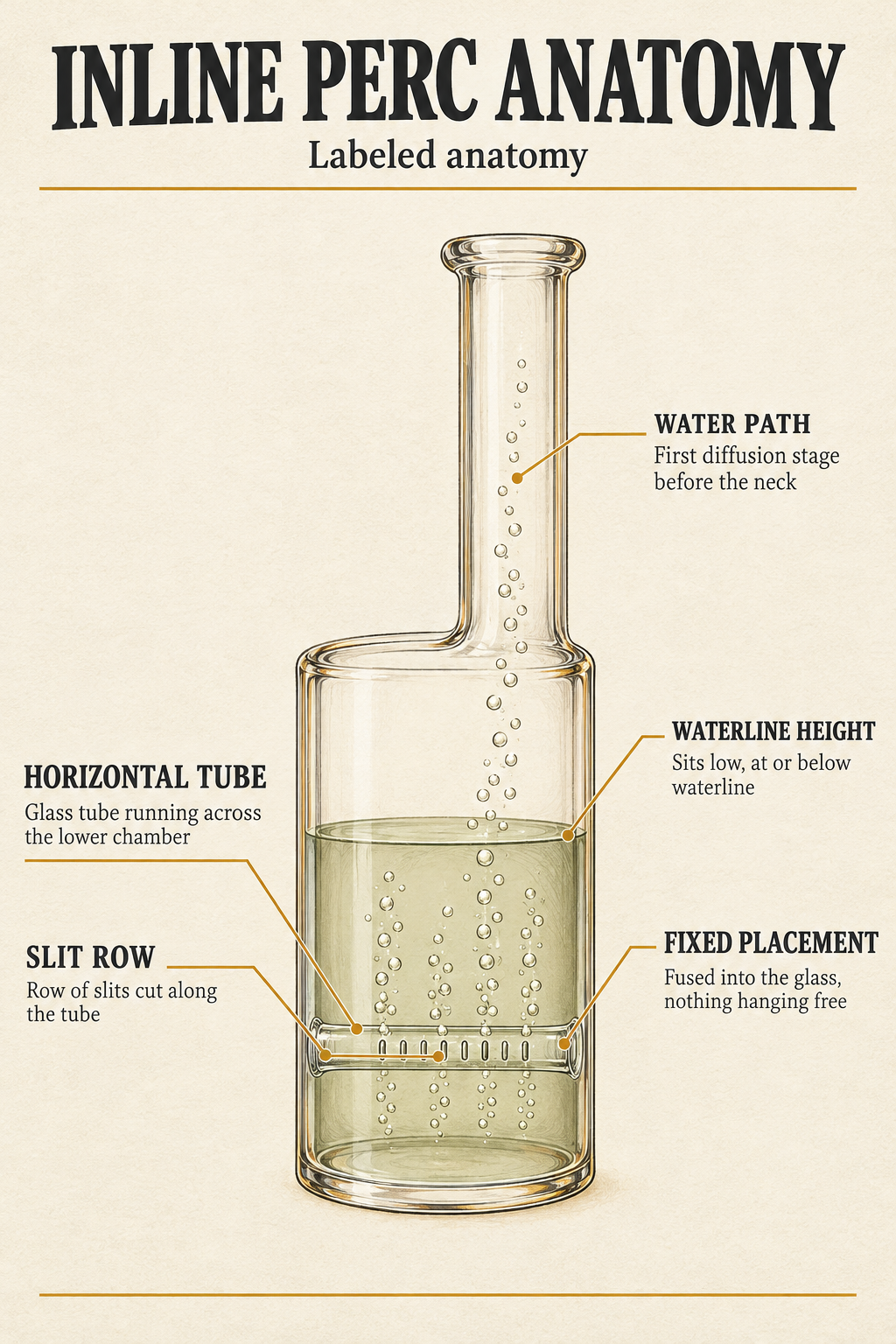
An inline perc is a horizontal glass tube fused into the lower chamber of a bong, with a row of slits cut along its length. Smoke enters one end and leaves through every slit at once, so bubbles spread across the chamber floor instead of rising from a single point, which is why the pull stays light. [1] It is a fixed diffuser, not a removable part. [2]
What is an inline perc and where does it sit inside a bong?
Picture a straight tube standing on your desk and look at the bottom third. An inline perc is the glasswork that runs sideways across that area, low and close to the base, with a line of narrow slits cut along the underside or the side of the tube. [2]
Smoke does not shoot straight up out of a single hole in this design. It enters at one end of the horizontal tube, travels along the inside, and pushes out through every slit in the row at the same moment. That is the whole trick: one entry point, many exits, spread over distance instead of concentrated in one spot. [6]
Most pieces fit the inline as a first stage. The bowl and downstem feed it, it diffuses into the lower chamber, and then smoke continues up the neck. On stacked builds, a showerhead, rocket or tree perc may sit above it as a second stage. [1]
Because the tube is fused into the chamber wall with nothing dangling free inside, retailer guides describe this as the most forgiving perc structure. There are no arms to snap and no removable section to lose or cross-thread. [3]
One thing shoppers get wrong: an inline perc is part of the bong, not an accessory. You cannot unscrew it, swap it out, or add one to a piece built without it. What you can change is the bowl and anything you hang at the joint. You will see the layout most often in Glass Bongs and other straight-walled pieces, where the horizontal run has room to sit level under a steady waterline.
- You pack the bowl and set it into the joint at the top of the downstem.
- Smoke leaves the bowl and travels down the vertical downstem into the water.
- It enters the near end of the horizontal inline tube at the base of the chamber.
- It runs along the inside of the tube and pushes out through the row of slits, forming bubbles across the chamber floor.
- The bubbles break at the surface and smoke rises through the open lower chamber.
- It continues up the neck to the mouthpiece, or into a second perc if the piece has one.
How is an inline perc different from a standard downstem?
The two parts get lumped together because both sit underwater and both make bubbles, but they are not the same thing. A downstem is a vertical tube that carries smoke from the bowl down into the water, and it is often a separate piece that slides into a ground joint. [3]
An inline perc is a second diffusion stage placed in the smoke’s path. Rather than releasing smoke at one point at the bottom, it spreads the smoke horizontally along a tube before it rises. [2]
For the wider picture of how diffusion stages stack up, start with What Is a Percolator Bong and How Does It Work?, which walks through the common perc types and where each one sits in the air path.
Many bongs use both parts at once. The downstem does the first drop, then feeds the inline, which does the wider spread. That is why you will see ‘diffused downstem’ and ‘inline perc’ in the same product description without either term being wrong.
Draw resistance is where the difference shows up most. A single open downstem end barely restricts the pull at all. An inline adds a row of narrow openings, so there is a little more resistance than a plain downstem, but far less than a multi-arm or multi-stage design. [1]
If you are weighing a two-stage or three-stage build, What Does a Triple Perc Bong Actually Do? explains what each added perc actually contributes. And if you are deciding between a recycling design and a fixed low perc, Recycler Bong vs. Percolator Bong: What Is the Difference? covers that split directly.
- Orientation: a downstem is vertical and usually removable; an inline perc is horizontal and fused into the glass.
- Diffusion pattern: a downstem releases smoke from a single opening, while an inline spreads it along a slit row across the chamber floor.
- Draw: a plain downstem is nearly unrestricted, while an inline adds light resistance spread over many small openings rather than one large one.
- Pairing: downstems appear on almost every water pipe, while inline percs are most common on straight tubes and scientific-style pieces.
- Replacement: downstems can be bought separately when they break, while a damaged inline means replacing the whole piece.
| Feature | Inline perc | Standard downstem |
|---|---|---|
| Orientation | Horizontal run across the lower chamber | Vertical tube from the joint into the water |
| Diffusion | Spread along a slit row, across the chamber floor | Released from one opening at the bottom |
| Draw | Light resistance across many small openings | Nearly unrestricted |
| Where it appears | Straight tubes and scientific-style pieces | Almost every water pipe |
| If it breaks | The whole piece has to be replaced | Replacement downstems are sold separately |
Inline perc vs tree perc: which one should you choose?
A tree perc splits smoke across several vertical arms, with slits at the end of each arm. That adds surface area and more diffusion than a single inline tube, and it also adds restriction, glass joints that can break, and dead zones between the arms where resin settles and stays. [3]
The published rating charts disagree with each other, which is worth knowing before you take any of them as a standard. Croia Glass scores an inline highest on airflow ease and lowest on splashback risk, while the tree wins on diffusion. [4] A second independent chart gives the inline the edge on cleaning and durability at similar smoothness, against a tree with moderate drag. [6] Both charts are below, so you can read the numbers yourself instead of trusting a summary.
The direction of the tradeoff holds across both: the tree gives you more diffusion, and the inline gives you easier airflow and easier upkeep. Neither chart is an industry standard, so weigh them as one shop’s judgment each.
If you want to compare diffusion against no water at all, a dry piece like the JW Original Steamroller Hand Pipe | Clear makes the contrast obvious, since there is nothing between the bowl and your mouth but open air.
- Airflow first. If you want the least resistance for the amount of diffusion you get, inline is the easier pull of the two.
- Diffusion second. If maximum bubble spread is the goal, an arm array splits the airflow more times than a single slit row.
- Cleaning access third. Slits in a horizontal tube are awkward to reach, but slits at the ends of several arms are worse, and resin collects in the gaps between them.
- Fragility fourth. A tree is several thin glass arms joined to a stem, while an inline is one straight run fused into the chamber wall.
- Splashback fifth. A low inline sits under less water and is less likely to push water up the neck than a perc mounted higher in the chamber.
- Rating charts last. Two independent publishers score these percs differently, so read any single chart as one shop’s judgment rather than a standard.
| Measure | Inline perc | Tree perc |
|---|---|---|
| Diffusion (Croia Glass) | 3 out of 5 | 4 out of 5 |
| Airflow ease (Croia Glass) | 5 out of 5 | 3 out of 5 |
| Splashback risk (Croia Glass) | 1 | 3 |
| Cleaning ease (Croia Glass) | 4 out of 5 | 2 out of 5 |
| Smoothness (Discreet Smoker) | 4 out of 5 | 4 out of 5 |
| Cleaning (Discreet Smoker) | 3 out of 5 | 2 out of 5 |
| Durability (Discreet Smoker) | 4 out of 5 | 2 out of 5 |
Why do inline percs usually show up in straight tubes instead of beaker bongs?
Inline percs and straight tubes are a natural pair because of geometry, not fashion. A straight tube gives the horizontal run a uniform cylinder to sit inside. The wall is the same distance away along its whole length, so the tube can sit level under the waterline and every slit can rest at the same depth. [2]
After diffusion, smoke has a clear vertical path. There is no shoulder, no taper, and no wide belly for bubbles to spread into and slow down. Smoke rises straight into the neck. [1]
Beakers can absolutely be built with an inline perc. It is just harder. The base widens as it goes down, so the internal floor is wider and sloped compared with the tube above it. Placing a level horizontal run under an even depth of water takes more work in that shape, so the combination shows up less often. [2]
What you get on the other side of that tradeoff is a wider footprint and more water volume in a beaker, which is why plenty of buyers still prefer them. You can browse the whole Bongs category to see how the two shapes split on a real shelf, but the pattern holds: the straight-tube segment carries most of the inline builds.
If you are drawn to a rounded chamber instead, What Is a Bubble Base Bong and How Does the Round Chamber Change the Hit? explains what that shape does to the draw and where the water sits in it.
- Straight tubes give the inline a uniform cylinder, so the tube can run level and every slit sits at the same depth.
- The path above the inline is unobstructed, so smoke rises straight into the neck with no shoulder in the way.
- A beaker’s tapered floor is wider and sloped, which makes a level horizontal run harder to place under an even water depth.
- Beaker bases hold more water volume and give a wider footprint, which is why some buyers accept the rarer inline layout to get that shape.
- Straight tubes also stack more predictably, so a second perc above an inline has a defined place to sit.
How much water does an inline perc need?
The rule is short: cover the slits and stop. Because the inline tube sits low in the base, it needs less water than most people expect when they first fill a perc bong. Water above the slit line adds pull resistance and does not add diffusion. [5]
On a piece with a second perc higher up, you are filling two zones. The lower chamber needs just enough to submerge the inline, and the upper perc gets its own level. A fill line on the glass is the usual reference point, and most makers mark one.
Two symptoms tell you the level is off. If bubbling is uneven along the slit row, part of the row is sitting above water. If the pull turns wet and you pick up water in your mouth, there is too much water in the chamber or you are drawing harder than the piece needs.
The check works the same way on any water pipe. The Beaker Bongs category spreads the same shallow waterline across a much wider base, and the slits-still-covered test still applies.
- Set the piece on a level surface and look at the inline through the glass before you pour anything.
- Add water slowly, a little at a time, until the slit row is just covered.
- Check that the waterline sits level along the whole run, not high at one end and low at the other.
- Draw gently with an empty bowl and watch the bubble pattern spread across the slit row.
- If part of the row stays dry, add a small amount and check again; if the pull feels heavy, pour a little out.
- Recheck the level before each session, since water moves and evaporates between uses.
How do you clean an inline perc when salt and shaking can’t reach the slits?
Cleaning is the real upkeep cost of this design. Resin collects inside the horizontal tube, and the slits are the narrowest point in the entire path, so they block first. You will notice it as drag creeping up over a few sessions and as bubbles that no longer form evenly across the row. [7]
Salt and alcohol handle most bong cleaning because the salt scatters and scrubs as you shake. That works on open glass. It does not work inside an enclosed perc slit, because the abrasive never makes contact with the surface you are trying to reach. [8]
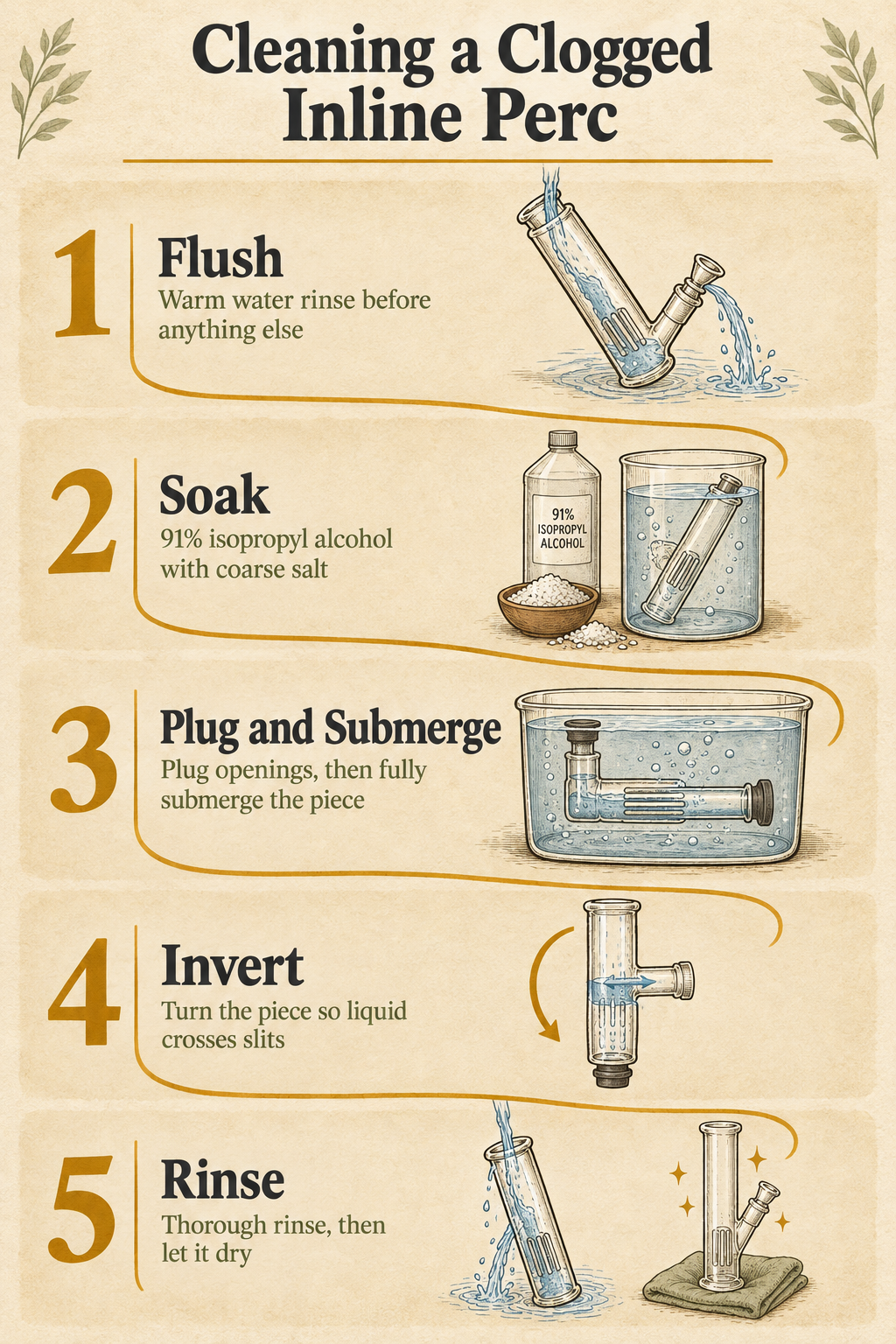
What works instead is liquid movement plus time. Submerge the piece, plug the openings so a little pressure builds, let it soak, and turn the piece partway through so the liquid has to travel back out through the slits in the other direction.
Heavily percolated glass needs a shorter cycle than a plain beaker. Warm-water rinses between sessions plus an alcohol clean every few days is the recommendation for multi-perc pieces, because the slits block quickly. [8]
One shortcut to skip: boiling water. The thermal shock can crack the glass, and a cracked inline cannot be repaired or replaced on its own. [8]
- Flush with warm water first to lift loose material out of the tube before you add anything else.
- Add 91% or higher isopropyl alcohol with coarse salt, then shake gently while keeping a hand on the joint.
- Run a pipe cleaner or thin brush through the straight section of the tube wherever it can reach.
- Plug both openings and fully submerge the piece in alcohol for about an hour.
- Invert the piece partway through the soak so liquid flows back through the slits from the other side.
- Rinse thoroughly with warm water, then let the piece air dry before the next use.
Do you need a second perc above the inline, or is one enough?
Inline percs are usually the bottom stage of a stacked build, with a showerhead, rocket or tree perc above them. Each stage splits the airflow again and adds restriction, and the gain from each added stage is smaller than the gain from the one before it, which is why guides settle on one or two well-built stages as the practical range for most pieces. [1]
A second perc is worth it if you want more diffusion and do not mind a heavier pull. A third is usually a design statement more than a performance gain, and it adds more places for resin to collect and more glass to clean. [5]
On the current Treehouse assortment, the Bongs category holds 252 products, and 19 of them mention an inline perc in the name or description with 15 of those in stock. Prices on the in-stock pieces run from $45.99 to $209.99, most carry a 14mm female joint with one 19mm female piece in the mix, and there is a dedicated straight-tube inline build listed at $69.00. [10]
One note that applies to any water pipe, inline perc or not: the CDC describes bongs as pipes or water pipes used to smoke cannabis and states that health and safety risks exist for each different way of using cannabis, that scientists do not have enough evidence to say one way is safer than another, and that smoking cannabis can expose the smoker and people nearby to harmful chemicals. No perc design changes that. [9]
- Joint size: 14mm is the easiest standard for finding replacement bowls and ash catchers, and 18mm is the other common size; most perc bongs use one of the two. [3]
- Slit layout: a single row of slits is the standard inline, while multiple rows are sold as gridded or super-slit, and none of those labels is regulated.
- Fixed placement: confirm the inline is part of the glass, because it cannot be added later or moved between pieces.
- Cleaning access: check that the tube is visible through the glass and that a pipe cleaner can reach the straight run.
- Price band: in-stock inline pieces in the current catalog run from $45.99 to $209.99, so a mid-range piece sits near $70 to $120. [10]
- Shipping: Treehouse Lifestyle offers free shipping on orders $150+, which matters on the higher end of that price band.
Frequently Asked Questions
Is an inline perc the same thing as a downstem?
No. A downstem is a vertical tube that carries smoke from the bowl down into the water, and it is often removable. An inline perc is a separate diffusion stage in that path: a horizontal glass tube with a row of slits, fused into the piece so smoke spreads along its length before rising into the neck. Plenty of bongs use both, with the downstem feeding the inline.
What does an inline perc do to the pull?
Retailer guides consistently describe it as low drag with a quick-clearing pull and a short tactile chug on the draw. Inline percs produce fewer, larger bubbles than high-diffusion designs, so resistance stays modest compared with multi-arm or multi-stage percs, which split the same airflow across many more openings.
Can you add an inline perc to a bong you already own?
Not as a drop-in part. The inline tube is fused into the glass, so it is built into the piece rather than added later. Accessories such as bowls and ash catchers attach at the joint, and the joint size decides what fits. If you want extra diffusion on an existing bong, a removable add-on at the joint is the usual route.
How can you tell a true inline perc from labels like gridded or stemless?
Ignore the label and look at the layout. The same idea is sold as an inline perc, inline percolator or inline tube, and some makers market multiple slit rows as gridded or super-slit inlines while others call a fixed build stemless. None of those terms is regulated. The reliable check is a horizontal tube with slits sitting in the water path.
How often does an inline perc need cleaning?
More often than a simple beaker. The slits are narrow and block quickly, so guides recommend warm-water rinses as routine and an alcohol clean every few days on multi-perc glass. Watch for the two warning signs of buildup: drag that creeps up over a session, and bubbling that stops forming evenly across the slit row.
Is an Inline Perc the Right Choice for Your Next Bong?
If you want a straight-tube piece that spreads bubbles across a wide area without a heavy pull, an inline perc is the simplest way to get there. It has no moving parts, no arms to break, and a fixed tube that distributes smoke along its full length instead of dumping it from one point. [3]
It is not the highest-diffusion design on the shelf, and there is no reason to pretend otherwise. A tree perc or a multi-stage piece will split the airflow more times. What the inline offers instead is a short list of tradeoffs you can live with: modest resistance, a water level that is easy to read, and one maintenance job that takes a soak rather than a scrub.
The tradeoff to accept is cleaning. Slits clog, salt cannot reach inside them, and the reliable fix is a full submersion with an invert partway through. If you are willing to do that every few days, the rest of the design is forgiving. [8]
Sources
- AFM Smoke: What Are Percs? Every Bong Percolator Type Explained
- Smoke Cartel: Best Inline Perc Bongs: Top Picks (2026)
- Dankstop: How Percolator Styles Boost Smoothness: Every Type Explained
- Croia Glass: Bong Percolator Types Explained | Complete Engineering Guide
- Thick Ass Glass: How to Fill a Percolator Bong (Every Perc Type)
- Discreet Smoker: Bong Percolator Types: Complete Visual Guide
- Scrubber Duckys: Mastering Bong Cleaning Techniques for Tree, Honeycomb, and Inline Percolators
- Smoke MEGA: How to Unclog a Percolator When Salt and Alcohol Can’t Reach
- Centers for Disease Control and Prevention (CDC): Cannabis Frequently Asked Questions
- Treehouse Lifestyle: WooCommerce Store API – Bongs category product list (category 16)