

A bubble base bong is a water pipe whose water chamber is shaped like a ball or bubble sitting on a flattened bottom, with a straight or slightly angled neck rising above it. The round body holds more water than a straight tube of similar height, takes less table space than a beaker, and sits between those two shapes on stability.
The name is where most shoppers get stuck. Pulsar files the style as Bubble Base in its own spec sheets [1]. Thick Ass Glass calls the same geometry a round base [7]. HEMPER calls it a bubble bong, notes the round base name, and traces the form to the round-bottom flask used in lab glassware [8]. Bubble base, round base, globe base and bubble bong all describe one family of water pipes.
What separates the shape from its neighbors is water volume and footprint. Thick Ass Glass ranks the round base as more stable than a straight tube and less stable than a beaker, with water volume sitting between the two [7].
Everything else follows from those facts rather than from roundness on its own: how much effort a pull takes, where the water line belongs, how many percolators fit inside the body, and how deliberately the piece should be set down. This guide works through each of those in order, using the measurements manufacturers publish and the product records for the bubble base pieces we currently carry.
What Is a Bubble Base Bong, and How Do You Spot One?
The quickest way to confirm the shape is to look at the bottom third of the piece. A beaker base widens with a straight, tapered wall. A straight tube holds one cylinder from the joint down to the water line. A bubble base swells outward into a ball or bubble and then runs in to a small flat spot that rests on the table.
Chameleon Glass describes the same piece as a beaker-style body with a rounded bottom instead of a tapered one. That large rounded bottom provides the water volume and even percolation when the piece stands straight up [9].
Above the chamber, the neck either rises vertically or leans slightly forward, which is the difference HEMPER draws between a straight neck and a slightly angled neck [8]. The joint is set into the shoulder and is usually fixed at one angle: Pulsar’s Classic Glass Bubble Base Bong lists a 45-degree joint, while the Rings of Saturn and Cubez bubble bodies list 90 degrees [1][2]. Both angles carry a 14mm female joint on the models covered here.
Inside the chamber, a diffuser drops below the water line. In the neck above the water sits an ice catcher, and its capacity varies by model: a single concave pinch on the Classic Glass Bubble Base Bong, three pinches on the Rings of Saturn and Cubez bodies [1][3].
Handling deserves its own note, because the geometry invites a bad habit. Chameleon Glass cautions that on classic round bottom pieces the base is sometimes not quite as thick as the walls, so extra care is warranted when moving the piece or setting it down [9].
In practice, that means lifting with two hands and placing the piece rather than dropping it the last inch onto a counter. The rounded body also gives you less flat surface to grip than a beaker’s straight wall, so carry it by the chamber and not by the neck.
If you want to compare this shape against everything else we stock, the full Bongs category is the fastest way to see heights, perc counts and prices side by side.
Here is what each part of the piece does, in plain terms:
- Round chamber — holds the water. Its volume is what puts the shape between a straight tube and a beaker.
- Flattened base — the small flat spot the piece stands on. Smaller than a beaker’s base, which is the trade for a smaller footprint.
- Neck — straight or slightly angled. Longer necks put more distance between the water and the joint.
- Joint angle — set into the shoulder at 45 or 90 degrees. It decides which way the bowl or slide leans in your hand.
- Diffuser — reaches down below the water line and splits the incoming stream into bubbles.
- Ice catcher — sits in the neck above the water, not in the chamber, so ice never sits in the water itself.
Is a Round Base Bong the Same Thing as a Bubble Base Bong?
Yes, and the naming is the most confusing part of shopping for one. Four manufacturers describe the identical single-chamber geometry, and no two of them use the same word for it.
No label is more correct than the others, and none of them signals a different build. Thick Ass Glass defines the round base as a ball- or bubble-shaped water chamber with a flattened bottom under a straight neck [7]. Chameleon Glass lists the same object as Classic (Round/Bubble) Base [9], and Pulsar titles it a Bubble Base [1].
When a listing says globe base, round base, bubble body or bubble bong, the chamber photo is the deciding evidence and the label is not.
That matters because retail labels contradict themselves. Our own Pulsar Rubik’s Cube Perc listing is titled and highlighted as a round bubble base, yet its product-details block lists the style as Beaker base with Rubik’s cube artwork [6]. Both fields cannot be right. The photo shows a round bubble chamber with a dual perc stack, so the title is accurate and the style field is a template artifact. Read the chamber photo first and read the style dropdown as a hint.
Once you know what you are looking at, the rest of the shopping is ordinary. For the anatomy of a water pipe from joint to water line, start with What Is a Bong and How Does It Work?. To see where the bubble base sits among the other chamber shapes, read What Are the Different Types of Bongs?.
The two closest comparisons each have their own breakdown: Beaker Bong vs Straight Tube: What Is the Difference? covers the beaker and tube question, and What Is a Percolator Bong and How Does It Work? explains what a perc actually adds. For material and thickness decisions, How Do I Choose the Right Glass Bong for My Needs? is the broader buyer’s walkthrough, while What Bong Size Should You Get? handles height. If you plan to run a different bowl or an ash catcher, What Bong Adapter Do I Actually Need? covers the joint matching that trips people up.
Here is the wording each manufacturer actually uses:
- Pulsar — files the style as Bubble Base in its spec sheets and product titles [1].
- Thick Ass Glass — calls it a round base and defines it as a ball- or bubble-shaped chamber with a flattened bottom [7].
- Chameleon Glass — lists it as Classic (Round/Bubble) Base, a beaker body with a rounded bottom instead of a tapered one [9].
- HEMPER — calls it a bubble bong, notes the round base name, and traces the form to the round-bottom flask used in lab glassware [8].
How Does a Bubble Base Compare to a Beaker or a Straight Tube?
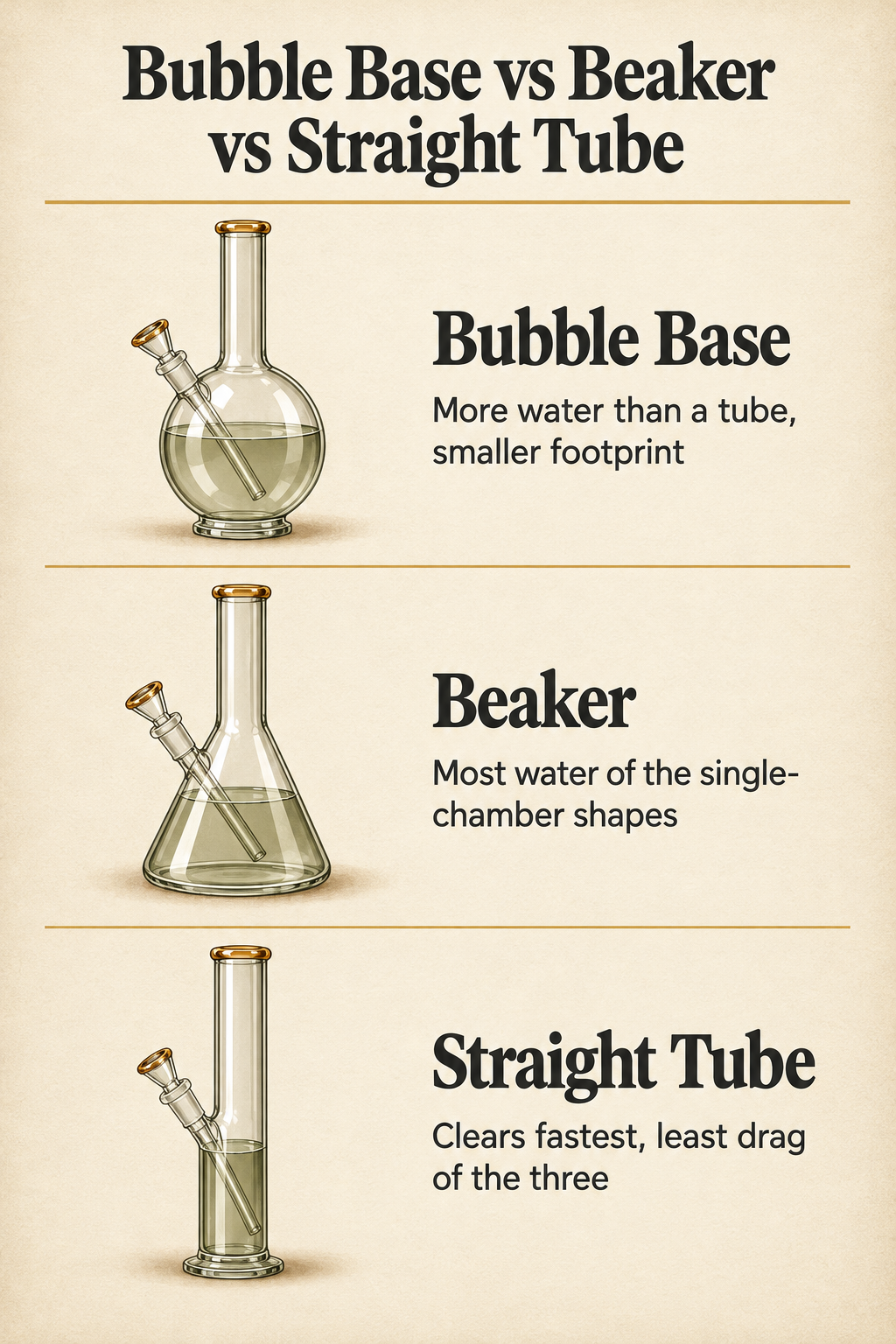
The fair comparison is between three single-chamber shapes, because that is what a bubble base is: one water chamber and one diffuser path. Thick Ass Glass ranks these three by water volume and by stability, and the two rankings are not the same order, which is the entire point [7].
Read these points as a set of trade-offs rather than a scoreboard. The beaker wins on stability and water volume, the straight tube wins on footprint and clear speed, and the bubble base trades a little of each to land between them. Chameleon Glass adds one more argument for the round body. With the piece standing straight up, the rounded bottom spreads the bubble activity across a wider area than a tapered base does, so the action is not concentrated in one corner [9].
The practical question is which trade you care about. If the piece lives on a crowded desk or a narrow shelf, the smaller footprint is worth more than the extra stability a beaker offers, and a bubble base is the better fit. If the piece gets knocked into regularly, or if it lives on a soft surface, a beaker’s wider base is the more forgiving choice. Neither answer is wrong; they are answers to different questions.
One thing the round shape does not do is change how the piece is filled or cleaned. A bubble base takes the same water level rule, the same downstem access question and the same cleaning routine as any other single-chamber piece. What changes is how the water looks while you fill it, which is covered further down.
Here are the comparison points that actually differ, in the order they affect day-to-day use:
- Water volume — a beaker holds the most water of any single-chamber shape, a bubble base holds less than a beaker, and a straight tube holds the least of the three at a similar height [7].
- Table footprint — the order flips. A beaker spreads wide across the table, a straight tube takes up little area but stands tall, and the round chamber sits between them.
- Contact patch — the flat spot under a round base is smaller than a beaker’s base, so the piece depends more on that one small patch for balance [7].
- Stability — more stable than a straight tube and less stable than a beaker, which is the ranking Thick Ass Glass publishes for the shape [7].
- Clear speed — a straight tube clears fastest with the least drag, and a beaker draws slightly heavier than a tube, which places the bubble base in the middle because its water volume is in the middle [7].
| Shape | Water volume | Table footprint | Stability |
|---|---|---|---|
| Bubble base | More than a straight tube, less than a beaker | Smaller than a beaker | Between a tube and a beaker |
| Beaker | Most of the single-chamber shapes | Widest of the three | Most stable |
| Straight tube | Least at a similar height | Narrowest of the three | Least stable |
Does the Round Chamber Make the Pull Harder or Easier?
Drag tracks two things: how much water the piece holds and what path the smoke takes through it. Roundness by itself does not enter the equation. That is why the bubble base lands in the middle of the three single-chamber shapes on pull effort. It is also why a 12-inch bubble base and a 12-inch tube of completely different widths can feel similar when their water depths match [7].
The physics is worth knowing because it corrects a common assumption. Pressure at any point in a liquid depends on how far below the surface that point sits and on the liquid’s density, and it is independent of how wide the container is [10]. Translated to a water pipe: what makes a pull work harder is the vertical depth of water sitting over the diffuser outlet, not the width of the bubble chamber around it.
A wide round bottom holding two inches of water over the diffuser takes about the same effort as a narrow tube holding two inches of water over its diffuser.
Percolators are the other half of the equation. A perc splits one stream into more, smaller bubbles, and Thick Ass Glass notes that more diffusion generally means more drag and more glass to clean [7]. That makes perc count a trade rather than a free upgrade: each stage inside the chamber adds a barrier the pull has to overcome and an inner surface that needs cleaning access.
Finally, remember what the shape is not. A bubble base is a single water chamber, so one diffuser downstem or one perc stack is the entire filtration path. Multi-chamber pieces and recyclers run separate water paths of their own, and comparing a bubble base to one of those is not a like-for-like test [7][8]. The fair comparison stays inside the single-chamber family.
One caution on retailer summaries: HEMPER credits the shape with a sturdy base and 360 degree filtration, then lists a limited filtration path and a less comfortable draw as cons for the same piece [8]. Those claims pull in opposite directions, which is a good reason to compare published measurements — water volume, height, glass thickness, perc type and joint size — instead of relying on a pros-and-cons block.
The factors that actually set pull effort, in order of how much they matter:
- Depth of water over the diffuser — the single biggest factor, because pressure rises linearly with depth [10].
- Perc count — each percolator adds diffusion, and more diffusion generally means more drag [7].
- Size of the diffuser openings — more and smaller holes split the stream further than a few large ones.
- Height of the water column above the perc stack — a tall stack holds water at several levels at once.
- Chamber width — this is the one factor that does not matter for effort, only for the volume of smoke the body can hold.
How Much Water Goes in a Bubble Base Bong?
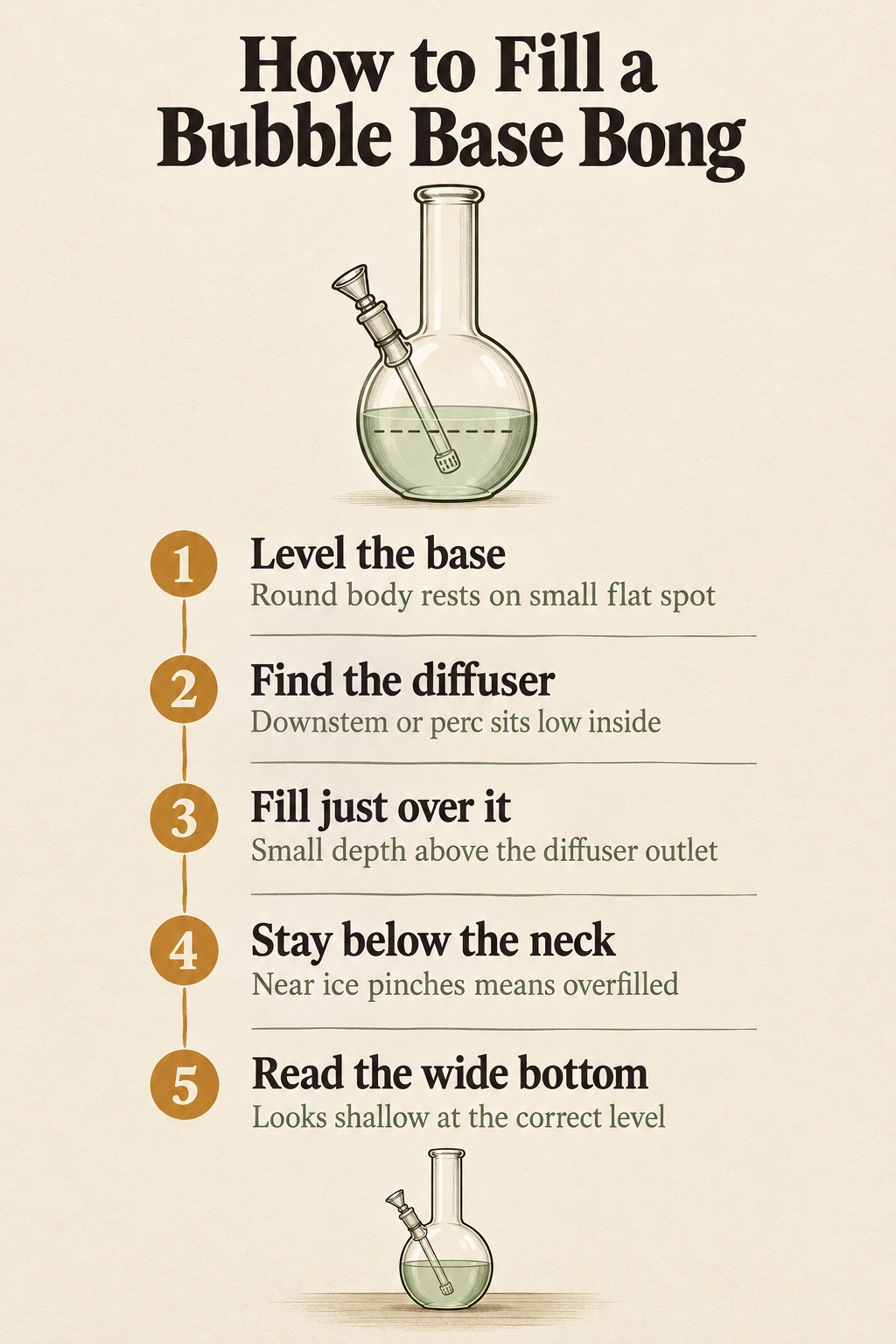
The rule for this shape is the same as for any other single-chamber piece: water belongs in the lower part of the base, just over the downstem or the perc. A piece filled anywhere near the ice pinches or the joint is overfilled and will splash [11]. The shape is easy to get wrong because the wide round bottom makes a correct water level look shallow.
The reason the round bottom fools people is surface area. A wide chamber spreads the same volume of water across a larger floor, so the depth you see through the glass stays low even after you have poured in the amount the piece needs.
The diffuser outlet is the reference point, not the apparent depth. If you are used to filling a straight tube until the water looks like it has some body to it, you will overfill a round base by a noticeable margin before the level looks right.
Opaque pieces need a different check. The same wide bubble bottom also appears in painted ceramic, as on the SeshGear Chinese Vase Ceramic Water Pipe, a 5.75-inch piece with a flared vase profile, a removable diffuser downstem and a 14mm joint [5].
You cannot watch the bubble action through a painted wall, so you match the water line to the downstem by feel and by eye from above. Pull the downstem, note where its openings sit relative to the body, replace it, and fill to just above that mark.
Two habits keep the level honest over time. Re-check after anyone else has used the piece, because a wide chamber hides a half-inch of extra water. And empty it before moving it across a room, since water sloshing in a round body with a small base is the most common way these pieces get tipped.
Work through it in this order and the level lands right the first time:
- Set the piece on a level surface first. A round body with a small flat spot will read a false water line on a sloped counter.
- Locate the diffuser outlet inside the chamber — the bottom of the downstem, or the lowest plate on a perc stack.
- Fill until the water sits a small distance above that outlet, enough to submerge it fully.
- Stop well below the ice pinches and the joint. Reaching either one means the piece is overfilled [11].
- Check the wide bottom against the diffuser, not against how deep the water looks, because a correct level reads shallow in a round chamber.
- For an opaque ceramic body, match the water line to the removed downstem by eye rather than watching the bubble action [5].
Fixed Downstem or Removable Downstem: Which Build Should You Get?
Two build styles share the same bubble base body, and the choice changes cleaning access and perc count rather than the shape itself. The first is a removable downstem dropped into the round chamber, which is how Pulsar’s Classic Glass Bubble Base Bong is built: a slitted or perforated diffuser downstem that lifts out, a concave single-pinch ice catcher, and a 14mm female joint at 45 degrees. It comes in a medium 10.5-inch version with 4mm glass and a large 14.25-inch version with 7mm glass [1].
The second is a stemless joint welded into a mini inline percolator that rises into a honeycomb percolator. Pulsar’s Rings of Saturn uses that stack in a 12.75-inch high-capacity bubble body with a 3-pinch ice catcher and a 90-degree joint [2], and the Cubez body runs the same platform at 12.5 inches [3]. Both are sold as bubble bases; the difference is how much glass sits inside the chamber.
Body material cuts across both builds. The same wide bubble bottom appears in painted ceramic with a removable diffuser downstem, as on the SeshGear Chinese Vase [5]. An opaque wall changes the routine, because you cannot inspect the inside of the chamber by eye. Ceramic is also a different handling proposition from borosilicate: the pieces are heavier for their size, and you check the water line by matching it to the downstem rather than by watching bubbles.
If you clean your pieces on a schedule and like to see what you are doing, the removable downstem build is the easier one to live with. The diffuser comes out and the chamber opens up. If you would rather have the extra perc stage and accept a longer cleaning routine, the stemless inline-and-honeycomb stack delivers more diffusion inside the same round body.
Neither is a better piece of glass; they are different answers to the question of how much time you want to spend maintaining it.
What each style means in practice:
- Removable downstem — lifts out for cleaning and can be replaced on its own if it chips, but adds one joint that needs to stay seated [1].
- Fixed or stemless build — fewer removable parts to lose and a shorter path from joint to perc, at the cost of cleaning access into the chamber [2].
- Perc count inside the body — one diffuser downstem on the Classic build, an inline plus a honeycomb on the Rings of Saturn and Cubez builds [1][3].
- Body material — borosilicate on the glass models, painted ceramic on the SeshGear vase, which changes both the weight and the way you check the water line [5].
Which Bubble Base Bong Size and Joint Size Should You Buy?
Start from the joint, then work outward to height, then decide how many percs you want inside the chamber. Every bubble base piece in our current assortment uses a 14mm joint [4][5][6], so a 14mm bowl, slide or ash catcher you already own will fit any of them. That single spec removes most of the compatibility guesswork before you look at anything else.
Three pieces show the spread. The Pulsar USA Top Hat Bubble Base Glass Water Pipe is $69.90 at 13.25 inches, with a round bubble chamber, inline and honeycomb percolators, a 3-pinch ice catcher and a 14mm male slide [4].
The Pulsar Rubik’s Cube Perc Bubble Base Glass Water Pipe is $89.99 at 12.5 inches with the same inline-and-honeycomb dual perc layout [6]. The SeshGear Chinese Vase Ceramic Water Pipe is $33.90 at 5.75 inches, a wide bubble base in painted ceramic with a removable diffuser downstem [5].
Across the six bubble base water pipes we carry, prices run from $33.90 to $89.99 and heights from 5.75 inches to 13.25 inches, all with 14mm joints [4][5][6].
That is a wide enough range that height should be a deliberate choice rather than whatever the listing photo suggests. The small end suits a compact setup and short sessions, while the large end carries the water volume and perc stack that justify the taller body. One practical note on cost: free shipping on orders $150+ applies, which matters if you are buying a piece plus a spare downstem or a second bowl in one go.
Whatever size you land on, plan where it will live. Round-bottom glass wants a stable, level surface and a deliberate two-handed move, and a small mat or a shelf with a lip costs less than replacing a chamber [9].
Work through the checklist in this order:
- Confirm the joint size first — 14mm female across the models described here — so the bowl and any accessory you already own will fit [4].
- Pick the height to match the space it lives in, not the biggest number on the page; the assortment runs 5.75 inches to 13.25 inches [5][4].
- Choose the perc layout: a single diffuser downstem for easier cleaning, or an inline plus honeycomb stack for more diffusion stages [1][2].
- Check the ice catcher count if you plan to use ice — one concave pinch on the Classic build, three pinches on the multi-perc bodies [1][3].
- Decide on body material — clear borosilicate if you want to watch the bubble action, painted ceramic if you prefer an opaque body [5].
- Budget for a spare downstem or an extra bowl alongside the piece, since a chipped diffuser is the part you will most likely need to replace [1].
Frequently Asked Questions
Is a bubble base bong the same as a round base bong?
Yes. Bubble base, round base, globe base and bubble bong all describe the same single-chamber shape: a ball- or bubble-shaped water chamber on a flattened bottom under a straight or slightly angled neck. Pulsar files it as Bubble Base, Thick Ass Glass calls it round base, and Chameleon Glass lists it as Classic (Round/Bubble) Base.
Do bubble base bongs tip over easily?
Less easily than a straight tube and more easily than a beaker. Thick Ass Glass ranks the shape between the two on stability, and the reason is geometry: the round body narrows to a small flat spot, so the contact patch on the table is smaller than a beaker’s. Chameleon Glass also notes that on classic round bottom pieces the base is sometimes not quite as thick as the walls, so the piece is worth moving deliberately rather than setting down hard.
Do bubble base bongs hold more water than a straight tube?
Yes. Thick Ass Glass places the round base between the straight tube and the beaker on water volume, so it holds more water than a tube of similar height and less than a beaker. A wide round chamber can look shallow while it is already holding that larger volume, which is why the diffuser rather than the visual depth is the fill reference.
Are bubble base bongs only made of glass?
No. The same wide bubble bottom appears in painted ceramic, such as the SeshGear Chinese Vase Ceramic Water Pipe at 5.75 inches with a removable diffuser downstem and a 14mm joint. An opaque body changes how you work with the piece, because the water line is matched to the downstem by feel rather than by watching the bubble action through the glass.
How many percolators does a bubble base bong have?
It depends on the build, but the shape itself is a single water chamber. One style uses a removable slitted or perforated diffuser downstem dropped into the round chamber. The other uses a stemless joint welded to a mini inline percolator that rises into a honeycomb percolator, as on Pulsar’s Rings of Saturn and Cubez bodies. Either way, the perc stack is the entire filtration path, so the fair comparison is another single-chamber shape rather than a multi-chamber recycler.
So Which Bubble Base Bong Should You Start With?
Pick the bubble base if you want more water volume than a straight tube without giving a beaker the middle of your table. That is the shape’s whole argument, and it holds up: a round chamber holds more water than a tube of similar height, takes less table area than a beaker, and sits between the two on stability [7]. The trade you accept is a smaller contact patch and a base that is worth treating gently [9].
Before you buy, settle four things in order. Confirm the joint is 14mm so your existing bowl fits [4]. Decide whether you want a removable diffuser downstem for easier cleaning or a stemless inline-and-honeycomb stack for more perc stages inside the same round body [1][2]. Choose the height against the space the piece will actually live in, from 5.75 inches up to 13.25 inches [5]. And decide whether you want clear glass or an opaque ceramic body, since that changes how you check the water line for the life of the piece.
Then fill it by the rule that matters: water just over the diffuser, well below the ice pinches and the joint, checked against the downstem rather than against how deep the water looks in a wide round bottom [11]. The chamber’s shape is what makes the piece what it is; the water level is what makes it work.
Sources
- Pulsar: Classic Glass Bubble Base Bong
- Pulsar: Rings of Saturn Bubble Bong
- Pulsar: Pulsar Cubez Bubble Bong
- Treehouse Lifestyle: Pulsar USA Top Hat Bubble Base Glass Water Pipe – 13.25 in / 14mm F
- Treehouse Lifestyle: SeshGear Chinese Vase Ceramic Water Pipe – 5.75 in / 14mm F / Bubble Base
- Treehouse Lifestyle: Pulsar Rubik’s Cube Perc Bubble Base Glass Water Pipe – 12.5 in
- Thick Ass Glass: Types of Bongs: Every Bong Shape and What Each One Does
- HEMPER: The Complete List of Every Type of Bong, Shape, and Material
- Chameleon Glass: Your Guide to Types of Bongs and their Shapes
- OpenStax (Rice University): College Physics 2e, 11.4 Variation of Pressure with Depth in a Fluid
- Thick Ass Glass: How Much Water to Put in a Bong: Water Levels for Every Type
- Centers for Disease Control and Prevention: State Medical Cannabis Laws