

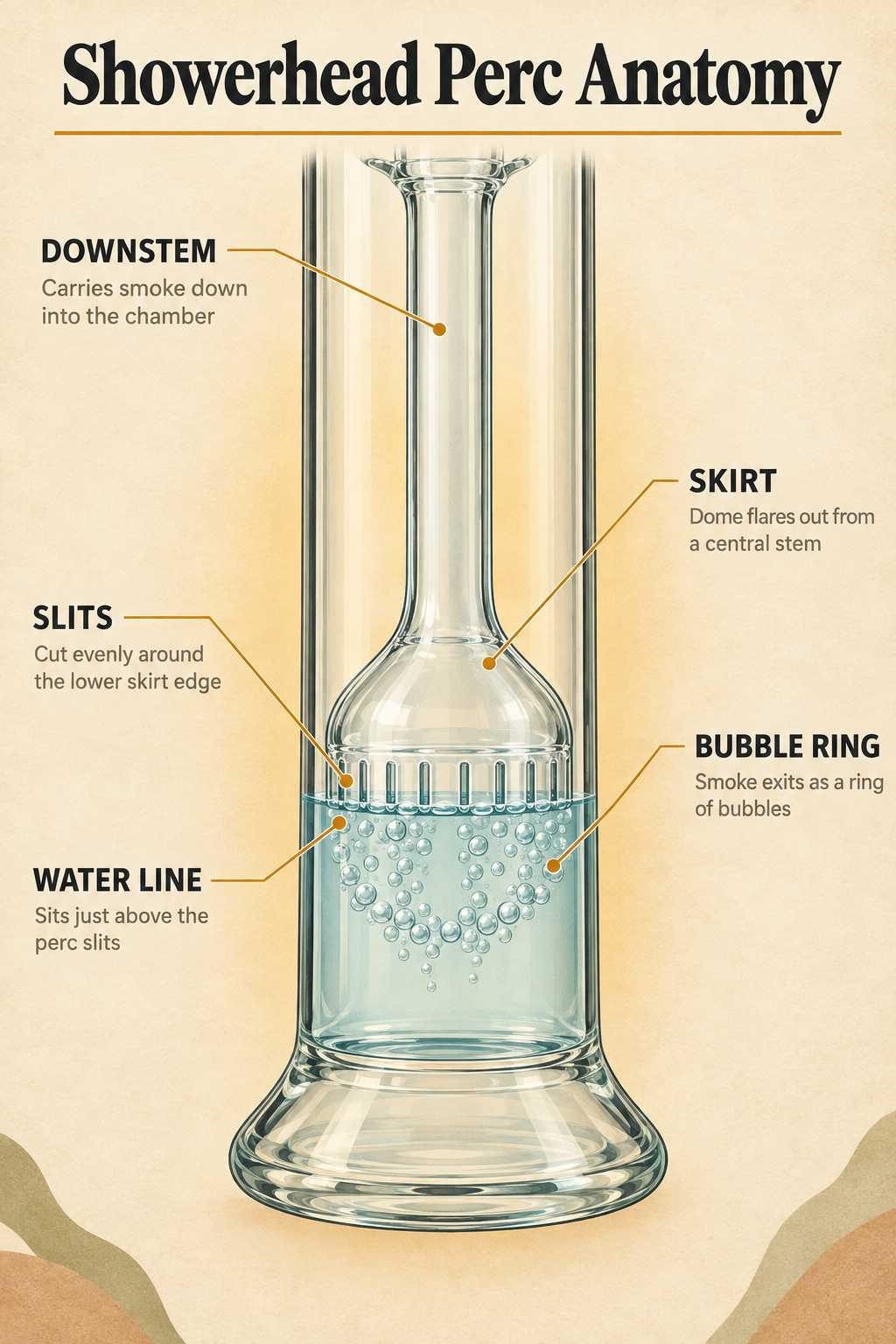
A showerhead perc is a percolator shaped like a dome or short skirt that flares out from a central stem, with slits cut evenly around its lower edge. Smoke runs down the downstem, gets pushed out through those slits, and leaves as a ring of small bubbles instead of one big bubble from an open tube.
One distinction is worth settling before you shop, because two different products carry the same name. A diffused showerhead downstem is a removable part that sets the first bubble size and most of the drag in a piece, and you can swap it or soak it on its own. A fixed showerhead perc is fused into the tube as a second diffusion stage, cleaned in place, and usually a repair or a replacement if it breaks [3].
This guide walks the smoke path from bowl to mouthpiece, compares showerhead and tree percs on drag, durability, cleaning, and diffusion, sorts out single versus double versus triple setups, and then lays out the specs to check on a product page before you spend anything.
What Is a Showerhead Perc and How Does It Work?
The shape is the giveaway. A showerhead perc rises from the downstem as a narrow neck, then opens into a dome or bell, and the slits sit around the bottom edge of that dome like the holes on a shower head [1][4]. Some pieces cut long vertical slits, some cut short ones, and a few feature a wide flat disc with slots around the rim [5]. The parts that stay constant are the closed top, the flared skirt, and the ring of openings at the base.
Smoke travels down the downstem and hits that closed top, so it cannot continue straight up the tube. It is forced outward and down, through the slits, into the water. One large bubble becomes many small ones, and smaller bubbles put more surface area against the water on every pull [3][4]. That is the entire mechanical purpose of the shape.
The vocabulary around this part is loose, and loose vocabulary costs buyers money. The same structure is sold as a showerhead perc, a showerhead diffuser, a showerhead downstem, a super slit, an inverted showerhead, a circ perc, and a UFO or disc perc [1][5]. Some retailers list a wide flat dome with edge slits as its own separate type. Read the description and look at the photo rather than trusting the label.
Opening counts vary as well. One beaker series lists six-slit diffusion, while GRAV’s coil showerhead piece diffuses smoke through 13 cuts [6][8]. More openings is not automatically better, because slit width, spacing, and placement change the feel of a pull more than the raw number does [1]. The walkthrough below follows the smoke from the bowl to the mouthpiece on a piece that has both a showerhead downstem and a fixed showerhead perc.
- Bowl — ground cannabis sits here, and the first air you draw pulls through it, starting the smoke moving down the tube [3].
- Joint and downstem — smoke passes the ground joint, then drops down the downstem toward the water [3][6].
- First bubble stage — a diffused showerhead downstem splits the incoming smoke into a first ring of bubbles at its slits [3].
- Water chamber — bubbles rise through the water, and the smoke gathers above the water line inside the tube [2].
- Fixed showerhead perc — on a two-stage piece, the smoke crosses a second skirt and slit ring before it continues upward [1][6].
- Ice pinch and mouthpiece — smoke passes any ice pinch on its way out, and you draw from the mouthpiece at the top [6].
What Does a Showerhead Perc Change About the Pull?
Percolation is a trade between diffusion and drag, and there is no way around that trade. Every slit, every hole, and every extra chamber adds resistance to the air path. You gain smaller bubbles, and you pay for them at the mouthpiece [1][3].
A showerhead sits near the low-drag end of the scale. It has a moderate amount of diffusion, a single-piece skirt with no arms to snap, and a structure that is easy to reach when you clean it [1][5]. Honeycomb, matrix, and multi-arm tree designs spread smoke across more openings and more internal glass, which adds total diffusion at the cost of more drag, faster clogging, or more fragile parts [4][5]. Those are engineering differences, not promises about what the smoke does when it reaches you.
One honest limit belongs in this section rather than at the bottom. Percolation changes bubble size and resistance. It does not make smoke risk-free. Research on water pipes finds that some water-soluble compounds and larger particles are removed from the smoke stream, while most smoke chemicals and fine PM2.5 particles still pass through, and bong smoking releases high concentrations of fine particles into the surrounding air [9][10]. A better-built perc is a better-built piece of glass, not a health measure.
If you are still filling in the background, the surrounding guides do most of this work already. The category overview is What Is a Bong and How Does It Work?, and the percolator primer is What Is a Percolator Bong and How Does It Work?. Bong size changes chamber volume and drag, so read What Bong Size Should You Get? before you pick a height. Recyclers route water differently and that changes the whole path, which is what Recycler Bong vs. Percolator Bong: What Is the Difference? covers. If you want a first stage that catches ash before the water, the options are laid out in What Is an Ash Catcher and How Do You Choose the Right One for Your Bong?.
- Bubble size — one open tube makes one large bubble, while a slit ring makes a crown of small ones [4][5].
- Contact per pull — smaller bubbles put more surface area against the water during the same draw [3].
- Drag — every slit adds resistance, and a showerhead adds less of it than a tree, honeycomb, or matrix design [1][5].
- Splashback — a slit ring pushes bubbles outward and up rather than straight up the tube, though fill level still decides how much water travels [2].
- Cleaning surface area — resin gathers along one slit ring and inside one skirt instead of across many small arms and holes [1][4].
- Water-level sensitivity — the slits have to sit within a narrow band under the water line, so fill matters more than it does on a single open downstem [2][3].
Showerhead Perc vs Tree Perc: Which One Should You Buy?
A tree perc puts a central stem in the water and branches it into several arms, each with slits of its own. That design multiplies the number of openings, and it also multiplies the amount of thin glass sitting in the water path. The showerhead takes the opposite approach: one skirt, one ring of slits, nothing branching [1][4].
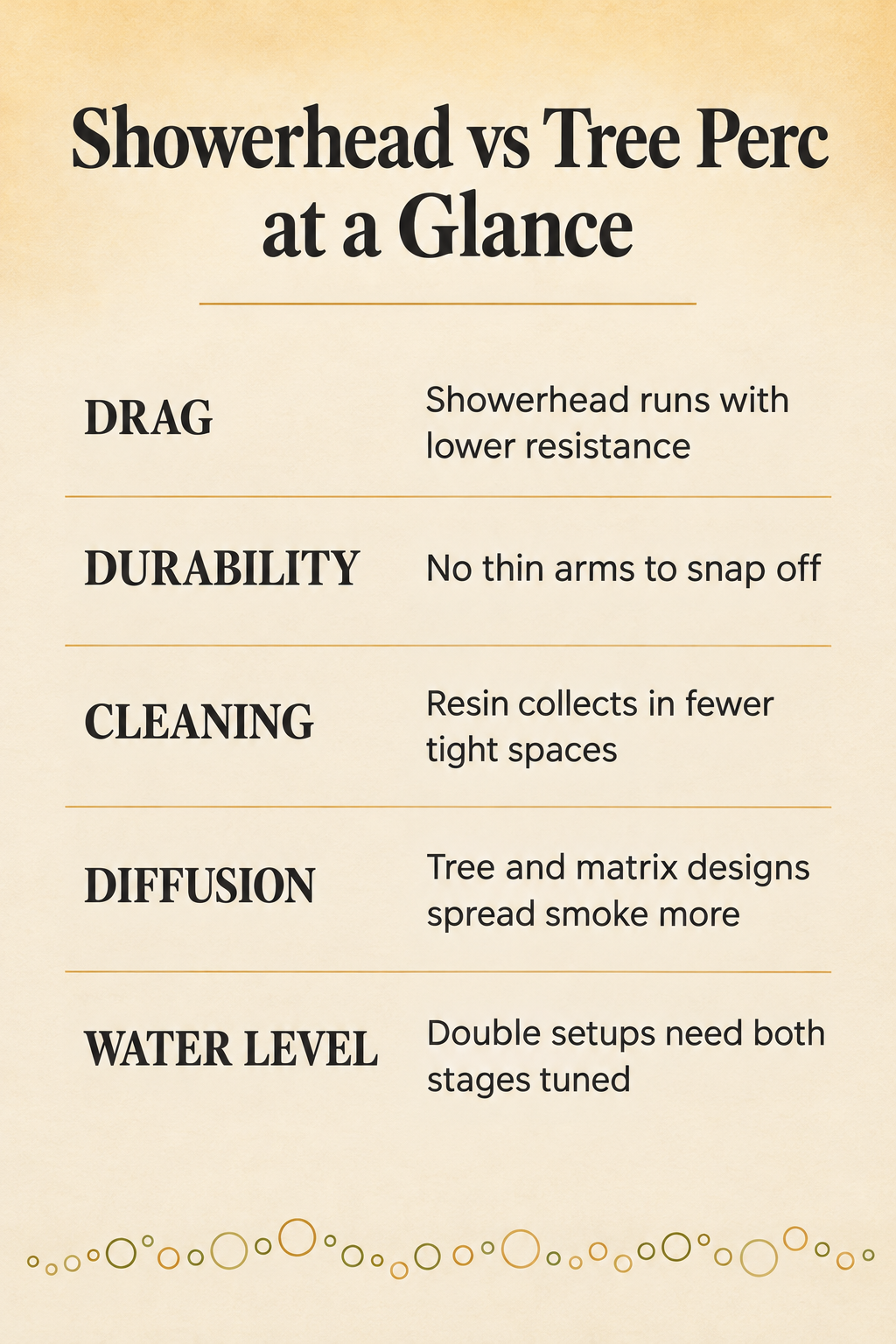
On drag, the showerhead consistently comes out lower. On structure, it is a single fused piece with no arms to snap if the piece gets knocked or set down hard. On cleaning, resin collects in fewer tight spaces, so there is less glass to work around with a brush [1][6]. Those three advantages show up in every comparison write-up, and they are the reasons manufacturers describe the design as durable and simple to maintain.
On total diffusion, the trade runs the other way. Tree percs, honeycomb discs, and matrix designs spread smoke across more openings and are described as delivering more diffusion than a single showerhead [4][5]. The cost is drag, faster clogging, and glass that breaks more easily. Nothing is free here.
Water level is the fourth axis, and it is the one buyers underestimate. A double-showerhead setup is more sensitive to fill than a single open downstem, because each stage has its own slit ring that has to sit in the right band under the water line [1][2]. Tree percs have their own fill sweet spot, but the showerhead stack is less forgiving of a guess.
So here is the decision rule. If you want the lowest-resistance pull, the fewest fragile parts, and the shortest cleaning session, buy a showerhead. If maximum diffusion matters more to you than drag and you are willing to maintain the piece, buy a tree, honeycomb, or matrix design. If you want a first stage that catches ash before it reaches the water, a perc ash catcher solves that separately [3].
- Drag — the showerhead runs with lower resistance, while a tree’s multiple arms and openings add more [1][5].
- Durability — a showerhead skirt is one fused piece with no thin arms, where a tree’s arms are the first thing to break [1][6].
- Cleaning — resin collects in fewer hard-to-reach spaces on a showerhead, and tree arms are harder to reach around [1][4].
- Diffusion — tree, honeycomb, and matrix designs spread smoke across more openings than a single showerhead does [4][5].
- Clogging — more small openings means more places for residue to build up, which is noted most often for tree and honeycomb designs [5].
- Water-level sensitivity — a stacked showerhead needs both stages tuned, where a single-stage design leaves more room for error [1][2].
| Feature | Showerhead Perc | Tree Perc |
|---|---|---|
| Drag | Lower resistance, fewer openings [1][5] | Higher resistance from many arms and slits [1] |
| Structure | One fused skirt, no thin arms to snap [6] | Central stem branching into several thin arms [4] |
| Cleaning | Resin gathers in fewer hard-to-reach spaces [1][4] | More small openings and internal glass to work around [5] |
| Diffusion | Moderate, from a single slit ring [5] | Higher, spread across more openings [4][5] |
| Water level | Narrow band; stacked versions need both stages tuned [2] | Its own fill sweet spot, more forgiving of a guess [1] |
Single, Double, or Triple Showerhead Perc: How Many Do You Need?
Manufacturers sell the same body in single, double, and triple configurations, and one LA Pipes series lists one, two, or three showerhead percs on otherwise identical 50mm tubing with 5mm walls [7]. Another series sells single and double versions at 14 and 16 inches and describes the taller double as its own size rather than a different design [6]. In practice that means the double version is often just a longer tube with a second stage inside it.
The returns flatten quickly. Sources describe two to three stages as the practical ceiling, past which a piece mostly gains drag and height rather than gaining anything at the mouthpiece [1][5]. A third stage is not wrong, but it is a small change you pay for twice, once in money and once in pull resistance.
Stacked setups are also less forgiving to fill. Too little water makes the draw feel airy and thin, because one stage is not submerged properly. Too much creates a chugging sensation, because the draw is fighting water it does not need. Both stages have to bubble together for the piece to feel like it was designed rather than assembled [1][2].
What you actually gain from a second stage is a second water crossing in a taller tube. What you give up is a little drag, a little more cleaning surface, and a narrower window for the water level. Weigh those four things in this order and the choice makes itself.
- How many stages you actually need — start at one, and consider two the sensible upgrade for a taller piece [1][5].
- Piece height — a double is usually a longer tube, so check the measurement against where the piece will sit and how you draw [6][7].
- Fill tolerance — every extra stage narrows the band where the water level works, which matters if you share the piece [1][2].
- Drag budget — each stage adds resistance, so decide how much pull resistance you are willing to trade for it [3][5].
- Cleaning effort — more stages means more skirt and more slit ring to soak and flush [1][4].
- Price — in one series the single, double, and triple are the same glass in different lengths, so pay for the length you want, not for a badge [7].
How Much Water Should You Put in a Showerhead Bong?
The target is narrow. Showerhead slits should sit about a quarter to half an inch under the water line, no more [2]. That band is wide enough to bubble evenly and shallow enough that the piece does not fight itself.
Water above that point does not add diffusion. It adds drag and splashback, because the smoke is pushing through depth it does not need to cross and the bubbles are breaking closer to the tube walls [2][3]. If the draw suddenly feels heavy after a top-up, you went past the band.
Then check it properly instead of guessing. A dry pull with an empty bowl is the standard test: every chamber and every perc should bubble evenly, and no water should reach the mouthpiece [1][2]. Bubbling on one side of the skirt and not the other usually means the piece is tilted or the level is low.
Fill levels are piece-specific, and the manufacturer’s number beats a general rule. GRAV documents about three inches of water for a combined coil-and-showerhead design, which is a different figure from a straight showerhead beaker [8]. On a double, tune the lower stage first, then bring the upper stage into its band, and dry pull after each adjustment rather than at the end.
- Set the piece on a flat surface and check that it sits level, so the water spreads evenly around the skirt [2].
- Add water slowly until the slit ring is just covered, aiming for about a quarter to half an inch above the slits [2].
- Run a dry pull with an empty bowl and watch the bubble pattern across the whole slit ring [1][2].
- Confirm every chamber bubbles evenly, since one dead stage means water is not reaching it [1].
- Add or pour off a small amount at a time until the pull feels even rather than heavy or thin [2].
- Recheck for splashback by drawing a little harder than usual and looking for water climbing toward the mouthpiece [2][3].
What Specs Should You Check Before Buying a Showerhead Piece?
Two showerhead pieces that photograph alike can differ on six or seven specs, and the ones that matter most are the boring ones. Joint size and joint angle decide whether your existing bowl fits at all. Downstem length decides whether the perc sits below the water line or hangs above it [6][7].
Read the listing for concrete numbers rather than marketing adjectives. One beaker series lists an 18mm female 45-degree joint with 34mm heavy-wall tubing, plus a removable downstem and an ice pinch [6]. A thicker series in the same catalog lists 50mm diameter tubing with 5mm walls and ground glass-on-glass fittings [7]. Those figures tell you how the piece will feel in the hand and which accessories will seat in it.
Removable versus fixed is the spec buyers skip and then regret. A removable downstem means you can swap it, shorten it, or soak it separately. A fixed perc means one less joint to work loose, but it also means cleaning happens in place and a break is a replacement [3][6].
Budget the extras at the same time, because a new piece usually wants a spare bowl, a set of screens, and cleaning supplies. The Accessories section covers that ground, and orders over the threshold earn free shipping on orders $150+ if you are adding a second piece or a cleaning kit to the cart.
- Joint size and gender — an 18mm female joint takes 18mm male bowls and accessories, while a 14mm joint takes a different set entirely [6][8].
- Joint angle — a 45-degree joint leans the bowl out from the tube, which changes how the piece sits and how you load it [6].
- Downstem length — this decides whether the perc tip reaches the water band or stops short of it [3][6].
- Perc count — one, two, or three showerhead stages, which sets drag, height, and fill sensitivity together [7].
- Wall thickness and tube diameter — 34mm heavy-wall tubing and 50mm tubing with 5mm walls are two very different pieces to hold [6][7].
- Removable or fixed downstem — a removable part can be swapped or soaked, while a fixed one is cleaned in place [3][6].
- Ice pinch — a pinched section in the tube that holds ice cubes above the water, present on some series and absent on others [6].
Can You Add a Showerhead Perc to a Bong You Already Own?
Usually yes, and you do not have to buy a new piece to get a showerhead stage. A showerhead-style downstem is the simplest route: pull the existing downstem and seat a diffused one in the same joint, and you have changed how the first bubbles form [3]. The joint size on your bong has to match the new downstem, so measure before ordering.
A perc ash catcher is the other route. It hangs on the joint between the bowl and the tube, adds a water stage of its own, and catches ash before it reaches the main chamber [3]. That option adds a second water crossing without touching the glass on your piece at all.
Then there is the fixed version, which is a different animal. A showerhead perc fused into the tube is cleaned in place, cannot be swapped for a shorter one, and is a repair or a replacement if the skirt cracks [3][6]. That is the design you buy when you want fewer joints, not the design you add later.
Showerhead percs also show up outside bongs. They appear in dab rigs and in ash catchers, and they are often suggested for compact or concentrate-focused pieces precisely because they add less diffusion than honeycomb or matrix designs, which keeps the air path short on a small rig [4][5]. The full range of water pieces that use the design is in Bongs, and the compact concentrate side is in Dab Rigs.
- Diffused showerhead downstem — a drop-in replacement part that sets the first bubble size and most of the drag, and can be swapped or soaked on its own [3].
- Perc ash catcher — an add-on stage that sits between bowl and tube, catches ash, and adds a water crossing without modifying your piece [3].
- Integrated fixed perc — fused into the tube as a second stage, cleaned in place, and a repair or replacement if it breaks [6].
- Compact rig configuration — small pieces and concentrate-focused rigs often use a single showerhead because it keeps diffusion and drag low [4][5].
- Not an option — you cannot add a fixed perc to an existing tube, so count the fixed version as a buying decision rather than an upgrade [3].
How Do You Clean and Maintain a Showerhead Perc?
The shape makes this easier than a tree perc and not effortless. There are fewer hard-to-reach spaces and no thin arms to work around, but resin still collects along the slit ring and inside the skirt, where a brush does not reach [1][4].
The narrow slits are the first thing to clog, because they are the smallest openings in the path and everything passing through them has already crossed the water. When a piece starts bubbling unevenly across the ring, that is usually residue rather than a crack [1].
Split the routine by part. A removable downstem comes out and soaks on its own, which lets the cleaning liquid reach the inside of the skirt directly. A fixed perc gets cleaned in place, with the liquid worked through the tube and the slit ring flushed from both directions [3][6].
Finish by looking at the glass rather than only at how clean it looks. A chip or hairline crack along the skirt edge changes how the piece bubbles and can fail later, so check the rim and the slit edges while the piece is empty and dry [6]. Keep to the routine below and the piece stays predictable.
- Rinse the piece with warm water as soon as you finish a session, before residue sets along the slit ring [1].
- Remove the downstem if it comes out, and pull any bowl so both joints are open [3].
- Soak the glass in isopropyl alcohol, or use a salt-and-alcohol mix for heavier buildup, and give it time to work [4].
- Work the slit ring with a brush or a pipe cleaner, since the slits clog before the chamber does [1].
- Flush the skirt from both directions so liquid passes through the slits rather than around them [3].
- Rinse thoroughly, let the piece dry, and inspect the skirt rim and slit edges for chips before the next fill [6].
Frequently Asked Questions
What is the difference between a showerhead perc and a showerhead downstem?
They are two different parts that share a name. A diffused showerhead downstem is a removable piece that sets the first bubble size and most of the drag in the piece, and you can swap it out or soak it on its own. A fixed showerhead perc is fused into the tube as a second stage, cleaned in place, and usually a repair or a replacement if it breaks.
Is a double showerhead bong harder to fill than a single?
Yes, it is more sensitive to fill level. Too little water makes the draw feel airy because one stage is not properly submerged, and too much creates a chugging sensation because the draw is pushing through water it does not need. Both stages have to bubble together, so fill slowly, run a dry pull with an empty bowl, and confirm even bubbling before you load anything.
Do showerhead percs clog faster than tree percs?
Not typically. Showerheads are described as easier to clean because resin collects in fewer hard-to-reach spaces and the single-piece skirt has no thin arms to work around. Tree, honeycomb, and matrix designs are the ones usually noted for faster clogging, largely because they have more small openings and more internal glass to reach.
What joint size and downstem length should I look for?
Match the joint to the bowl and accessories you already own, and match the downstem length to the piece so the perc sits inside the water band. Manufacturer examples in this category include an 18mm female 45-degree joint with 34mm heavy-wall tubing on one beaker series, and 50mm tubing with 5mm walls on another. Joint angle and downstem length are the two specs most likely to make a piece incompatible with your setup.
Is a showerhead perc a good choice for a dab rig?
It is often suggested for compact and concentrate-focused pieces because it adds less diffusion than honeycomb or matrix designs, which keeps the air path short on a small rig. The same trade applies as on a bong: you get a lower-drag path, and you give up some of the total diffusion a multi-stage design would add.
So Which Showerhead Perc Should You Buy?
Buy one stage unless you have a reason for two. A single showerhead gives you the slit ring, the low-drag path, and the easy cleaning that make the design worth choosing, and two stages are a reasonable upgrade on a taller tube. Three is a small change that costs money and adds resistance, and past that point the piece mostly gets heavier to pull [1][5].
Then check the boring specs before you pay. Joint size and joint angle decide whether your bowl fits. Downstem length decides whether the slits land in the water. Wall thickness and tube diameter decide whether the piece feels like something you want to hold. Those four lines on a product page are worth more than any adjective in the description [6][7].
And keep the expectation calibrated. A showerhead perc splits one big bubble into a ring of small ones, which changes contact and resistance in a way you can feel. It does not make smoke risk-free, and no perc count will [9][10]. Pick the piece for how it is built, fill it to the band, clean the slit ring, and it will do exactly what the design is supposed to do.
Sources
- Thick Ass Glass: Showerhead vs Tree Perc | A Practical Comparison
- Thick Ass Glass: How to Fill a Percolator Bong (Every Perc Type)
- Thick Ass Glass: What Is a Bong Diffuser? Diffusers vs Percolators Compared
- Encore Collection: What Is a Showerhead Perc? Bong Perc Guide
- Oil Slick: Types of Percs Explained: All 8 Bong Percolators Ranked
- LA Pipes: "Champ" Single or Double Showerhead Perc Beaker Water Pipe
- LA Pipes: "Magnum Flow" Thick Glass Beaker Showerhead Perc Water Pipe
- GRAV: GRAV Clear Coil Showerhead Water Pipe
- UCSF Center for Tobacco Control Research and Education: New Study: Secondhand Bong Smoke is full of Hazardous Fine Particles
- Centers for Disease Control and Prevention: About Cannabis