

A silicone dab rig is a water pipe made primarily from flexible, heat-resistant silicone and designed for concentrates like wax, shatter, and oil [1]. It works the same way a glass rig does: you heat a banger or nail, place a small amount of concentrate on the hot surface, and the vapor travels through the water before you inhale [2].
The silicone body is built to survive drops and travel, which makes these rigs a popular choice for people who want durability over looks [3]. The trade-offs are real: silicone can pick up and hold flavors over time, most rigs do not offer complex percolators, and the material does not have the visual appeal of glass [1] [3].
This guide covers what silicone dab rigs are made of, the biggest benefits, the honest downsides, how silicone compares to glass, how to clean and heat one, and how a silicone rig differs from a silicone bong.
What Is a Silicone Dab Rig Made Of?
The body of a silicone dab rig is molded from flexible, heat-resistant silicone, the same family of material used in many kitchen tools that have to stand up to regular use [2]. Manufacturers describe their silicone in different terms, such as food-grade or platinum-cured, and Ooze Life states that its material is food-grade, platinum-cured silicone with a heat index of 600°F (315°C) [6].
The body is not the part that gets hot. The heated component is a banger, nail, or tip made from quartz, glass, ceramic, or metal, and it fits into the silicone body [4]. This removable piece is what you heat with a torch, and it is also the part most likely to chip, crack, bend, or wear over time [2].
A silicone rig does not have to look plain, either. Some models add color or patterns, while others stay simple and solid. The material quality and the styling both vary by brand, so reading the product details before you buy matters.
Because the silicone itself never touches the flame, the body can stay flexible while the heated part does the hard work. Most rigs keep the two pieces separate, so you can replace a worn banger without replacing the whole rig [4].
If you want a softer touch where the rig meets your lips, the Silicone Filter MouthPiece adds a flexible silicone surface to the mouthpiece area.
- The body is flexible, heat-resistant silicone that bends instead of breaking [2].
- Manufacturers use different material labels, including food-grade and platinum-cured silicone [6].
- The heated banger, nail, or tip is quartz, glass, ceramic, or metal, not silicone [4].
- Ooze Life lists a 600°F (315°C) heat index for its food-grade, platinum-cured silicone [6].
What Are the Biggest Benefits of a Silicone Dab Rig?
The biggest selling point is durability. The silicone body can bend, flex, and bounce back when dropped, and it does not shatter the way glass can [2]. People who have broken a glass rig often switch to silicone simply to stop replacing broken pieces.
Portability is the second big win. A silicone rig packs into a bag without the careful padding glass demands, which makes it a natural travel companion [3].
Routine cleaning is easier for many people too. Silicone is non-polar, so resin is less likely to stick to it than to glass, and a quick rinse can handle most of the buildup [3].
Silicone rigs also make a popular backup piece. Because they cost less and pack down small, many people keep one in a travel bag, a camping kit, or a desk drawer so there is always something ready to use. The flexible body handles the bumps that come with everyday storage [3].
Price seals the deal for a lot of buyers. Silicone rigs are generally more budget-friendly than comparable glass rigs [1] [2].
If you are weighing the two materials for other gear, our comparison Glass vs Silicone Smoking Accessories: Which Should You Choose? looks at silicone and glass accessories side by side.
- Drop resistance: the body bends and flexes without breaking [2].
- Portability: soft silicone packs and travels with far less worry than glass [3].
- Easier routine cleaning: silicone is non-polar, so resin sticks to it less than to glass [3].
- Budget-friendly price: silicone rigs are generally less expensive than comparable glass rigs [1].
What Are the Downsides of a Silicone Dab Rig?
The most common complaint is flavor. Silicone can absorb and hold onto flavors and smells over time, so a well-used rig may start to taste like everything that has passed through it [3] [5].
Design is limited too. Because silicone is soft and opaque, most rigs do not offer complex percolators, and you cannot see inside the body to check how much buildup is hiding there [3].
Looks are a real factor for many buyers. Glass offers color, art, and handmade detail, while silicone is functional and plain by comparison [1] [5].
Finally, the whole rig is durable but not indestructible. Removable quartz, glass, ceramic, or metal components can still chip, crack, bend, or wear, so the most fragile parts of a silicone rig are the same kinds of parts that can break on a glass one [4].
If you like the idea of a silicone body but want a traditional glass bowl for flower, the SILICONE BEAKER BONG WITH REMOVABLE GLASS BOWL pairs the two materials in one piece.
- Flavor retention: silicone can absorb and hold flavors and smells over time [3].
- Limited designs: complex percolators are rare in silicone rigs [3].
- Hard to inspect: the opaque body makes it difficult to see inside for cleaning checks [3].
- Less visual appeal: glass offers more color and artistry than silicone [5].
- Removable parts can still break: quartz, glass, ceramic, or metal components wear like they would on any rig [4].
Silicone Dab Rig vs. Glass Dab Rig: Which One Should You Choose?
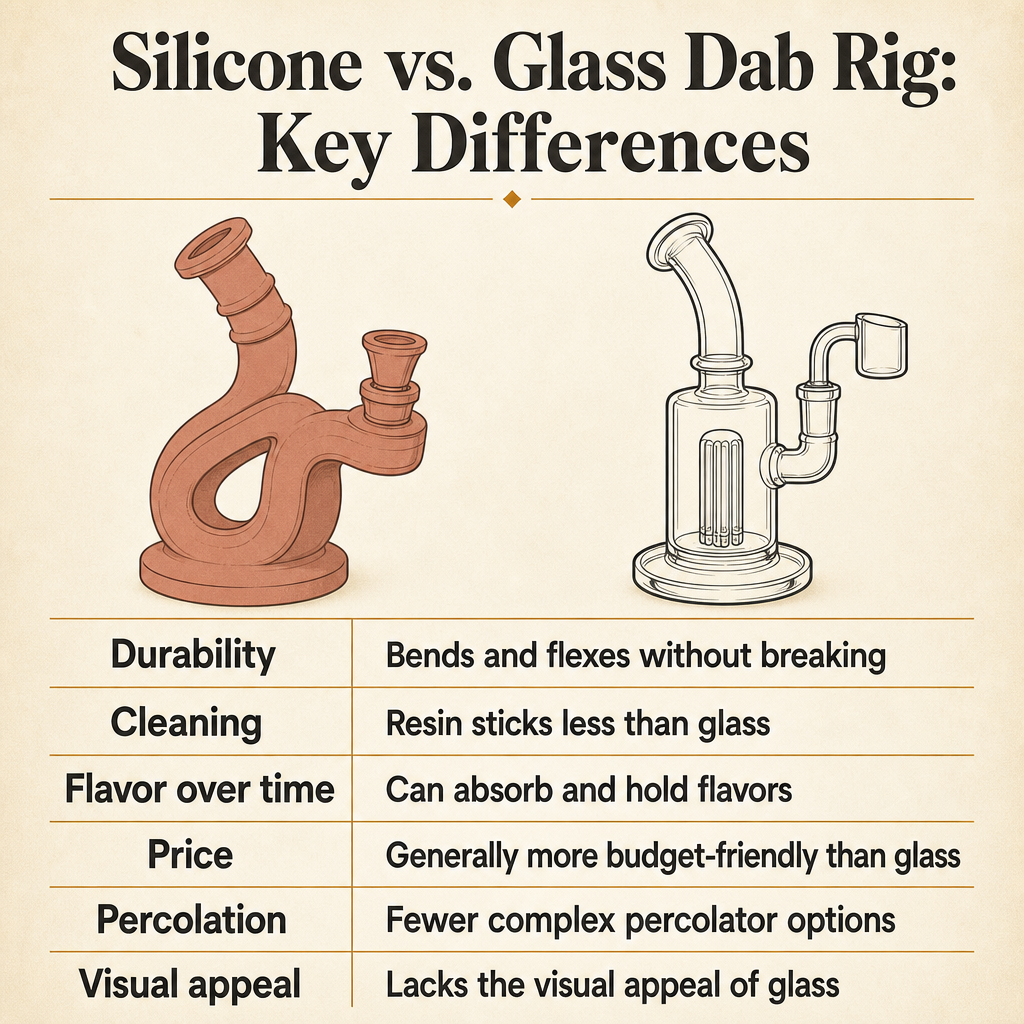
The short answer is that silicone wins when durability, portability, and price matter most, while glass wins when you care about flavor clarity, percolator variety, and looks [1]. Neither one is objectively better, and the right choice depends on how you use your rig.
Durability is the clearest difference. A silicone body bends and flexes instead of breaking, while a glass rig can shatter on a hard drop [2]. That makes silicone the better pick for travel, the outdoors, or wobbly tables. But the removable heated parts on both materials are fragile, so a silicone owner still handles the banger with care [4].
Flavor and cleaning cut the other way. Glass stays neutral over time, which is why many people prefer it when taste matters most [3]. Silicone is easier to wipe clean because resin sticks to it less, but it can hold onto old flavors in return [3].
Percolation and appearance are the rest of the story. Glass offers many more percolator designs and a range of artistic styles, while silicone keeps things simple and functional [3] [5].
A good way to decide is to write down your top two priorities before shopping. If they are “survives drops” and “easy to pack,” silicone nearly always wins. If they are “reliable flavor” and “interesting percolation,” glass usually takes the lead [1].
Price usually makes the decision easy for first-time buyers. Silicone rigs are generally more budget-friendly, and if you want a glass rig instead, a classic option like the LA Pipes Classic Beaker Concentrate Rig is a well-known starting point. Treehouse Lifestyle ships with free shipping on orders $150+.
- Durability: silicone bends and flexes; glass can shatter on a hard drop [2].
- Flavor: glass stays neutral; silicone can absorb and hold flavors over time [3].
- Cleaning: silicone is easier to wipe clean, but harder to see inside [3].
- Percolation: glass offers many more percolator designs [3].
- Appearance: glass offers far more color and artistry [5].
- Price: silicone rigs are generally more budget-friendly [1].
| Feature | Silicone Dab Rig | Glass Dab Rig |
|---|---|---|
| Durability | Bends and flexes instead of breaking | Can shatter on a hard drop |
| Cleaning | Non-stick surface, so resin sticks less | Needs more scrubbing; buildup is easy to see |
| Flavor over time | Can absorb and hold flavors | Stays neutral over time |
| Percolation | Few complex percolator options | Many percolator designs to choose from |
| Appearance | Functional and plain | Color, art, and handmade detail |
| Price | Generally more budget-friendly | Often more expensive for comparable rigs |
How Do You Clean a Silicone Dab Rig?
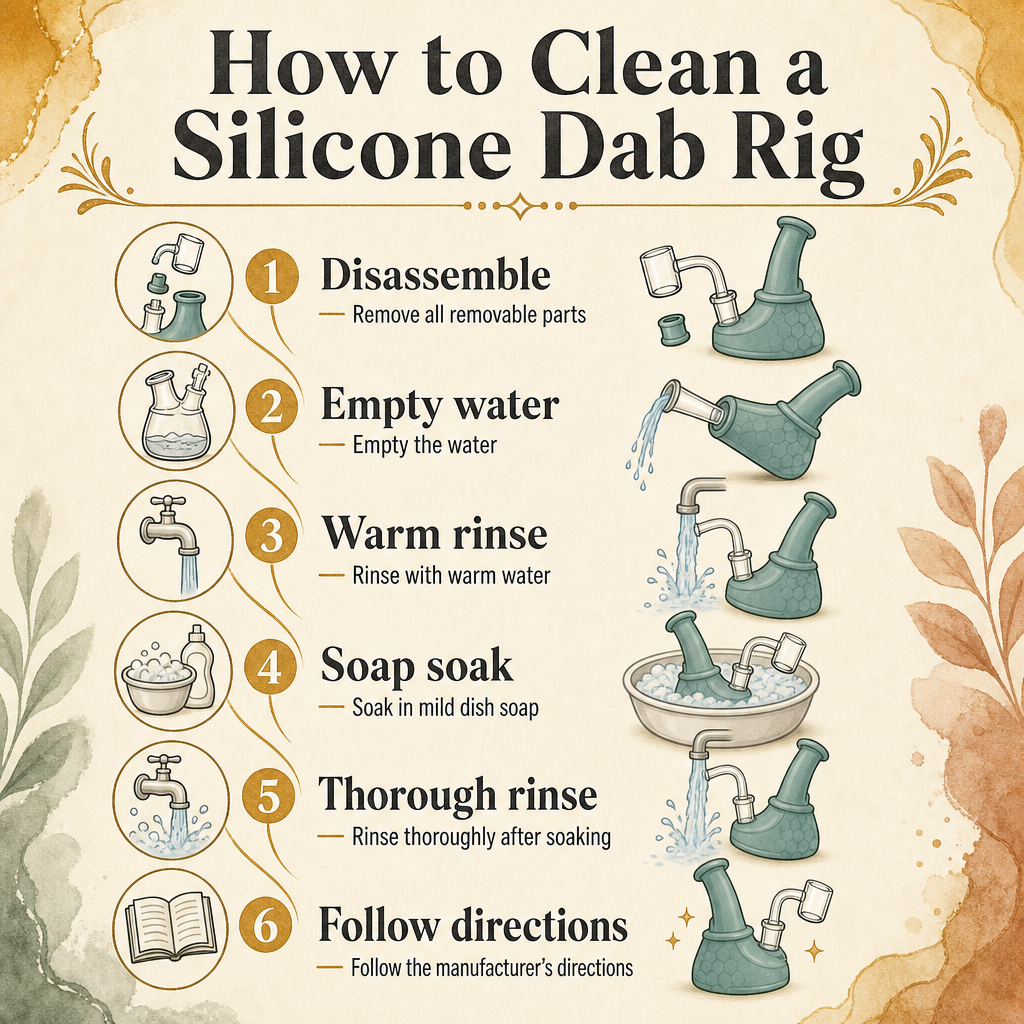
Cleaning a silicone rig follows the same basic routine as any water pipe, with a few extra reminders. The steps below work for the silicone body and the removable parts.
Start by taking the rig apart. Remove the banger, nail, or tip and any other removable pieces, then empty the water and give the body a first rinse with warm water [1] [4].
Soaking is the next step. A wash in a mild dish soap solution handles most of the residue, and the silicone’s non-stick surface means resin comes off more easily than it does on glass [1].
Two caveats are worth repeating. Warm water is fine, but boiling water is not the right move for every part. And when in doubt, a mild dish soap solution is the better starting point than a strong solvent, so check the product label and the manufacturer’s guidance before you soak anything [1].
Dry everything fully and follow the manufacturer’s directions. Not every part is dishwasher-safe, and prolonged solvent soaking is not right for every material, so read the care instructions that came with your rig before you try anything aggressive [1].
If you keep several devices clean on a schedule, the routine in How Do You Clean a Vaporizer Without Damaging It? shows how to clean a vaporizer without damaging it.
- Disassemble the rig. Remove the banger, nail, or tip and any other removable parts [4].
- Empty the water and rinse the body with warm water [1].
- Soak the pieces in a mild dish soap solution [1].
- Rinse everything thoroughly until the soap is gone [1].
- Let all parts dry completely before reassembly.
- Follow the manufacturer’s directions, since not every part is dishwasher-safe or made for prolonged solvent soaking [1].
How Do You Heat a Silicone Dab Rig?
Yes, you can use a torch with a silicone dab rig, but only on the part made for it. The flame goes on the banger, nail, or tip, never on the silicone body [4].
The silicone is heat-resistant, which is why the body can sit near a heated component without softening or degrading [2]. But it is not built to take direct flame. The torch is meant for the removable heated piece, and the silicone stays cool by design.
Keep the heated part seated fully in the joint before you light the torch. A loose fit can let heat travel where you do not want it, and it makes the whole session harder to control [4].
A common beginner mistake is trying to warm the silicone itself so the chamber heats faster. That is the one thing to avoid: the flame belongs only on the removable heated piece, and the rest of the rig is designed to stay out of the heat [4].
Always handle the heated component as a fragile piece even though the body is tough. A quartz banger can chip and a metal nail can bend, and both are far easier to replace than the whole rig [4].
If you are new to the full routine, our guide What Is a Dab Rig and How Do You Use One? walks through how a dab rig works and how to use one from start to finish.
- Seat the banger, nail, or tip securely in the joint [4].
- Point the torch flame only at the heated component, never at the silicone body [4].
- Wait for the heated component to cool to your preferred temperature before loading concentrate [2].
- Load a small portion of concentrate, then cap and inhale.
- Let the heated piece cool fully before you handle or clean it.
Silicone Dab Rig vs. Silicone Bong: What’s the Difference?
Both are silicone water pipes, so the names can feel interchangeable. The difference is what each one is designed to hold [4].
A silicone dab rig is built for concentrates. It uses a banger, nail, or heated tip that you warm with a torch. A silicone bong, by contrast, is generally configured for flower and uses a bowl instead [4].
Keep an eye out for hybrids as well. Some brands sell a single silicone water pipe that can switch between a bowl and a banger, which is handy if you use both flower and concentrates [6]. Just check which parts actually come in the box before you order.
Everything else, including the flexible body, the drop resistance, and the easy travel, is the same family of design. The choice comes down to what you plan to use: concentrate users should look for a rig, while flower users are better served by a bong [4].
When you are ready to shop, the Silicone Dab Rigs collection lists the concentrate-specific options in one place.
- A silicone dab rig is configured for concentrates and uses a banger, nail, or heated tip [4].
- A silicone bong is generally configured for flower and uses a bowl [4].
- Both share the same flexible, drop-resistant silicone body.
- Choose by what you use most: concentrates point to a rig, flower points to a bong [4].
Frequently Asked Questions
Are silicone dab rigs durable?
The silicone body is highly resistant to ordinary drops and can bend or flex without breaking. The complete rig is durable, not indestructible: removable quartz, glass, ceramic, or metal components can still chip, crack, bend, or wear over time [4].
Can you use a torch with a silicone dab rig?
Yes, but only on the banger, nail, or tip that is designed for heating. Never apply direct flame to the silicone body [4].
Do silicone dab rigs affect flavor?
They can. Silicone can pick up and hold onto flavors over time, which is one reason people who care most about taste often choose glass [3].
Are silicone dab rigs cheaper than glass dab rigs?
Generally yes. Silicone rigs are usually more budget-friendly than comparable glass rigs [1].
Is a Silicone Dab Rig the Right Choice for You?
A silicone dab rig is a practical choice for many people. It survives drops, travels well, cleans easily, and costs less than comparable glass, and the trade-offs are honest ones, including flavor retention, limited designs, and fewer percolator options [1] [3].
If durability, portability, and price lead your list, a silicone rig is a strong pick. If flavor clarity, percolation, and appearance matter more, glass is worth the extra care. Either way, handle the removable heated parts gently and follow the cleaning directions, and your rig will keep working for a long time [4].
Sources
- Zen Leaf: What is a Silicone Dab Rig and How Does It Work?
- Smoke Cartel: Travel-Friendly Silicone Dab Rigs: Portable & Durable
- Thick Ass Glass: Pros & Cons of Silicone vs. Glass Bongs
- Aqua Lab Technologies: Silicone Dab Rigs | Durable, Portable Rigs
- Phoenix Star Glass: Types of Dab Rigs: The Complete Guide to Glass, E-Rigs, Nectar Collectors & More
- Ooze Life: Silicone Bongs, Water Pipes & Nectar Collectors