
An e-rig, short for electronic rig, is a battery- or electricity-powered device designed to vaporize cannabis concentrates without a butane torch. Instead of heating a quartz banger with an open flame, an e-rig uses a built-in electronic heating element — most often ceramic or quartz, with some models using induction — to bring a chamber up to a chosen temperature and vaporize the concentrate on contact. [1] [4]
Most e-rigs also include a rechargeable battery, temperature controls, a vapor path, and water filtration, so the whole session runs through one self-contained unit rather than a torch, a banger, and a separate rig. [3]
If you have been curious about what an electric dab rig actually is and what makes it different from the torch-and-banger setup many people picture, this guide walks through the parts, how the heating works, how an e-rig compares to an e-nail, and what to look for if you are shopping for one.
How Does an E-Rig Differ From a Traditional Dab Rig?
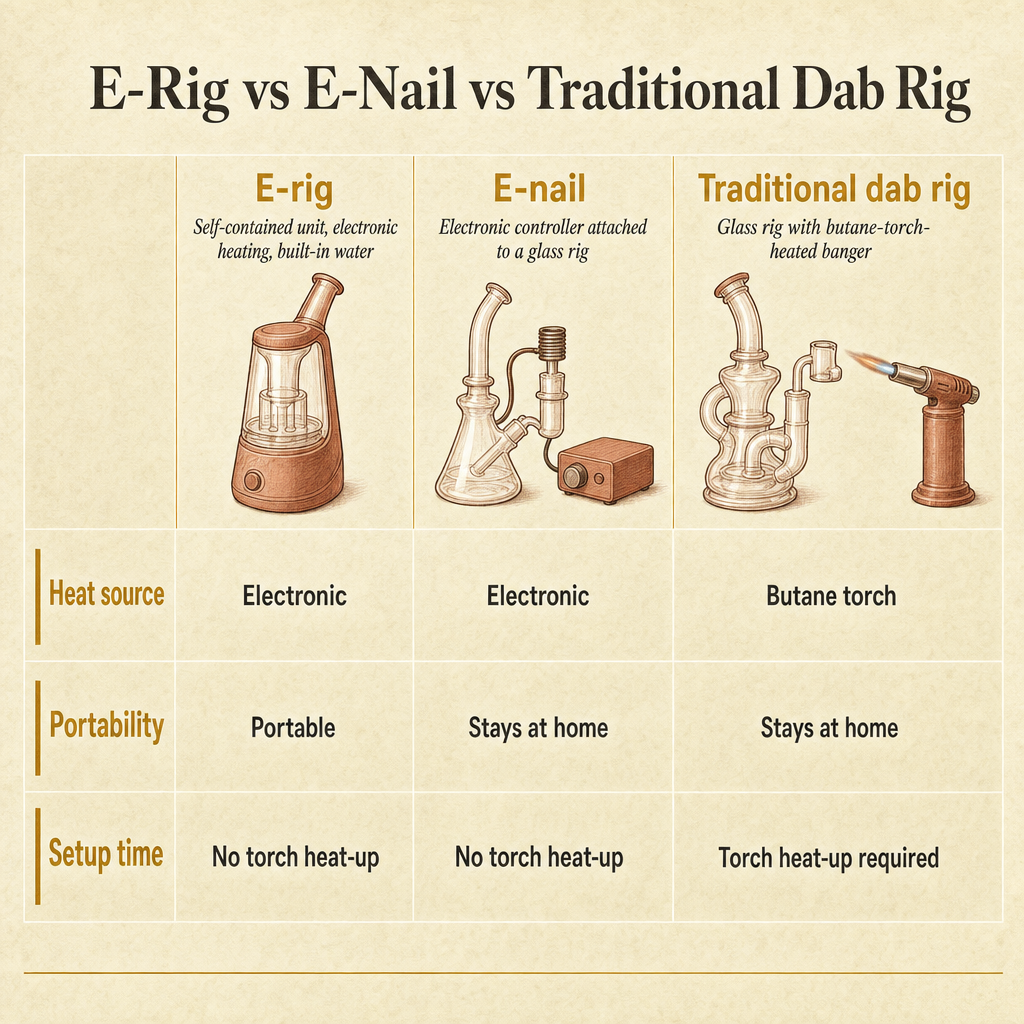
A traditional dab rig is a glass water pipe with a quartz banger or nail that you heat with a butane torch before each dab. The heat source is the torch itself, and the user controls temperature by feel and timing — heat the banger, let it cool for a few seconds, drop the concentrate on, and inhale. An e-rig replaces the torch and the manual heat-up cycle with an electronic heating chamber or atomizer built into the device. [5]
Because the heating is electronic, most e-rigs run at a steadier, more repeatable temperature than a torch-heated banger, where the actual surface temperature depends on torch flame size, hold time, and cool-down timing. That repeatability is one of the main reasons people switch from a torch setup to an electric rig. [4] [5]
Setup time also changes. A traditional dab rig means finding the torch, lighting it, heating the banger, and waiting for it to cool. An e-rig usually needs about ten to thirty seconds of preheat before the chamber is ready, depending on the model and the temperature setting. [4]
Portability is another big shift. A torch-and-glass rig is a stay-at-home setup because of the open flame and the fragile glass. Many e-rigs are designed to be carried and used away from a table, although you still need to handle the concentrate and the chamber carefully. [1] [5]
What stays the same is the basic idea — concentrate goes onto a hot surface, vapor forms, vapor passes through water on many setups, and you inhale the vapor. The water filtration, the concentrate itself, and the look of the vapor cloud are similar across both styles. [5]
Cost is worth mentioning too. A basic torch setup can be inexpensive, while a quality e-rig is usually a larger up-front purchase. Over time, an e-rig also removes the ongoing cost of butane refills, which some users find appealing. If you want a deeper look at how heat and airflow shape a concentrate session, our guide on What Do Terp Pearls Do, and How Do You Choose the Right Ones? covers how small additions to a chamber can change how vapor moves through the rig.
- Heat source — e-rig uses an electronic heating element; traditional rig uses a butane torch
- Temperature control — e-rig runs a chosen temperature through onboard controls; traditional rig relies on torch timing and feel
- Setup time — e-rig preheats in seconds; traditional rig needs torch heat-up and a cool-down window
- Portability — most e-rigs are designed to be carried; torch setups stay in one place
- Cost shape — e-rig is a larger one-time buy; torch setup is cheaper up front but needs butane refills
What Are the Main Parts of an Electric Dab Rig?
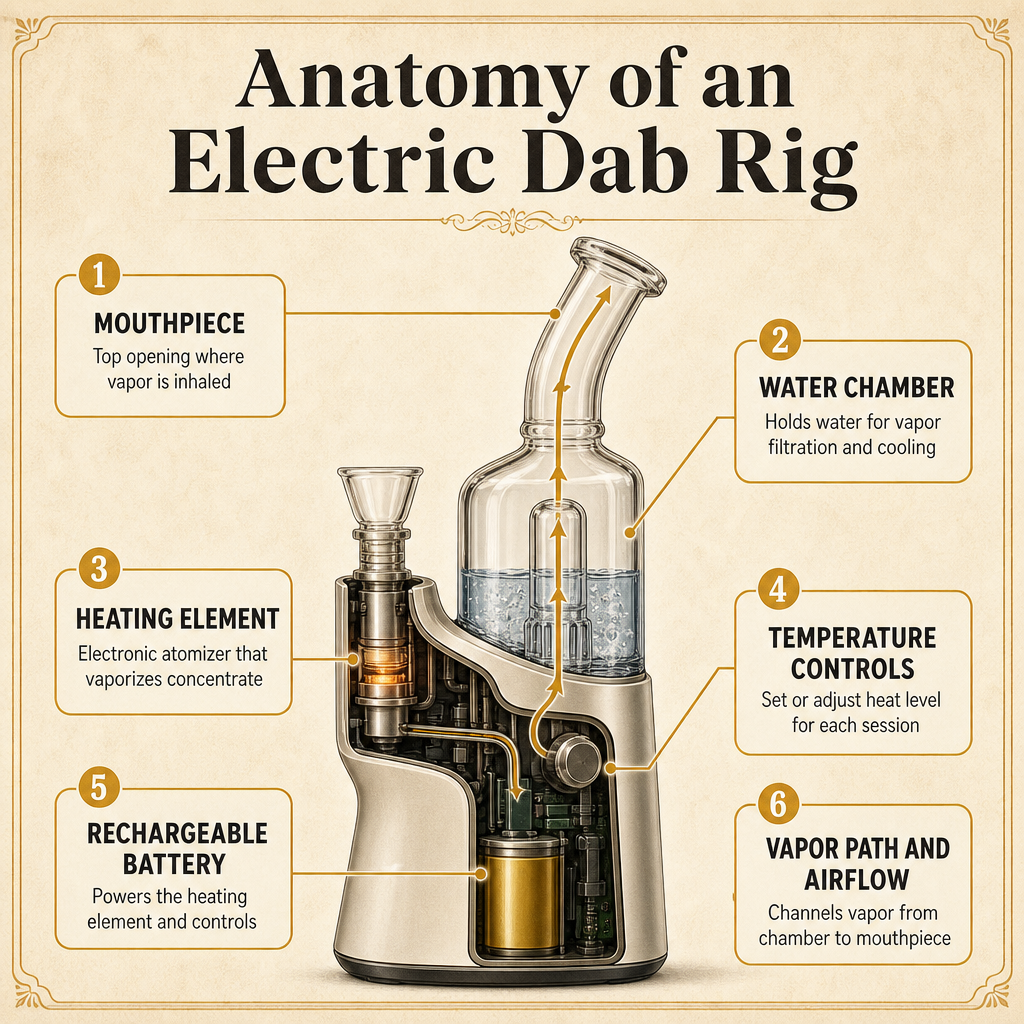
An electric dab rig looks like one piece from the outside, but inside it has a small set of parts that each do a specific job. Knowing the parts makes it easier to compare models and figure out which features actually matter for how you plan to use it. [3]
The mouthpiece sits at the top and is where the vapor is inhaled. Mouthpieces are often glass or food-grade silicone, and some models let you swap the mouthpiece for cleaning or for a different draw style. [3]
Below the mouthpiece, many e-rigs include a water chamber. The chamber holds a small amount of water that the vapor passes through before it reaches your lips. Some e-rigs skip the water chamber entirely and run dry. [4]
The heating element — sometimes called the atomizer or e-nail — is where the concentrate is vaporized. Most heating elements are ceramic or quartz, and a few high-end models use induction heating instead. The chamber sits at the base or in the center of the device, depending on the form factor. [3] [4]
Temperature controls let you pick the heat level for each session. On basic models, temperature is set with a few buttons on the device. On more advanced models, temperature and other settings are controlled through a phone app over Bluetooth. [2]
A rechargeable battery powers the heating element and the controls. Most modern e-rigs charge over USB-C, and a full charge usually covers several sessions. [9]
Finally, every e-rig has a vapor path and an airflow control of some kind. The vapor path is the internal route vapor takes from the chamber up to the mouthpiece, and airflow control adjusts how easily air moves through the device as you inhale. [4]
If you want a side-by-side look at how an e-rig’s chamber and airflow stack up against another electronic concentrate device, our guide on How Do You Choose the Right Portable Vaporizer? breaks down the parts of a portable vaporizer in the same way.
- Mouthpiece — the top opening where vapor is inhaled
- Water chamber — holds water for vapor filtration and cooling (on most models)
- Heating element or atomizer — electronic chamber that vaporizes the concentrate, usually ceramic or quartz
- Temperature controls — onboard buttons or a phone app that set the heat level
- Rechargeable battery — powers the heating element and the controls; charges over USB-C on most models
- Vapor path and airflow control — channels vapor from the chamber to the mouthpiece and adjusts draw resistance
How Does an E-Rig Heat Concentrates Without a Torch?
The most common heating approach in an e-rig is a built-in electronic atomizer or heating chamber. When you press the button to start a session, current flows from the battery into a small resistive element inside the chamber. That element heats up, the chamber reaches the temperature you set, and the concentrate vaporizes on contact when it lands on the hot surface. [4]
Inside those electronic chambers, the surface the concentrate touches is usually ceramic or quartz. Ceramic holds heat evenly across the surface and tends to be a bit more forgiving about minor temperature swings. Quartz heats and cools faster and is the same material many traditional bangers are made of. [3]
A smaller group of e-rigs uses induction heating instead of a resistive element. Induction heating works by running alternating current through a coil, which generates a magnetic field. That field induces eddy currents in a metal insert sitting inside the chamber, and the resistance of the metal to those currents produces heat. The metal insert gets hot, and the concentrate vaporizes on that surface. [6]
Induction setups are often paired with sensors that watch the chamber temperature in real time. The sensor feeds back to the controller, which adjusts power to the coil to hold the chosen temperature through the whole session. That real-time control is one of the reasons induction e-rigs can hold a steady temperature from the first second of a dab to the last. [9]
Why does the type of heating matter? Two reasons. First, a steady chamber temperature means the concentrate is exposed to a consistent level of heat, which makes each session behave more like the last. Second, the heating element itself is one of the parts you replace over time, so knowing whether a model uses a standard atomizer, a quartz cup, or an induction insert tells you what kind of replacement parts you will be looking for later. [4] [9]
If you want a deeper look at how vapor moves through a water chamber once it leaves the heating element, our guide on What Is a Recycler Bong and How Does It Work? walks through how recycler-style airflow paths work in a glass rig.
- Electronic atomizer — current flows from the battery into a resistive element that heats the chamber
- Ceramic surface — heats evenly and is more forgiving of small temperature swings
- Quartz surface — heats and cools quickly; matches the material used in traditional bangers
- Induction heating — a coil-driven magnetic field induces eddy currents in a metal insert, producing heat from the metal’s own resistance
- Real-time temperature control — sensors read the chamber and adjust power to hold the set temperature through the session
What Is the Difference Between an E-Rig and an E-Nail?
An e-nail, short for electronic nail, is a small electronic controller that attaches to a traditional glass dab rig. It replaces the torch by clamping onto or sliding into a banger or nail and heating that surface electronically. The banger, the rig, the water chamber, and the mouthpiece are all the same as a torch setup — only the heat source changes. [5]
An e-rig, by contrast, is a fully self-contained electronic device. The heating element, the chamber, and on most models the water filtration are all built into one unit. There is no separate glass rig and no separate heating controller — everything needed for a session is inside the device. [1] [4]
In practice, that means an e-nail upgrades a torch setup in place, while an e-rig replaces the torch setup entirely. If you already own a glass rig that you like, an e-nail lets you keep using it and skip the torch. If you would rather have one device that does everything, an e-rig is the simpler path. [5]
Portability is another difference. E-nails are tied to a power source or a large battery and a stationary glass rig, so they are usually a stay-at-home option. Most e-rigs are designed to travel and can run for several sessions on a single charge, which makes them more flexible for use away from a table. [5] [4]
Setup time and learning curve also differ. An e-nail takes a bit of practice to attach to a banger and to dial in a temperature, but it gives you the full glass-rig experience with electronic heating. An e-rig is usually simpler to get started with because there is no assembly — you fill the water chamber, drop the concentrate on the hot atomizer, and inhale. [3] [5]
If you are shopping and want to see the current lineup of self-contained electronic units, the Electric Rigs page on our site collects e-rigs in one place so you can compare form factors, chamber materials, and price points side by side.
- E-nail — an electronic controller that attaches to a traditional glass dab rig and heats an existing banger or nail
- E-rig — a fully self-contained electronic device with its own built-in heating element and, on most models, water filtration
- What each replaces — an e-nail replaces the torch; an e-rig replaces the torch, the banger, and often the separate rig
- Portability — e-nails stay put; most e-rigs are designed to travel
- Best for — e-nail suits someone who already owns a glass rig; e-rig suits someone who wants one device for everything
What Types of Cannabis Concentrates Can You Use in an E-Rig?
A concentrate is a cannabis extract that condenses the plant’s cannabinoids and terpenes into a more potent form. A dab is a small amount of that concentrate, and dabbing is the act of vaporizing a dab on a hot surface and inhaling the resulting vapor. E-rigs are designed to dab any of the common concentrate types. [7]
Concentrates come in two broad families. Solventless concentrates are made without chemical solvents, using only heat and pressure. Rosin is the most common solventless concentrate, made by applying heat and pressure to cannabis flower or hash. [8]
Solvent-based concentrates are made using a solvent — usually a hydrocarbon like butane or propane — to extract cannabinoids and terpenes from the plant material. After extraction, the solvent is purged from the final product. Common solvent-based concentrate categories include live resin, badder or budder, shatter, crumble, sauce, and crystalline. [8]
Different concentrates have different textures, and that texture matters for how they sit on a heated chamber. Thicker, waxier concentrates like badder, budder, and crumble tend to stay put on the chamber once you drop them on the surface. Runnier textures like live resin and sauce can spread across the chamber as they warm up, which is normal for those forms. [8]
Shatter is hard and glass-like, so it usually needs a dab tool to break off a piece. Crystalline is the most solid form and looks like coarse sugar or small crystals. Both still vaporize at the same chamber temperatures as softer concentrates — the only difference is how you handle them before they land on the surface. [8]
The one accessory every e-rig user ends up needing, no matter which concentrate they use, is a good cleaning routine. Concentrate residue builds up on the chamber and inside the vapor path over time, and most manufacturers recommend an isopropyl alcohol soak for the chamber and accessories on a regular schedule. Our Formula 420 Cleaner – A2 product page is a good starting point if you want to pick up a cleaning solution designed for concentrate gear.
- Rosin — solventless concentrate made with heat and pressure
- Live resin — solvent-based concentrate made from fresh-frozen cannabis flower
- Badder or budder — soft, creamy solvent-based concentrate
- Shatter — hard, glass-like solvent-based concentrate that breaks off in sheets
- Crumble — drier, flaky solvent-based concentrate
- Sauce — solvent-based concentrate with a runny, terpene-rich texture
- Crystalline — solid solvent-based concentrate in coarse crystal form
What Features Should You Look for When Choosing an E-Rig?
Once you understand the parts and how the heating works, the next step is matching features to how you actually plan to use the device. A short checklist of the most useful features makes it easier to compare models side by side. [2] [4]
Real-time temperature control is the first feature to look for. Some e-rigs set a target temperature and let the chamber drift a bit during a session. Models with real-time control use a sensor inside the chamber to read the actual temperature and adjust power on the fly, which holds the chosen heat level from start to finish. [2] [9]
Customizable heat profiles let you save more than one temperature and switch between them. Lower temperatures are useful for flavor-focused sessions, and higher temperatures are useful for thicker concentrates that need more heat to vaporize fully. App-connected models let you fine-tune profiles from a phone, while simpler units offer a few preset heat levels through onboard buttons. [2]
Chamber material — ceramic or quartz — shapes how the chamber heats and how it wears over time. Ceramic tends to be more forgiving of minor temperature swings, while quartz heats and cools faster. Both work well; the right choice is mostly a feel preference. [4]
Charging and battery life matter for portable use. USB-C charging is now standard on most modern e-rigs, which means you can use the same cable you already charge a phone or a laptop with. Battery life is usually listed as a number of sessions per charge — anywhere from about ten to forty sessions depending on the model and the temperature setting. [9]
Water filtration is a feature to think about, not a given. Some e-rigs have a built-in water chamber, some have a removable glass bubbler attachment, and some run dry. If you prefer cooled, filtered vapor, make sure the model you are considering includes water filtration of some kind. [4]
Finally, app support and onboard controls both work, but they feel different in daily use. App-connected models let you change temperature profiles, session length, and sometimes light settings from a phone. Onboard-only models are simpler and don’t need a phone nearby. Either is fine — pick the one that matches how you plan to use the device. [2] [9]
If you are weighing an e-rig against a different style of electronic vaporizer and want to see what features carry over, our Desktop Vaporizers page collects desktop vaporizers in one place so you can compare chamber size, controls, and price points.
- Real-time temperature control — sensor-based control that holds the chosen heat through the session
- Customizable heat profiles — save and switch between multiple temperature settings
- Chamber material — ceramic for even heat or quartz for faster heat-up and cool-down
- USB-C charging and sessions per charge — modern charging standard plus a session count that fits your use
- Water filtration — built-in chamber, removable bubbler attachment, or dry-only design
- App support vs onboard controls — phone app for fine-tuning, or onboard buttons for simple operation
Frequently Asked Questions
What is an e-rig and how is it different from a traditional dab rig?
An e-rig is a battery- or electricity-powered device that vaporizes cannabis concentrates using a built-in electronic heating element instead of a butane torch. A traditional dab rig uses an open flame to heat a quartz banger, which means the user controls temperature by timing the heat cycle. An e-rig replaces that manual step with an electronically controlled atomizer or heating chamber, which is why most e-rigs run at a steadier, more repeatable temperature.
What are the main parts of an electric dab rig?
Most electric dab rigs combine a mouthpiece, a water chamber for filtration, a heating element or atomizer (often ceramic or quartz), a rechargeable battery, temperature controls, a vapor path, and airflow control. Higher-end models add features like real-time temperature sensors, customizable heat profiles, and USB-C charging.
How does an e-rig heat cannabis concentrates without a torch?
An e-rig uses a built-in electronic heating element to bring its chamber up to a chosen temperature, then vaporizes the concentrate on contact when it lands on the hot surface. Most e-rigs use a standard electronic atomizer or heating chamber, while some models use induction heating — a coil-driven magnetic field that induces eddy currents in a metal insert to produce heat from the material’s own resistance.
What is the difference between an e-rig and an e-nail?
An e-nail is an electronic controller that attaches to a traditional glass dab rig and heats an existing banger or nail. An e-rig is a fully self-contained electronic device with its own built-in heating element and, on most models, its own water filtration. In short, an e-nail upgrades a torch setup; an e-rig replaces the torch setup entirely.
What types of cannabis concentrates can you use in an e-rig?
An e-rig works with most cannabis concentrates, including solventless forms like rosin and solvent-based forms like live resin, badder or budder, shatter, crumble, sauce, and crystalline. Thicker concentrates like badder and live resin are common picks because they handle cleanly on a heated chamber without running off the surface.
What should I look for when choosing an e-rig?
Focus on the features that match how you actually use it: real-time temperature control and customizable heat profiles, chamber material (ceramic or quartz), USB-C charging, sessions per charge, and whether the unit has built-in water filtration. App-connected models let you fine-tune temperature and session length from a phone, while simpler units rely on onboard controls.
Is an E-Rig the Right Choice for Your Concentrate Setup?
An e-rig boils the dab-rig experience down to one self-contained device — a rechargeable battery, an electronic heating element, temperature controls, and on most models a built-in water chamber — so the whole session runs through a single unit rather than a torch, a banger, and a separate rig. For most beginners and many experienced concentrate users, that means a shorter setup, a more repeatable chamber temperature, and a portable form factor. [1] [4]
If you already own a glass rig you love and just want to skip the torch, an e-nail is the smaller upgrade. If you want one device for everything and value portability, an e-rig is the simpler choice. Either way, the same concentrate categories work — rosin, live resin, badder, shatter, crumble, sauce, and crystalline — and the same cleaning routine applies once you start using the chamber regularly. [5] [8]
The shopping checklist is short: real-time temperature control, customizable heat profiles, ceramic or quartz chamber material, USB-C charging, water filtration if you want cooled vapor, and either app support or onboard controls depending on how you like to set up a session. Picking the model that matches those features — instead of chasing the spec sheet — is what makes the device feel right in everyday use. [2] [9]
Sources
- Puffco: What is an E-rig & Are E-rigs Worth It?
- Puffco: Puffco Peak Pro 3DXL: Premium Bluetooth Dab Rigs
- HEMPER: What is an Electric Dab Rig or E-Rig: Key Benefits
- Focus V: Best Electric Dab Rigs: How to Choose the Right E-Rig in 2026
- Badass Glass: E-Rig vs Dab Rig: Which is Right For You?
- Dr. Dabber: How Does Induction Heating Work in Vaporizers?
- UCLA Center for Cannabis and Cannabinoids: Terminology
- Weedmaps: What is a Weed Concentrate? Cannabis Concentrates Guide
- Dr. Dabber: Dr. Dabber Switch²