

Wig wag glass is a decorative color pattern worked into glass, not a type of pipe. Two or more colors are laid into interlocking wave, zig-zag or ribbon stripes that seem to move as you turn the piece. The pattern sits inside the glass wall under a smooth clear outer layer, so it is not a coating that wears off.
That construction is also why a wig wag piece costs more than a plain clear one. Patterned tubing is a hand-made material bought by weight, the reversal step is unforgiving handwork, and how much of the piece is covered drives how much of both gets used up.
This guide covers what the pattern actually is, how a glass worker builds it, how to tell worked color from a printed decal, and what a fair price gap looks like between one wig wag pipe and the next.
What Is Wig Wag Glass, Exactly?
Wig wag glass is color work, not a shape. Glass workers take two or more colors and work them into interlocking waves, zig-zags or ribbon stripes that appear to shift as the piece turns in your hand. [3]
The pattern normally sits inside the wall of the glass, beneath a smooth clear outer layer. That is the detail that matters most when you are holding a piece in a shop. The color is part of the glass itself, which is why the pattern cannot peel, rub off or fade from handling the way a surface treatment can. [1]
Because the word describes decoration rather than a shape, the same pattern shows up on very different objects. A small spoon, a curved sherlock, a hammer bubbler and a tall beaker can all wear it. When you browse Glass Hand Pipes or Glass Bongs, you are choosing a form first and a decoration second, and the two decisions are separate. A curved neck is a shape question, which is why What Is a Sherlock Pipe and How Does the Curved Shape Work? is a useful read before you commit to a pattern. [2]
- Interlocking waves. The stripes bend back and forth in repeating curves and meet cleanly at each turn, which is the feature most people picture when they hear the term. [3]
- Sharper zig-zag sections. Some blowers pull the twist tighter, so the pattern reads as an angular staircase instead of a soft wave.
- Ribbon stripes. Wide bands of color alternate with narrow ones, giving the section a layered look rather than a flat printed appearance.
- An almost Op-Art shimmer. The lines seem to drift as the light angle changes across the piece, which is a side effect of the pattern curving through the wall. [2]
- No two sections repeat exactly. Each one is hand work, so the wave spacing, the color order and the number of bands differ slightly from piece to piece. [2]
Is Wig Wag the Same Thing as Reversal Glass?
The trade does not fully agree here, and three widely cited references nest the words three different ways.
AFM Smoke takes the strictest line: all wig wag is reversal, but not all reversal is wig wag. In that framing, reversal is the method, meaning you pattern a tube of layered color and then flip the section inside out, and wig wag is one pattern you can build with it alongside straight-line reversals and spirals. [1]
Mile High Glass Pipes nests it the other way around. Its glossary puts reversal glass in the headline position, describes it as a striped zig-zag pattern with a spiral at each end, and then adds that the style is also a form of linework known as a wig-wag. [3]
Headshop.com goes the other direction again. It uses wig wag as the umbrella term and describes colors that are layered and then pulled back and forth with a pick or rod, without requiring the reversal step at all. [2]
The drift reaches the storefront too. A catalog search for one spelling and a search for a variant can return different results, so it is worth trying both before you decide a shop does not carry the pattern. [9]
None of this is a scam; it is normal vocabulary drift in a craft trade. Read the description, not just the label. If you want the build side of the swirl in detail, How Is the Swirl Pattern on a Linework Glass Pipe Actually Built? covers it. Fumed work is a separate tradition with its own rules, and Why Does a Fumed Glass Pipe Change Color? explains why those pieces change color. Surface etching is another sibling treatment, covered in How Is an Etched Glass Pipe Made, and What Does the Pattern Actually Change?. Round chambers come up often in pattern shopping too, and What Is a Ball Water Pipe and Why Does the Round Chamber Feel Different? covers that shape.
- AFM Smoke. Reversal is the method; wig wag is one pattern made with it, so every wig wag is a reversal but not every reversal is a wig wag. [1]
- Mile High Glass Pipes. Reversal glass is the headline term, defined as striped zig-zag color with a spiral at each end, and wig wag is listed as a synonym. [3]
- Headshop.com. Wig wag is the main term and the description focuses on layered color pulled back and forth, with no reversal requirement. [2]
- Linework. Both glossaries tie the pattern back to linework, the base technique of laying parallel colored rods onto a clear tube.
- Catalog drift. Searching one spelling can surface products the other spelling misses, so compare both before assuming a shop has nothing. [9]
How Is a Wig Wag Pattern Actually Made?
The build runs in a fixed order, and each step narrows the margin for error a little further. What follows is the sequence as trade sources describe it, not a shortcut version.
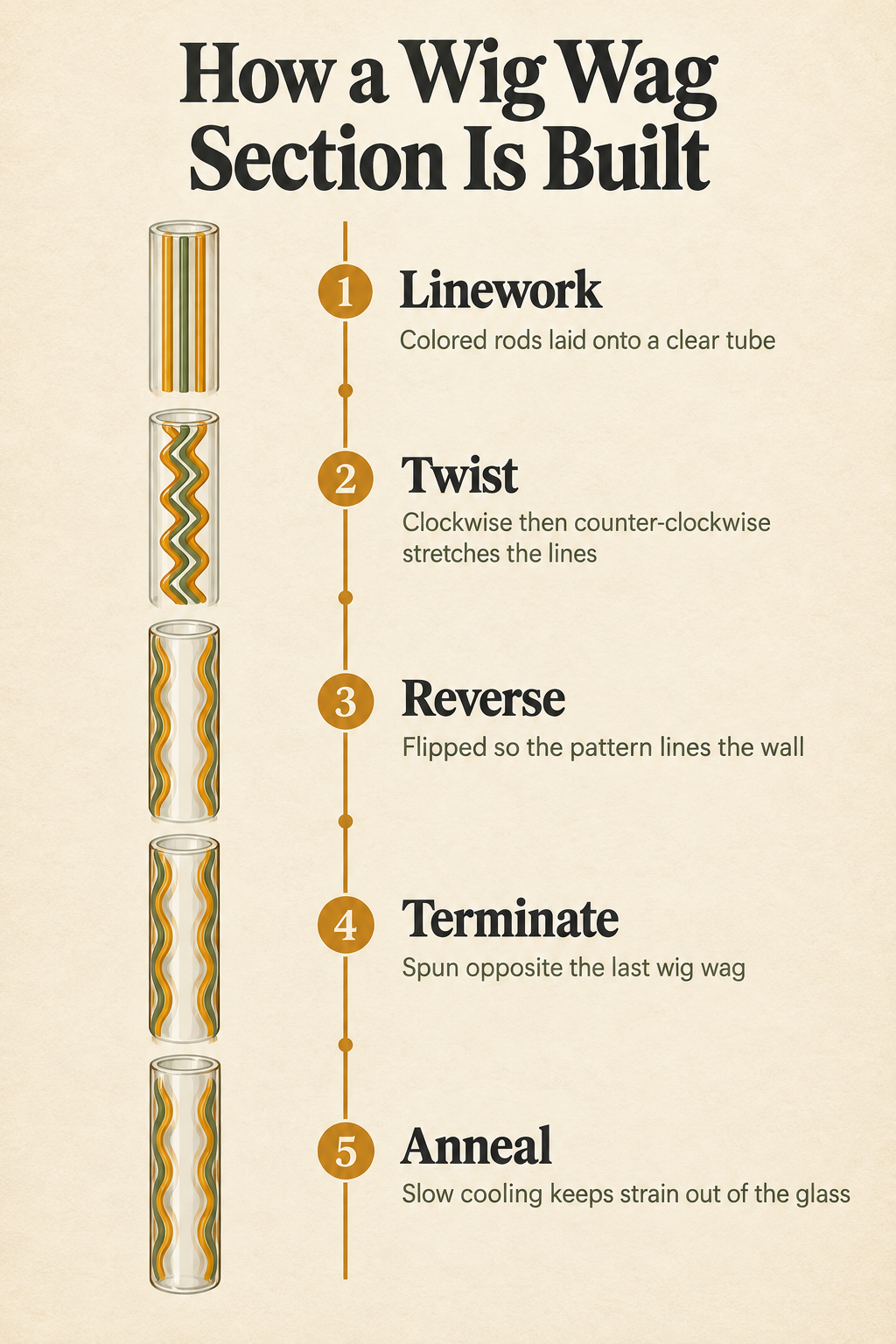
It starts with linework. Colored rods are laid in parallel onto a clear tube so the tube carries even stripes down its length. At this stage the piece looks striped, not wavy. [1]
Then comes the twist. The blower heats a narrow band of the striped tube and spins it clockwise, then counter-clockwise. That back-and-forth stretch is what turns straight lines into a wave or a zig-zag, and it is the move that gives the pattern its name. [1] A working tutorial on the same step stresses using a small flame and just enough heat to move the glass, since overheating smears the colors before the shape ever forms. [6]
The reversal is the step that separates true reversal work from surface decoration. The patterned section is heated, sealed and physically flipped inside out, so the color that sat on the exterior now lines the interior and shows through a smooth clear outer wall. [1] That is why the pattern on a good piece looks suspended rather than applied.
This is also where pieces are lost. AFM describes the margin bluntly: one uneven pull, one hot spot, and hours of linework smear with no way to undo it. [1] A blower cannot patch a bad reversal, only start over.
The twist itself is an old idea rather than a modern shop invention. The Corning Museum of Glass defines zanfirico as a bundle of colored rods heated soft, drawn out and twisted at the same time to produce a spiral pattern, a technique revived on Murano in the 1830s. [4] Same mechanism, different century and different object.
The last step is annealing, the slow kiln cool that lets the finished piece come down to room temperature without locking in strain. [5]
In order, the build looks like this:
- Build the linework. Parallel colored rods are laid onto a clear tube, leaving even stripes of color running its length. [1]
- Heat a narrow band. A small flame warms one section at a time, using just enough heat to move the glass without washing out the color. [6]
- Twist one way, then back. Spinning the striped tube clockwise and then counter-clockwise stretches the straight lines into waves or zig-zags. [1]
- Reverse the section. The patterned piece is heated, sealed and flipped inside out so the color lines the interior of the wall under clear glass. [1]
- Terminate the end. The finish is spun opposite the direction of the last wig wag so both ends read evenly instead of stair-stepping.
- Anneal slowly. The completed piece cools in a kiln so it reaches room temperature without built-in strain. [5]
Is the Wig Wag Pattern Worked Into the Glass or Printed On?
Both exist, and the price gap between them is large. Worked color is glass that was patterned and reversed inside the wall. A print or decal is a design applied to the outside of a finished clear body. [1]
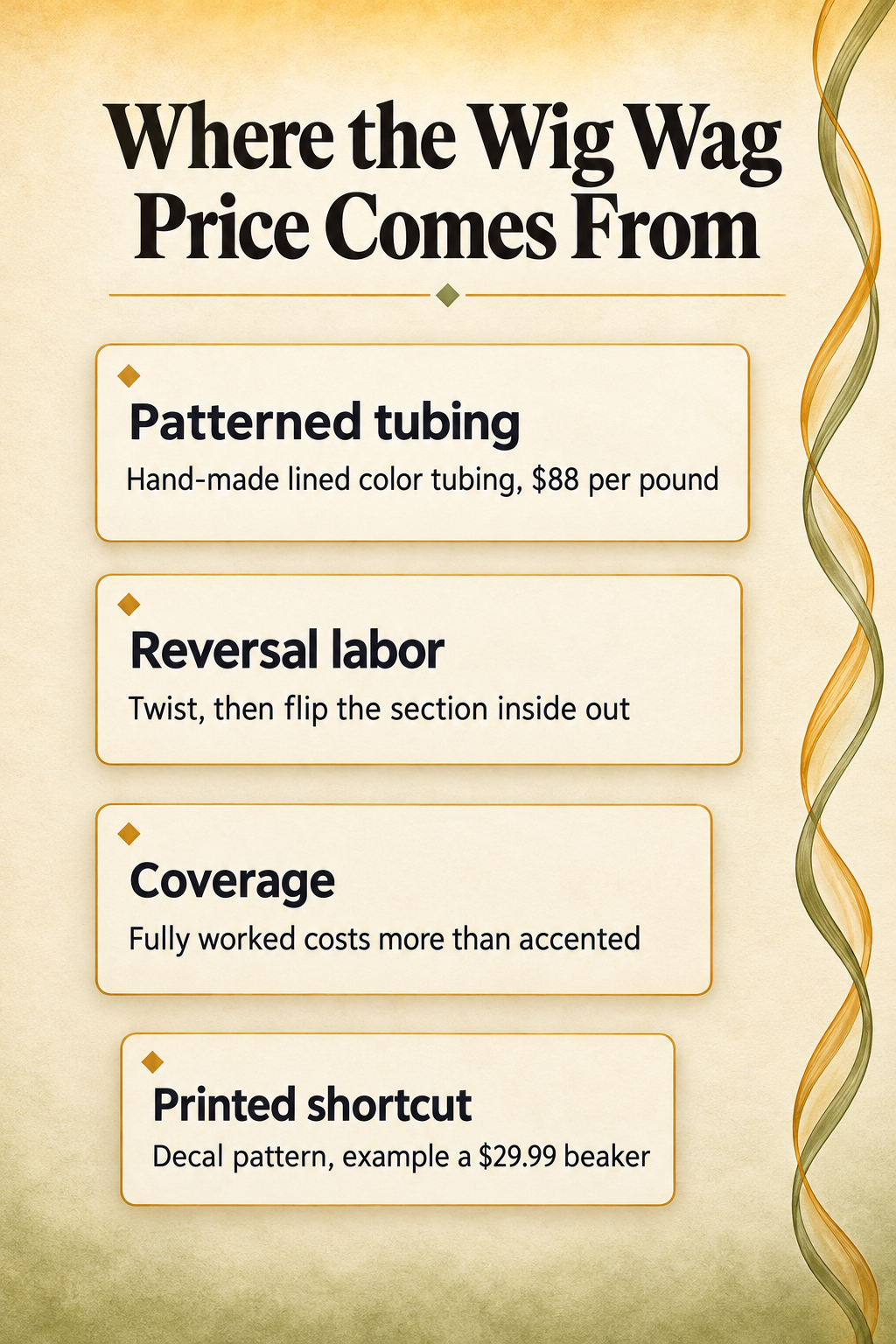
Some listings are clear about which one you are getting. Pulsar describes its SeshGear Technicolor Wig Wag Beaker Bong, listed at $29.99, as clear borosilicate with psychedelic decals of wig wag patterning on the neck, joint and base. [8] That is a printed pattern on a clear body, stated in the manufacturer’s own copy. Headshop.com separately carries a Wig Wag Colorful Print Glass Hand Pipe at $19.99, again labeled as a print. [2]
This matters most when you compare prices. A $29.99 decal beaker and a $119 reversal beaker are not the same product at two prices; they are two different products that share a pattern name. Neither one is dishonest, as long as the listing says which it is. If the description is vague, read the wording closely, because it usually settles the question in one pass. [1]
Reading the description is the whole test. These are the phrases that separate the two categories:
- Decal, print or graphic wording. Words like decals, print, printed pattern or graphic point to a design applied on the surface rather than worked into the wall. [8]
- Clear body plus decoration. If the copy describes a clear borosilicate body with patterning added on the neck, joint and base, the body itself is not patterned. [8]
- Reversal, lined tubing or worked color. These terms point to color built into the wall and turned inside out during the build. [1]
- Coverage language. Fully worked versus accented tells you how much of the piece carries worked color, which is a different question from how much carries ink. [2]
- A price that looks too low for the coverage. Full reversal work on a large water pipe sits near the top of the market ladder; a printed piece of the same size does not. [2]
Why Does a Wig Wag Pipe or Bong Cost More?
Five things move the price, and only one of them is the pattern itself. Ranked by how much they typically matter:
Patterned tubing is a purchased raw material. This is the part shoppers rarely think about. Blowers buy hand-made lined borosilicate tubing by weight before any patterning work starts. One supplier lists vac-stack lined tubing in COE 33, made with American color and German clear, in 15mm to 26mm outside diameter and roughly 12-inch lengths, at $88 per pound or $5.50 per ounce. [7] A larger-diameter piece simply consumes a bigger share of an expensive material.
Reversal labor is slow and it fails. Twisting and flipping a section takes practice, and a single overheated spot can wipe out hours of linework with no undo. [1]
Failed attempts end up inside the prices of the pieces that survive. That is not a markup so much as arithmetic: a blower who loses one section in three has to cover the three attempts when one sells.
Coverage decides how much of everything gets used. Fully worked means the pattern runs across the whole piece; accented means it appears on the mouthpiece, base or a single section. Trade guides put it simply: both look good, and fully worked costs more. [2]
Color density adds labor and glass on top of coverage. Tight, dense patterns with saturated color take more material and more torch time than open ones. [2]
You can see all of this in the market spread. On one retailer’s wig wag collection the ladder runs from a $12.99 dichro slide and a $19.99 printed hand pipe up through a $79.99 beaker and a $99.00 egg rig to reversal water pipes at $119.00 and $200.00. [2] The cheap end is small, printed or single-accent work. The expensive end is full reversal work on a large body.
Our own catalog follows the same curve. In-stock wig wag pieces run from a $21.99 hole hand pipe and $23.99 spiral and spoon hand pipes, through a $49.99 sherlock and a $59.90 Grateful Dead x Pulsar hammer bubbler, up to a $79.99 Sentience beaker and a $99.00 Calibear egg rig. [9] For scale, the lowest-priced plain glass spoon in the hand pipe category is $7.90, so the cheapest patterned hand pipe costs roughly three times as much. That ratio is the honest summary of this whole article. If you are weighing forms against budgets, the Bubblers range is where the middle of the price ladder tends to sit.
- Patterned tubing. Hand-made lined color tubing, bought by weight before any torch work starts. [7]
- Reversal labor. Twist, heat, seal and flip the section, with no way to undo a bad pull. [1]
- Lost attempts. Ruined sections are paid for by the ones that survive, so part of the price is the failure rate.
- Coverage. Fully worked uses far more material and torch time than an accent on the mouthpiece or base. [2]
- Color density. Tight, saturated patterns require more labor and glass than open ones. [2]
Which Pipe and Bong Styles Come in Wig Wag?
The pattern is applied to a form, so the real question is which forms blowers tend to decorate. In practice, most of the familiar categories show up.
Hand pipes are the widest entry point. Spoons and hole pipes are the most common, and they are where the pattern is cheapest to see in person because the surface is small and easy to read. [9]
Curved and angled forms follow. A sherlock gives the pattern a long neck to run along, and a hammer bubbler puts the work on a body with a bend in it, so the waves have somewhere to travel. [9]
Water pipes are where full reversal work concentrates. Beakers are the classic canvas, and egg rigs and percolator pieces carry the pattern on a rounder shell. Trade references list bongs and water pipes as the product types that carry the pattern, which matches what is on shelves. [3]
Small accessories carry it too. Slides, dab marbles and matching sets get a single accented section rather than full coverage, which is why they sit at the low end of the ladder. [9]
If you are ordering online, free shipping on orders $150+ applies, so a patterned beaker plus a spare slide can arrive in one shipment. Check joint size and height before you buy, since the pattern tells you nothing about fit.
- Spoon and hole hand pipes. The most common and least expensive way to own the pattern, with the waves running along a short body. [9]
- Sherlocks. The curved neck gives the pattern a longer run and puts the color work where your hand sits. [9]
- Hammer bubblers. An angled body with a chamber, so the pattern follows the bend rather than a straight tube. [9]
- Beaker water pipes. The classic full-coverage canvas, and where most reversal work on a large body appears. [2]
- Egg rigs and percolator pieces. Rounder shells that show the pattern curving across the surface as it turns. [9]
- Slides, dab marbles and small sets. Accented rather than fully worked, which keeps them at the entry end of the price range. [9]
How Do You Spot Well-Made Wig Wag Work?
Line count is the most popular test and the least reliable one. A denser pattern does not automatically mean better work, because tubing diameter does a lot of the work on its own.
A working tutorial is explicit about this. The blower prefers his method because he can get really tight wig wags, then adds the caveat that the smaller the tubing diameter, the tighter the wig wags will be. [6] So a small piece will read as tight even when the work is routine, and a large piece can be well executed and still look comparatively open. Judging density without knowing the diameter is comparing apples to oranges.
What actually separates good work from rushed work is consistency, the ends, the color and the heat history.
The ends are a visible tell. A tutorial on the bender-back reversal says the termination should be spun opposite the direction of the last wig wag, because going with it produces a stair-step effect. [6] A deliberate, even finish on both ends reads as control. A lopsided one reads as a shortcut.
Color condition is the second tell. Smeared, washed-out or muddy sections usually mean the glass was overheated during the twist. The same tutorial repeats the warning not to heat the glass too much, just enough to bend it. [6] Overheating is invisible in a photo and obvious in a hand.
Heat history is the tell you cannot see at all. Glass that cooled too fast carries strain and may break as it cools or later on, and strained glass breaks more easily under mechanical or thermal shock. [5] Two pieces can look identical on a shelf and behave very differently in a sink.
Here is a practical order of inspection:
- Check symmetry first. Look at whether the waves repeat evenly on both sides of the piece, not at how many lines there are.
- Weigh density against diameter. A tight pattern on a small tube is expected; on a wide tube it means something. [6]
- Inspect both ends. The termination should be spun opposite the last wig wag and look even, without a stair-step run. [6]
- Look for smeared or washed-out color, which points to overheating during the twist. [6]
- Ask whether the piece was kiln annealed. Slow cooling is a structural marker and not a cosmetic one. [5]
- Confirm coverage and fit. Note whether the work is fully worked or accented, then check joint size and height separately. [2]
How Do You Clean and Care for a Wig Wag Piece?
Routine cleaning is the same as for any borosilicate piece, and the pattern itself does not need special handling. Trade care guidance is isopropyl alcohol plus coarse salt, a rinse and a full dry. [1]
The reason the pattern is not a cleaning concern is where it lives. Because the color is sealed inside the wall under clear glass, ordinary cleaning never reaches it, so there is nothing to scrub around or work loose. [1]
Two handling risks do deserve attention, and neither has anything to do with the decoration. The first is alcohol vapor. Isopropyl alcohol has a flash point of 53 degrees Fahrenheit, or 12 degrees Celsius, per the National Toxicology Program record, which means it gives off ignitable vapor at ordinary room temperature. [10] Clean away from any flame or heat source and let the piece air dry completely before you use it again.
The second is thermal shock. Thick colored glass holds heat unevenly, so sudden temperature swings are the thing to manage. Glass carrying strain breaks more easily under thermal shock [5], and shop guidance gives the rule in plain terms: do not pour boiling water into a cold piece, and let hot glass cool before a cold rinse. [1]
In order, a careful routine looks like this:
- Fill with isopropyl alcohol and a spoonful of coarse salt, then shake gently so the salt works the corners. [1]
- Pour the alcohol out and rinse with warm water, not hot and not cold, to stay clear of a temperature jump.
- Shake out as much water as you can and let the piece air dry fully before storing or using it.
- Do the whole job away from open flame, pilot lights and heat sources, since alcohol vapor ignites at room temperature. [10]
- Bring the piece up and down in temperature gradually, and never pour boiling water into cold glass. [1]
Frequently Asked Questions
Is wig wag glass just linework under a different name?
Not quite. Linework is the starting point, where parallel colored rods are laid onto a clear tube. Wig wag adds the twist that stretches those lines into a wave or zig-zag, and usually the reversal that turns the pattern inside the wall. Trade glossaries nest the words differently, and some use reversal glass as the headline term with wig wag as a synonym.
Does a wig wag pattern change how a piece hits?
No. The pattern is decoration. Draw and diffusion come from the shape of the piece, its percolator and how thick the glass is built. A patterned beaker behaves like the beaker it was made on, so when two pieces feel different, compare geometry and wall thickness rather than the color work.
Is a printed wig wag bong the same as a worked one?
They are different products. A decal or print sits on the outside of the glass, while reversal work sits inside the wall beneath a clear outer layer. Some manufacturer listings say outright that the patterning is a decal, so reading the description tells you which construction you are being offered before you compare prices.
Is wig wag glass more fragile than plain borosilicate?
The color work is not the weak point; heat history is. Glass cooled too quickly carries strain and breaks more easily under mechanical or thermal shock. That is why slow annealing matters on any heavily worked piece, and why sudden temperature swings are the thing to avoid no matter what pattern is on the outside.
Why do two wig wag pieces with similar patterns cost different amounts?
Coverage, technique and material. A single accented section uses far less patterned tubing and torch time than a fully worked body, and dense saturated color takes more labor and glass. Reversal work also carries real failure risk, and the cost of ruined attempts ends up inside the price of the pieces that survive.
So What Should You Take Away Before You Buy?
Wig wag is a decoration with a construction method behind it. The color is worked into the glass, twisted into waves and usually reversed so it sits inside the wall under a clear outer layer. That is why it cannot wear off, and it is also why it costs what it does.
Before you buy, settle four things. Confirm the pattern is worked color rather than a print or decal. Note whether the piece is fully worked or only accented. Check that the waves look even on both sides and that the ends finish cleanly. Then look at the shape itself, because the shape and the percolator set the function and the pattern does not.
Price gaps are usually explaining something real. A piece that costs three times a plain spoon is telling you it used patterned tubing bought by weight, torch time that cannot be rushed, and coverage that runs across the whole body. If a listing is vague about which of those you are paying for, ask before you check out.
Sources
- AFM Smoke: What Is Reversal Glass? Wig-Wag and Fume Work Explained
- Headshop.com: Wig Wag Glass Pipes, Bongs & Dab Rigs
- Mile High Glass Pipes: Smoke Shop Dictionary — 72+ Headshop Terms Defined
- Corning Museum of Glass: Zanfirico — Glass Dictionary
- Corning Museum of Glass: Annealing — Glass Dictionary
- Elev8 Premier Glass Blowing Studio and School: Learn how to make a bender back switch ball reversal with lined tubing
- Colorado Color Company: Area 51 — Vac Stack — Borosilicate Glass — COE 33 — Lined Tubing
- Pulsar: SeshGear Technicolor Wig Wag Beaker Bong
- Treehouse Lifestyle: WooCommerce Store API — product search "wig wag"
- National Institutes of Health — PubChem: Isopropanol (CID 3776) — Flash Point