

A fumed glass pipe changes color because of a thin metal film, not the glass itself. During blowing, silver or gold is vaporized and the hot glass is passed through it, leaving a layer only nanometers thick. That film sits near the thickness of visible light, so reflected light favors some colors over others. Residue behind it deepens the effect, and cleaning fades it back. [1][3][4][13]
What Is a Fumed Glass Pipe?
A fumed glass pipe is a glass piece that carries a thin metal film laid down while the glass is still on the torch. The film is not paint, not a spray coating, and not a decal. It is metal vapor that condensed onto hot glass and stayed there. [1]
The metals are precious ones. Workers use .999 fine silver most often and 24-karat gold for warmer work, and platinum turns up in older descriptions of the technique. The metal is heated until it vaporizes, and the glass is turned through the plume so the vapor lands evenly. [3][6]
In hand, a new fumed piece does not look like a rainbow. It looks faintly golden, silvery, or hazy. The iridescence becomes obvious only once the piece has seen some use, which is why retailers describe that first impression as pale or almost unfinished. [13]
Most fumed work is hand-sized, which is why the Hand Pipes shelf holds the largest selection of spoons, chillums, and one-piece designs. Fuming is not limited to hand pipes, though. The Bongs category includes fumed water pieces, among them pull-stem designs with a silver-fumed chamber.
The vocabulary trips people up first, because the same object is sold under several names. If you are still sorting the categories themselves, What Are Hand Pipes and Bubblers, and How Do They Differ? is the short version of how hand pipes and bubblers split apart.
- Fuming is a glassblowing step, not an applied finish: metal is vaporized in a flame and deposited onto hot glass.
- The metals are fine silver at .999 purity and 24-karat gold, with platinum appearing in older descriptions of the technique.
- A clean, unused fumed pipe reads faintly golden, silvery, or hazy rather than vividly colored.
- Listings call the same work fumed glass, color-changing glass, silver fumed, gold fumed, inside-out, and Snodgrass finish.
- The word fumed on a listing does not guarantee a visible shift, because fume thickness and placement decide whether color shows up at all.
Why Does a Fumed Glass Pipe Change Color?
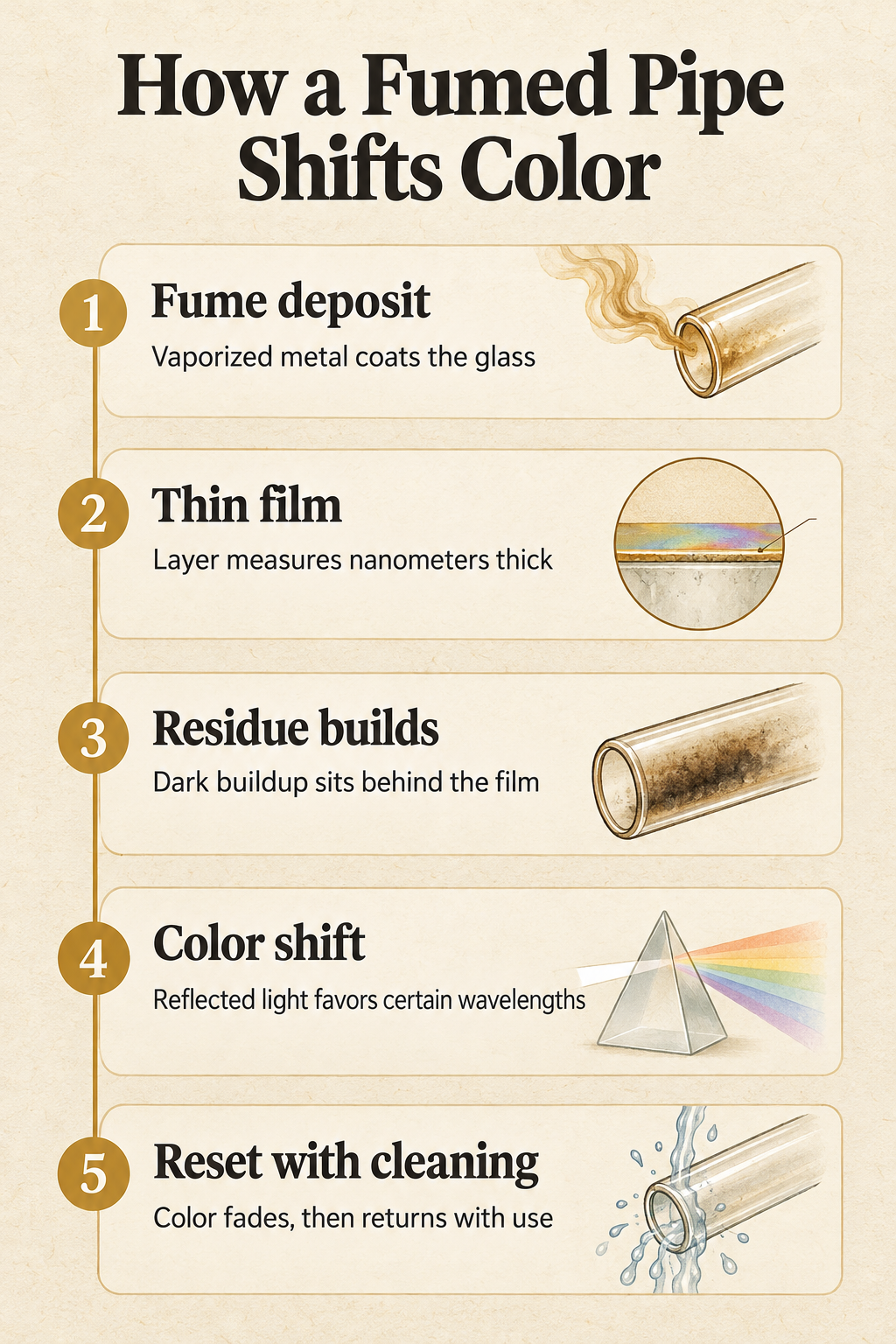
The sequence is easiest to follow as a chain, because each step depends on the one before it. Here is the order glass educators describe. [1][3]
The everyday comparison is a soap bubble or a patch of oil on wet pavement. Neither is pigmented, yet both flash color, because their film thickness sits near the wavelength of light and the color you see shifts as the film thins or as you change your viewing angle. [4]
State the cause carefully. Sources agree on what you see, and they broadly agree that a thin metal film is behind it, but they explain the cause differently. One manufacturer points to resin building until light reflects through the fume layer instead of passing straight through. A glassblowing resource points to thin-film interference plus dark residue changing the light path. A retailer describes residue interacting with ions from the fumed metal. None of them publishes a measurement. [1][3][6]
The interference account is more accurately described as the commonly given explanation, not settled fact. It fits the two things you can check yourself: the color changes with viewing angle, and it changes with how thick the fume layer is. It also matches what thin films do everywhere else. The practical takeaways are the same either way. The shift depends on the film, on what collects behind it, and on the light reaching it.
One detail about the body glass is worth knowing while you are here. Borosilicate vs Soda-Lime Glass: What Are You Actually Paying For? explains why the piece is borosilicate in the first place: the low-expansion family holds its shape through torch work, with a coefficient of thermal expansion near 3.3 x 10⁻⁶ per kelvin, roughly a third that of ordinary soda-lime glass. [10]
Fumed work is usually a spoon, a chillum, or a small water piece. What Is a Spoon Pipe and How Does It Work? covers the spoon shape itself, and What Are the Different Types of Hand Pipes? sorts the wider set of hand pipe styles. Start with What Are Specialty Pipes and How Do You Choose the Right One? if you want the whole specialty pipe family mapped before you narrow down, and How Do You Choose a Hand Pipe That’s Right for You? covers the buying decision when you are ready to pick one.
- A worker heats a small piece of silver or gold in the torch flame until it vaporizes into a visible metal plume.
- The hot glass is passed through that plume, and the metal condenses onto the surface as a very thin film.
- The film measures tens to a few hundred nanometers, the same scale as visible light at roughly 380 to 700 nanometers. [3][4]
- Light hitting the piece reflects off both the top and the bottom boundary of the film, and the two reflected waves recombine.
- Where the recombined waves reinforce a wavelength, that color stands out; where they cancel, that color drops out of the mix.
- Residue collecting behind or inside the film darkens the backdrop, which changes the light path and makes colors read more strongly.
- Cleaning removes that residue, the film returns to its earlier optical state, and the cycle can begin again.
Does the Glass Itself Change Color, or Is It Something Else?
No. The glass does not change color. What changes is the fume layer and whatever collects on and behind it. Manufacturers say so directly: the glass never shifts shade, and the visible change comes from buildup interacting with the fumed layer. [1][6]
The clearest proof is what cleaning does. Wash the piece and the color fades back toward the pale, hazy look it had when new. Use it again and the colors return. A change in the glass itself would not behave that way. [13]
The second proof is background. The same unused fumed piece shot against a white surface reads with a warm yellow tint. Shot against black, the identical piece reads cool blue. Nothing about the glass changed between those two photos, only what sat behind it and how much light came through. [6]
That is also why a product photo can look nothing like the piece in your hand. Listings are shot on white backdrops under studio lighting, which pushes fumed glass toward its warm reading. Hold the same piece against a dark shirt and it will look cooler and deeper.
- Cleaning fades the color toward the piece’s original pale look, and ordinary use brings it back.
- The same unused piece reads warm yellow on a white surface and cool blue on a black one.
- The color changes with viewing angle and with fume thickness rather than with the glass body.
- A fumed piece can still look flat, because a layer heavy enough to be opaque produces no shift.
- Loose use of the phrase color changing covers plain darkening that happens with no fume at all.
What Is the Difference Between Silver Fuming and Gold Fuming?
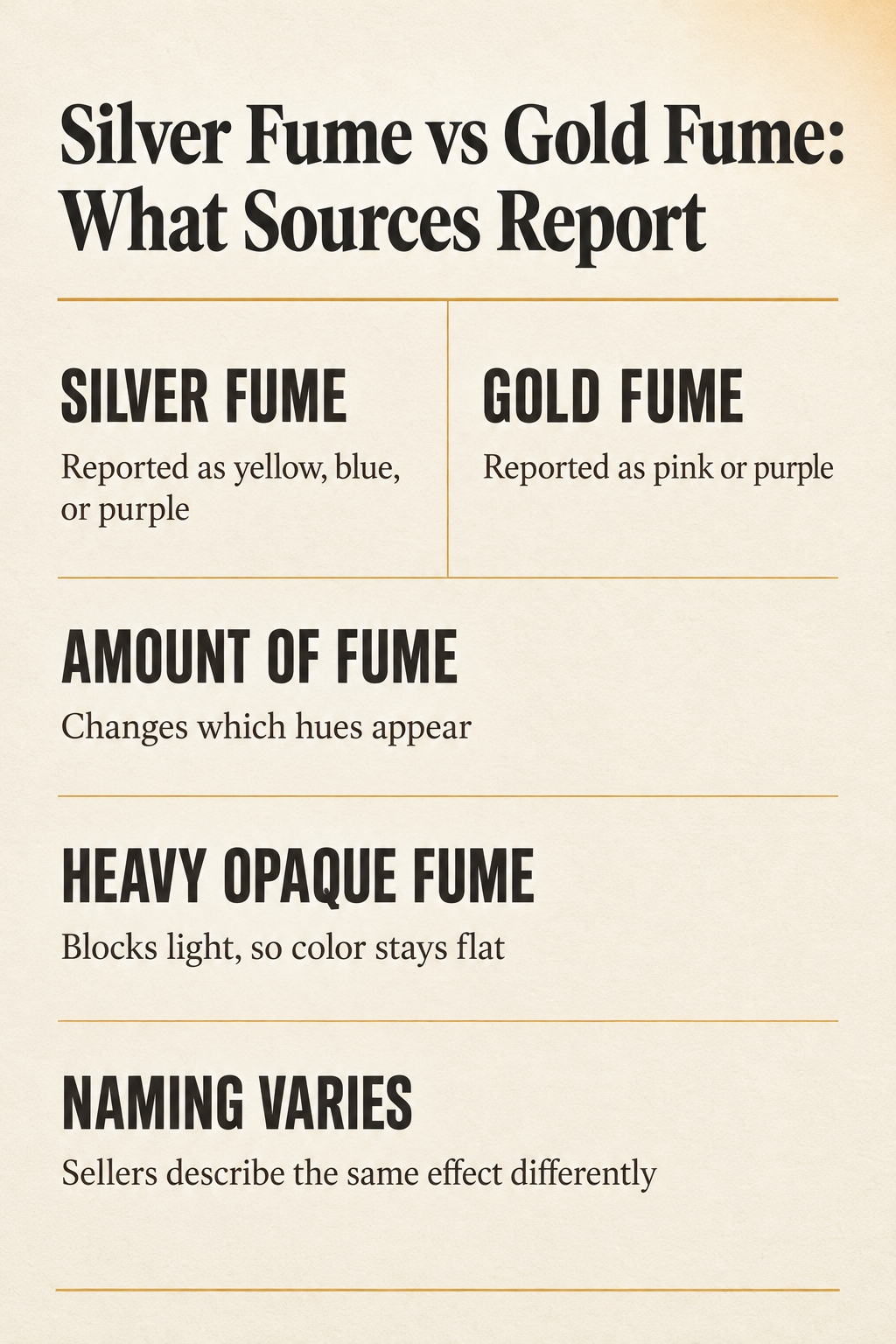
Both metals produce a shift, and neither comes with a fixed color chart. What the sources report is a range, and they do not agree all the way across it. [6][3]
For silver, one retailer says .999 fine silver usually reads yellow or blue. A glassblowing resource says silver tends toward blues, purples, and yellows. A second retailer says silver gives a yellow hue. Silver is the metal used most often in production work, and that spread reflects how much fume is laid down and how the piece was worked. [6][3][13]
Gold is where the accounts actually conflict. One retailer says 24-karat gold reads pink or purple. Another says gold gives off a blue or pink tint. Blue and pink are not the same claim, and neither source publishes a test. Read gold hues as a range and expect the individual piece to make its own case. [6][13]
There is an older reference point worth knowing. In traditional stained glass, a mixture containing silver compounds, notably silver nitrate, is applied to glass and fired lightly. It produces yellow to orange or brown shades, or green over a blue glass base. That is kiln-fired chemical staining rather than torch deposition, but it explains why silver so often reads warm. [12]
The variable that matters more than the metal is how much fume went down. More is not better. Once the layer is heavy enough to look opaque, light stops passing through it and the shift never develops, which is why a very dark, dense metallic coating often stays flat next to a lighter transparent fume job. [1]
- Silver is reported as yellow or blue by one retailer, blues, purples, and yellows by a glassblowing resource, and yellow by a second retailer.
- Gold is reported as pink or purple by one source and blue or pink by another, so the hue is a range rather than a rule.
- The amount of fume laid down changes which hues appear, and technique matters as much as the metal.
- A heavy, opaque fume layer blocks light and produces no visible shift at all.
- Traditional silver staining yields yellow to orange or brown, or green over a blue glass base, which matches the warm reading people report.
| Fume metal | Hues the sources report | What changes the result |
|---|---|---|
| Silver (.999 fine) | Yellow or blue (retailer); blues, purples, yellows (glassblowing resource); yellow (second retailer) | How much fume was laid down and how the piece was worked |
| Gold (24-karat) | Pink or purple (one retailer); blue or pink (another), a range rather than a rule | Same variables; the sources conflict on the blue reading |
| Heavy or opaque fume | None, because light stops passing through the layer | Fume thickness above all: no transparent layer means no shift |
| Silver stain in traditional glass | Yellow to orange or brown, or green over a blue base | Kiln firing rather than torch work, but the same warm reading |
What Do Inside-Out and Surface Fuming Mean?
Placement is about where the fume sits, and it changes how a piece behaves. Inside-out work puts the color and the fume inside the tube, then encases them. Surface work applies fume to the outside of the tube and melts it in. [1]
Manufacturers do not present the two as equivalent. One states that surface work produces the stronger color change of the two placements. That is a maker’s claim rather than a measurement, but it is consistent with the idea that the shift depends on light passing through the fume layer and reflecting off what sits behind it. [1]
Inside-out pieces are often combined with other techniques. One production line fumed with pure silver also works the interior with solid color cane and latticinio, where strands of colored glass are wrapped around each other and melted into the clear glass, so the fume and the color work read together. [9]
The naming is not standardized, and that is a buying problem rather than a technical one. The same construction is sold as inside-out, inside fumed, surface fumed, double blown, or simply color changing, and one brand’s inside-out is another brand’s standard. Read the description for where the fume sits instead of trusting the label.
One more piece of vocabulary: some fumed chillums combine both metals. One current production chillum is fumed with solid silver and gold, comes in around 3.25 inches, and uses heavy glass. [8]
- Inside-out means fume and color are applied inside the tube and then encased in more glass.
- Surface fuming means the metal is applied to the outside and melted into the glass wall.
- The manufacturer behind one line argues surface work produces the stronger color change of the two.
- Inside-out work is often combined with color cane and latticinio for additional pattern inside the tube.
- Naming varies by seller: inside-out, inside fumed, surface fumed, double blown, and color changing are all in use.
How Should You Clean a Fumed Glass Pipe?
Cleaning is the one place where a fumed piece behaves differently from clear glass, and it is where most permanent damage happens. The rule that matters most: an internally fumed, color-changing pipe should never be cleaned with a solution over 50% alcohol. Strong solvents can wash the fume out permanently, and once the fume is gone the color change goes with it. [2]
One step is worth spelling out, because thermal shock is the most common way a borosilicate piece breaks. Borosilicate handles a temperature differential of roughly 330 degrees Fahrenheit, or 166 to 170 degrees Celsius, before it fractures. It can still crack or shatter under rapid or uneven temperature change. It is tougher than soda-lime glass, not immune to it. Running cold water into a warm pipe, or setting a cold pipe on a hot surface, is exactly the kind of uneven change that breaks one. [10]
Surface-fumed pieces are not affected by alcohol cleaners the same way as internally fumed ones, according to the same care guidance. The problem is that you cannot always tell which type you have, and a listing may not say. Default to the conservative routine and stick with warm water and an alcohol-free soak. [2]
Finally, keep the soak short. A long soak does not lift more residue than a normal one, and it puts more solvent contact on the fume layer for no gain.
- Empty the piece and rinse it with warm water right after a session, while residue is still soft.
- Soak in an alcohol-free cleaning solution for a deeper clean, following the product’s dilution directions.
- Rinse thoroughly with warm water until the solution is gone.
- Dry in open air on a stable surface rather than dropping the piece into a sink.
- If you are unsure whether a piece is internally or surface fumed, clean it as though it is internally fumed.
- Never move glass straight from hot to cold, or cold to hot, in a single step.
How Can You Tell a Fumed Pipe Before You Buy It?
A listing gives you enough to judge a fumed piece if you know what to read. Start with the description of what was fumed, not with the color in the photo. [7]
The naming on a listing is not always clean either. One current production spoon page states 99.9% pure silver fumed onto cobalt blue tubing, around 3.5 or 4.5 inches long, in solid borosilicate, hand-blown in Los Angeles, and then refers to the same pipe by a different name twice in the body copy. Check the item rather than trusting the title. [7]
At the time of writing, four fumed pieces are in stock: the LA Pipes Time Traveler Silver Fumed Pull-Stem Bubble Bong at $49.99, the LA Pipes Twisted Rainbow Fumed Glass Chillum at $44.99, the Fumed Galaxy Spoon at $34.99, and the LA Pipes Galaxy Fumed Spoon Pipe at $34.99. A lower-priced golden fumed hand pipe is listed at $11.99 but sits out of stock, so it is not a reliable pick right now. [11]
You get free shipping on orders $150+, so adding a fumed piece to an order that is already near that line is worth it. For the wider decision, work through the hand pipe choosing guide before you commit to a shape.
- Look for a named metal: 99.9% pure silver, .999 fine silver, or 24-karat gold. Color changing alone says nothing about fume.
- Check whether the fume is described as inside-out or surface, since the two behave differently when you clean them.
- Read fumed, color changing, silver fumed, gold fumed, inside-out, and Snodgrass finish as six labels for overlapping things.
- Look at the body glass. Fumed work is normally borosilicate, and a listing should state it.
- Be cautious about a very dark, dense metallic coating, because an opaque fume layer produces no visible shift.
- Expect product photos to skew warm, since studio backdrops are white and fumed glass reads yellow against white.
Frequently Asked Questions
Why did my fumed pipe stop changing color?
Two common reasons. If the piece was cleaned with a strong solvent, the fume layer itself can be washed out, and the shift does not come back. More often the piece simply has little residue built up yet, so the effect looks weak until it sees regular use again.
Does cleaning a fumed glass pipe wash the color out for good?
Usually not. Cleaning fades the color back toward the piece’s original look, and using it again rebuilds the effect. The exception is an internally fumed piece exposed to a cleaner above 50% alcohol, which can strip the fume permanently.
Why does a new fumed pipe look pale instead of colorful?
A clean fumed piece looks faintly golden, silvery, or hazy because the fume layer is thin and there is no residue behind it yet. The visible shift develops with buildup, and even a new piece can read warm on a white surface and cool on a black one.
Can a pipe change color without any fume at all?
Yes, in the loose sense of the phrase. Sellers use color changing for any pipe that darkens with use, whether or not metal fume is present. If the shift is a true iridescent range rather than plain darkening, that is the fumed work.
Who came up with color-changing glass?
Bob Snodgrass is credited with inventing it, by his own account by accident, using borosilicate fumed with gold or silver that shifts as dark residue builds inside. The iridescent finish is still widely called a Snodgrass finish, and the technique spread on the festival circuit through the 1970s and 1980s. [5][3]
Is a darker, heavier metallic coating better?
No. More fume is not better. Once the layer is heavy enough to look opaque, light stops passing through it and the color shift never develops, so a very dark metallic coating often stays flat compared with a lighter transparent fume job. [1]
What Should You Remember About Fumed Glass Pipes?
A fumed pipe is a glassblowing artifact first and a color trick second. The metal layer is real, measured in nanometers, and it is what makes the shift possible. The glass under it never changes.
The practical checklist is short. Know which metal was used, know whether the fume sits inside or on the surface, keep strong alcohol away from an internally fumed piece, never shock the glass with a fast temperature change, and expect the color to fade when you clean and return when you use it again.
Buy accordingly. A named metal and a stated fume placement tell you more than a dramatic product photo, and a lighter transparent fume job will show more color than a heavy dark coating that stops light at the surface.
Sources
- Chameleon Glass: Glass Education — Color Changing Artwork / Fuming & Color Change
- Chameleon Glass: How to Clean a Glass Pipe Properly (Step-by-Step Guide)
- Boro Mastery: How Color-Changing Glass Works: Fuming Explained
- Wikipedia: Thin-film interference
- Wikipedia: Bob Snodgrass
- Fat Buddha Glass: What is Fuming or Color Changing Glass?
- LA Pipes: "Galaxy" Fumed Spoon Pipe
- LA Pipes: "Twisted Rainbow" Fumed Glass Chillum
- LA Pipes: "Candy Spoon" Inside-Out Color Changing Glass Pipe
- Wikipedia: Borosilicate glass
- Treehouse Lifestyle (WooCommerce Store API): Store API product search: "fumed"
- Wikipedia: Silver staining (silver stain in stained glass)
- Up-N-Smoke: Does My Glass Pipe Change Color?