

A dichroic glass pipe is an ordinary borosilicate pipe with a microscopically thin multilayer coating worked into it. The coating is optical, not pigment, and it is why one piece shows two colors.[1]
One color appears in light passing through the glass, another in the light it reflects, and both shift as you turn the piece in your hand. The Greek root says it plainly: two-colored.
What Is a Dichroic Glass Pipe, and Why Does the Color Shift?
A dichroic pipe is a spoon, a sherlock, or a bowl built from coated stock. The word describes decoration, not form. Fumed and linework work the same way: they tell you how the glass was colored, not what shape it is.
The material has no pigment in it at all. The museum conservation database defines dichroic glass as glass that reflects and transmits different wavelengths of light. It appears as one color in reflected light and another in transmitted light.[3] A coating supplier puts the same thing in maker terms: there is a transmitted color and a completely different reflective color, and both shift with the angle of view.[4]
The mechanism is optical interference, not absorption. NASA’s write-up translates the Greek root as two-colored. It explains that the material partly reflects the light passing through it, so an observer sees different colors depending on which direction the light comes from.[1]
Depth is the other thing people notice. The color sits behind a layer of glass, so you are looking through clear material to reach it. That reads differently from surface paint, and it is the whole reason inside-out work exists.
Most people meet dichro on a spoon, which is the simplest format to compare, so Spoon Pipes is a sensible place to start. The same coating turns up on water pipe bowls as well, which is what Bong Bowls covers. Glass Hand Pipes is the wider category if you want to see how many shapes the material shows up in.
- One color when light passes through, a different color when light reflects off it
- Color that moves as the viewing angle changes, rather than staying fixed
- Color that appears to sit behind clear glass instead of on top of it
- Highlights that look metallic or foil-like rather than evenly glittery
- Two pieces of the same model that still read slightly differently in different light
How Is a Dichroic Coating Actually Put Onto Glass?
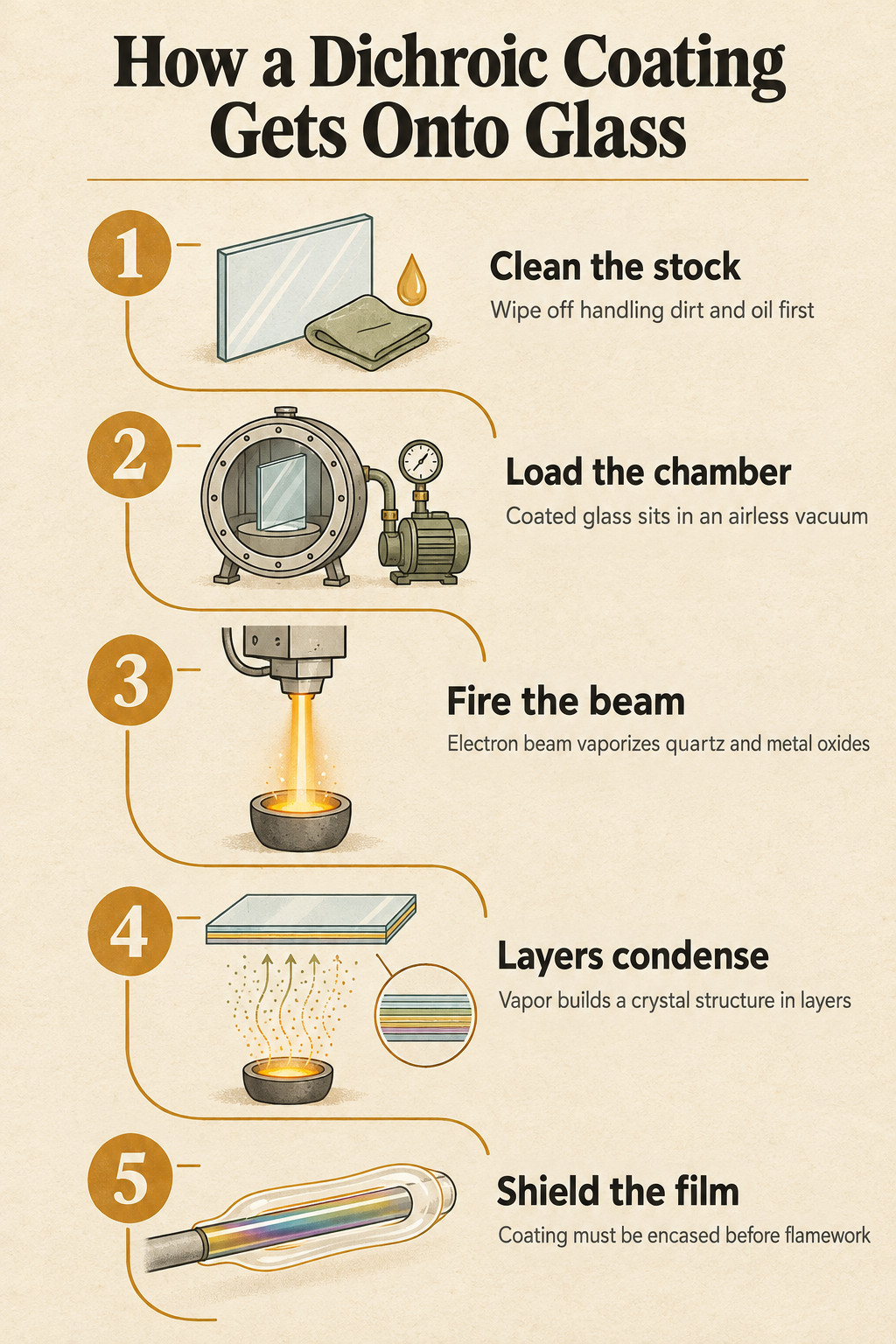
The process is a vacuum deposition run, not a recipe stirred into a batch of glass. It happens in a chamber, in layers, and in an order that matters.
The sources do not agree on a single headline number, and that is worth saying out loud rather than picking a favorite. The coating supplier describes a structure of as many as 30 layers.[4] The encyclopedia entry records 30 to 50 layers and a total coating of roughly 30 to 35 millionths of an inch, given as about 760 to 890 nanometers.[9] NASA says the cycle repeats for up to several dozen coatings, with a finished film about 30 millionths of an inch thick.[1] The glass supplier describes the individual layers as roughly 700 angstroms thick.[5]
All four agree on the part that matters: the finished film is a fraction of a human hair, and thickness control is what sets the color. There is no dye vat to match against. The color comes from how the layers stack.
Because the film is built to a spec, artists buy it as a material. That is also why the same coating can look different on two finished pieces. It depends on how many layers were laid down and how the artist oriented them in the build.
Dichro is one of several color treatments rather than a category of its own. Why Does a Fumed Glass Pipe Change Color? explains a treatment that changes with heat and time instead of with angle, and How Is the Swirl Pattern on a Linework Glass Pipe Actually Built? walks through a pattern built from cane instead of coating. For how materials compare overall, see Glass vs Silicone vs Wood vs Metal Pipes: Which Material Is Best?.
- The stock is wiped clean of handling oil and dust before any heat
- The glass goes into an airless vacuum chamber
- Quartz crystal and metal oxides are melted and vaporized by an electron beam
- The vapor condenses onto the surface as a crystal structure in thin layers
- The cycle repeats until dozens of coatings have stacked up
- The finished stock ships as coated sheet, coated clear rod, or colored rod with a coating
Did NASA Invent Dichroic Glass, or Is the Idea Older?
The modern coating is a space-program product. NASA states that the agency revitalized dichroic glass production in the 1950s and 1960s as a way of protecting its astronauts. The vacuum-deposition method was later spun off into commercial uses including art glass.[1]
The Smithsonian design museum dates the thin-film approach to the 1960s, when the coatings were developed as filters to shield spacecraft from solar irradiation.[2] The coating supplier says the material was originally created for the aerospace industry before it was made available to artists.[4]
Color-changing glass itself is far older, and it is a genuinely different material. The fourth-century Lycurgus Cup shifts between red and green because nanoparticles of gold and silver sit inside the glass melt, not because of alternating thin films on the surface.[2] The conservation entry records the same cup as dull green in reflected light and deep wine in transmitted light.[3]
So the honest answer runs in two directions. The modern coating has a 1960s aerospace lineage. The idea of a glass that changes color goes back at least sixteen centuries, and it is made in a completely different way.
That distinction matters at the shelf. Not every piece that changes appearance is dichroic. Glow in the dark is another effect again, and Glow in the Dark Bongs: Do They Work and Are They Safe? covers how that material works and what it does not do.
- Modern: a microns-thin coating applied on top of the glass or sandwiched between layers
- Modern: color set by layer thickness and light interference, with no pigment involved
- Ancient: metal nanoparticles dispersed through the glass melt itself
- Ancient: the effect belongs to the whole batch of glass, not to a surface treatment
What Does Inside Out Mean on a Dichro Pipe?
Inside out is a statement about where the decoration sits, not about what the glass is. A studio glossary defines inside-out work as color or cane laid into the inner surface of the tubing to add depth and thickness along with color and pattern. It names dichroic strips among the materials used that way.[7]
A retailer’s guide describes the same thing from the buyer’s side: decorative work that appears to sit inside the wall of the pipe rather than being painted or added to the outside surface.[8]
This is documented craft, not catalog language. The Corning Museum of Glass research library lists a step-by-step tutorial on producing a flameworked inside-out pipe in the trade journal The Flow.[6] That is a reasonable sign the term predates any product page.
Why go to the trouble? Because the coating has to be covered. Technical notes from a glass supplier state that the dichroic coating must be completely covered over in a layer of glass to shield it from the flame. Coating that is overheated or touched directly by the torch turns gray.[5] Encasing is not a flourish. It is the reason the color survives the build at all.
Some listings use their own vocabulary for the same construction. One Treehouse piece is described as inverse glassblowing, with the dichroic layer sealed inside the walls.[11] Same idea, different label.
- Start with a tube and lay the decoration onto its inner surface
- Add the dichroic strips or cane in the pattern you want
- Build the wall up so the decoration ends up behind glass
- Shape the bowl, mouthpiece and carburetor
- Finish the surface so the color reads cleanly through the outer layer
Does a Dichroic Finish Fade, Burn, or Scratch Off?
No source reviewed for this guide describes a coated dichroic surface as permanent. The museum conservation entry lists coating deterioration over time under risks.[3] That is not a reason to avoid the material, but it is a reason to be careful with absolute claims.
Treehouse’s own listing for its inside-out spoon says the sealed finish means the color never burns, fades, or scratches off.[11] Read that as the listing’s claim rather than an independent finding. What the outside sources support is narrower: a coating protected under clear glass is exposed to less wear and less direct heat than an uncovered one.
On the bench, the threats are specific. Overheating the coating, or letting the torch flame touch it directly, turns it gray.[5] Dirt or oil left on the surface before flamework can discolor it or burn it out.[5] That is why the prep steps exist and why encasing is standard on worked pieces.
Cleaning is the ordinary routine. An isopropyl alcohol soak with coarse salt for agitation, a thorough rinse, and a full air dry before the piece goes back into rotation. The one real caution is the alcohol itself: its flash point is recorded at 53 degrees Fahrenheit,[15] which means it gives off ignitable vapor at ordinary room temperature. Clean away from any flame or heat source, and let the piece dry completely first.
The rest is handling. Storage, transport and packing are separate from the coating but they decide how long a piece lasts, and Grinders covers the prep side of that routine.
- Direct flame contact during the build, which turns the coating gray
- Overheating, even when the flame is aimed elsewhere on the piece
- Handling residue left on the surface before the coating is encased
- Long-term coating change, which conservation notes list as a known risk
How Can You Tell Real Dichroic Glass From Glitter or Crushed Glass?
Sparkle is the trap. A retailer’s guide is blunt about it: products get described as dichroic simply because they sparkle. Glitter-like inclusions, crushed colored glass and metallic-looking decoration can all create an attractive effect without any multilayer optical coating.[8]
The field test is angle. Turn the piece slowly under a couple of different light sources and watch the color itself. Real dichroic material changes hue as the viewing angle changes. Glitter and crushed glass tend to sparkle the same way from every direction.
The listing test is description. If a seller charges a premium for dichroic content, the material should be named and the reflective color behavior should be visible in the photos. Vague dichro-style wording with no material description behind it is a reason to keep looking.
Then check the build, because decoration cannot rescue weak construction. The same guide says plainly that beautiful dichroic color cannot compensate for a weak bowl, a crooked shape or a badly finished mouthpiece.[8] Heavily worked pieces are also where thin walls hide, so feel for them.
- Rotate the piece under two different light sources and confirm the color actually shifts
- Check that the color sits behind glass rather than on a coating you can feel
- Look at the bowl for even walls and obvious thin spots
- Hold it by the mouthpiece and see whether it feels balanced in the hand
- Look into the airway and judge how hard it will be to clean
| What to check | Real dichroic | Glitter or crushed glass |
|---|---|---|
| Color versus angle | Hue shifts as the viewing angle moves | Glitters the same way from every direction |
| Where the color sits | Behind clear glass, so it reads with depth | Inclusions or metallic paint at the surface |
| What sets the price | Coated stock that ran through a deposition process | Decoration with no coating cost behind it |
| What the listing says | Names the material and shows the color behavior | Uses dichroic as a style word with no detail |
Why Does a Dichroic Pipe Cost More Than a Plain Colored Spoon?
Three things push the price up, and only one of them is the coating itself.
First, the material arrives already processed. Dichroic stock has been through a specialized coating run before an artist touches it. A small amount of expensive material can add a noticeable amount to the price of a hand pipe.[8]
Second, working it is risky. The artist has to incorporate the material without wrecking the optical effect, which narrows the margin for error on every piece.[8]
Third, coverage varies enormously. Dichro can be the whole body of a piece or a small marble accent. The MJ Arsenal flower bowl is described as a handblown borosilicate bowl with a crushed dichro marble accent,[13] which is a very different amount of coated material than a fully worked spoon. Suppliers sell coated stock in three forms for the same reason: builders need options.[5]
The market numbers show the result. A store search for dichro returns six listings spread from $19.99 to $49.99, while the lowest-priced in-stock glass hand pipe in the same category is $7.90.[10] The entry-level dichro spoon lists at roughly two and a half times that.
- Coated stock costs money before the first cut is made
- Handwork has to protect the optics, not just shape the glass
- Coverage, from full body to small accent, changes the material bill
- The shelf spread: $19.99 to $49.99 against $7.90 for a plain glass spoon
Which Dichroic Pieces Does Treehouse Carry, and How Do You Choose One?
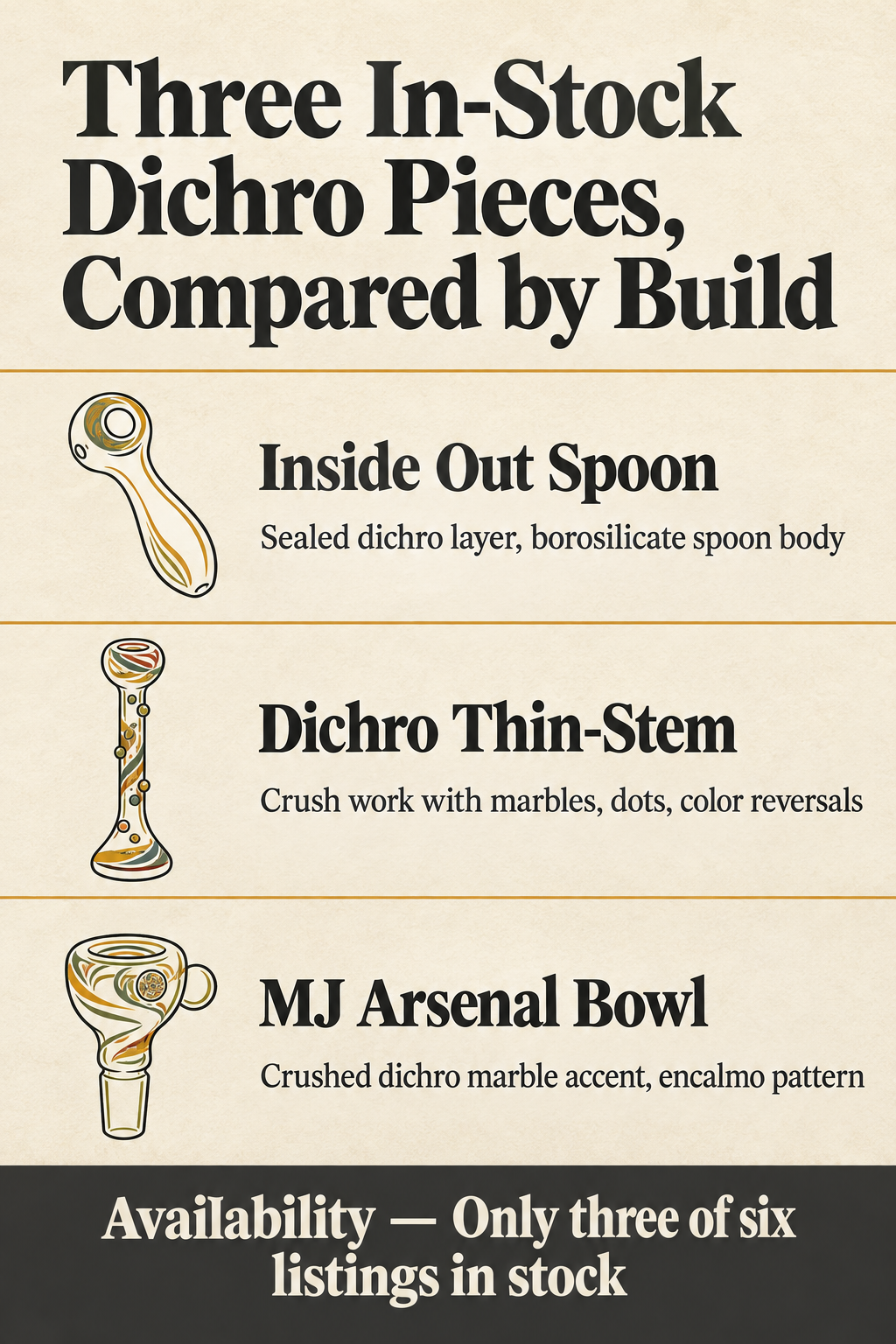
A store search for dichro returns six listings, and three were in stock at the time of research.[10] The three in-stock pieces are built differently, which is the most useful thing to know before picking one.
The Inside Out Dichro Hand Pipe Spoon is a borosilicate spoon at $19.99. It comes as a 2.5-inch mini or a 6-inch large, with walls listed at approximately 3mm or more and the dichroic layer sealed inside the wall.[11] It is the entry point to the material.
The Dichro Thin-Stem Spoons are $27.99, roughly 4.5 inches, made by Eye Candy Crush, with dichroic glasswork plus marbles, dots and color reversals, a side carb hole and a decal.[12] More worked surface, higher price.
The MJ Arsenal Dichro Flower Bowl is $22.99, and it is a different kind of object. It is a 14mm female-joint flower bowl for a water pipe, dab rig or bubbler, with a crushed dichro marble inlay in an encalmo pattern.[13] Here dichro is an accent rather than the body of the piece.
Three more listings were out of stock at the time of research, running up to $49.99,[10] so the full range goes higher than what is currently on the shelf.
One caution about names. The same product name can carry different specs at different stores. One listing offers the inside-out spoon in a 2.5-inch mini and a 6-inch large with a stated wall thickness. Another retailer lists a piece under the same name as a 4-inch model in six colorways.[14] Neither is necessarily wrong, but size and wall claims belong to the specific listing you are reading. If you are comparing a few pieces at once, free shipping on orders $150+ is worth factoring in.
- Confirm the actual length on the listing rather than trusting the model name
- Check whether the dichroic is the body of the piece or a small accent inlay
- Look for a stated wall thickness if the piece will be handled daily
- Match the joint size if you are buying a bowl rather than a spoon
- Compare bowl shape and airway before comparing color work
Frequently Asked Questions
Is dichro just shorthand for dichroic?
Yes. Glass artists routinely shorten dichroic to dichro, and product names follow the same habit. Several Treehouse listings drop the full word entirely. It is the same material and the same coating, not a separate grade or a cheaper version.
Is the color on the outside of the pipe or sealed inside the wall?
It depends on the build, and the listing should tell you. Coated stock can be laid onto the inner surface and then encased in clear glass, which is what inside-out work means, or it can sit closer to the outer surface. Inside-out pieces read with more depth because you are looking through a layer of glass to reach the color.
Why does the same dichro spoon show different specs at different stores?
Retailers buy different size runs and colorways under names that travel. One store lists an inside-out dichro spoon in a mini and a large with a stated wall thickness, while another lists a piece under the same name at a different length in six colorways. Neither is necessarily wrong, but it means size and wall claims belong to the specific listing.
How do I clean a dichroic glass pipe?
The usual glass routine works: an isopropyl alcohol soak with coarse salt for agitation, a thorough rinse, and a full air dry before the piece goes back into use. The sealed layer sits behind glass, so ordinary cleaning does not reach it and no special solvent is needed. Note that isopropyl alcohol gives off ignitable vapor at ordinary room temperature, with a flash point recorded in the low fifties Fahrenheit. Clean away from any flame or heat source, and let the piece dry completely.
Is dichroic glass more fragile than plain borosilicate?
The thin coating is fragile on the bench, not on the shelf. It has to be shielded under a layer of glass because direct flame contact, overheating or handling residue can discolor it or burn it out during flamework. Once the piece is finished the color sits behind glass, but no independent source describes coated dichroic glass as permanent. Museum conservation notes list coating deterioration over time as a known risk.
Does a dichroic pipe draw differently from a plain one?
No. The coating changes what you see, not how the piece works. Draw and airflow come from the shape of the pipe, how the bowl is formed, the carburetor and how thick the glass is built. When two pieces feel different in use, compare their geometry and airway rather than their color work.
What Should You Remember Before Buying a Dichroic Pipe?
Dichroic means two colors from one piece of glass, produced by a coating a few millionths of an inch thick rather than by pigment. The color shifts with the angle because the layers interfere with light, which is a different mechanism from anything mixed into the melt.
Inside out is where the color sits, not what the glass is. Sealing the coating under clear glass is what lets it survive the torch, and it is why a worked piece reads with depth instead of looking painted on.
Weigh the build first. A real dichro piece should change color as you rotate it, name its material in the listing, and be honest about its specs. The color work is the last thing to judge, not the first.
Sources
- NASA — Spinoff (2012): Ultra-Thin Coatings Beautify Art
- Cooper Hewitt, Smithsonian Design Museum: Year of Glass: Specialty Glasses with Special Effects
- CAMEO — Museum of Fine Arts, Boston: Dichroic glass
- CBS — Coatings by Sandberg, Inc.: Frequently Asked Questions about Dichroic Glass
- Northstar Glassworks: Boro News — Issue 17, "Color and Dichro!"
- Corning Museum of Glass — Rakow Research Library: Pipe Making: Pipe Making Techniques
- Bern Gallery: How to Blow Glass (Equipment, Tools & Techniques)
- Simple Glass Pipe: Types of Glass Hand Pipes | Spoon, Sherlock, Hammer & Glass Styles
- Wikipedia: Dichroic glass
- Treehouse Lifestyle: WooCommerce Store API — product search "dichro"
- Treehouse Lifestyle: INSIDE OUT DICHRO HAND PIPE SPOON — product record (id 16365)
- Treehouse Lifestyle: Dichro Thin-Stem Spoons (Various Colors) — product record (id 16042)
- Treehouse Lifestyle: MJ Arsenal Dichro Flower Bowl — product record (id 13740)
- Discreet Smoker: INSIDE OUT DICHRO HAND PIPE SPOON
- National Institutes of Health — PubChem: Isopropanol (CID 3776) — Flash Point