

An etched glass pipe carries a pattern cut into the glass surface, not printed on it. A resist mask decides where the design lands, then grit, fluoride acid, or a CO2 laser turns the exposed glass matte and light-scattering. Nothing is added, so nothing peels off; only the surface changes.
The routes differ in what they do to the surface, but all three leave the frost the trade calls an etch [1]. That mark is in the material rather than on it, which is the difference that matters when a piece is handled every week for years.
What the pattern changes is the surface, and the surface drives how the piece feels in the hand, how it shows oils, how easily it cleans up, and how the finish behaves over years of use. This guide walks the process from mask to finished piece, separates etched from frosted and from laser engraved, explains why some etched designs look like polished metal, and covers what to check on an etched banger before you buy.
How Is the Pattern on an Etched Glass Pipe Actually Made?
Every etched pipe starts as a clear blank. The maker covers the piece with a mask, opens the design in that mask, and then attacks the exposed glass until the surface turns matte. The design comes from the mask, not from the tool doing the damage, which is why the same blasting cabinet can turn out a logo, a repeating pattern, or a name.
Glass etches by fracture rather than by coating. Glass sits around 5.5 on the Mohs scale, aluminum oxide is about 9.0 and silicon carbide about 9.5, so grit driven at blast velocity starts a micro-crack that the surrounding material arrests almost immediately [4]. Millions of those tiny fracture events across the blast zone are what read to the eye as frost. Nothing is added and nothing is painted on.
A pipe is the harder case compared with a flat panel. Curved, three-dimensional work needs the mask slit, pinched, stretched, and joined so the artwork does not distort, and thin or curved glass gets blasted at roughly 10 to 20 psi with the nozzle held perpendicular while the piece is rotated [3]. Flat decorative panels are run much harder, at 30 to 50 psi with 80 to 100 grit abrasive [1].
A photoresist mask holds detail as fine as 0.003 inch lines, and stage-carving lets different areas of one piece be cut to different depths [2]. That is how a single pipe ends up with a crisp logo and a softer background from the same blast. Grit size and pressure set micro-crater size, which is why two etched pieces can look and feel completely different up close.
- Clean the blank first. Dust, cutting oil, and skin oil all lift a mask mid-blast, and a lifted mask leaves a blurred edge that cannot be fixed after the fact.
- Cut the resist. Hand-cut vinyl suits simple shapes and one-off work; UV-sensitive photoresist suits fine detail and repeat runs.
- Apply and squeegee the mask so it follows the curve without trapping air. On a pipe this usually means slitting and overlapping the film rather than trying to wrap it in one piece.
- Open the artwork in the resist by weeding the vinyl or washing out the exposed photoresist, so only the areas you want frosted are bare glass.
- Blast the exposed glass at reduced pressure, holding the nozzle perpendicular and rotating the piece, until the frost reads even under a raking light.
- Check depth and edge sharpness before stripping anything. Re-blasting into a mask that has already started to erode widens the edge and softens the pattern.
- Strip the mask, wash the piece, and dry it. Residue left behind reads as haze, which is the cloudiness plenty of new etched pipes arrive with.
Is Etched Glass the Same Thing as Frosted, Sandblasted, or Laser Engraved?
The four words get used as if they were interchangeable, and strictly they are not. Etching means the chemical route with fluoride acid, sandblasting or sandcarving means the abrasive route, and engraving means cutting a recess. In ordinary trade use all three get applied to any frosted glass design, and on glass a laser’s etch and a laser’s engrave describe the same frosted mark [1][6].
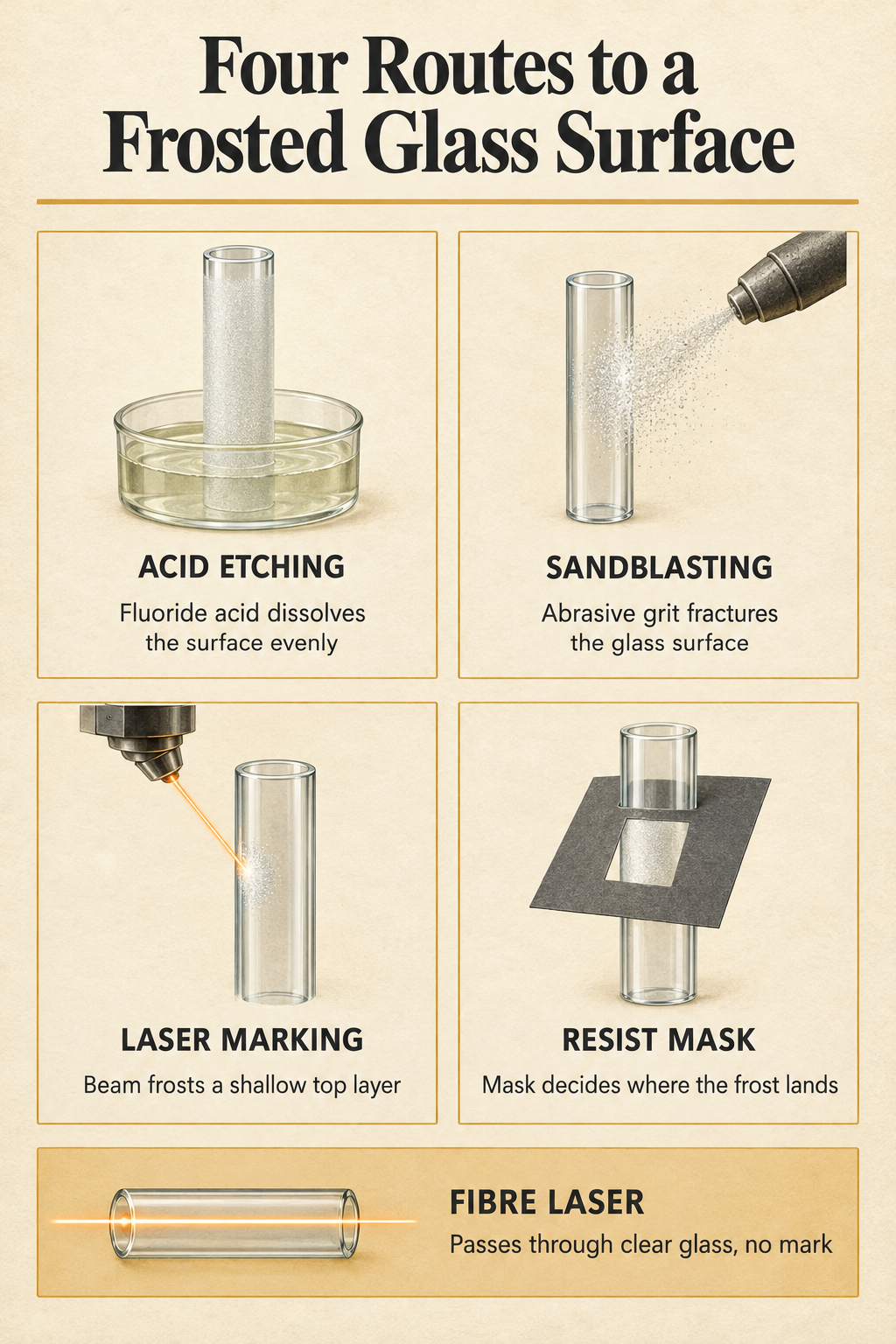
The routes are not cosmetic variants of one another. Acid attacks the surface evenly and leaves a satin etch with very fine imperfections. Abrasive grit leaves larger micro-craters and a coarser, brighter frost. A CO2 laser at 10.6 microns is absorbed right at the surface and micro-fractures a shallow top layer into a permanent white mark, while a fiber laser at about 1064 nm passes straight through clear glass and leaves no mark at all [5].
The material wrinkle matters on pipes. Soda-lime glass softens near 400 C and can be marked by ring fracture, with fracture depths of roughly 30 to 60 microns on a 25 W laser; borosilicate, fused silica, and quartz soften near 1000 C and above and mark by the stress-relieved technique with no fracturing [7]. The same artwork therefore reads differently on a borosilicate body than on a cheap soda-lime tumbler. For the substrate comparison in plain terms, see Borosilicate vs Soda-Lime Glass: What Are You Actually Paying For?.
Then there is the shopping reality. Retail listings rarely name the process, so the same pattern family ships as laser etched, electro etched, metallic etched, and plain frosted quartz with etched designs, with no process documentation attached to any of it [22][23][18].
Two further pieces of reading help here, because the comparison only matters once you know what you are comparing. If the pattern is going on a spoon or a chillum rather than a banger, What Are the Different Types of Hand Pipes? covers those formats. If the piece that caught your eye has small quartz parts sitting in the bucket, What Are Quartz Pillars, and What Do They Do Inside a Banger? explains what they do. If you want the wider category view before drilling into process, read What Are Specialty Pipes and How Do You Choose the Right One?.
- Acid etching: fluoride chemistry dissolves the surface evenly. Fine, satin, and the coarser-versus-finer difference is visible up close [1].
- Sandblasting or sandcarving: abrasive grit fractures the surface. Coarser and brighter, and the standard route for a heavy overall frost.
- CO2 laser marking: the beam frosts a shallow top layer without cutting through the glass. Repeatable, and what most laser etched bangers mean in practice.
- Laser engraving: on glass this produces the same frosted mark as laser etching, despite the word suggesting a deeper cut. If you are matching a pattern to a quartz format, What Is a Quartz Banger and How Do You Choose One? covers how those are built.
- Frosted quartz with etched designs: a listing phrase, not a process. It tells you the look and nothing at all about how it got there.
- Reading the wording: laser etched and electro etched at least name a route, while metallic etched describes a coating sitting on top of the frost.
- What never appears in a listing: the pressure, the grit, the mask type, or the annealing state of the blank. Those are the variables that separate a crisp pattern from a soft one.
| Route | What it does to the surface | What the frost looks like | Applied layer that can wear |
|---|---|---|---|
| Acid etching | Fluoride chemistry dissolves a thin layer evenly | Fine satin frost, very small imperfections | No |
| Sandblasting or sandcarving | Abrasive grit fractures the surface on impact | Coarser, brighter frost, larger micro-craters | No |
| CO2 laser marking | Beam micro-fractures a shallow top layer | Permanent white frost, repeatable | No |
| Fiber laser | Beam passes straight through clear glass | No mark at all | Not applicable |
| Metallic or gold fill | Optional pigment, gilding, or metal worked into the etch | Mirror-bright lettering inside a matte field | Yes: fill plus topcoat |
Why Do Some Etched Pipes Look Metallic Instead of Frosted?
A metallic-looking etched piece usually carries two different finishes at once, and the metal is not an etch. Pulsar describes its Death Row metallic etched spoon as an etched logo that produces a flashy metallic gold finish for the lettering against a matte sandblasted background [15]. The frost is the etch; the gold is a fill applied into it.
True electroplating is not simply sprayed onto glass. Glass conducts no electricity, so a conductive layer has to come first, and the commercial metallic finish is built in three stages: a base lacquer that gives the metal a key, vacuum-deposited aluminium that supplies the mirror brightness, and a clear topcoat that seals it [14]. Brightness depends on the base coat because the metal mirrors the surface underneath it.
Here is where two published promises do not agree. Our own listing for the Pulsar Dub Chamber electro-etched water pipe markets its detailing as permanent and as something that will not fade or wash off with use [23]. The suppliers who actually run the metallising process state the finish does not survive abrasion, caustic washing, or a dishwasher, and that an unprotected metallised surface marks quickly [14].
The working reading is that permanent metallic means a sealed decorative coating sitting on the glass, not part of the glass. Etchers and laser shops do offer pigment, gilding, and metal fill as an optional extra step into the etched recess [1]. That fill is exactly the layer that can wear, even when the frost underneath cannot.
- The frost: glass, permanently altered, and not going anywhere. This part survives scrubbing, alcohol, and years of handling.
- The recess: a shallow cut or fractured layer the fill sits in. Its depth sets how much material the decorative layer has to hold onto.
- The fill: pigment, gilding, or metal sitting in that recess. This is the wear layer, and the reason a metallic design can lose its shine while the pattern stays.
- The topcoat: a clear seal over the metal. It governs how long the brightness lasts, and it is the one thing a listing almost never mentions.
- The base lacquer: the key coat between glass and metal. Variance here is why two pieces of the same design can differ in how mirror-bright they look.
- What to take from a listing: permanent describes the seal, not the glass, so read any metallic claim as a statement about a coating that sits on the surface.
Can Quartz Bangers Be Etched, and Why Is the Inside of the Bucket Left Smooth?
Etching works on quartz the same way it works on borosilicate, because both substrates are attacked by the same narrow set of chemistries. Borosilicate 3.3 is documented as attacked by hydrofluoric acid, concentrated phosphoric acid, and strong alkalis at higher concentrations and temperatures [12], and fused quartz is attacked by hydrofluoric and phosphoric acid plus hot potassium hydroxide while resisting almost everything else [11].
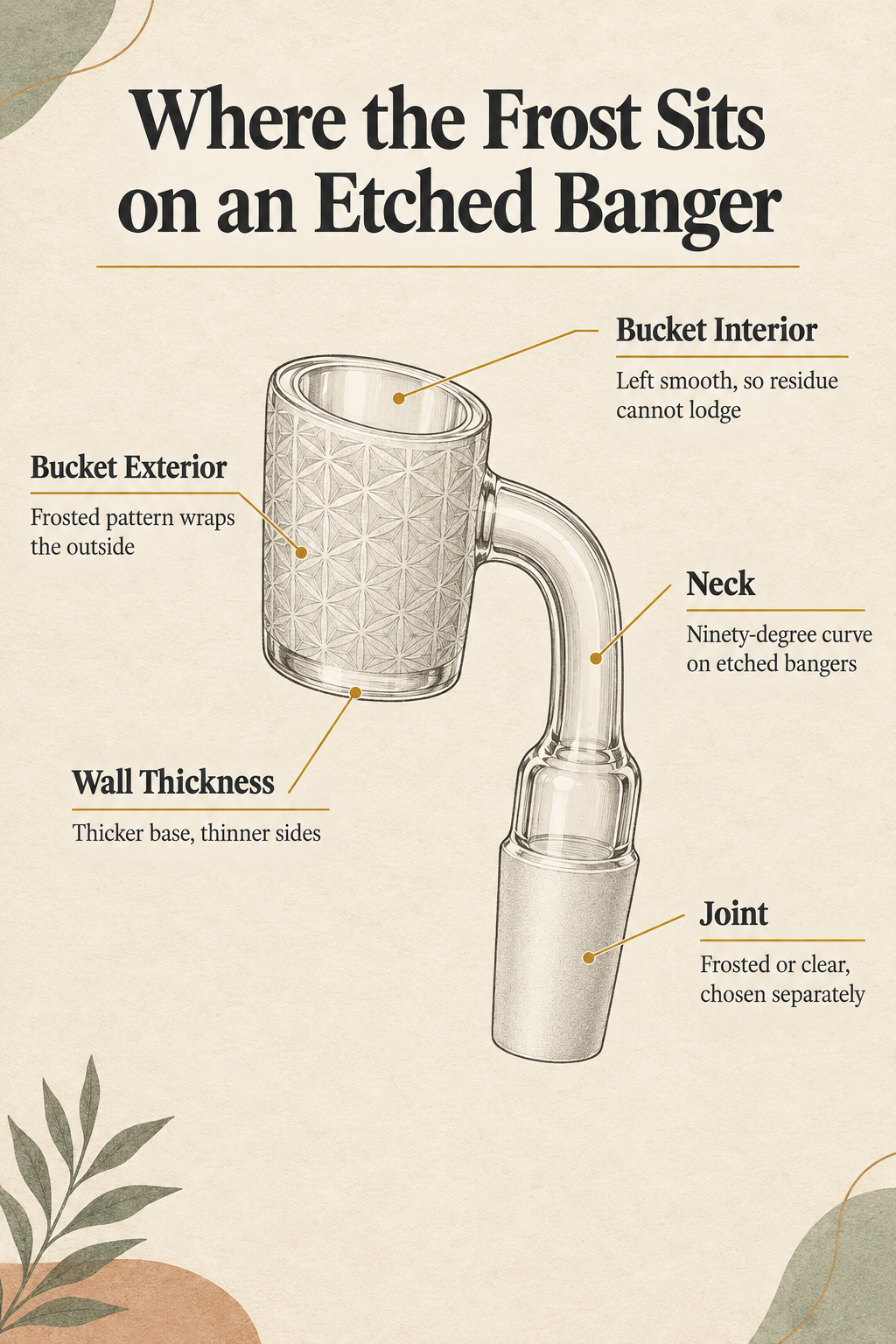
Retail etched bangers are built the same way every time: the frosting and the pattern wrap the outside of the bucket while the inside of the cup stays smooth. The listings state it plainly, describing an all-over frosted exterior with etched patterns on the bucket, a smooth interior for even heating, and a frosted surface that adds grip when capping and swabbing [18].
Custom etching guidance draws the same line for a harder reason. Keep decorative work on the neck, the joint, and the outer surfaces, because a roughened bucket interior creates micro-irregularities that affect heat distribution and trap residue that is very hard to clean out [20]. That guidance and the retail build agree rather than conflict.
The part buyers get wrong is assuming that etched tells you anything about the joint. Within our own range, the Pulsar Cellular Mosaic etched banger has a frosted male joint on a 90-degree neck [21], while the Interlocking Diamonds etched quartz banger has a clear ground joint [22]. Pattern and joint finish are separate choices. Sizing is written just as loosely: the same male joint gets listed as 14 mm on one page and 14.5 mm on others, which is a naming difference rather than two different joints [19]. Match by what seats without force. If frosted quartz is new to you, browse the Quartz Bangers category and compare necks side by side before ordering.
- Bucket exterior: frosted, and where the pattern lives. This is the surface that also gives your fingers something to hold when you cap and swab.
- Bucket interior: smooth by design. A roughened interior changes how heat spreads across the floor of the cup and holds residue the swab cannot reach.
- Joint: frosted or clear ground, chosen separately from the pattern. Two bangers with the same etch can arrive with completely different joints.
- Neck: usually a 90-degree curve on etched flat-top bangers, which sets the angle the piece sits at in the rig.
- Wall thickness: a typical 14.5 mm male flat-top measures about 4 mm at the bottom of the bucket and 2 mm at the sides, at roughly 20 g [19].
- Sizing label: 14 mm and 14.5 mm describe the same joint family on the same piece of glass, so read the numbers as naming convention rather than a spec difference.
Does Etching Make the Glass Weaker or More Likely to Break?
Strength is a surface question, not only a composition question, and quartz suppliers say so directly. Performance depends on factors beyond expansion coefficient, including surface condition, which defines strength, and geometry [11]. That is the whole argument in one line, because an etch is a change to the surface.
What no source establishes is a measured penalty. No maker of etched smoking accessories publishes strength testing, and nothing in the published material shows an etched pipe is either weaker or stronger than the same pipe left clear. The honest position is that the etch changes the surface and the surface governs strength, not that etching halves the wall or doubles it.
The properties that do apply are the ones under the pattern. Borosilicate 3.3 is specified at a coefficient of expansion of 33 x 10^-7 per K with a strain point of 515 C and an annealing point of 565 C, and its datasheet recommends using the strain point as the maximum service temperature [12]. Fused quartz sits near 5 x 10^-7 per degree C with a softening point between 1600 and 1710 C depending on the fusion method [11].
Published maximum working temperatures conflict across suppliers. One reference lists 1160 C continuous for electrically fused quartz [11], while another gives approximately 900 C maximum continuous use and notes the limit depends on grade [13]. Any single max-temp figure should be read as supplier- and grade-specific rather than as a property of quartz in general. The one laser-specific caveat is really a manufacturing caveat: glass that is not fully annealed can shatter from its own internal stress when the beam hits it, and tempered glass cannot be laser engraved at all [8].
Practically, that means the visible risk in this category is not the frost. It is the same risk that applies to any glass piece: a knock against a hard edge, a sudden temperature swing, or a joint forced into a taper it does not fit. If you are buying broader glassAccessories, the same handling rules carry over.
- What the sources say: surface condition defines strength, and an etch is a modification of surface condition.
- What the sources do not say: a number. There is no published comparison of the same pipe etched and left clear.
- Substrate baseline, borosilicate: expansion of 33 x 10^-7 per K, strain point 515 C, annealing point 565 C, with the strain point recommended as the practical ceiling.
- Substrate baseline, quartz: expansion near 5 x 10^-7 per degree C and softening between 1600 and 1710 C, with maximum continuous use quoted anywhere from about 900 C to 1160 C depending on supplier and grade.
- Process limits rather than product limits: unannealed glass can fail at the laser, and tempered glass cannot be laser marked at all.
- Where breakage actually comes from: impact, thermal shock, and forced joints, not the decorative surface.
How Do You Clean an Etched Pipe Without Clouding the Pattern?
Start with the surprise that generates the most support questions: an etched glass pipe can arrive cloudy straight out of the box. A widely reproduced manufacturer note warns that the finishing process may leave a light residue on the pipe exterior that clouds the glass, and that wiping the exterior with an isopropyl alcohol cleaner and letting it dry restores a brighter look [17]. A hazy new piece is finishing residue, not a defect in the pattern.
From there the routine is short. Wipe the exterior after a session, before oils settle into the frost, and use alcohol on the outside rather than soaking the piece. Frost holds oils differently from clear glass, and the longer they sit, the more work they take to lift.
Avoid the dishwasher entirely. Machine dishwashing causes glass corrosion, the clouding and iridescence that cannot be polished out, and it accumulates over repeated cycles rather than appearing after a single wash [26]. Industry guidance is explicit that even water alone can cause corrosion under machine-dishwashing conditions, and that applied decoration is not resistant to those stresses [26][12].
Then keep one chemistry away: fluoride-containing cleaners. Hydrofluoric acid is the one common acid that dissolves glass, and both borosilicate 3.3 and fused quartz are documented as attacked by it [9][12][11]. Quartz resists almost everything else, which makes fluoride the exception worth remembering. The finish itself also has an asymmetry worth knowing: an acid-etched surface has much finer imperfections than a sandblasted one and produces a satin etch that is easier to keep clean, while a coarser blasted frost gives larger micro-craters that hold more [1][4]. That is the practical argument for a fine etch on a piece you plan to use daily rather than display.
- Wipe the exterior after each session with a soft cloth, before oils have a chance to settle into the frost.
- Wipe the exterior with an isopropyl alcohol cleaner, then let it dry fully. This also handles the residue haze on a brand-new piece.
- Keep the piece out of the dishwasher permanently, including on a short or delicate cycle.
- Skip any cleaner whose label mentions fluoride or hydrofluoric acid, and skip abrasive scouring powders that scratch both frost and clear glass.
- Store it where it will not rub against other glass, since a frosted surface shows scuffs more readily than a polished one.
- Check the joint and neck for chips when you clean, because those are the places that matter for how the piece seats.
What Do the Etched Pieces at Treehouse Lifestyle Actually Cover?
A catalog pull dated 2026-11-14 returns seven in-stock etched SKUs spanning a $10.99 fused-quartz banger up to a $124.50 dual-chamber water pipe [24]. They are genuinely different objects rather than one finish in several sizes, which is the clearest illustration of how little the word etched pins down.
The bangers alone cover three different builds. There is the Pulsar Cellular Mosaic etched banger at $10.99 with a frosted male joint [21], the Interlocking Diamonds etched quartz banger at $16.99 with a laser etched pattern and a clear ground joint [22], and a 12-count Grateful Dead x Pulsar etched quartz banger display at $119.90 in 14 mm male [25].
The rest of the range runs from quartz parts to full glass. The Etched Quartz Pillars 5-pack sits at $49.99, the Death Row Records metallic etched glass spoon at $16.00 [15], a 4-count Hiya Cat electroplated etched glass spoon bundle at $44.00, and the Pulsar Dub Chamber electro-etched water pipe at $124.50, which is 13.75 inches tall with a 14 mm joint, twin jellyfish percolators, and a metallic damask etch [23].
The hand pipes in the group share a build, and the manufacturer listings are consistent about it. The etch wraps the outside of a borosilicate body, with a built-in carb hole and a tapered mouthpiece, in 4-inch and 4.75-inch lengths [16][15]. The inside of the bowl and the airway is not the decorated surface. If spoons are what you are after rather than bangers, the Hand Pipes category is the place to compare body lengths and finishes.
- Pulsar Cellular Mosaic etched quartz banger, $10.99: frosted male joint, 90-degree neck, flat-top bucket.
- Interlocking Diamonds etched quartz banger, $16.99: laser etched pattern, 90-degree neck, clear ground joint.
- Etched Quartz Pillars 5-pack, $49.99: small quartz parts rather than a piece you hold.
- Grateful Dead x Pulsar etched quartz banger 12-count display, $119.90: 14 mm male, sold as a display.
- Death Row Records metallic etched glass spoon, $16.00: etched logo with metallic gold lettering on a matte sandblasted background.
- Hiya Cat electroplated etched glass spoon bundle, 4 count, $44.00: plated finish over an etched pattern.
- Pulsar Dub Chamber electro-etched water pipe, $124.50: 13.75 inches, 14 mm joint, twin jellyfish percolators, metallic damask etch.
- Buying checklist: confirm which surface is frosted, whether the joint is frosted or clear ground, whether any metal fill sits in the pattern, and whether the piece is likely to end up near a dishwasher.
Frequently Asked Questions
Is the pattern on an etched pipe printed on or cut into the glass?
It is cut into it, in the sense that a thin layer of the surface is removed or fractured. A resist mask decides where the attack happens, and the exposed glass is then either blasted with abrasive grit, dissolved with fluoride acid, or micro-fractured by a CO2 laser. There is no ink or decal layer holding the design.
Is etched glass the same as frosted glass?
In everyday trade use, yes. Etching, sandblasting, and engraving all get applied to any frosted glass design, and on glass a laser’s etch and a laser’s engrave describe the same frosted mark. The words point at different processes more often than at different looks.
Why does my brand-new etched pipe look cloudy?
Finishing residue. Manufacturer notes reproduced on retailer pages warn that the process may leave a light film on the exterior that clouds the glass, and that wiping the exterior with an isopropyl alcohol cleaner and letting it dry brings the brighter look back. It is not a flaw in the pattern.
Can the design on an etched pipe rub off?
The etch cannot, because the mark is in the material rather than printed on it. What can wear is a separate applied layer, such as pigment, gilding, or metal fill sitting in the etched recess, and metallised finishes are documented as failing under abrasion and caustic washing.
Should a quartz banger be etched inside the bucket?
No. Custom etching guidance keeps decorative work on the neck, joint, and outer surfaces, because a roughened bucket interior creates micro-irregularities that affect heat distribution and trap residue that is very hard to clean out. Retail etched bangers follow the same rule, frosted outside and smooth inside.
Will a dishwasher dull an etched design?
It is the wrong tool for the piece. Machine dishwashing causes glass corrosion, clouding and iridescence that cannot be polished out, and it accumulates over repeated cycles. Industry guidance notes even water alone can cause corrosion under machine conditions, and applied decoration is not resistant to those stresses.
So What Does the Pattern on an Etched Pipe Actually Change?
It changes the surface, and the surface is the part you touch, look at, and clean. A mask decided where the frost landed, grit or acid or a laser produced it, and no layer was added on top. That is why the pattern survives handling while an applied fill sitting in the recess may not.
The practical takeaways fit in a short list. Two pieces with the same word on the listing can be a fine satin etch or a coarse blast, with very different cleaning behavior. Metallic means a sealed coating, so read the shine as the delicate part and the frost as the durable part. On a banger, the pattern belongs on the outside of the bucket and the pattern says nothing about the joint. And a cloudy new piece is residue, not a fault.
Buy accordingly: check which surface is frosted, confirm the joint finish, note whether metal fill sits in the pattern, and keep the piece out of the dishwasher. Everything else is detail you can see in a photo, and Treehouse Lifestyle includes free shipping on orders $150+.
Sources
- Artistry in Glass: What is the difference between sandblasting & etching?
- Sandcarver: Introduction to Sandblasting
- GRAPHICS PRO: Tips and Tricks: Sandcarving Odd-Shaped Substrates
- Henglihong Abrasive: Abrasive Media for Sandcarving & Glass Etching
- Epilog Laser: Laser Etching & Engraving Glass
- Boss Laser: Laser Engraving FAQs
- Laser Focus World / Industrial Laser Solutions: Understanding and Optimizing Processes: A Technical Look at Three Common CO2 Laser Processing Topics
- GRAPHICS PRO: What actually happens to glass when it is being etched with a CO2 laser?
- Oregon OSHA: Hydrofluoric acid
- U.S. Occupational Safety and Health Administration: Highly Hazardous Chemicals as it applies to aqueous solutions of hydrofluoric acid
- Heraeus Covantics: Properties of fused silica
- STEREON Glassfilters (Robuglas): Borosilicate Glass 3.3 Data Sheet (Boro33)
- Top Seiko Co., Ltd.: Fused Silica Glass / Borosilicate Glass – Custom Machined Parts
- SGSBOTTLE: Electroplating Glass: How the Metal Layer Bonds in 3 Stages
- Pulsar: Death Row Records Metallic Etched Spoon Pipe
- Pulsar: Grateful Dead x Pulsar Etched Spoon Pipe | Steal Your Face
- SMOKEA: Pulsar x Grateful Dead Etched Spoon Pipe
- Discreet Smoker: Quartz 14.5 mm Male 90 Degree Frosted Flat-Top Banger – Etched Designs
- SPS Wholesale: 14.5 mm Male Frosted Flat-Top Quartz Banger with Design – BS771
- Oil Slick: Custom Glass Banger Etching & Personalization 2026
- Treehouse Lifestyle: Pulsar Quartz Banger – Cellular Mosaic Etched
- Treehouse Lifestyle: Interlocking Diamonds Etched Quartz Banger
- Treehouse Lifestyle: Pulsar Dub Chamber Electro Etched Water Pipe | 13.75 in | 14mm F
- Treehouse Lifestyle (WooCommerce Store API): WooCommerce Store API – product search for ‘etched’
- Treehouse Lifestyle: 12CT Display – Grateful Dead x Pulsar Etched Quartz Banger – 14mm M
- Arbeitskreis Glas (AKG), Compendium of practice for Commercial Dishwashing: Section 09 – Glass wash items