

A linework glass pipe is striped color built into the wall itself, and the swirl is decided long before the pipe is shaped. A glassworker pulls cane, colored glass rods, lays those rods in parallel on a clear tube and fuses them in, then twists the heated tube both ways so the straight lines travel into a spiral.
The patterned section is then sealed and flipped inside out, shaped, and cooled slowly in a kiln. The color ends up sitting behind clear glass, which is why it reads as depth rather than as paint on a surface.
What Does Linework Mean on a Glass Pipe?
Pipe-trade glossaries describe linework from slightly different angles, and the two descriptions agree on the thing that matters. One defines linework as striped colored patterns built into a glass pipe, with the stripes most often spiraled or wig-wagged rather than left straight [1]. Another words it as a style of glassblowing featuring clean, precise colored lines running through the glass, often in a swirling or symmetrical pattern [2].
What separates linework from most listing language is that the color is in the glass, not on it. The word describes a construction method, not a finish. Twist, swirl and spiral all get used loosely for the same family of work, and linework is the broadest of the four.
Listings also mix categories that are not the same kind of thing. Spoon, Sherlock, hammer and chillum are shapes. Borosilicate is a material. Fumed, dichroic and inside out are techniques [8]. One pipe can sit in several of those boxes at once, which is why a title like "inside out linework swirl spoon" is technically accurate and still confusing to read.
Linework belongs to the specialty pipe family, and every piece in the current Treehouse Lifestyle pull is a spoon [12]. If you want to see the shape range the technique lands on, browse the full Hand Pipes range or narrow straight down to Glass Hand Pipes.
- Linework, glossary one: striped colored patterns built into the pipe, usually spiraled or wig-wagged rather than straight.
- Linework, glossary two: clean, precise colored lines running through the glass, often in a swirling or symmetrical pattern.
- Loose words you will meet: twist, swirl and spiral all describe the same family of work, and all are narrower or vaguer than linework.
- Shape names that get bundled in: spoon, Sherlock, hammer, chillum.
- Material name that gets bundled in: borosilicate.
- Technique names that get bundled in: fumed, dichroic, inside out, reversed.
How Is the Swirl Pattern Inside a Linework Pipe Actually Built?
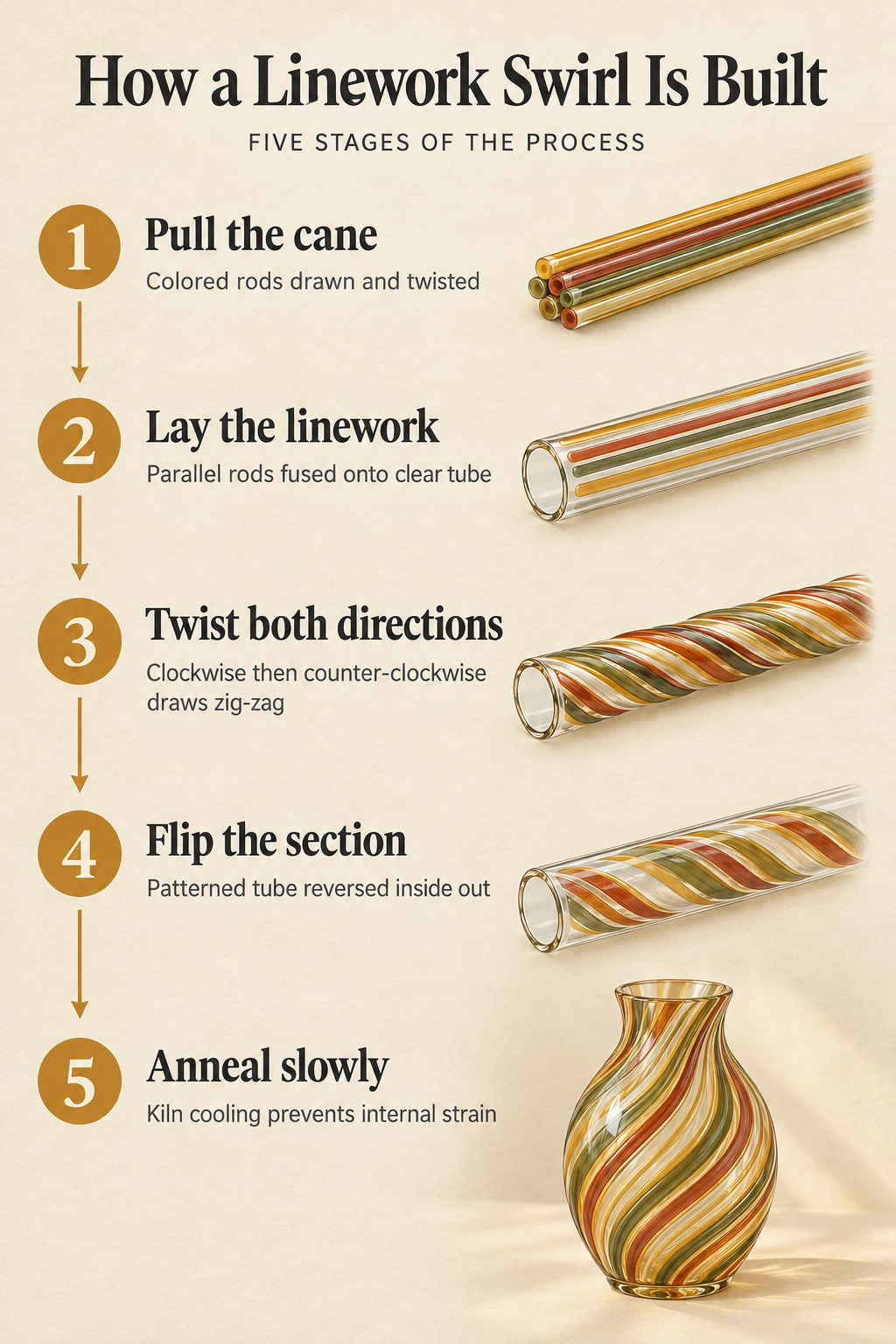
The build runs in a fixed order, and each step narrows what the next one can do. The pattern is set before the pipe has a shape at all, which is the part most buyers never see in a listing photo.
The hard part of that sequence is the twist. It only works inside a narrow working temperature. Too cool and the lines crack or refuse to move, too hot and they smear into mud [6]. So the pattern is as much a temperature problem as a design problem, and a glassworker’s control at that one moment decides the whole piece.
None of this is folklore. The Corning Museum of Glass keeps a pipe-making research guide that catalogues step-by-step technique resources, including a walkthrough of producing a flameworked inside-out pipe, plus magazine issues covering wig-wag, reversal and cane work [11].
If you want to compare the bodies this pattern lands on, What Is a Spoon Pipe and How Does It Work? covers the spoon, What Are the Different Types of Hand Pipes? lays out the wider shape family, and What Are Specialty Pipes and How Do You Choose the Right One? puts the whole category in context. When you are ready to narrow down, How Do You Choose a Hand Pipe That’s Right for You? walks through the fit questions.
Two related techniques are worth reading next to this one. Why Does a Fumed Glass Pipe Change Color? explains color that comes from fume rather than from cane, and How Is an Etched Glass Pipe Made, and What Does the Pattern Actually Change? covers pattern cut into the surface instead of built into the wall.
- Pull the cane. Bundled colored rods are drawn out while hot, with a twist worked in, so the color pattern is locked into the rod before it ever touches a pipe.
- Lay the linework. Parallel colored rods are laid onto a clear tube and fused in place, still running straight at this stage.
- Twist clockwise. The heated striped tube is turned one direction, drawing the straight lines out of true.
- Twist counter-clockwise. Turning back the other way pulls the lines into a zig-zag, which is where a wig-wag pattern comes from.
- Seal and reverse. The patterned section is closed off and physically flipped inside out.
- Shape the piece. The reversed section is worked into its final spoon, hammer or chillum form.
- Anneal in the kiln. The finished piece cools slowly so the glass does not stay strained [10].
What Is a Glass Cane, and Why Does It Decide How the Pattern Reads?
A cane is a thin single-color rod, or a composite rod of bundled colors fused so that a polychrome design stays visible in cross-section [3]. That cross-section is the whole trick. A cane is not a stripe painted on; it is a slice of a pattern that runs the entire length of the rod.
Cane pulling is its own craft. A compact mass of hot glass is stretched, sometimes to twenty meters or more, and more complicated designs are made by attaching previously made canes to a contrasting rod and twisting the tools as the cane is drawn [3].
The twisted version has names that predate pipe making by centuries. Zanfirico is a polychrome cane made by assembling a bundle of colored rods, heating it soft, attaching it to two pontils and drawing it out while twisting, so the spiral is locked into the rod itself [4]. The Corning dictionary lists vetro a retorti, Italian for glass with twists, as blown glass made with canes twisted into spiral patterns, and lists zanfirico as a synonym [5].
This is why the pattern shifts as the pipe takes shape. Because the design lives in the cross-section, every cut and every change in wall thickness shows a slightly different slice, so the swirl near the bowl is never the same slice as the swirl near the mouthpiece. A listing that says color canes are suspended inside the glass walls is describing exactly this arrangement [12].
- Single-color cane: one thin rod of one color, drawn out to a workable diameter.
- Composite cane: bundled rods fused together so a multi-color design survives in cross-section.
- Twisted cane: a bundle drawn out while being rotated, so the spiral is built into the rod rather than added later.
- Zanfirico and vetro a retorti: the historic names for twisted-cane glass, still the same underlying idea.
- Why it matters to a buyer: the pattern is stored in the cross-section, so it changes as the wall changes shape.
Is Linework the Same Thing as Wig-Wag, Reversal, or a Swirl?
Shops use several words for overlapping work, and it helps to know which ones are trade terms and which are just description. Linework is the broadest. A wig-wag is a design of striped colors sharply waving back and forth with a spiral at each end, also called a reversal, and trade glossaries list it as a form of linework [1].
The cleanest way to hold the relationship is the line one explainer gives: all wig-wag is reversal work, but not all reversal is wig-wag, because straight-line reversals and spirals exist too [6]. Reversal is the technique. Wig-wag is one pattern that technique produces.
Wig-wag is also a family rather than a single design. A glassblowing gallery lists zippers, spirals, reversals, bitchwindows and beachballs as patterns sitting inside the wider wig-wag family [7]. Another glossary defines wig wag and reversal separately, as decorative twisting and folding of colored glass [2].
Swirl and twist are descriptive words rather than technical ones: useful in a listing title, vague as a spec. The historic Venetian names for twisted-cane glass almost never appear on a pipe listing either, even when the cane work underneath is the same idea.
- Linework: the broad term for colored lines built into the glass, usually not left straight.
- Reversal: the technique, where a striped section is twisted and then flipped inside out.
- Wig-wag: one pattern made with that technique, with stripes waving back and forth and a spiral at each end.
- Zipper, spiral, beachball, bitchwindow: further patterns inside the wig-wag family.
- Swirl and twist: loose description, useful to a shopper and meaningless as a spec.
- The one-way relationship: all wig-wag is reversal work, but not all reversal is wig-wag.
| Term | What it names | Where it sits in the build |
|---|---|---|
| Linework | Striped color built into the glass | The broad term for the color work |
| Reversal | Striped section twisted, then flipped inside out | The technique |
| Wig-wag | Stripes waving back and forth, spiral at each end | One pattern made with reversal |
| Swirl, twist, spiral | Loose description with no fixed spec | Listing language, not a spec |
What Does Inside Out Mean on a Linework Hand Pipe?
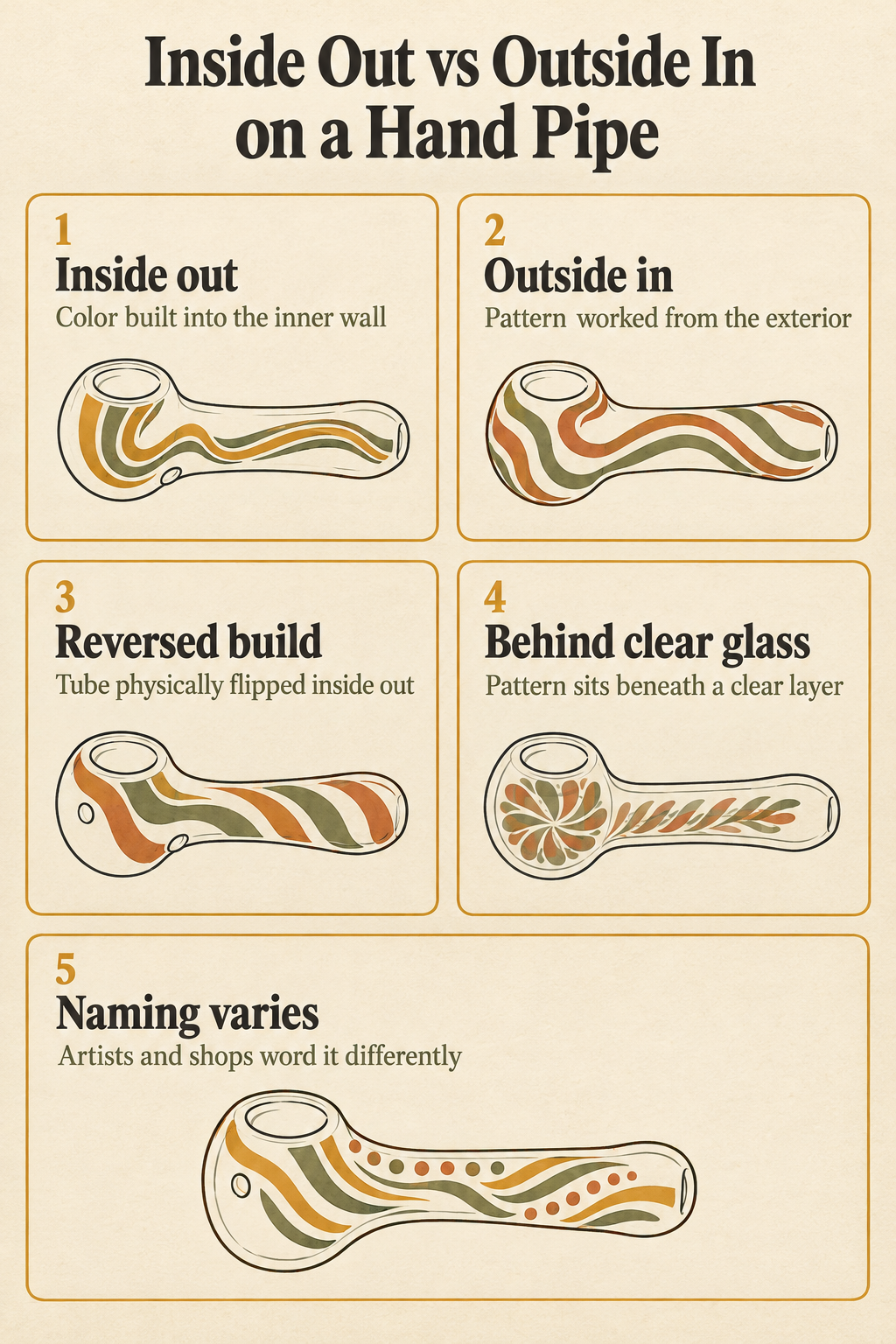
Inside out describes where the decoration sits in the build, not how the pipe is shaped. It means decoration built into the construction of the glass rather than applied to the outside surface, with lines, dots and patterns formed in layers of hot glass that are then encased and shaped as the piece develops [8].
Outside in is the paired term. It describes pattern built and manipulated from the exterior before more shaping or encasing changes how it reads, and the source is candid that the exact technique varies considerably from artist to artist [8].
This is where listings get slippery. Hand-pipe guides use inside out for color worked into the inner wall of a pipe. Reversal guides use reversed for a patterned tube flipped inside out [6]. Both accounts end with the pattern sitting behind clear glass, but they are naming different steps in the build. Neither usage is wrong; they answer different questions.
Treehouse listing language follows the hand-pipe convention. The Inside Out Linework Swirl spoon describes color canes suspended inside the glass walls, visible beneath a clear outer layer, in borosilicate, made in the USA [12]. That is a description of construction, not a claim about how the piece behaves.
- Inside out: color formed in layers and then encased, so the pattern sits behind clear glass.
- Outside in: pattern worked and manipulated from the exterior, then shaped or encased over.
- Reversed: a patterned tube physically flipped inside out, which is a build step rather than the same word as inside out.
- What the three share: the finished pattern reads through a clear outer layer.
- What varies: artists and shops word all three differently, so read the description rather than trusting the label alone.
Why Do Two Linework Pipes With the Same Pattern Never Look Identical?
Small differences in length, color placement, bowl shape and decorative detail are normal in handmade glass, so two pieces built from the same basic pattern will not come out identical [8]. That is a property of the process, not a defect to negotiate over.
Two process reasons explain most of it. First, the twist has to land inside the narrow heat window described above, so hand control at that moment means the lines never fall in exactly the same place twice [6]. Second, annealing. Glass cooled too quickly stays strained, may break as it cools or later, and breaks easily under mechanical or thermal shock [10]. Where a piece sits in the kiln schedule changes how it comes out.
So read a product photo as representative rather than exact. The shot is one piece from a run. The piece in your hand can differ in where the color sits, how wide a stripe runs, or how tightly the spiral closes, and nothing is wrong with it.
- Length: hand-shaped pieces settle slightly differently from one another.
- Color placement: where a stripe lands depends on the twist that day.
- Bowl shape: worked by hand, so the proportions drift a little between pieces.
- Decorative detail: a spiral can close tighter or looser from one piece to the next.
- How to read a photo: representative of the pattern, not a guarantee that the exact piece shown is the one you receive.
How Can You Tell Careful Linework From Rushed Linework Before You Buy?
Four visible signals do most of the work, and you can check them against a decent listing photo before you order anything [6]. Run them in this order, because each one is easier to judge once the one before it has passed.
Then confirm the details a photo cannot show. Is the material stated as borosilicate, the low-expansion glass that uses boric oxide as its flux rather than alkali [9]? Does the description name the technique, inside out or reversed, or only the color? And for handmade work, the anneal question is a manufacturing detail worth asking about, since a strained piece is the one that fails under stress [10].
Keep the questions proportionate. None of these checks tells you how a piece will perform in use; they tell you how carefully it was made [8]. Pattern quality and build quality are separate questions, and the four checks below are about the second one.
- Stripe width. It should stay even through the twists. Stripes that widen and pinch usually mean the heat was fought rather than controlled.
- The seam. The pattern should meet itself cleanly around the circumference, with no obvious join where the two ends come together.
- The clear layer. It should be glassy and free of bubbles, so the pattern behind it stays readable.
- Color density. The color behind the clear layer should stay dense and saturated rather than thin or patchy.
- The photos. Check whether the listing actually shows the seam and the underside, or only the top of the bowl.
- The words. Look for the technique named in the description, whether that is inside out, reversed or linework, and not just a color name.
- The material. Confirm borosilicate is stated rather than assumed.
Can a Linework Pattern Wear Off, and Which Linework Pipes Are Available Now?
The pattern is not going to wash away, with one honest caveat. Because the color sits inside the glass wall instead of on it, one trade guide says it cannot be scrubbed off, bleached or damaged by normal cleaning, while still warning against thermal shock [6]. The design survives cleaning. The piece itself can still be broken by temperature extremes, and that is a separate issue from the stripes.
The material point comes from the Corning Museum of Glass: borosilicate uses boric oxide as its flux instead of alkali, was first made by Otto Schott in 1882, and has a low coefficient of expansion that lets it withstand sudden changes of temperature [9].
The current Treehouse Lifestyle pull lists four linework spoons in stock: the Inside Out Linework Swirl Hand Pipe Spoon at $19.99, plus the Colorburst Linework Spoon Pipe, the Vibrant Linework Twist Spoon Pipe and the Inside Out Linework Hand Pipe Spoon at $24.99 each [12]. The listings describe color canes suspended inside the glass walls, visible beneath a clear outer layer, in borosilicate and made in the USA [12]. Prices and stock come from that pull and can change.
A higher price is not a shortcut past the checks in the section above. The five dollar gap between those pieces buys a particular look, not a passed inspection. Free shipping on orders $150+ applies at checkout, and if built-in color is the thing you are chasing, the fumed work is the other technique worth understanding.
- Cleaning: the color sits behind the wall, so normal cleaning does not reach it.
- Thermal shock: sudden temperature swings remain the real risk to the piece.
- Material: borosilicate, with boric oxide as the flux and a low coefficient of expansion.
- Price and stock: taken from the current WooCommerce pull and subject to change.
- Not a quality signal: a higher price does not replace the four pattern checks above.
Frequently Asked Questions
What does linework mean on a glass pipe?
It means striped colored patterns built into the glass rather than applied on top of it, usually spiraled or wig-wagged instead of left straight. One glossary frames it as clean, precise colored lines running through the glass in a swirling or symmetrical pattern. Linework is the broad term; twist, swirl and spiral get used loosely for the same family of work.
Is linework the same thing as wig-wag or a reversal?
No, though the words overlap. Wig-wag names stripes sharply waving back and forth with a spiral at each end, and trade glossaries list it as a form of linework. Reversal is the technique behind it. As one explainer puts it, all wig-wag is reversal work, but not all reversal is wig-wag, because straight-line reversals and spirals exist too.
Why does the swirl pattern on my pipe not match the product photo?
Because handmade glass carries small differences in length, color placement, bowl shape and decorative detail, so two pieces built from the same basic pattern will not come out identical. The twist also has to land inside a narrow heat window, which is why the lines never fall in exactly the same place twice.
Can the pattern on a linework pipe fade or wash off?
The color sits inside the glass wall rather than on the surface, so one trade guide says it cannot be scrubbed off, bleached or damaged by normal cleaning. What the same guide still warns about is thermal shock, so temperature swings remain the thing to watch rather than the stripes.
What is a cane, and why does it matter for linework?
A cane is a thin single-color rod, or a composite rod of bundled colors fused so the design stays visible in cross-section. Canes get pulled by stretching hot glass, sometimes to twenty meters or more, and twisted canes of this kind are what carry the stripes into the finished piece.
Does a linework pipe cost more than a plain one?
Not necessarily, and the pattern alone does not set the price. In the current Treehouse Lifestyle pull the four in-stock linework spoons run $19.99 and $24.99, which overlaps entirely with plain spoons. Prices change, so check the listing, and the quality checks in this guide are the part worth paying attention to.
What Should You Look at First on a Linework Pipe?
Look at the seam first, then the stripe width, then the clear layer, then the color density. Those four tell you more about the work than any adjective in the product title, and all four are visible in a decent photo. If a listing will not show you the join where the pattern meets itself, that is information too.
Once the pattern checks out, decide on shape and size, and let price follow. Linework is a construction method: cane pulled, rods fused, striped tube twisted both ways, section reversed, piece shaped and annealed. Two pieces made that way will never be identical, and the difference between listing photo and the piece in your hand is part of how the work is made rather than a flaw in it.
If you are still choosing, start with the shape family before the pattern. Pattern is the last decision, not the first.
Sources
- The Dab Lab: Head Shop Dictionary (Lingo & Terminology)
- The Hippie House: Glass Terms and Techniques
- Corning Museum of Glass, Rakow Research Library: Cane/Murrine: Overview
- Corning Museum of Glass: Zanfirico — Glass Dictionary
- Corning Museum of Glass: Vetro a retorti — Glass Dictionary
- AFM Smoke: What Is Reversal Glass? Wig-Wag and Fume Work Explained
- Bern Gallery: How to Blow Glass (Equipment, Tools & Techniques)
- Simple Glass Pipe: Types of Glass Hand Pipes: Spoon, Sherlock, Hammer & Glass Styles
- Corning Museum of Glass: Borosilicate glass — Glass Dictionary
- Corning Museum of Glass: Annealing — Glass Dictionary
- Corning Museum of Glass, Rakow Research Library: Pipe Making: Pipe Making Techniques
- Treehouse Lifestyle: WooCommerce Store API — linework product pull