

A glycerin pipe is a piece of glass with a sealed, double-walled chamber of glycerin wrapped around the smoke path. Chill that chamber in a freezer and the fill sets into a cold semi-solid, so the smoke passes a chilled section on its way to your mouth without ever touching the gel. That is the entire mechanism: no pump, no battery, nothing to refill.
The naming is where buyers get lost. The same setup sells as a glycerin coil, a condenser coil, a freezable pipe, or a freeze pipe, and one brand turned that last phrase into a product name. Glycerin, glycerine, and glycerol are three spellings of one substance, logged as CAS 56-81-5 [8].
What actually changes between pieces is the format: a hand pipe, a bubbler, a modular water pipe, or a dab straw, plus whether the chilled section comes off or stays sealed inside the body. Here is how the chamber works, how long retailers say to freeze it, when freezing the whole piece is a bad idea, and how to clean and reassemble the glass.
What Is a Glycerin Pipe and Why Do Shops Call It a Freeze Pipe?
Most of the confusion around these pieces is vocabulary rather than engineering. Glycerin, glycerine, and glycerol all name the same liquid, and the trade piles three more terms on top: glycerin coil, condenser coil, and freezable pipe. None of those words describes a different mechanism [8] [6].
The substance itself is a hygroscopic, viscous, colourless liquid that mixes with water. Its melting point is 18 C, its boiling point is 290 C, and its flash point is 176 C [8]. Those three numbers explain most of how a freezable chamber behaves, from why a kitchen freezer can set the fill to why makers are firm about where you point a flame.
The most misleading label is freeze pipe. That one is a brand name, and other shops have adopted it as a generic description, which is why you will see the phrase attached to pieces that brand never made [7] [5]. Glycerin pipe is the category term, and it returns the widest set of results.
When you shop, these pieces tend to sit in predictable places. Treehouse Lifestyle files them under Glass Hand Pipes, Bubblers and Bongs. That placement is a useful hint before you click: the same freezable technology shows up in a straight hand pipe, a bubble-shaped piece, and a full water pipe.
- Glycerin, glycerine, glycerol. One substance under three spellings, all pointing to the same fill.
- Glycerin coil. The trade term for the sealed spiral section wrapped around the smoke path.
- Condenser coil. An older name for that same part, still used by several retailers [6].
- Freezable pipe and freeze pipe. Loose category descriptions that any shop may use for any brand.
- Freeze Pipe. A maker name that has leaked into generic use, so check who actually built the piece [5].
How Does the Glycerin Chamber Actually Work?
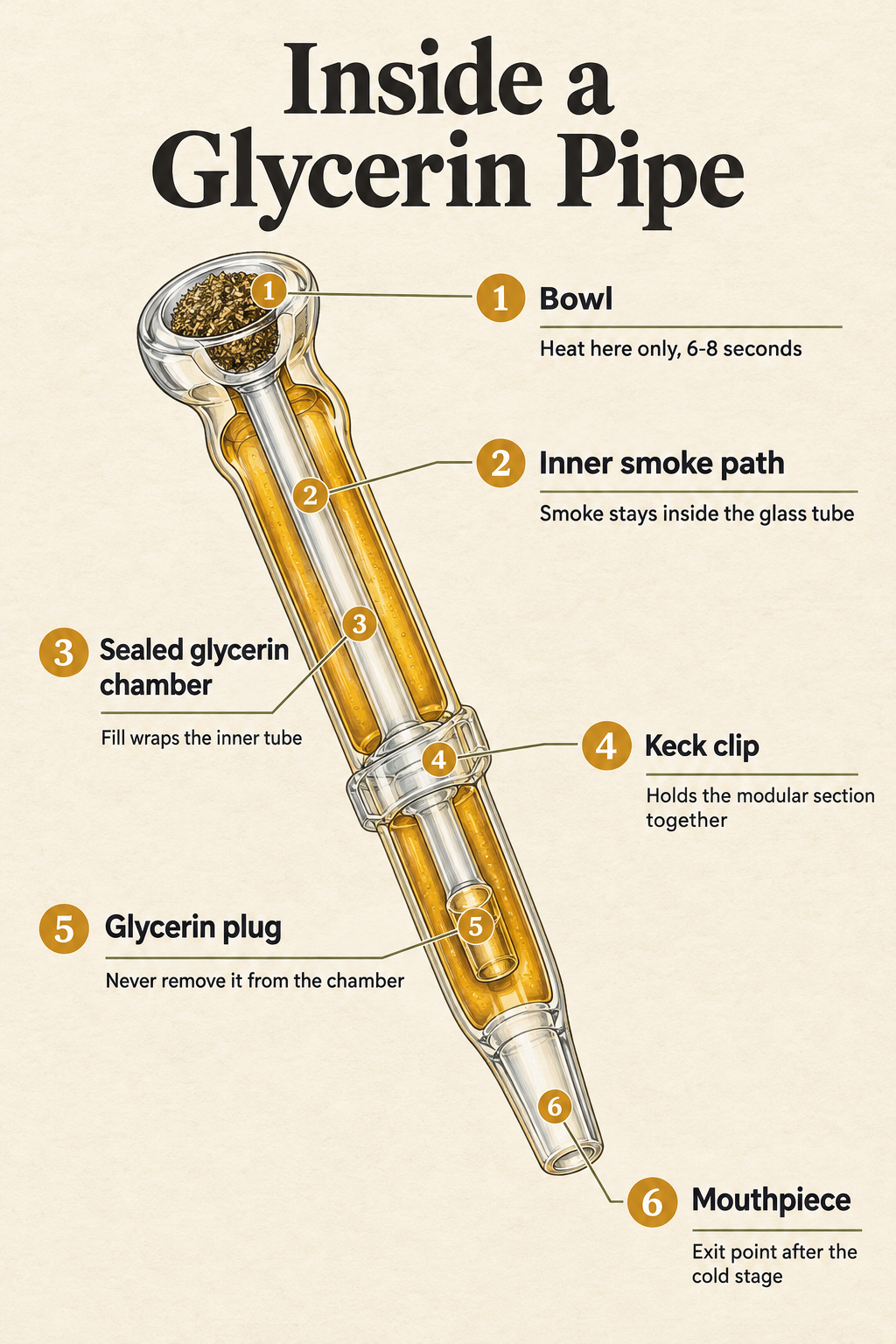
Follow the smoke and the object makes sense. It starts in the bowl, travels down an inner glass tube, passes through a section wrapped in a sealed jacket of glycerin, and exits at the mouthpiece. At no point does the fill enter that path [1] [7].
The freezer trick works because of the melting point. Glycerol sets at 18 C and a home freezer runs well below that, so the fill arrives as a cold semi-solid rather than a liquid [8]. Retailers state that the fill does not expand as it freezes, and that is their stated reason a sealed chamber comes through repeated freezer cycles [5] [9].
The chamber is sealed for a reason. Pulsar’s instructions say the glycerin plug must never be removed, and every product page reviewed here repeats that rule [1] [3]. The chemical card adds context: glycerol decomposes on heating to give corrosive fumes, which is why the fill sits inside its own glass envelope and away from the bowl [8].
That sealing also explains the modular versions. When the chilled section unclips from the base, you freeze the cold part on its own and handle the chamber as a separate object instead of moving the whole piece [2] [6].
If this is your first pipe of any kind, pair the anatomy below with a wider read. See What Are Hand Pipes and Bubblers, and How Do They Differ? for the family these pieces belong to, How Do You Choose the Right Bubbler for You? if a water stage appeals to you, and What Are the Different Types of Hand Pipes? for how the individual shapes differ. Glass vs Silicone Smoking Accessories: Which Should You Choose? is useful if you are still weighing glass against other materials, and Ice Water or Warm Water in a Bong: What Actually Changes? covers the water-temperature side of the same question.
- Bowl. Heat goes here and nowhere else. Pulsar caps it at 6 to 8 seconds of flame [1].
- Inner smoke path. A glass tube that carries smoke from the bowl toward the mouthpiece without meeting the fill.
- Sealed glycerin chamber. The double-walled jacket of fill wrapped around that inner tube, and the part you chill [5].
- Keck clip. A clip that holds the modular joints together so the chilled section stays seated [6].
- Glycerin plug. The sealed port on the chamber. Leave it in place, because no reviewed page supports opening it [1].
- Mouthpiece. Where smoke leaves, after it has passed the chilled section [7].
What Kinds of Glycerin Pipes Can You Buy?
Three build formats cover almost everything on a shelf. One is a detachable glycerin-filled neck or top on a modular water pipe. The second is a chamber sealed into the body of a single-piece hand pipe. The third is an aftermarket glycerin slide or attachment that drops into a joint you already own [3] [6].
Within those formats, the details vary more than the technology does. The Pulsar Chillr hand pipe is a 7.5-inch borosilicate spoon with a double-walled glycerin stem, a built-in screen, and a carb on the left side [1]. The Kryo bubble pipe runs 6 inches and markets its fill as Kryogel rather than glycerin, which is a branding choice rather than a different system [12].
Modular water pipes look different again. The Chillr straight tube is 13 inches with a 14mm female joint at a 45-degree angle, a flared base, a slitted diffuser downstem, and two clips holding the glycerin section in place [2].
Concentrate users get their own version. The glycerin dab straw is 8.5 inches of borosilicate filled with freezable glycerin around an internal cooling spiral, with a threaded connection and swappable quartz and titanium tips. The instruction is to freeze it for an hour with the tip removed [13].
One warning about fill names: when a maker invents a term like Kryogel, the piece is still a sealed chamber you freeze. Ask what the fill is before you assume a proprietary name means a proprietary mechanism.
- Single-piece hand pipe. A straight spoon with the chamber sealed into the stem, so the whole body goes cold [1].
- Bubble hand pipe. A shorter, rounder body with a bubble mouthpiece, often sold under a maker’s own fill brand [12].
- Modular water pipe. A base plus a detachable glycerin neck that unclips, so only the top section gets frozen [3].
- Straight tube bong. A taller modular design with a diffuser downstem, a flared base, and two clips on the chilled section [2].
- Glycerin dab straw. A narrow tube with a spiral inside, a threaded tip connection, and a freezer routine that requires removing the tip first [13].
- Aftermarket attachment. A glycerin slide or coil that fits an existing joint, which only works if the size and angle match [6].
How Long Should You Freeze a Glycerin Pipe?
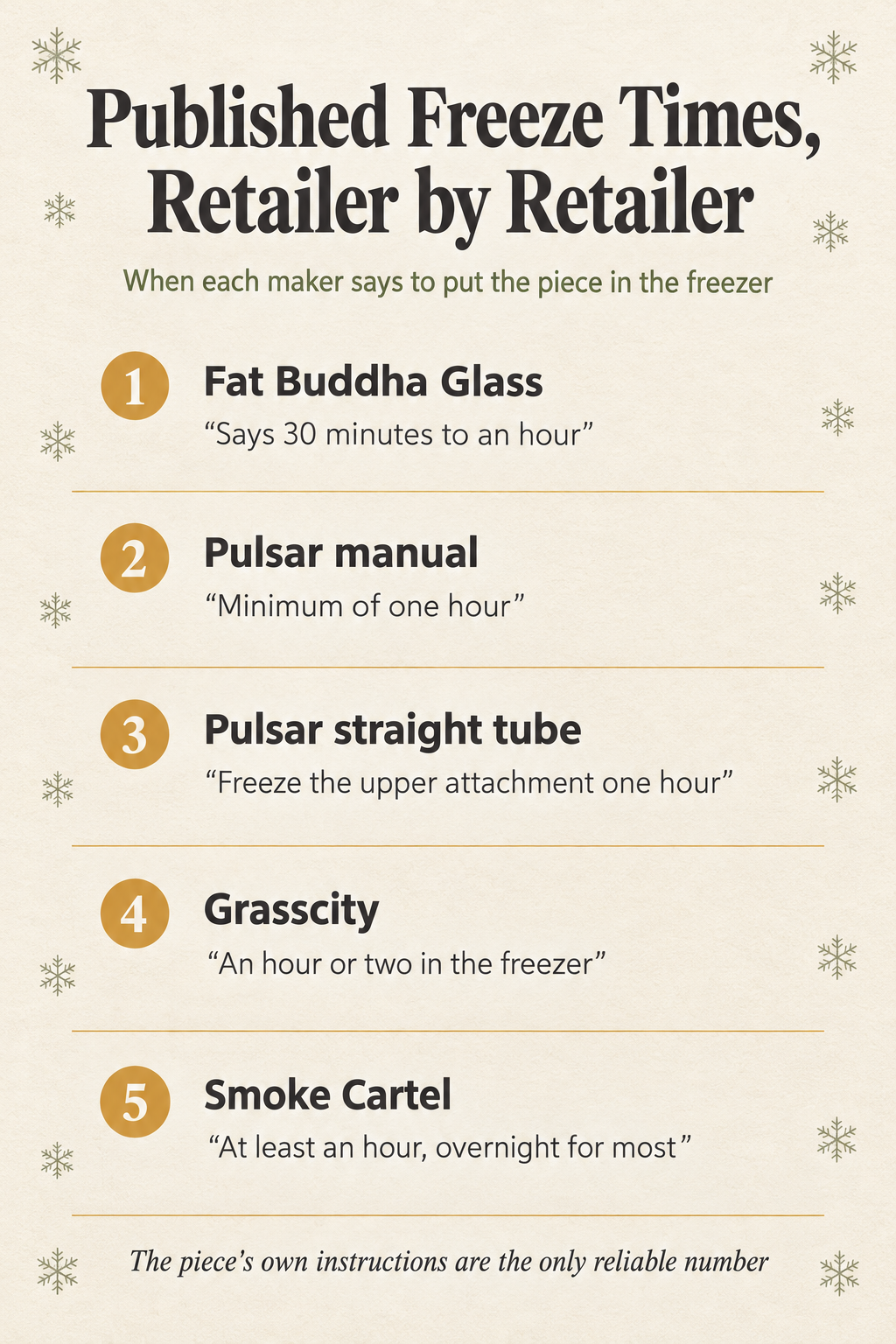
Published freeze times do not agree, and the spread is worth seeing before you pick a number. Fat Buddha Glass says 30 minutes to an hour [9]. Pulsar’s manual says a minimum of one hour [3]. Pulsar’s straight tube page says to freeze the upper attachment for one hour [2]. Grasscity says an hour or two [10]. Smoke Cartel says at least an hour, with overnight for the coldest result [7].
Read that spread as a clue about how the pieces differ rather than a contradiction to resolve. A thin hand-pipe stem chills faster than a full modular neck, and the only number that accounts for your wall thickness and your freezer is the one in your own piece’s instructions.
The warm-up rule is the part most buyers miss. Pulsar’s hand-pipe page says to give the bowl at least 10 minutes after it leaves the freezer before applying heat. It then caps the flame on the bowl at 6 to 8 seconds [1]. That guidance appears on the product page but not in the Chillr manual, which covers freezing, assembly, and cleaning, so a buyer reading only the manual never sees it [3].
On how long the cold lasts, makers claim roughly an hour of usable cold from a one-hour freeze and say that window shrinks in warm rooms and with frequent hits [5] [10]. Take with suspicion any harder number: Freeze Pipe prints a figure of smoke cooled by 300 degrees, and its page does not show a test behind it [5].
- Separate the chilled section if it detaches. Removing the glycerin top or neck is the first step in the instructions, and only that section goes in [3].
- Freeze it for at least an hour. That is the floor nearly every source lands on, and longer is fine [7].
- Reassemble and secure the clip. A modular piece needs the joint seated and the clip in place before you use it [2].
- Let the bowl sit for 10 minutes. Pulsar’s warm-up rule applies after the freezer, before any heat [1].
- Apply heat to the bowl for 6 to 8 seconds only. The flame goes on the bowl, not on the chilled glass [1].
- Refreeze between sessions. The cold window is temporary, and room temperature erodes it [10].
Should You Freeze the Whole Pipe or Only the Chamber?
This is the one point in the category where the sources genuinely disagree, and the disagreement runs along the build type rather than along brand loyalty.
Pulsar’s manual explicitly allows single-piece pipes to go into the freezer whole, which makes sense for a design with no removable chamber [3]. Against that, Badass Glass warns never to put an entire bong in the freezer because the glass can crack, and Freeze Pipe says the same. Smoke Cartel goes further and says only the insert should be frozen [6] [5] [7].
The deciding factor is whether your piece comes apart. If the chilled section detaches, freeze that section alone and leave the base at room temperature. If the chamber is sealed into a one-piece body, follow that piece’s own instructions, because the maker knows the wall thickness you are working with [2].
Notice what the warnings are actually about: whole bongs, not whole hand pipes. A 7-inch spoon and a 13-inch water pipe are not the same object to put in a freezer. A rule written for one does not transfer to the other.
- Pulsar manual. Single-piece pipes may go into the freezer as a whole unit [3].
- Badass Glass. Never freeze an entire bong, because the glass can crack [6].
- Freeze Pipe. Same warning against freezing a full water pipe [5].
- Smoke Cartel. Only the insert belongs in the freezer [7].
- Deciding condition. Detachable chamber means freeze the chamber; sealed chamber means follow that piece’s instructions [2].
| Source | What it tells you to freeze |
|---|---|
| Pulsar manual | Single-piece pipes go in whole; modular tops come off first |
| Badass Glass | Never freeze an entire bong, because the glass can crack |
| The Freeze Pipe | Same warning against freezing a full water pipe |
| Smoke Cartel | Only the insert belongs in the freezer |
| Pulsar straight tube page | Freeze the upper attachment on its own for an hour |
Which Glycerin Pipe Fits How You Actually Use It?
Turn the format list into a decision. A hand pipe suits someone who wants a pocketable piece with no water to carry, and the sealed-chamber versions are the simplest expression of the technology: one object, one freezer routine [1].
A bubbler adds a water stage in something you still hold in one hand, which is a different experience from a straight spoon. A modular water pipe is a further step, because the chilled chamber sits after the water and works as a second stage rather than the only one [7]. A dab straw is the concentrate equivalent, and it freezes with the tip off [13].
The range on shelves today is wider than most buyers expect. Treehouse Lifestyle carries seven in-stock glycerin pieces from $28.99 to $209.99, running from a small hand pipe up to a 16-inch water pipe kit. They are filed across hand pipes, glass hand pipes, spoon pipes, bongs, and dab rigs [11]. Ordering carries free shipping on orders $150+, which matters once you are looking at the water-pipe end of that spread.
If you already own a pipe and only want the chilled part, check joint size and joint angle before buying an attachment. Fit depends on the joint and on how much room the piece gives you [10].
- Portability. A hand pipe travels; a water pipe does not, and a modular neck travels better than a full base [1].
- Water or no water. A bubbler or water pipe adds a water stage, while a spoon does not [7].
- Detachable or sealed. A detachable neck is easier to freeze and easier to clean than a one-piece body [2].
- What you load. Flower goes in a bowl, concentrates go on a dab straw tip [13].
- Attachment fit. Joint size and joint angle decide whether an aftermarket coil will work on your existing pipe [10].
Can You Add Ice to a Glycerin Pipe Too?
Sometimes, and the sources do not line up on which models qualify. AFG Distribution lists a 3-pinch ice catcher on the Chillr straight tube, which would let you add ice as a second option [4]. Pulsar’s own page for the same piece markets it as chilling without ice, and its parts list has no ice catcher at all [2].
That is not a scandal so much as a lesson about listing copy. A distributor sheet and a manufacturer page can describe the same 13-inch tube differently, so read the parts list on the page you are actually buying from if ice matters to you.
Where both exist, understand the order of operations. On a water-pipe model the chilled chamber is a second stage, so smoke is diffused through water first and then passes the frozen section on the way to the mouthpiece [7] [5]. The glycerin does not replace the water and the water does not replace the glycerin.
On a hand pipe there is no water and usually no ice catcher, so the freezer is the only cooling step you have. That is the trade you accept for a piece that fits in a jacket pocket.
- Glycerin only. One chill stage, a freezer, and no ice to buy or carry [2].
- Glycerin plus ice. Two chill stages on models that actually list an ice catcher, which one distributor does for the straight tube [4].
- Where the ice goes. In the neck above the water, not in the glycerin chamber, which stays sealed.
- What to check before buying. The parts list on the listing, because manufacturer and distributor sheets can disagree on the same model [2].
How Do You Clean and Reassemble a Glycerin Pipe?
Cleaning is where a glycerin piece differs most from ordinary glass, and the retailers converge on the same routine. Separate every part first, then keep the sealed chamber away from anything abrasive or hot.
For the chamber itself, Pulsar’s manual specifies 91% isopropyl alcohol on the glycerin top [3]. Freeze Pipe adds coarse salt to the alcohol for glass that has built up residue [5]. Badass Glass recommends a room-temperature rinse rather than hot water, which keeps the glass away from sudden temperature swings [6].
Reassembly is the step people rush. Seat the joints fully, then secure the clip or clips so the chilled section cannot shift mid-session [2]. Two clips on a straight tube are there for a reason, and using one is not the same as using both.
Handle the sealed chamber like the one part you cannot repair. Do not remove the plug, do not put a flame near the fill, and stop using a piece whose chamber has a visible crack. Every reviewed page routes back to the same rule: the chamber is sealed and stays that way [1].
- Take the piece apart. Remove the glycerin top or neck, the downstem, and the bowl before cleaning anything [3].
- Clean the chamber with 91% isopropyl alcohol. That is the concentration the manufacturer specifies [3].
- Clean the base with alcohol and a stem brush. The non-chilled glass takes the normal routine.
- Add coarse salt for built-up residue. Salt scours what alcohol alone leaves behind [5].
- Rinse at room temperature. Skip hot water, which is the one thing retailers warn against here [6].
- Reassemble and clip. Seat the joints, then secure every clip before the next session [2].
Frequently Asked Questions
How long do you freeze a glycerin pipe?
Published guidance runs from 30 minutes to an hour at one retailer and an hour or two at another shop. The manufacturer’s manual sets a minimum of one hour, and Smoke Cartel says at least an hour, with overnight freezing for the coldest result. Because the numbers disagree, use your own piece’s instructions as the number that counts. One hour is the figure nearly every source agrees on as a floor.
Can you put a whole glycerin bong in the freezer?
It depends on the build, and the sources genuinely conflict. The Pulsar manual says single-piece pipes can go in whole, while other retailers warn against freezing an entire bong and say only the insert should go in. The practical reading: if the chilled section detaches, freeze that section alone; if the chamber is sealed into a one-piece body, follow that piece’s own instructions.
Does the glycerin in a pipe freeze solid and crack the glass?
Retailers state the fill does not expand as it freezes, which is their stated reason a sealed chamber survives repeated freezer cycles. The fill does become a cold semi-solid at freezer temperatures. Whichever piece you own, keep the glycerin plug in place, because every product page reviewed says the chamber is sealed and must not be opened.
Do you have to let a glycerin pipe warm up before you light it?
Pulsar’s hand-pipe page says yes: after the freezer, give the bowl at least 10 minutes before applying heat. It then caps the flame on the bowl at 6 to 8 seconds. That guidance appears on the product page but not in the instruction manual, so a buyer reading only the manual would miss it. It costs nothing to follow, so follow it.
Is a glycerin pipe better than an ice catcher?
They do different jobs, and some water pipes can carry both. An ice catcher holds ice in the neck of a bong, while a glycerin chamber is a sealed section of the glass that you chill in a freezer. On a water-pipe model the chilled section sits after the water, so smoke passes through water first and the cold glass second rather than choosing between the two.
Which Glycerin Pipe Should You Buy First?
Start with the piece that matches where you actually use it. If you want something to drop in a pocket, a sealed-chamber hand pipe is the simplest version of this technology: one piece, no water, and a freezer routine measured in minutes. If you already know you like a water stage, buy the modular design. The chilled section unclips, so you never have to freeze the whole body.
Two rules carry across every format. Keep the fill sealed, and follow your own piece’s instructions over any number you read online, because the published freeze times disagree by a factor of four [9] [3] [10].
And read the marketing copy as marketing. Food-grade wording, temperature-drop figures, and percentage comparisons are sales language. The mechanism you can verify is simpler than the pitch: a sealed chamber, a fill that sets at 18 C, and glass that gets cold in a freezer [8].
Sources
- Pulsar: Pulsar Chillr Glycerin Hand Pipe
- Pulsar: Pulsar Chillr Glycerin Straight Tube Bong
- Pulsar: Chillr Instruction Manual (PU-0922-25)
- AFG Distribution: Pulsar Chillr Glycerin Straight Tube Glass Water Pipe – 13in / 14mm F / Blue
- The Freeze Pipe: Cooling Hand Pipes | Freezable Glass Pipes
- Badass Glass: What is a Glycerin Coil? How do they work?
- Smoke Cartel: What Is a Freeze Pipe? How the Glycerin Coil Works
- ILO / WHO International Chemical Safety Cards (ICSC 0624): GLYCEROL – ICSC 0624
- Fat Buddha Glass: Freezable Glycerin Pipes & Bongs
- Grasscity: Freeze Pipe Bongs & Glycerin Coil Pipes
- Treehouse Lifestyle: WooCommerce Store API – glycerin product search
- HEMPER: Kryo Freezable Glycerin Bubble Hand Pipe
- Smokea: Pulsar x Grateful Dead Steal Your Face Glycerin Coil Dab Straw