

A sandblasted glass pipe has had its outer surface abraded by fine grains of sand carried on compressed air. That blasting wears away a thin layer of glass and leaves a pitted, matte surface, which is the same thing the glass trade calls a frosted finish. The change is made to the glass itself rather than applied over it, so there is no coating to peel.
The practical results are a grippier feel in the hand and a body that looks soft and translucent instead of clear. The pitted surface scatters light instead of letting it pass straight through. The pipe’s shape, bowl, and carb stay exactly as they were.
This guide covers how the process works, how it differs from acid etching and sprayed frost, how the finish handles wear and cleaning, and what the sandblasted pieces in the Treehouse Lifestyle catalog actually cost.
What Does Sandblasting Actually Do to a Glass Pipe?
Sandblasting is a mechanical process. The Corning Museum of Glass defines it as removing glass or imparting a matte finish by bombarding the surface with fine grains of sand propelled by compressed air [1]. Abrasive blasting in general works by forcing solid particles across a hard surface at high speed, and the media chosen changes how aggressive the cut is [7].
Glassworking sources describe blasting as one method of etching glass. The longer the blast runs over a given area, the more glass wears away and the deeper the cut goes [2]. Whiteness and opacity are not fixed properties; they are dialled in with the speed and pressure of the abrasive stream [4].
On a pipe, the work happens on the outside only. GRAV says the exterior of its sandblasted pipes has been sandblasted, and MJ Arsenal describes fine particles of sand propelled at high velocity to etch and matte the surface [9][11]. Nothing about the inner bowl, the carb, or the mouthpiece changes.
The result is not a film sitting on the pipe. Both blasting and etching remove material, so there is no added layer that can scratch through or lift at an edge [3]. What you handle afterwards is a new surface of the same glass.
The same frosted surface turns up well beyond small spoons, on Bongs and Glass Hand Pipes alike. The blasting step works the same way on a four-inch piece and a twelve-inch one; only the masking and the handling change.
Here is the sequence a shop follows, in order:
- Clean the glass blank first, so no oil or dust sits between the abrasive and the surface.
- Cover the areas that must stay clear with a stencil or mask, because blasting only affects what is exposed [5].
- Drive the abrasive across the exposed glass with compressed air until the surface turns matte.
- Check depth and whiteness as you go, then keep blasting the same spot to deepen the frost if the design calls for it.
- Leave the masked zones clear, which is how bands, windows, and logo shapes end up standing out inside a frosted body.
- Seal the surface if the shop offers it; a sealer resists dirt and fingerprints on an etched surface [5].
Is a Sandblasted Pipe the Same as a Frosted or Etched Pipe?
In everyday shopping language, sandblasted, frosted, matte, and etched all point at the same look. That is because blasting is itself described as a way of etching glass, and the result is what the industry calls frosted glass [2]. A frosted pipe is therefore very often a sandblasted one.
The trade keeps the routes apart. Sandblasting is the mechanical method, acid etching is the chemical one, and frost coating is an applied layer [3]. Listings rarely make that distinction, so the wording in a product description is a better clue than the label on its own.
Several Treehouse listings name the process outright. The MJ Arsenal Sandblasted Pioneer says high-speed sandblasting etches the borosilicate into a matte frosted finish [15], and the GRAV Sandblasted Spoon describes a sandblasted matte exterior with a soft diffused look [14].
Shape matters as much as finish, and How Do You Choose a Hand Pipe That’s Right for You? is the place to start if you have not settled on one yet. The frosted label shows up across spoons, Sherlocks, and larger forms, and What Are the Different Types of Hand Pipes? covers what separates those shapes. For the most common form in this group, read What Is a Spoon Pipe and How Does It Work?.
Glass type sits underneath all of this, and Borosilicate vs Soda-Lime Glass: What Are You Actually Paying For? explains why borosilicate carries a higher price than soda-lime. If the shape you want falls outside the standard forms, What Are Specialty Pipes and How Do You Choose the Right One? covers the specialty side.
- Sandblasted: usually means abrasive blasting was used, which cuts the surface and leaves a grainier, brighter white.
- Frosted: a look, not a method. Frosted glass is produced by either sandblasting or acid etching, so the word alone tells you nothing about how it was made [6].
- Matte: a description of how light behaves on the surface, used loosely across all three routes.
- Etched: a real method word, but in everyday use it covers both blasting and acid work.
- Frost coated: the one label that points to an added layer rather than a change to the glass itself.
How Does Sandblasting Compare With Acid Etching and Frost Coating?
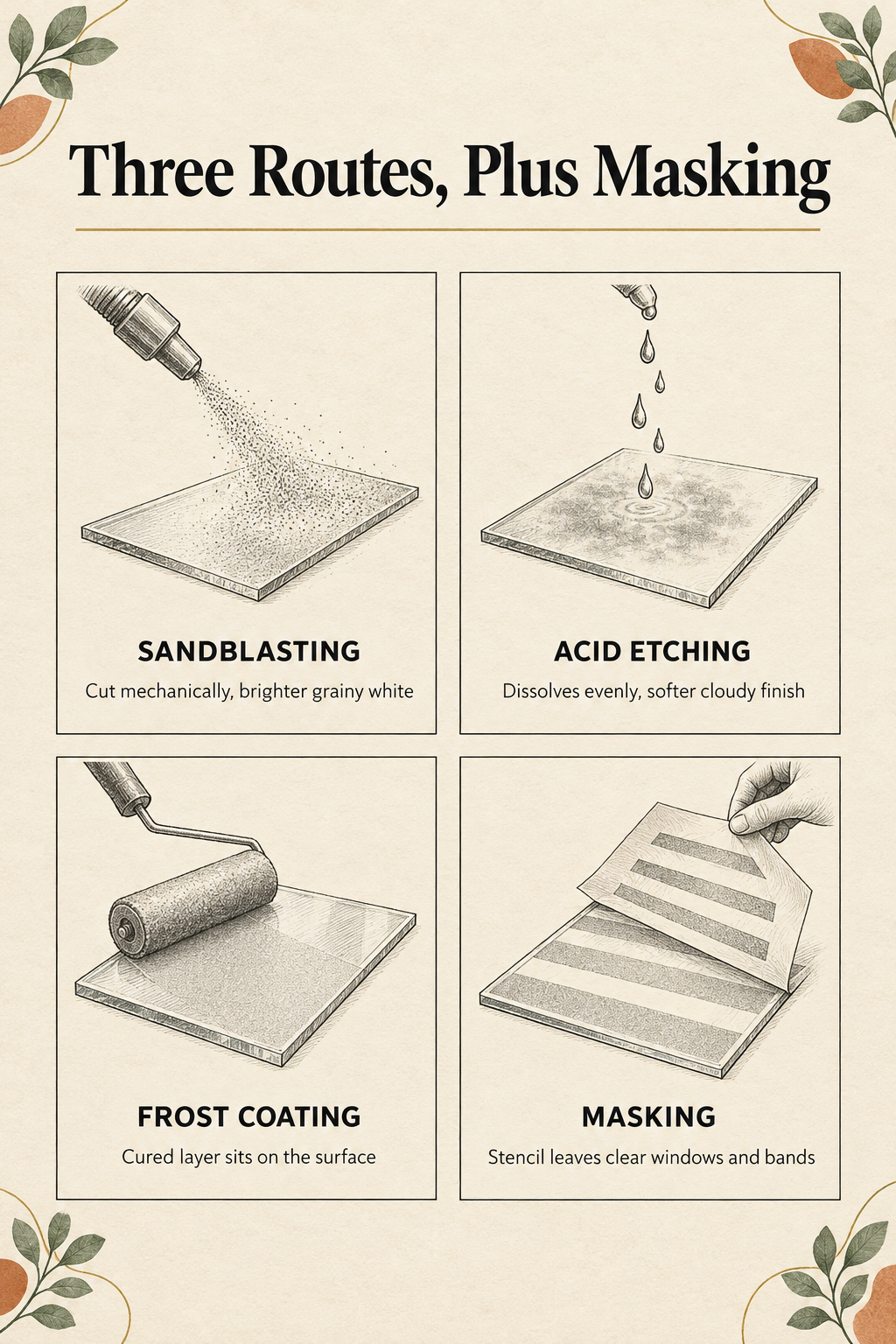
All three routes end with a surface that no longer reads as clear glass, but they get there differently. Sandblasting cuts the surface mechanically. Acid etching dissolves it. Frost coating adds something on top.
The difference shows up in the texture. Blasting leaves a coarser, grainier, brighter white with a texture you can feel, while acid etching produces a softer, cloudier, more uniform finish [3]. Blasting is generally the rougher of the two techniques [4].
Durability is the part buyers care about most. Blasting and etching both remove material, so there is nothing sitting on the surface to scratch through. A cured frost coating is the one route that behaves like a layer [3].
Masking works the same way in both removal methods. The glass is cleaned and covered with a stencil so only the exposed areas are worked, which is how clear windows, bands, and logo shapes are left inside an otherwise frosted surface [5].
The table below puts the three routes side by side on the points that decide how a piece will age.
- Feel is the fastest test. A fingertip run across the surface finds a grain on blasted glass, a silkier drag on acid work, and a smooth face on a coating [3].
- Look at the white. Blasting reads brighter and grainier, acid etching reads softer and cloudier, and a coating reads flat and even [3][4].
- Ask what changed. Wording about abrasive or chemical work means the glass itself was altered; wording about a cured, sprayed, or applied finish points to a coating [3].
- Read masking as a step, not a route. Any clear window, band, or logo inside a frosted body came from a stencil protecting that area [5].
| Route | How it works | Surface it leaves | Wears through? |
|---|---|---|---|
| Sandblasting | Abrasive grains driven by compressed air | Coarse, brighter white, grainy to the touch | No, the glass itself is cut |
| Acid etching | A chemical dissolves the surface evenly | Soft, cloudy, and uniform | No, the glass itself is dissolved |
| Frost coating | A coating is cured onto the surface | Flat and smooth | Yes, it is a layer on top |
| Masking | A stencil step, not a method of its own | Clear windows, bands, and logo shapes | Not applicable |
Does the Frosted Finish Wear Off, Fade, or Rub Away?
The short answer is no, not the way a printed or sprayed finish can. Blasting removes glass rather than adding a coating, so the texture is part of the pipe’s surface [3]. There is no film to peel, flake, or wear into a patchy pattern.
Depth is a process setting rather than a fixed property. The longer the blast runs over one area, the more glass wears away and the deeper the cut [2]. Two pipes with the same design can therefore have slightly different frost depth, and a heavier cut will hold its look longer than a light one.
What changes with handling is visible oil. Frosted surfaces hold skin oils in their texture and show them as dull marks [3]. A frosted piece can look handled sooner than a clear glass one, and that is a cosmetic signal rather than damage to the finish.
Treehouse’s own copy on the GRAV Sandblasted Spoon credits the finish with adding grip and hiding minor wear [14]. The grip half lines up with published notes on the friction of frosted glass. The wear-hiding half is a brand claim, and no independent test located for this guide confirms it, so read that part as a description of the look rather than a measured property.
- Permanent: the texture, because it is cut into the glass rather than applied to it [3].
- Permanent: the pattern, as long as the masking was right during blasting [5].
- Not permanent: the clean look, because the surface collects oils and shows them as dull patches.
- Variable: the exact depth of the frost, which depends on how long the blast ran over that area [4].
- Brand claim only: that the finish hides minor wear [14].
Will a Sandblasted Pipe Show Fingerprints and Need Different Cleaning?
Yes to both, and neither is a problem if you stay ahead of it. The pitted surface holds oils, so marks appear sooner than they would on clear glass, and a quick dry wipe is the everyday answer. Glass-industry guidance for etched surfaces adds a second rule: clean them regularly with a glass-specific cleaner, because soil left sitting on a textured surface can stain it and cause damage that will not come back out [5].
Abrasive powders and scouring pads work against you here. They cut material by design, and on a frosted surface they add fresh scratches instead of lifting oil out of the texture.
An ordered routine keeps the surface from ever getting bad enough to need scrubbing. Work through these steps in sequence rather than reaching for the harshest option first:
- Empty and rinse the bowl as soon as a session ends, before oils have a chance to set.
- Wipe the outside with a dry, lint-free cloth while the glass is still slightly warm; this clears the handled look in seconds.
- Between deeper sessions, apply a glass-specific cleaner inside the bowl and let it sit for the time the label gives.
- Rinse thoroughly and dry completely before storing, so nothing stays trapped in the texture.
- Store the piece where it is not knocking against other glass, since a textured surface scuffs against neighbours.
Does Sandblasting Make a Glass Pipe Weaker or Easier to Break?
Glass strength is very sensitive to the condition of its surface, and a controlled study found that surface damage equivalent to twenty years of natural weathering cost every glass type tested some strength [8].
That study has limits worth naming. It measures long-term erosive wear on architectural glass, not the shallow decorative frost applied to a pipe during manufacturing, and it does not test borosilicate. No source located for this guide publishes a strength figure for a sandblasted glass pipe. The accurate framing is that the finish changes the surface, and no measured breakage penalty for pipes is available.
What borosilicate brings to this group is separate from the finish. Its coefficient of thermal expansion is about 3 x 10^-6 per kelvin at 20 degrees Celsius, which is why it resists thermal shock better than other common glasses [13]. Every sandblasted piece examined for this guide is borosilicate, per GRAV’s spec sheet and MJ Arsenal’s product page [10][11].
- Documented: glass strength depends heavily on surface condition, and long-term surface damage reduces it [8].
- Not documented: any measured strength loss from the decorative frost on a glass pipe.
- Not tested in that study: borosilicate, the material used in every piece here [13].
- Documented: borosilicate’s low thermal expansion, which is why it handles temperature swings better than soda-lime glass.
- Handling: a drop or a knock is the likeliest way a hand pipe breaks, so grip and storage matter more than the finish.
Which Sandblasted Glass Pipes Does Treehouse Lifestyle Carry?
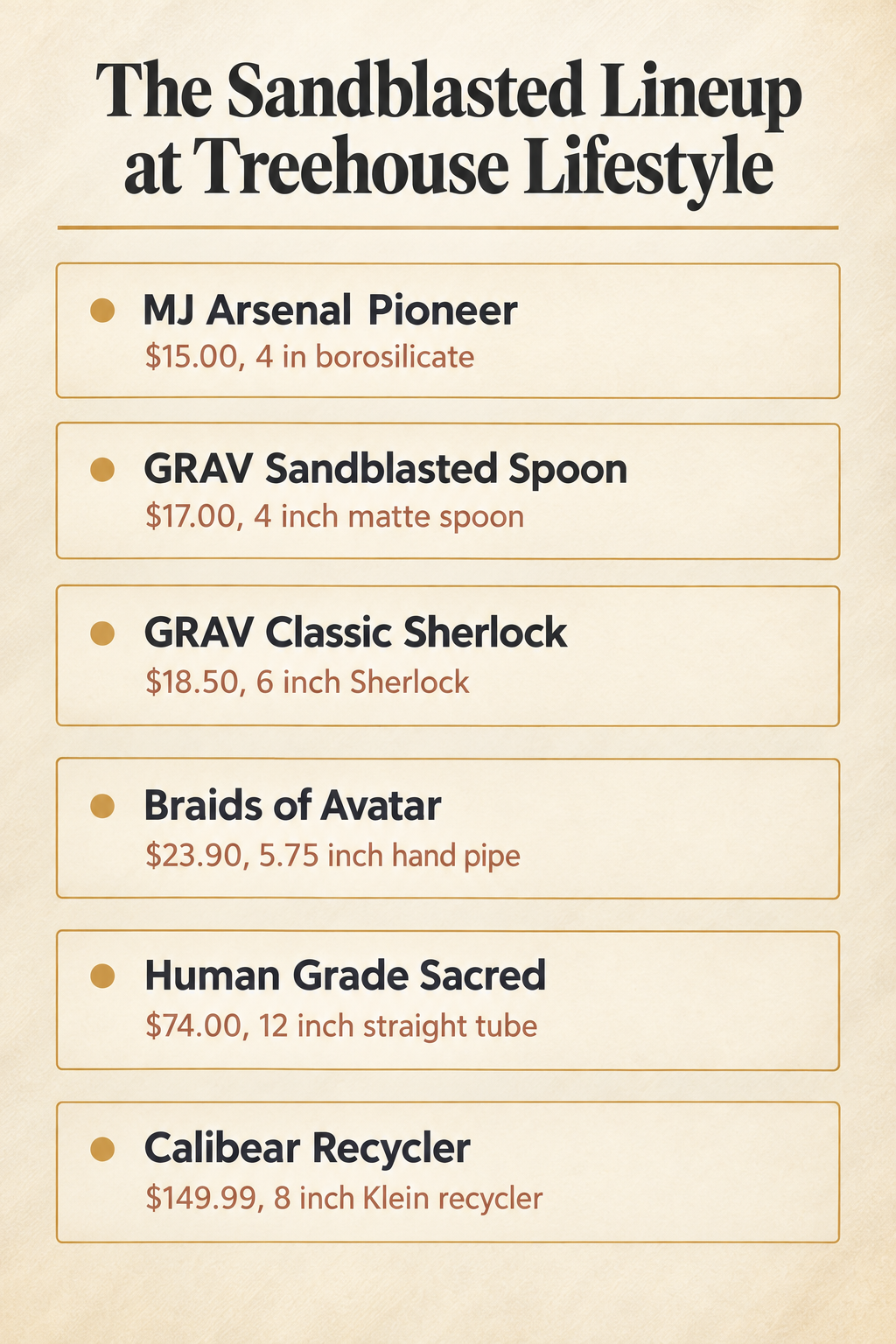
Treehouse Lifestyle lists eight sandblasted glass pieces across hand pipes and water pipes, priced from $15.00 to $149.99. All prices were verified against the WooCommerce Store API on November 13, 2026 [17].
At the hand pipe end, the range runs from the 4-inch MJ Arsenal Sandblasted Pioneer at $15.00 to the 5.75-inch Braids of Avatar Sandblasted Glass Hand Pipe at $23.90 [15][18]. The GRAV Sandblasted Spoon and the GRAV Sandblasted Pebble Spoon both sit at $17.00, and the GRAV Sandblasted Classic Sherlock is $18.50 [19][20].
The same finish appears on bigger glass. The 12-inch Human Grade Sacred Straight Sandblasted Glass Water Pipe is $74.00 and the 8-inch Calibear Sandblasted Showerhead Klein Recycler is $149.99 [16][17].
GRAV runs the finish as a full line rather than a single SKU, listing seven dry-flower hand pipes from $17.99 to $34.99 across spoon, Sherlock, Gandalf, and Gandalfini shapes [12]. Colors vary on some designs, and individual colorways cycle in and out of stock, so check availability before ordering. Treehouse offers free shipping on orders $150+. The full range sits in Hand Pipes, alongside the rest of the shop’s hand pipe lineup.
- MJ Arsenal Sandblasted Pioneer Spoon Pipe, 4 inches, $15.00, 18.5 mm bowl diameter and 15 mm depth [15].
- GRAV Sandblasted Spoon, 4 inches, $17.00, matte exterior with the carb on the left [14].
- GRAV Sandblasted Pebble Spoon Pipe, 3 inches, $17.00, low-profile pebble shape [19].
- GRAV Sandblasted Classic Sherlock, 6 inches, $18.50, deep bowl and ash-catching mouthpiece [20].
- Braids of Avatar Sandblasted Glass Hand Pipe, 5.75 inches, $23.90, deity-faced bowl and built-in feet [18].
- Human Grade Sacred Straight Sandblasted Glass Water Pipe, 12 inches, $74.00, full-body frost pattern and a 14 mm female joint [16].
- Calibear Sandblasted Showerhead Klein Recycler, 8 inches, $149.99, fixed showerhead percolator and bent neck [17].
- Flower of Leaf Sandblasted Glass Hand Pipe, 4.75 inches, $47.99 and currently out of stock, so worth watching [21].
Frequently Asked Questions
Is sandblasted glass the same as frosted glass?
In practice, yes. Frosted glass is produced either by sandblasting or by acid etching, and both leave the pitted surface that scatters light and makes the glass look soft rather than clear. A listing that says frosted, matte, or etched usually describes the same family of finish you get from blasting.
Can the frost rub off over time?
Not the way a coating can. Sandblasting removes a layer of glass instead of adding one, so the texture is part of the surface rather than a film on top of it. What changes with handling is visible oil: the texture traps it and shows it as dull marks, which a dry wipe clears.
Does a sandblasted pipe hide scratches better than clear glass?
Treehouse’s product copy on the GRAV Sandblasted Spoon credits the finish with adding grip and hiding minor wear. The grip half lines up with published notes on the friction of frosted surfaces. The wear-hiding half is a brand claim, and no independent test located for this guide confirms it, so read it as a description of the look rather than a measured property.
How should I clean a frosted glass pipe?
Wipe it dry after a session before oils settle, then clean regularly with a glass-specific cleaner. Glass-industry guidance for etched surfaces is explicit that soil left sitting on a textured surface can stain it and cause damage that does not reverse, so skip abrasive powders and scouring pads and let the cleaner do the work.
What is the cheapest sandblasted pipe at Treehouse?
The MJ Arsenal Sandblasted Pioneer Spoon Pipe at $15.00. It is a 4 by 1.5 by 1.5 inch borosilicate spoon with a sandblasted matte finish, an 18.5 mm bowl diameter, and a 15 mm bowl depth. The GRAV Sandblasted Spoon and the Pebble Spoon both sit at $17.00.
Does sandblasting weaken the glass?
No measured figure exists for pipes. Published research shows glass strength is sensitive to surface condition and that long-term erosive damage costs strength in architectural glass, but that work does not test borosilicate and does not describe the shallow decorative frost applied to a pipe during manufacturing.
So What Does the Frosted Finish Actually Change?
It changes the surface, not the pipe. A sandblasted glass pipe is the same borosilicate form it would be without the treatment, with a layer of glass cut away so the outside reads matte and soft instead of clear. Nothing is added, so nothing peels.
What that buys you is grip in the hand and a body that scatters light instead of passing it straight through, which is why the piece looks soft rather than clear. What it costs you is upkeep. The texture collects oil, so a dry wipe after each session and a glass-specific cleaner on a regular schedule keep it looking right.
If the finish is the reason you are shopping, the Treehouse lineup covers the whole spread, from a $15.00 four-inch spoon to a $149.99 recycler. Pick the shape and bowl size first, then let the finish decide between the pieces that fit.
Sources
- Corning Museum of Glass: Sandblasting – Glass Dictionary
- Glass.com: What is Sandblasted Glass? – Glass Dictionary
- SGSBOTTLE (MAIDAO Industry): Frosting Glass: 3 Methods, Bands and Gradients
- ToughGlaze: How is frosted glass made? 4 techniques explored
- Clearlight Glass and Mirror: What are the different ways to etch glass?
- Wikimedia Foundation: Frosted glass – Wikipedia
- Wikimedia Foundation: Abrasive blasting (sandblasting) – Wikipedia
- Glass Structures & Engineering (Springer), Datsiou & Overend: The strength of aged glass
- GRAV: GRAV Sandblasted Spoon
- GRAV Wholesale: GRAV Sandblasted Classic Spoon – Colors (SKU SPF.1)
- MJ Arsenal: Sandblasted Pioneer
- GRAV: Sandblasted Pipes collection
- Wikimedia Foundation: Borosilicate glass – Wikipedia
- Treehouse Lifestyle: Grav Sandblasted Spoon
- Treehouse Lifestyle: MJ Arsenal Sandblasted Pioneer Spoon Pipe
- Treehouse Lifestyle: Human Grade Sacred Straight Sandblasted Glass Water Pipe
- Treehouse Lifestyle: Calibear Sandblasted Showerhead Klein Recycler
- Treehouse Lifestyle: Braids of Avatar Sandblasted Glass Hand Pipe – 5.75 in / Colors Vary
- Treehouse Lifestyle: Grav Sandblasted Pebble Spoon Pipe
- Treehouse Lifestyle: Grav Sandblasted Classic Sherlock
- Treehouse Lifestyle: Flower of Leaf Sandblasted Glass Hand Pipe – 4.75 in / Colors Vary