

A hammer bubbler is a single-piece handheld water pipe. The water chamber lies horizontally on a wide flat base, the bowl sits at one end, and the mouthpiece comes off the other end or rises from the side. Because everything is fused into one unit, there is no separate downstem or bowl to lose, and the flat base lets the piece stand on a table between hits. [2] [5]
Buying one comes down to five things, in this order. Does it clear by a carb hole or by lifting a slide? What joint size does it take? How much chamber and body do you want to hold? What happens if it gets dropped, and does the finish matter enough to pay for it? Answer those and the shortlist builds itself.
This guide walks each question in turn, then lines up the five hammer pieces in the Treehouse lineup with current prices and sizes. Everything here is smoking hardware sold as an accessory. Treehouse Lifestyle sells pipes, bubblers and smoking accessories, not cannabis.
What Is a Hammer Bubbler and Why Is It Called That?
The name is a description of the silhouette. A glassmaker fuses a horizontal barrel-shaped chamber to a wide base. From the side the piece looks like a hammer head lying flat, with the mouthpiece acting as the handle. Smoke Cartel puts it plainly: a hammer is a pipe shaped like a gavel. The head of the hammer holds the water and the bowl, and the handle serves as the mouthpiece. [2]
Eyce describes the same object from the holding end, calling it a horizontal barrel body with the mouthpiece angled up at one end and the bowl at the other. [1] Those two descriptions sound different but point at the same shape. The chamber lies down, the base is flat, and the draw point is not directly above the bubbling water.
What matters more than the nickname is the one-piece build. There is no separate downstem to lose, no ground joint to keep clean on most versions, and nothing to assemble before you use it. You fill the chamber, you hold the body, you set it down, and the piece stays where you put it. [5]
That construction is the real line between a hammer bubbler and a dry hand pipe. A dry pipe is a bowl, a tube and a mouthpiece with no chamber to fill, and most dry pipes will not stand on their own. A hammer bubbler adds a water chamber and a base wide enough to sit flat, and it is cleared either through a carb hole or by lifting a slide. [3]
If you want to see how the glass versions look before you commit, Glass Hand Pipes is the closest shelf to browse. Check the shape of the body and the position of the mouthpiece, not the label on the listing. Here are the construction facts you can verify on any hammer bubbler by eye and by hand.
- One fused body: bowl, water chamber and mouthpiece are joined into a single piece of hardware, with no separate downstem on the fixed-bowl versions.
- A horizontal chamber: the barrel lies flat rather than standing upright, which is what gives the piece its hammer profile. [1]
- A wide flat base: the bottom is broad enough that the piece rests on a table instead of rolling or tipping over. [3]
- A bowl at one end: material loads at the front of the body, where you can usually see it while you light it.
- A mouthpiece that comes off the far end or rises from the side of the chamber, depending on the maker.
- A carb hole drilled into the body on fixed-bowl pieces, or a ground joint where a slide sits on jointed ones.
Is a Hammer Bubbler the Same Thing as a Sidecar Bubbler?
Sometimes, and the trade does not use the two words consistently. Both describe a water pipe whose mouthpiece is set away from the bubbling water rather than sitting directly above it. Where sellers disagree is how wide the hammer label should be. [2] [5]
Here is how four sources draw the line.
Smoke Cartel defines hammer as the gavel shape: the water and bowl live in the head, and the handle is the mouthpiece. It calls a sidecar a piece where the mouthpiece is offset to the side of the water chamber, a layout it says moves the draw path away from the bubbling water. [2] Eyce stays with hammer and never uses sidecar, describing a horizontal barrel with the mouthpiece angled up at one end. [1]
Roots Glass separates them cleanly. Hammer means the chamber lies horizontally on a flat base. Sidecar means the bowl and neck come off the side of the chamber rather than sitting on top. [5] Purr Glass uses sidecar for a piece whose mouthpiece extends from the bowl’s side, and frames that offset as a way to keep water out of the mouth. [4]
The sidecar rationale is worth understanding because it is the actual design difference. On a hammer the draw point is at the end of the barrel; on a sidecar it is off to one side of the chamber. Both still pull through water, but on a sidecar the mouthpiece sits out of the path the splash takes when the chamber is moving a lot of water. Gear Patrol describes sidecar as a stem and mouthpiece attached to the side of the chamber specifically to address splash-back. [3]
Roots Glass puts the trade-off the other way. The offset sidecar body sits at a lower centre of gravity, and Roots describes the draw as airier than a hammer’s because of the geometry. So a sidecar is not simply the better version of a hammer. It moves where the mouthpiece sits, and that changes both the splash behaviour and the way the piece pulls. [5]
For a shopper, the practical rule is short: read hammer and sidecar as two names for a family of offset-mouthpiece water pipes, then look at the photo. If the chamber lies flat with the mouthpiece off the end, you are looking at a hammer. If the bowl and neck branch off the side of the chamber, you are looking at a sidecar, whatever the title says.
It also helps to see this shape against the rest of the shelf. How Do You Choose the Right Bubbler for You? compares the other body styles side by side. What Are the Different Types of Hand Pipes? covers the dry-pipe formats, What Is a Steamboat Bubbler and How Does It Work? walks through the steamboat layout, How Do Glycerin Pipes Work and Which One Should You Buy? explains the glycerin options, and How Do You Choose a Hand Pipe That’s Right for You? is the broader buying walkthrough if you have not settled on a body style yet.
- Smoke Cartel: hammer is the gavel shape with water and bowl in the head and the handle as the mouthpiece; sidecar is a mouthpiece offset to the side of the chamber. [2]
- Eyce: a hammer is a horizontal barrel with the bowl at one end and the mouthpiece angled up at the other, with no separate sidecar category. [1]
- Roots Glass: hammer means a horizontal chamber on a flat base, sidecar means the bowl and neck come off the side instead of the top. [5]
- Purr Glass: a sidecar is a piece whose mouthpiece extends from the side of the bowl, which it frames as a way to keep water from splashing into the mouth. [4]
- Where they overlap: every definition puts the draw point away from the bubbling water, which is the one feature all of these pieces share.
- What the disagreement means for you: the words overlap, so the product photo and the spec block tell you more than the title does.
| Source | What it calls a hammer | What it calls a sidecar |
|---|---|---|
| Smoke Cartel | Gavel shape: water and bowl in the head, handle is the mouthpiece | Mouthpiece offset to the side of the chamber |
| Eyce | Horizontal barrel, bowl at one end, mouthpiece angled up at the other | Does not use the term |
| Roots Glass | Chamber lying flat on a base | Bowl and neck coming off the side of the chamber |
| Purr Glass | Not defined separately | Mouthpiece extending from the side of the bowl |
How Does a Hammer Bubbler Pull Smoke Through Water?
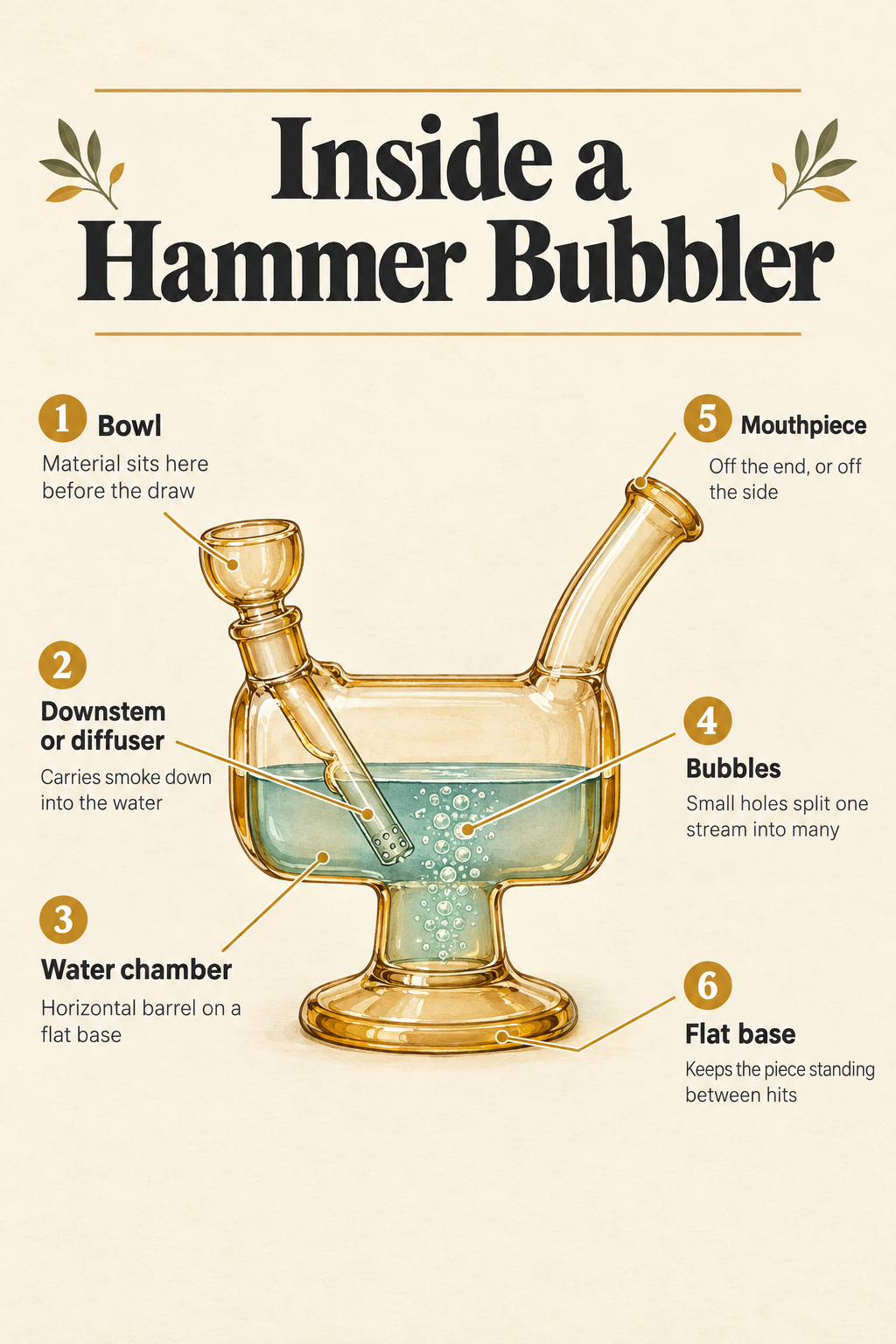
The working parts are the same as on any small water pipe, just arranged on a horizontal body. Smoke Cartel breaks a bubbler into three core parts: bowl, downstem and water chamber. The hammer shape does not change that list, it only changes where each part sits. [2]
Here is the path in the order smoke meets each part.
Percolation is the general term for pulling smoke through water. Diffusion is what the downstem does inside that process. Slits or small holes split one smoke stream into many smaller bubbles, so more bubble surface touches the water than a single open tube would give you. [2]
The cooling is heat transfer, not a filter. Smoke leaves the bowl hot, the water is cooler, and as bubbles rise through the chamber some heat moves out of the smoke and into the water. Retail write-ups also describe the water catching heavier ash and resin on the way through. [2] [5]
That is the honest limit of the description. None of the sources reviewed for this guide publishes measured data on what a small water chamber removes from smoke. So the accurate way to describe a hammer bubbler is as a handheld water pipe that cools smoke and catches heavier ash and resin in the chamber. Anything past that is a claim the sources do not support.
- Bowl: this is where material sits, and on a hammer it is mounted at the front end of the body where you can see it while lighting.
- Downstem or diffuser: it carries smoke down from the bowl into the water, and its slits or small holes are what break one stream into many bubbles. [2]
- Water chamber: the horizontal barrel you fill, where the bubbles rise and where heavier ash and resin collect. [2]
- Mouthpiece: the draw point at the far end of the barrel or off the side of the chamber, set away from the bubbling water.
How Much Water Should You Put in a Hammer Bubbler?
Water level is the single biggest variable in how a hammer bubbler behaves, and it is also the thing buyers get wrong most often. The goal is simple: enough water to cover the diffuser, and not one drop more than the chamber can take without splash.
Purr Glass gives concrete numbers for their hammer and sherlock shapes: stop filling once the downstem percolator is just fully submerged, which lands around one-quarter to one-third of the chamber. Eyce’s FAQ gets to the same place in kitchen terms, suggesting you start with about a tablespoon and adjust until the piece bubbles without splash-back. [4] [1]
Both error directions have a symptom, and both are easy to recognise. Too much water creates excessive drag that makes it hard to draw at all. Too little leaves minimal diffusion and poor bubbling, so the water barely does anything. If water reaches your mouth on a dry test pull, the chamber is overfilled and needs to be poured down. [4]
Level matters more on a small horizontal chamber than on a tall upright piece, because there is less headroom between the water surface and the mouthpiece. A quarter-inch of overfill on a compact barrel is a much bigger share of the total volume than the same quarter-inch in a tall tube. That is why the dry pull check is worth the ten seconds it takes.
- Start dry and low. Fill with about a tablespoon of water rather than guessing at a fraction of the chamber.
- Add a little at a time until the diffuser points are just submerged. On hammer shapes that is generally about one-quarter to one-third of the chamber. [4]
- Set the piece on its flat base and check it sits level, since the chamber is horizontal and the water line runs along the barrel.
- Draw air through the mouthpiece with nothing loaded. You want bubbling without water climbing toward your mouth. [1]
- Pour some out if you taste or feel water on that dry pull. Overfilled is the common failure, not underfilled. [4]
- Re-check after cleaning. A fresh fill after a wash is the same operation every time, so repeat the sequence rather than eyeballing it.
How Do You Clear a Hammer Bubbler — Carb Hole or Lifting the Slide?
There are two different clearing systems on hammer bubblers, and the one your piece uses changes how you handle it every single session. Gear Patrol notes that bubblers as a class are defined by a fixed non-removable mouthpiece plus a carb, which is the traditional arrangement. [3] Roots Glass describes that cycle: cover the carb with a finger while you pull, then release it to clear the chamber in one breath. [5]
On a piece with a standard ground joint there is no carb to cover. You lift the slide out to clear instead, and the bowl comes away with it. That is a different muscle memory, and it also means the bowl is a separate part you can replace or swap rather than something fused into the body.
Treehouse stocks both systems under the hammer label, which makes the choice concrete. The Cube Hammer Crayon Bubbler has a left-side carb hole and a fixed bowl, so it clears carb-style. [11] The Grateful Dead x Pulsar Wig Wag Hammer Bubbler uses a 14mm female joint with a matching 14mm male herb slide included. It lists no carb, so it clears by lifting the slide. [13]
The advice follows directly. If you already own 14mm slides, buy the jointed piece and use the glass you have. If you want one-piece simplicity and nothing to lose, buy the carbed one. Neither is better hardware. They just ask different things of you.
- Carb and fixed bowl: you cover the hole with a finger during the pull and release it to clear, with the bowl staying part of the body. [5]
- Ground joint and removable slide: you lift the slide to clear, and there is no carb hole to manage. [3]
- Parts to keep track of: a carbed piece has no loose bowl, while a jointed piece has a slide you can drop, chip or replace.
- Replacement path: a jointed piece lets you fit a new slide in the size it takes, while a fixed-bowl piece is replaced as a whole unit.
- Treehouse example, carbed: the Cube Hammer Crayon Bubbler, with a left-side carb and a fixed bowl. [11]
- Treehouse example, jointed: the Grateful Dead x Pulsar Wig Wag Hammer Bubbler, 14mm female with a matching male slide and no carb. [13]
- Who should pick which: existing slide owners should take the jointed piece, and anyone who wants nothing removable should take the carbed one.
Should You Buy a Glass, Silicone, or Wood Hammer Bubbler?
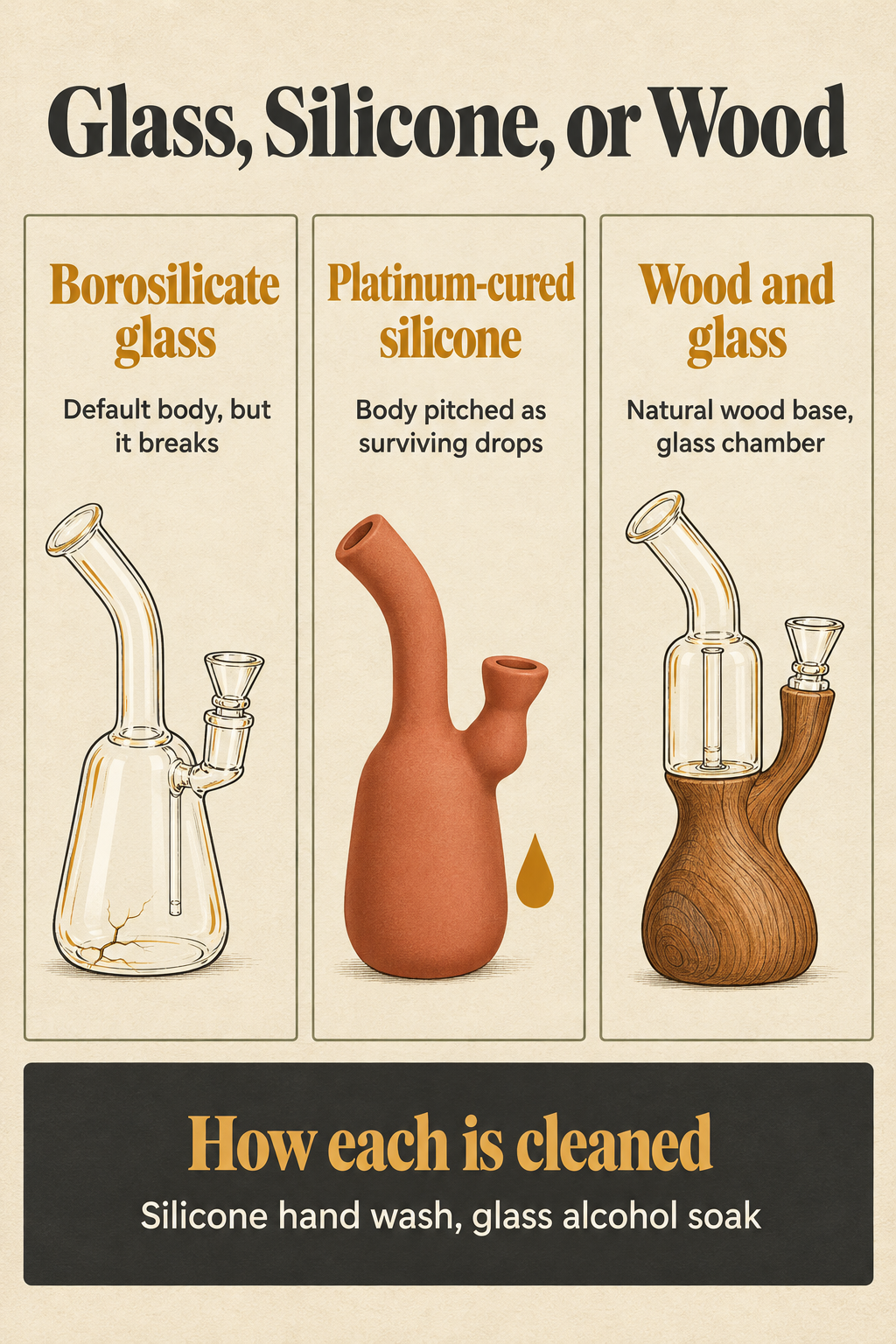
Material is the decision that sets the failure mode, so it is worth settling before you compare prices. Borosilicate glass is the default and shows up on four of the five hammer pieces Treehouse carries, but glass breaks. That is not a defect, it is the trade you make for a body you can see through and clean thoroughly. [13] [11]
Silicone takes a different approach. Eyce builds its hammer from platinum-cured silicone with a removable glass bowl, and the brand’s own copy pitches the body as surviving drops. The same piece carries a built-in stash compartment, an integrated poker tool and interchangeable top caps. [1] [9]
Wood and glass is the third route. The Dogg Pounds Everyday Wood Hammer Hand Pipe pairs a natural wood grain base and stem with a blue borosilicate chamber. It ships as one fixed design with no color options. [12]
Care follows material, and this is where buyers get surprised. Silicone is hand washed with warm soapy water rather than soaked in a solvent. Glass is cleaned with isopropyl alcohol and coarse salt roughly every three to five sessions. [9] [5] Isopropyl alcohol is a flammable liquid. The NIOSH Pocket Guide lists a flash point of 53 degrees Fahrenheit, a Class IB flammable classification, and irritation, drowsiness, dizziness and headache among the effects of exposure. [7] Clean with ventilation, away from any ignition source, and let the glass air dry completely before the next session.
- Borosilicate glass: the default body, transparent so you can see the water level and the resin build-up, but it breaks if it is dropped. [13]
- Platinum-cured silicone: a body the maker pitches as surviving drops, with a removable glass bowl, a built-in stash and an integrated poker tool. [9]
- Wood and glass: a natural wood base and stem around a glass chamber, one fixed design, no color choices. [12]
- Glass care: isopropyl alcohol and coarse salt every three to five sessions, with ventilation and no ignition source nearby. [5] [7]
- Silicone care: hand wash with warm soapy water rather than a solvent soak, per the manufacturer. [9]
- What you give up with silicone: you cannot watch the water level or the resin through the body the way you can with glass.
| Material | What it is good at | What it costs you | How it is cleaned |
|---|---|---|---|
| Borosilicate glass | You can watch the water level and the resin build-up | It breaks if it is dropped | Isopropyl alcohol and coarse salt every 3-5 sessions |
| Platinum-cured silicone | Body pitched as surviving drops, with a built-in stash and poker | You cannot see the water or resin through the body | Hand wash with warm soapy water |
| Wood and glass | A natural wood base and stem around a glass chamber | One fixed design, no color choices | Same glass care for the glass chamber |
What Size Hammer Bubbler Fits How You Plan to Use It?
Size is really a question about where the piece will live. Treehouse’s five hammer pieces run from about 4.5 inches to 6.25 inches, which covers pocket, jacket and table use rather than one size that suits everyone. [11] [13]
The miniature class deserves a note because it behaves differently. Roots Glass puts mini bubblers under 4 inches. They fit in a pocket and stash easily, but less water means less diffusion, and a small chamber fills fast. That suits quick solo sessions better than passing a piece around. [5]
Nothing in the current Treehouse hammer lineup is under 4 inches. The Cube at roughly 4.5 inches is the closest, and the 5 inch Dogg Pounds and 5.3 inch WIG WAG sit just above it. [11] [12] [10] If you want true pocket size, you are shopping outside this set. If you want something that still stands on a table and holds a workable water level, the 5 inch range is the sweet spot.
Length, chamber volume and base width move together but not perfectly. A longer body usually gives you a longer barrel to fill, and a wider base gives you more stability at the cost of bulk. The 6.25 inch Grateful Dead x Pulsar piece has the widest flat base and the largest footprint of the five. That is exactly what you want on a table and exactly what you do not want in a jacket pocket. [13]
To see the full range of shapes beyond the hammer, Bubblers lists the other bubbler styles with dimensions on each listing.
- Decide where it lives first. Pocket, jacket or table changes the answer more than any spec sheet does.
- Check the length against that answer. Under 4 inches is the pocket class, and roughly 4.5 to 5.3 inches is the jacket and small-bag range. [5]
- Check the chamber against your sessions. A small chamber fills fast and gives less diffusion, which suits solo use more than group passing. [5]
- Check the base width against the surface. A wide flat base is what keeps the piece planted, so a bigger footprint is a table benefit and a pocket cost. [3]
- Confirm the piece actually stands. Set it on a hard surface before you commit to how you will store it.
Which Hammer Bubbler Should You Buy at Treehouse?
Work the list in order and the answer usually falls out. First, decide whether you want to clear by carb or by lifting a slide. Second, check the joint size if you already own slides. Third, pick the length and chamber volume that match where the piece will live. Fourth, decide what you want to happen if it is dropped. Fifth, decide whether the finish or the collab is worth paying for. [5]
One spec deserves a callout. Of the five pieces, only the Grateful Dead x Pulsar Wig Wag Hammer Bubbler publishes a joint size: 14mm female, with a matching 14mm male herb slide included. [13] The other four do not list one, because on the fixed-bowl versions the bowl is not a removable part. If joint compatibility matters to you, that narrows the field to one.
There is also a catalog quirk worth explaining honestly. All five pieces are filed under Hand Pipes rather than a Bubblers category, and one listing contradicts itself outright. The WIG WAG Hammer Bubbler is named and described as a hammer bubbler with an inline water chamber, while its own spec block labels the category Spoon Pipes. [10] Read store categories as browsing aids, not as a description of the shape. These pieces are water pipes by construction, and they are filed with hand pipes because you hold them. The Hand Pipes shelf is where you will find the rest of them.
Treehouse also offers free shipping on orders $150+, which is worth factoring in if you are adding glass or accessories at the same time.
Here is the lineup as it stands, with current prices and published sizes.
- Eyce Silicone Hammer Bubbler, $44.99: the only silicone option and the only one with storage built in, including a removable glass bowl, a stash compartment, a poker tool and eight colorways. Pick it if drop resistance and built-in storage matter more than seeing through the body. [9]
- WIG WAG Hammer Bubbler, $29.99 at 5.3 inches: borosilicate glass with a hammer-style body and an inline water chamber, in Blue, Yellow or Black. Pick it as the lowest-cost entry into the shape. [10]
- Cube Hammer Crayon Bubblers, $49.99 at roughly 4.5 inches: thick borosilicate from The Crush Eye Candy collection, with a left-side carb and a fixed bowl, in five colorways. Pick it if you want the shortest body in the set and carb-style clearing. [11]
- Dogg Pounds Everyday Wood Hammer Hand Pipe, $26.00 at 5 inches: a natural wood base and stem around a blue borosilicate chamber, one fixed design. Pick it if you want the wood-and-glass look and the lowest price in the lineup. [12]
- Grateful Dead x Pulsar Wig Wag Hammer Bubbler, $59.90 at 6.25 inches: 14mm female joint with a matching male slide, a fixed downstem, and red and blue wig-wag striping with frosted skeletons. Pick it if you own 14mm slides, want the largest piece, or want the collab. [13]
- Price spread: the five run from $26.00 to $59.90, a $33.90 range that buys material, joint hardware and finish rather than a difference in how the shape works.
Frequently Asked Questions
Does a flat-bottom hammer bubbler tip over or spill?
That flat bottom is the main handling reason to choose the shape. Every source that covers it describes the wide flat base as what keeps the piece planted on a table between hits instead of rolling or tipping. One retailer lists stability on flat surfaces as the first argument for the shape. [3] Water can still move if you tilt the piece while drawing, which is why the dry pull check before loading is worth doing.
Do all hammer bubblers have a carb hole?
No. Fixed-bowl pieces usually have a carb hole that you cover while pulling and release to clear. Pieces with a standard ground joint clear when you lift the slide and have no carb to cover. [5] Treehouse stocks both under the hammer label. The Cube Hammer Crayon Bubbler has a left-side carb with a fixed bowl, and the Grateful Dead x Pulsar Wig Wag Hammer Bubbler lists a 14mm female joint and no carb. [11] [13]
What joint size does a hammer bubbler take?
It depends on the piece, and most fixed-bowl hammer bubblers do not publish a joint size at all because the bowl is not removable. Of the five hammer pieces Treehouse carries, only the Grateful Dead x Pulsar Wig Wag Hammer Bubbler publishes one: 14mm female, with a matching 14mm male herb slide included. [13] If you already own slides, check that spec before buying anything else.
How often should you clean a hammer bubbler?
Glass pieces are usually cleaned every three to five sessions with isopropyl alcohol and coarse salt. [5] Silicone bodies are treated differently, and Eyce specifies hand washing with warm soapy water rather than a solvent soak. [9] Either way, the water should be changed between sessions rather than left sitting in the chamber. Isopropyl alcohol has a flash point of 53 degrees Fahrenheit per the NIOSH Pocket Guide, so work with ventilation and away from ignition sources. [7]
Is a hammer bubbler worth it compared to a dry hand pipe?
It does more work and asks more of you. You get a water chamber that cools smoke by heat transfer and catches heavier ash and resin, plus a flat base that stands on a table. [2] In exchange, Gear Patrol lists cleaning difficulty, more frequent cleaning, a fixed non-removable mouthpiece, no customization and a bowl smaller than a bong’s. Any of those is a fair reason to skip a bubbler entirely. [3] If you want zero maintenance, a dry pipe is the simpler object.
So Which Hammer Bubbler Should You Actually Get?
Start with the clearing system, because it is the one feature you cannot change later. If you own 14mm slides, the Grateful Dead x Pulsar Wig Wag at $59.90 is the only piece here that will take them. It is also the largest at 6.25 inches. [13] If you want nothing removable and a shorter body, the Cube Hammer Crayon Bubbler at $49.99 clears carb-style and measures roughly 4.5 inches. [11]
Then decide what you want the body made of. The Eyce Silicone Hammer Bubbler at $44.99 is the pick if the piece is going to travel or if you want storage built into the hardware. [9] The Dogg Pounds wood-and-glass pipe at $26.00 is the look-driven budget choice. [12] The WIG WAG at $29.99 is the cheapest way into the shape if you just want to try a hammer before spending more. [10]
Whichever you choose, budget ten seconds for the water check. Fill until the diffuser is just covered, set the piece on its flat base, and pull once with nothing loaded. That single habit does more for how the piece behaves than any difference between these five. And if you are still weighing body styles, the bubbler family is broader than this one shape. [4]
Sources
- Eyce Molds: What Is a Hammer Bubbler? | Eyce
- Smoke Cartel: What Is a Glass Bubbler? How It Works, Types, and Cleaning Basics
- Gear Patrol: Bubbler Pipes: Everything You Need to Know
- Purr Glass: How Much Water to Put in Your Bubbler
- Roots Glass: Glass Bubbler Guide: Types, How to Use & Clean
- GRAV: GRAV Mini Hammer Bubbler – Assorted Colors
- CDC / NIOSH: NIOSH Pocket Guide to Chemical Hazards — Isopropyl alcohol
- DankGeek: Hammer Bubblers
- Treehouse Lifestyle: Eyce Silicone Hammer Bubbler
- Treehouse Lifestyle: WIG WAG HAMMER BUBBLER
- Treehouse Lifestyle: Cube Hammer Crayon Bubblers (Various Colors)
- Treehouse Lifestyle: Dogg Pounds Everyday Wood Hammer Hand Pipe – 5 in
- Treehouse Lifestyle: Grateful Dead x Pulsar Wig Wag Hammer Bubbler – 6.25 in / 14mm F