

A pocket bubbler is a one-piece handheld water pipe small enough to carry in a jacket pocket, with a bowl, water chamber and mouthpiece fused into a single glass body [13][14]. What the water does is cool the draw and catch some ash on the way up. It does not turn smoke into something clean [17][18].
What Is a Pocket Bubbler, and How Is It Different From a Hand Pipe?
The shortest definition is a hand pipe frame that has been given a water chamber. Trade guides draw the line from that direction, and they place the format between a dry hand pipe and a bong in both size and function [15].
Because the format is defined by size rather than by one fixed shape, the term covers several glass profiles. A hammer, a sidecar, a sphere and a coffee mug can all be pocket bubblers if they are small enough and hold water. One brand files six products under its pocket bubbler collection across three separate subcategory tags, which tells you the label is merchandising rather than engineering [6].
Vocabulary is the other thing to sort out early. Mini bubbler and pocket bubbler get used for the same class of piece, and trade guides disagree on where the ceiling sits: one puts mini bubblers under four inches, while another says mini water pipes top out around eight inches because a water chamber needs room [14][15]. Shape names are no more precise. One guide calls hammer, sherlock and sidecar shop slang with no official definition, which is why two stores can name the same glass differently [17].
Everything here is smoking hardware sold as an accessory. Treehouse Lifestyle sells pipes, bubblers and the parts that go with them, not cannabis. What follows covers how the format is defined, how big pocket really is, the joint sizes you will meet, how much water to use, how to clean a fused chamber, and the three pieces Treehouse currently stocks.
- Water chamber: a pocket bubbler holds a small charge of water in a fused chamber, a dry hand pipe holds none, and a bong holds enough to run through one or more percolators [13].
- Body: bowl, chamber and mouthpiece are one fused glass piece on a pocket bubbler, so there is no separate downstem to seat or lose [14].
- Setup: a pocket bubbler needs water and material and nothing else, while a bong wants water, a downstem and a bowl before the first pull [13].
- Carry: a pocket bubbler travels in a jacket pocket, a dry hand pipe travels almost anywhere, and a bong stays on a table [13].
- Clearing: a carbed pocket bubbler clears by covering and releasing the carb hole, while a ground-joint piece clears by lifting the slide out instead [14].
- Cleaning: a fused chamber cannot be fully opened, so a pocket bubbler takes a solvent shake rather than a full teardown [14].
| Pocket bubbler | Dry hand pipe | Bong | |
|---|---|---|---|
| Water chamber | Small, fused into the body | None | Large, often with percolators |
| Body | Bowl, chamber and mouthpiece in one piece | One piece, no water | Tube, downstem and separate bowl |
| Setup | Water and material | Material only | Water, downstem, bowl |
| Carry | Jacket pocket, carried upright | Anywhere | Stays on a table |
| Clearing | Cover and release the carb, or lift the slide | Carb or open end | Lift the bowl or slide |
| Cleaning | Solvent shake, no full teardown | Quick swab | Full teardown |
What Does the Water Chamber Actually Do?
What the water does is cool the draw. Heat moves from hot smoke into cooler water, so what arrives at the mouthpiece is at a lower temperature than what left the bowl. The chamber also catches ash and heavier bits that would otherwise keep travelling toward the mouthpiece [13][14].
What the water does not do is make smoke clean. Trade writing is blunt about this: water does not turn smoke into something clean, and the classic water-filtration study that gets cited everywhere used tobacco rather than cannabis, so it reads as a direction rather than a number [17].
The device study people quote most often measured indoor fine particles in a real residence with a repeatable three-puff protocol. The devices tested were a pre-rolled joint, a bong, a glass pipe and a vape pen. A bubbler was not among them, so there is no bubbler-specific emission figure to quote, and anyone who hands you one is extrapolating [18].
If you are still deciding between formats, How Do You Choose a Hand Pipe That’s Right for You? covers grip, bowl size and carb placement. For the wider water-piece picture, How Do You Choose the Right Bubbler for You? walks through chamber shapes and what each one is for. Other designs are worth comparing too: What Is a Steamboat Bubbler and How Does It Work? explains one specific body style, How Do Glycerin Pipes Work and Which One Should You Buy? covers glycerin-filled pieces, What Are the Different Types of Hand Pipes? lays out the broader hand pipe families, and What Is a Spinner Perc and How Does It Actually Work? goes into how a spinner perc works inside a chamber.
- What it does: pulls heat out of the draw, so the smoke reaching the mouthpiece is cooler than what left the bowl [14].
- What it does: catches ash and heavier bits inside the chamber rather than at the mouthpiece [13].
- What it does: adds a little drag, because a small chamber holds a shallow column of water and the draw has to move it.
- What it does not do: make smoke clean. Water does not turn smoke into something clean [17].
- What it does not do: appear in the 2021 residential fine-particle study, which tested a joint, a bong, a glass pipe and a vape pen [18].
- What it does not do: stay fresh on its own, since a small water volume fouls faster than a full bong’s and needs changing between sessions [17].
How Big Is a Pocket Bubbler Really, and How Much Does It Weigh?
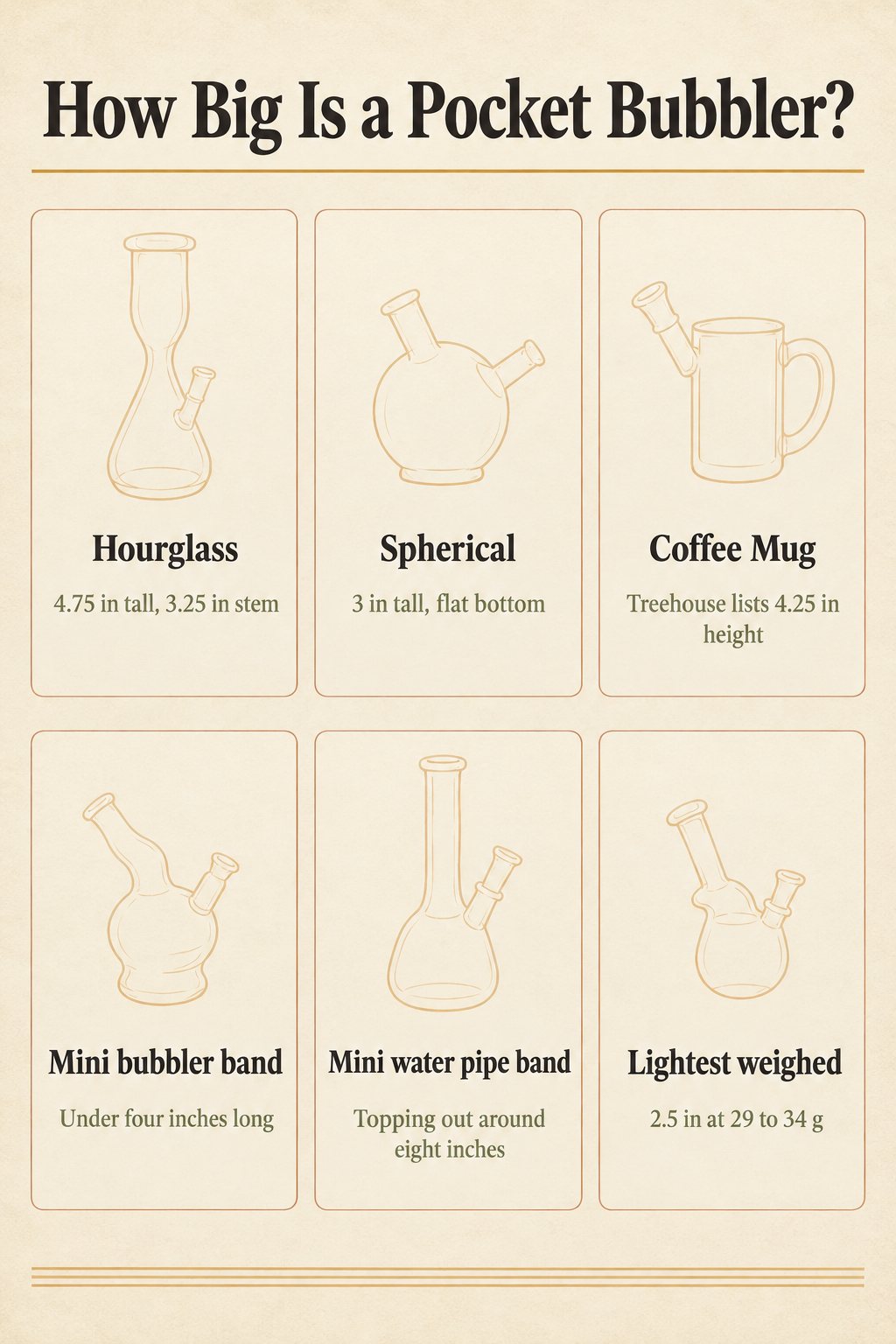
Published size bands overlap, so the number to trust is the one printed on the listing you are actually buying. One trade guide puts mini hand pipes at two to four inches and mini water pipes at up to about eight inches, since a water chamber needs room. Another puts mini bubblers under four inches [15][14].
Retail data shows how wide the spread really is. One collection page weighs a 2.5 inch mini bubbler at roughly 29 to 34 grams, a five-inch piece at about 170 to 190 grams, a six-inch piece at around 116 grams and an eight-inch piece near 180 grams. Past about eight inches, the difference between a large bubbler and a compact tabletop water pipe stops being obvious [16].
The naming problem makes this worse. The same Coffee Mug Pocket Bubbler is published at 2.8 inches by the manufacturer, 2.75 inches by one retailer, and 4.25 and 5 inches on two listings for the same family. Four numbers, four sellers, one piece of glass [4][11][10]. Read the height, length and weight lines on the specific listing rather than trusting the word pocket, and check the piece against the rest of the hand pipe range if you want a sense of scale Hand Pipes.
When you are ready to compare actual products rather than bands, Bubblers holds the water-filtered hand pieces in one place, which makes the size spread easier to see side by side than any spec table.
- Mini hand pipes: typically two to four inches, with no water chamber to house [15].
- Mini bubblers: under four inches by one guide’s band, the smallest water-filtered format [14].
- Mini water pipes: usually topping out around eight inches, because the chamber takes up space [15].
- Lightest weighed example: a 2.5 inch mini bubbler at roughly 29 to 34 grams [16].
- Mid-size examples: a five-inch piece at about 170 to 190 grams, and a six-inch bubbler at about 116 grams [16].
- Largest example: an eight-inch piece near 180 grams, where the category blends into tabletop water pipes [16].
- Same piece, four heights: the Coffee Mug Pocket Bubbler published at 2.8, 2.75, 4.25 and 5 inches by four sellers [4][11][10].
How Does a Pocket Bubbler Work, Part by Part?
Follow the air from the bowl to your mouth and the piece stops being mysterious. Every pocket bubbler has the same short list of parts, and the differences between models come down to how those parts are shaped and where they sit [13].
The Hourglass shows geometry doing the splash work: a long 3.25 inch stem inside a 3 inch chamber, an angled sidecar neck, and a fission downstem whose holes are angled to face the chamber walls and away from the mouthpiece [1][12]. The Coffee Mug solves the same problem differently, with a 45 degree mouthpiece whose tip angles slightly down so the piece can be tipped away while lighting, over a two-hole percolator downstem working in shallow water [4].
The last decision is how you clear it, and that depends on which of two systems the piece uses. A carbed piece asks you to cover a hole with a finger and release it. A ground-joint piece has no carb; you lift the slide out instead [14][12].
- Bowl or slide: the cup that holds material and seats into the joint. GRAV’s pocket pieces ship with a 10mm cup bowl [1].
- Ground joint: the socket the bowl sits in. A 10mm female joint takes a cup bowl, a 90 degree male banger or a rolled joint [5].
- Downstem: the tube that carries the draw down into the water, sometimes ending in a percolator with small holes [4].
- Water chamber: the sealed body section the draw passes through. Hourglass uses an hourglass shape, Coffee Mug a cup shape, Spherical a globe [12][4].
- Mouthpiece: where the draw leaves. An angled sidecar neck or a 45 degree tip both aim to keep water out of the path [12][4].
- Carb or slide: your two clearing options. Cover and release a carb hole, or lift the slide out of a ground joint [14].
How Much Water Should You Put in a Pocket Bubbler?
Water level is the single biggest variable on a small chamber, and it is the one thing you can get wrong before you ever load material. Trade guidance is consistent: fill until the water just covers the bottom of the downstem, which one guide puts at roughly one quarter to one half inch, then test the piece dry [14].
Both failure directions are worth knowing. Too much water produces splashback and heavy drag. Too little produces weak bubbling and little contact between the smoke and the water [13]. Less water also means less diffusion, which is part of why these pieces behave like short, controlled draws rather than group-passing hardware [14].
- Fill until the water just covers the bottom of the downstem, roughly one quarter to one half inch in a small chamber [14].
- Pull dry with nothing loaded and listen for clean bubbling [13].
- Check that no water reaches the mouthpiece on that dry pull, and pour some out if it does [13].
- Load, then pull the bowl sooner than you would on a full-size piece; the manufacturer’s own advice is earlier than you are used to [1].
- Empty the chamber after the session instead of leaving the water standing [14].
What Joint Size Do Pocket Bubblers Use, and Can You Swap the Bowl?
The joint is what makes this format flexible. One glass body with a 10mm female joint takes a 10mm cup bowl for flower, a 10mm 90 degree male banger for concentrate, or a rolled joint or blunt pushed into the same opening. GRAV states that plainly for its pocket pieces, and the Spherical listing repeats it for the whole line [1][5].
The number still has to be checked rather than assumed, because trade guidance says most mini water pipes use a 14mm joint for the bowl or downstem while some ultra-compact and dab-focused pieces use a smaller 10mm joint [15]. Published specs also contradict each other in places, and the contradictions are worth naming because they are the ones that cost you a return.
The clearest case is the Hourglass. The coloured SKU’s wholesale spec table lists a 10mm female joint, and the retail page ships a 10mm cup bowl, but the wholesale page for the clear SKU lists 14mm female while publishing identical dimensions of 116mm height, 90mm length and 56mm width [2][3]. Only one of those can be right for a piece that ships with a 10mm bowl. Read the joint line on the exact listing before you buy slides or a banger.
- A 10mm female joint accepts a 10mm cup bowl for flower [1].
- It also accepts a 10mm 90 degree male banger for concentrate, which turns the piece into a small dab rig [4].
- It will take a pre-rolled joint or blunt without any bowl at all [5].
- Hourglass coloured SKU: spec table says 10mm female [2].
- Hourglass clear SKU: spec table says 14mm female on identical dimensions, which conflicts with the 10mm bowl it ships with [3].
- Treehouse Coffee Mug listing: reads 10mm male on the connection line while also listing and shipping a 10mm male slide, so the glass joint is female [9].
- Collection-level view: one brand’s pocket collection filters all six products as 10mm female [6].
How Do You Clean a Pocket Bubbler, and How Often?
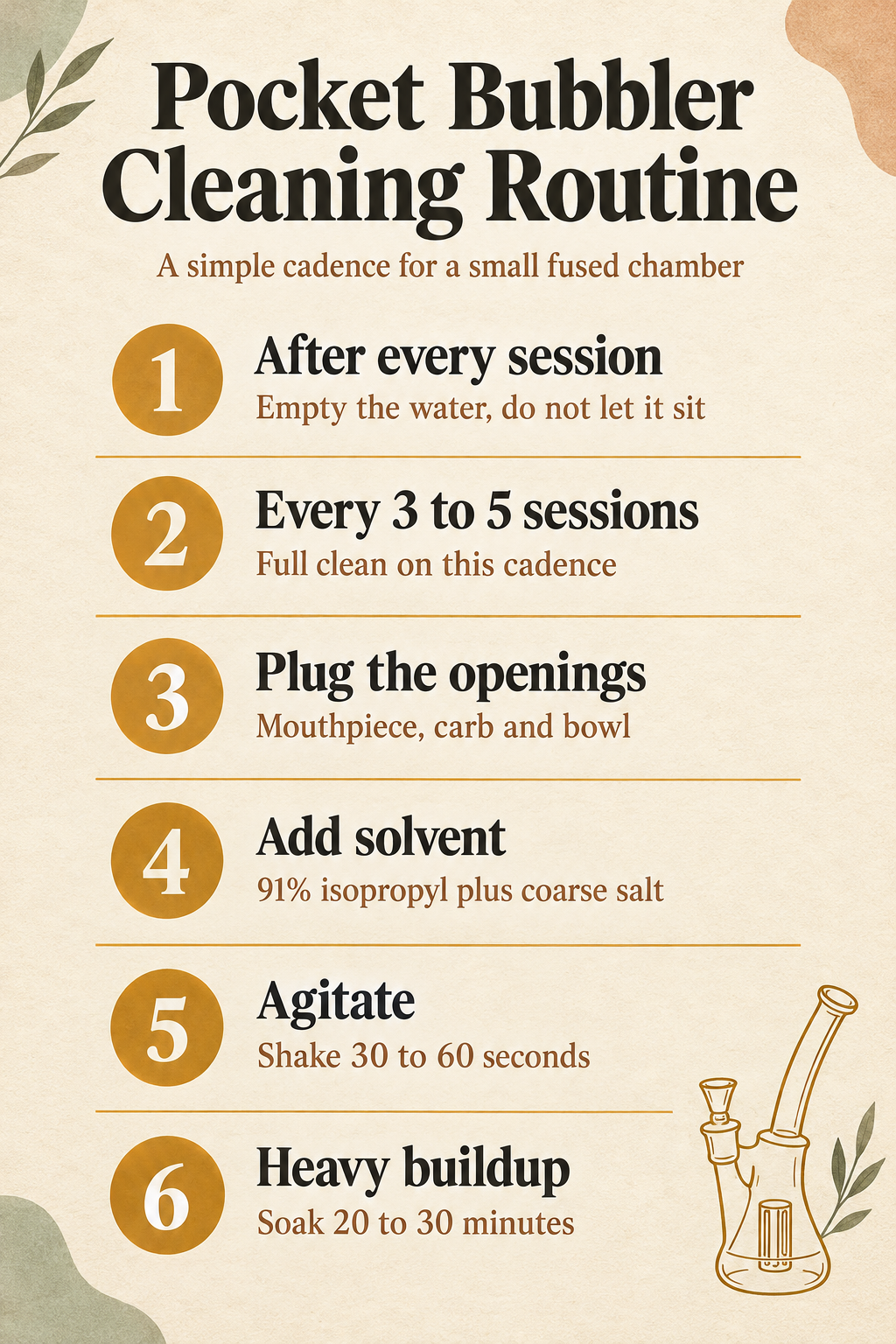
Cleaning is the real ownership cost here, because the chamber is fused and cannot be fully taken apart. You cannot reach inside with a brush the way you can with a bong that separates at a joint, so the routine leans on solvent and agitation instead [14].
The working recipe is short enough to do in a couple of minutes. A piece that gets a full clean every few sessions never needs the long soak, and the water habit matters as much as the solvent: a pocket chamber holds a small volume that fouls quickly, so empty it after a session rather than leaving it to sit [17].
Handle the solvent with some respect while you are at it. The NIOSH Pocket Guide gives isopropyl alcohol a flash point of 53 degrees Fahrenheit and classes it as a Class IB flammable liquid, lists inhalation and skin contact among the exposure routes, and names eye, nose and throat irritation, drowsiness, dizziness and headache as symptoms [19]. Work with ventilation, keep it away from ignition sources, and let the glass dry completely before the next session.
- Plug the mouthpiece, carb and bowl openings so the solvent stays inside [14].
- Fill or partly fill with 91 percent or higher isopropyl alcohol and add a pinch of coarse salt [14].
- Shake for 30 to 60 seconds, long enough for the salt to work the walls [14].
- Rinse with hot water until the alcohol smell is gone, then let it air-dry completely [14].
- Soak 20 to 30 minutes instead of shaking when the buildup is heavy [14].
- Set the cadence at every three to five sessions, and empty the water after every single session [14].
Which Pocket Bubblers Does Treehouse Stock, and What Should You Check First?
Treehouse currently carries three pocket-format pieces, all GRAV, all borosilicate, all on a 10mm joint, from 36 to 53.90 dollars. That narrow spread is helpful, because the choice comes down to shape and chamber style rather than to material or connection type [7][8][9].
Before any of that, check the listing itself. Sizes and joint specs disagree between sellers often enough that the name on the product is the least reliable thing on the page. The naming collision is a good example: Treehouse lists one piece as the Houseglass Pocket Bubbler while GRAV calls the same SKU the Hourglass Pocket Bubbler, with the same stem, the same overall height claim and the same colours. The difference is a spelling [7][1].
Glass thickness deserves a line too. One guide’s buying advice is 3mm or thicker borosilicate, and 4mm or more if the piece will actually travel, framing a 30 to 60 dollar 4mm piece as the practical sweet spot [14]. All three pieces here are listed as borosilicate, which is the material to look for on any pocket piece. Free shipping on orders $150+ applies if you are adding a slide or a banger to the same order.
- Grav Houseglass Pocket Bubbler, 36.00 dollars: 4.75 inches, 3.25 inch stem, 10mm female joint, cup bowl included, five colours [7].
- Grav Spherical Pocket Bubbler, 36.00 dollars: 3 inches, flat bottom so it stands on its own, 10mm female joint, listed for flower and concentrate, six colours [8].
- GRAV Coffee Mug Pocket Bubbler, 53.90 dollars: 4.25 inch listing, 10mm joint, male herb slide included, clear and assorted finishes [9].
- Skip the second Coffee Mug listing: the assorted-colours SKU is out of stock and priced at zero, so it is not a buyable option [10].
- Check one: the joint line on the exact listing you are buying, not the collection page [2][3].
- Check two: published height and weight rather than the marketing name, since the same piece is listed from 2.75 to 5 inches across sellers [11][10].
- Check three: which part is male. A slide is the male part that seats into a female joint, even when the spec block says male on the connection line [9].
Frequently Asked Questions
Is a pocket bubbler the same thing as a mini bubbler?
Mostly, yes. Trade guides use mini bubbler for a compact hand pipe frame that has been given a water chamber, and brands merchandise the same class of piece as a pocket bubbler. The label describes size and merchandising rather than a specification, so check the published height, weight and joint size on the specific listing instead of relying on the name.
Does a pocket bubbler leak or spill if you carry it in a bag?
The glass body is sealed, so nothing leaks out of the piece itself. The real risk is the water you left in the chamber finding its way out through the mouthpiece or the joint once the piece tips over. Empty the water before you pack it and carry it upright. A small chamber holds very little water, which is also why it needs changing between sessions.
Can you use a pocket bubbler with concentrate?
Some can. The GRAV pocket pieces ship with a 10mm cup bowl and accept a 10mm 90 degree male banger in the same female joint, and the Spherical and Hourglass are both listed for flower and concentrate. Confirm the joint size on the listing and check that the piece is listed for concentrate before you order a banger to go with it.
Is a pocket bubbler worth it over a plain hand pipe?
If you want a cooler draw and less ash travelling toward the mouthpiece, and you do not mind changing water and cleaning a chamber you cannot fully open, a pocket bubbler earns its place. If you want the fewest parts and the easiest clean, a dry hand pipe wins. The water cools the draw and catches some ash; it does not make smoke clean.
What does a pocket bubbler cost at Treehouse?
The three in-stock pocket pieces run from 36.00 to 53.90 dollars. The Grav Houseglass Pocket Bubbler and the Grav Spherical Pocket Bubbler are 36.00 each, and the GRAV Coffee Mug Pocket Bubbler is 53.90. All three are borosilicate glass on a 10mm female joint with a cup bowl included. Prices and stock were checked against the store API on November 12, 2026.
So, Is a Pocket Bubbler Right for You?
A pocket bubbler is the middle option in a small category: more parts and more maintenance than a dry hand pipe, far less water and far more portability than a bong. It earns its place if you want a cooler draw and some ash staying in the chamber rather than travelling, and if you are willing to change water and run a solvent shake every few sessions [13][14].
Buy on the numbers, not the label. Check the published height and weight, read the joint line on the exact listing, confirm which part is male, and look for borosilicate glass of 3mm or thicker with 4mm or more if the piece will travel [15][14]. On a 10mm female joint you can run a cup bowl, a banger or a rolled joint in the same body, which is the format’s real advantage.
Keep expectations honest at the same time. The water cools the draw and catches some ash. It does not make smoke clean, and the residential study most often quoted did not test a bubbler, so nobody has a bubbler-specific number to give you [17][18]. Buy the piece that fits how you actually carry and clean your glass, and it will do its job.
Sources
- GRAV: GRAV® Hourglass Pocket Bubbler – Assorted Colors
- GRAV (wholesale): GRAV® Hourglass Pocket Bubbler – Colors
- GRAV (wholesale): GRAV® Hourglass Pocket Bubbler (Clear, SKU PBH.0)
- GRAV: GRAV® Coffee Mug Pocket Bubbler – Assorted Colors
- GRAV (wholesale): GRAV® Spherical Pocket Bubbler – Colors
- GRAV: GRAV® Pocket Bubblers — collection page
- Treehouse Lifestyle: Grav Houseglass Pocket Bubbler
- Treehouse Lifestyle: Grav Spherical Pocket Bubbler
- Treehouse Lifestyle: GRAV Coffee Mug Pocket Bubbler | 4.25 in | 10mm F
- Treehouse Lifestyle: GRAV® Coffee Mug Pocket Bubbler – Assorted Colors
- 420 Science: GRAV® Coffee Mug Pocket Bubbler – Assorted Colors
- Mission Dispensary (accessories store): Grav® Hourglass Pocket Bubbler
- Smoke Cartel: Bong vs. Bubbler: Which Water Pipe is Right for You in 2026?
- Roots Glass: Glass Bubbler Guide: Types, How to Use & Clean
- DankStop: Mini Pipe Guide: Types, Sizes, and How to Choose One
- Simple Glass Pipe: Glass Bubbler Pipes | Mini, Hammer & Sherlock Bubblers
- Barney’s Farm: Bubblers: The Pipe-Bong Hybrid Explained
- Elsevier (peer-reviewed journal, ScienceDirect): Measuring indoor fine particle concentrations, emission rates, and decay rates from cannabis use in a residence
- CDC / NIOSH: NIOSH Pocket Guide to Chemical Hazards — Isopropyl alcohol
- Vermont Cannabis Control Board: Frequently Asked Questions | Cannabis Control Board