

On a frit glass pipe, the speckled surface that looks almost painted is glass. Frit means crushed glass. On a pipe, it is melted onto or into the piece while the glass is still hot. The color becomes part of the pipe instead of sitting on top of it.[2]
That short answer explains most of what surprises people about these pieces. The finish does not peel away. Two pipes built from the same batch never match exactly. A frit pipe can also feel completely smooth or noticeably bumpy, depending on how far the maker melted the color in.
This guide covers what frit is made of and how it gets into the glass. It also explains how frit differs from fumed and painted work, and which frit pipes Treehouse Lifestyle carries.
What Is Frit Glass, and What Is the Speckled Finish Made Of?
A glass-art glossary sums it up in one line: frit is crushed glass, often melted onto other glass to produce patterns and color.[2] A working glass studio describes the same material the same way: crushed glass pieces used to add color or texture to a piece. The artist rolls molten glass over the frit so the particles stick to the surface.[3]
So the speckled finish is glass added to glass. Nothing sits on top of the pipe the way paint sits on a wall. The particles fuse while the piece is hot, which means the color is built into the wall of the pipe rather than resting on it.
The word can also send a search in the wrong direction. In ceramics and glass history, a frit is a composition that has been fused, quenched, and granulated. In laboratory and industrial equipment, the same word names a filter made by sintering glass particles together into a disc of known porosity, sold as fritted glass.[1] Neither of those is the decoration on a hand pipe. The pipe version is the glassblower’s meaning, and that is the one that applies here.
It also helps to separate the finish from the pipe it sits on. Frit describes how a piece is decorated, not what shape it is. A colorful glass piece is not automatically a frit piece either, so the technique has to be confirmed from the product description rather than guessed from the color.[10] If you want to see the finish sitting next to plain clear and solid colored glass, the Hand Pipes category is the fastest place to compare.
Frit is one way to build color into hot glass. How Is the Swirl Pattern on a Linework Glass Pipe Actually Built? explains a cane-based method that bundles and twists rods of color instead, which produces a very different look from scattered particles.
- It is crushed colored glass, fused into the pipe while the glass is hot.[2]
- It is not paint, glaze, or a plastic film applied to the outside.
- It is not a pottery ingredient, even though ceramic work uses the same word for a fused and granulated mix.[1]
- It is not a laboratory filter, even though fritted glass is also the name of a sintered disc used for filtering.[1]
- It is not a shape or a base material, so a frit piece can be a spoon, a sherlock, or something else entirely.
How Does Frit Actually Get Into a Glass Pipe?
Frit is not applied at the end of the build. It goes on while the pipe is still being worked, which is the reason the color ends up in the glass rather than on it. Makers use two routes, and the two put the color in slightly different places.
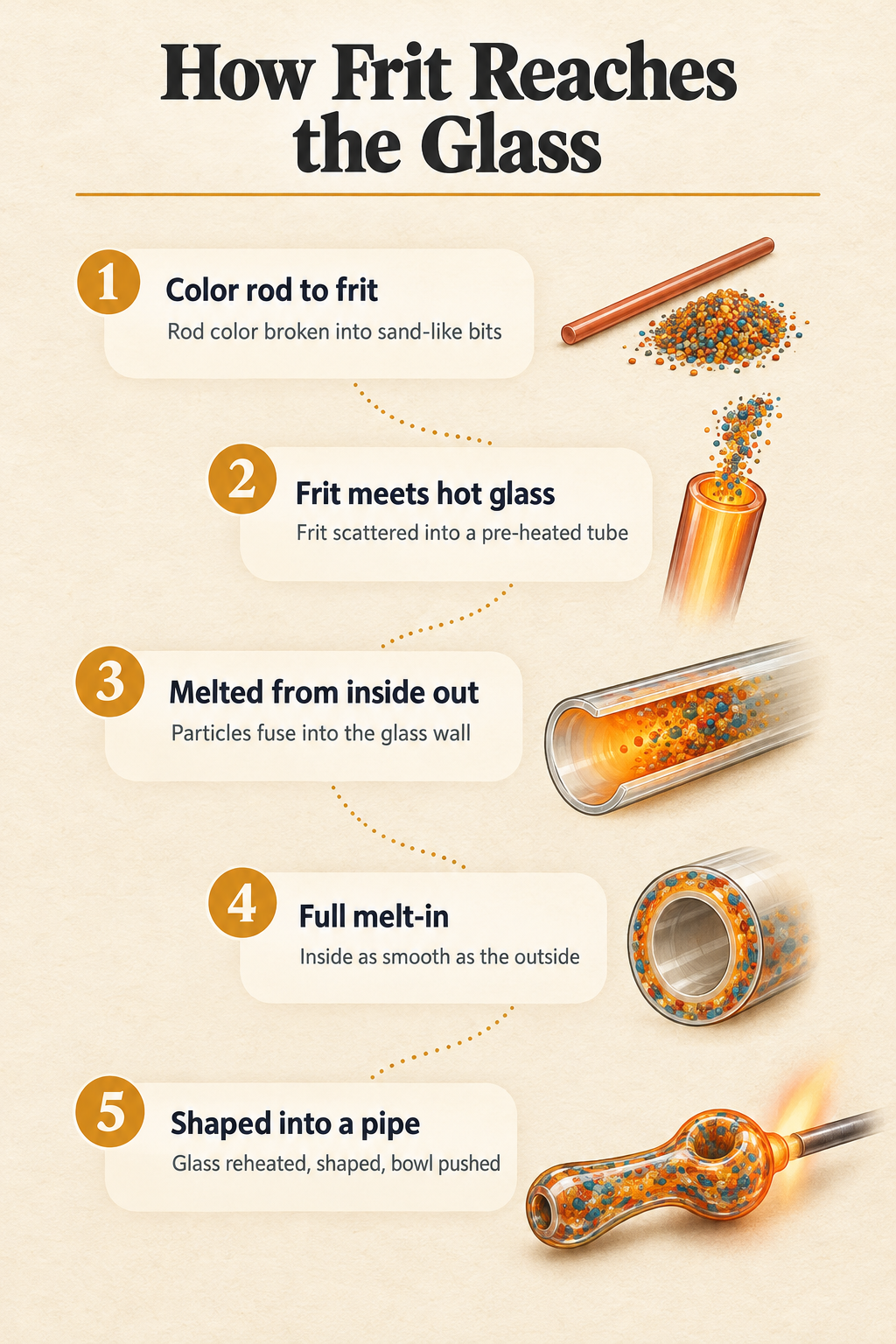
The inside route is the one most pipe makers describe. Frit is scooped or poured down into heavy-wall tubing, the glass is heated until the particles stick, and then the color is melted all the way in. Elev8 Premier’s walkthrough states the check plainly: the inside should be just as smooth as the outside, or you did not melt it in all the way.[7]
The outside route works from the surface. The molten gather is rolled over the frit so the particles adhere to the outside of the glass.[3] That is the standard vessel technique, and it leaves the color at the surface unless a layer of clear glass goes over the top.
On a production pipe, the frit is often made in house rather than bought as powder. Chameleon Glass says it makes its own frit from 10 mm colored borosilicate rods. The rods are broken into bits with a hammermill until the pieces are close to sand in size and consistency.[8]
Once the color is melted in, the rest of the build is ordinary glasswork. The section is reheated, shaped, and turned into whatever form the design calls for, and the pattern that started as loose particles is now part of the wall. Where the piece goes after that is a shape question more than a frit question: What Is a Spoon Pipe and How Does It Work? and What Is a Sherlock Pipe and How Does the Curved Shape Work? cover the two most common forms these builds land in.
Choosing between them comes down to size, bowl, and how you plan to hold the piece, which How Do You Choose a Hand Pipe That’s Right for You? and What Are the Different Types of Hand Pipes? walk through. Surface treatments are a separate decision again. What Does a Sandblasted Glass Pipe Do Differently? covers a different way of changing the outside of a pipe. What does Grav Labs make, and which GRAV pipe should you buy? is a good next stop if brand and build quality shape how you choose.
- Break colored glass rod into bits until the pieces are close to sand in size and consistency.[8]
- Load the bits into pre-heated tubing, or roll a molten gather over them so they stick to the outside.[3]
- Heat the section until the frit adheres to the glass.
- Melt the color in fully, then check that the inside is as smooth as the outside.[7]
- Place frit into shapes with specialty tools and backfill with a contrasting frit where the design needs it.[8]
- Reheat the section, shape the piece, and push the bowl.[8]
Why Do Two Frit Pipes in the Same Colorway Never Match?
The technique is built on loose material going into a hot form, and loose material does not land the same way twice. A pipe decoration explainer credits the one-of-a-kind look to a lack of control when shards are poured into the molten glass frame.[11] A retail guide describes batches where every piece belongs to the same family but none is an exact copy of the next.[10]
Placement is only half of it. The pattern keeps moving after the frit goes in, because the glass is still being heated, stretched, twisted, or blown. Particles travel with the body of the piece, so they end up longer, softer, or further apart than the grains that went in.[10]
Particle size changes the read as well. Fine particles build a dense field of color that looks almost powdered or cloudy once melted, while larger grains stay legible as individual flecks.[10] The same effect shows up outside pipe making. Bullseye Glass notes that a casting made from billet has excellent clarity. Casting the same color in frit instead results in many small bubbles and a milky appearance.[4]
Together those three things explain the odd look of a dense frit piece. Sections that read almost solid are not a different material, and the speckled areas are not a different process. It is the same crushed glass, sitting at different concentrations and different grain sizes across the surface.
- Loose particles land unevenly, so placement varies on every piece.[11]
- The pattern keeps shifting while the glass is heated, stretched, twisted, or blown.[10]
- Fine frit builds a dense, cloudy field of color, while coarse grains stay visible as separate flecks.[10]
- Casting a color in frit instead of billet produces many small bubbles and a milky look.[4]
- Colorways repeat the palette, not the layout, so an exactly matching pair is not something a listing can promise.
How Is Frit Different From Fumed or Painted Glass?
Frit, fuming, and painted decoration all change how a pipe looks. Retailers often mention them in the same breath, but they are three different processes. Each one leaves different evidence on the glass.
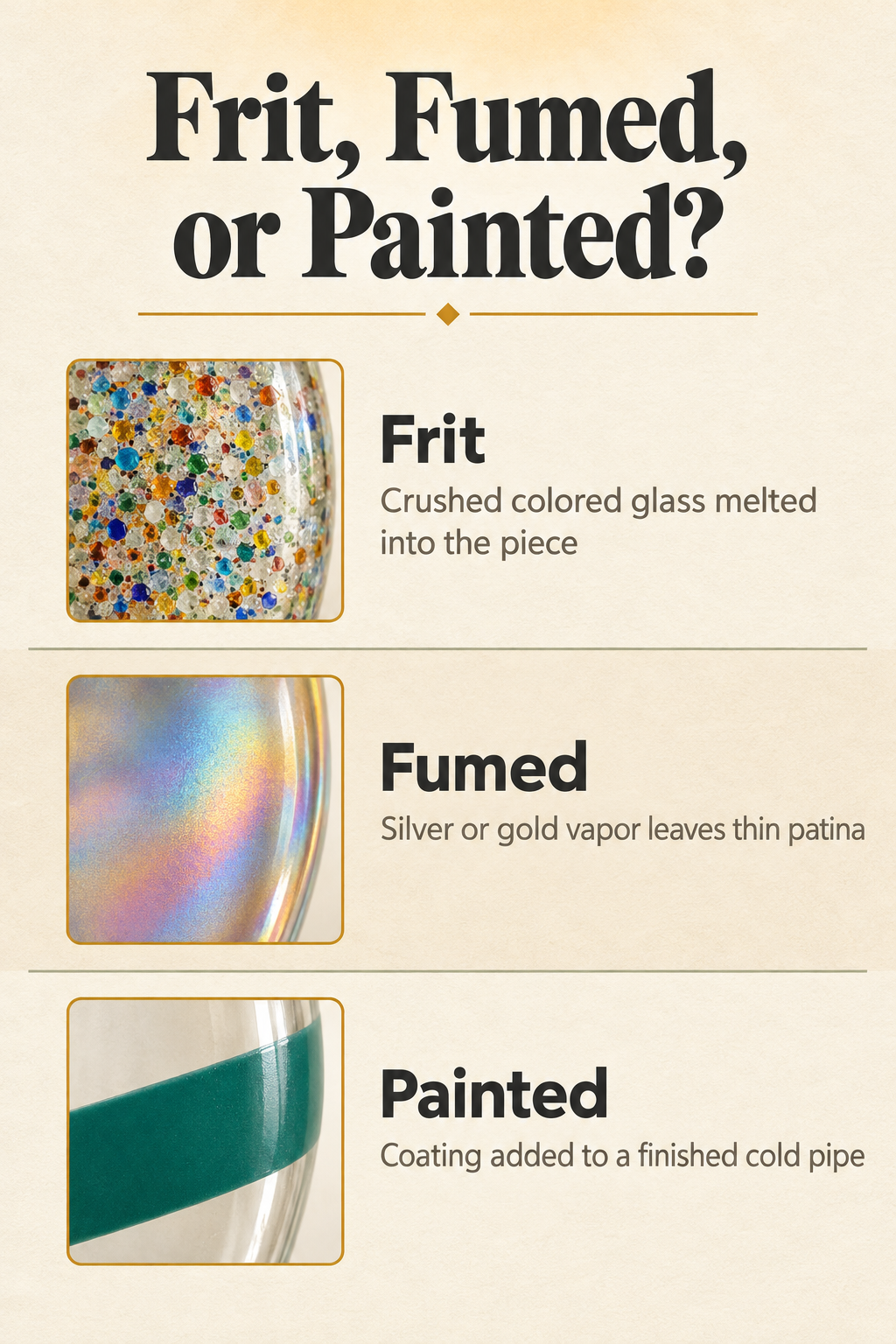
Frit adds material. Crushed colored glass goes onto or into the piece during hot working.[10] Fuming changes the surface instead of adding crushed glass. Solid silver or gold is turned to vapor in the torch flame. The metal then condenses on glass held further out as an extremely thin patina. Silver can read blue, pink, and white, while gold reads orange, green, and red.[9] That patina is fragile in a specific way: a neutral to oxidizing flame can burn silver fume off unless the work is encased in additional clear glass.[9]
Painted decoration is different again. It is a separate coating applied to a finished cold pipe rather than glass worked in while the piece is hot.[10] That is why paint can wear away at a high point, while frit color has no separate layer to lose.
The practical consequence is that color alone tells you nothing. A bright pipe might be frit, fumed, or painted. It could also just be made from colored rod. The technique has to be confirmed from the description, not inferred from the shade. A fumed piece reads as a metallic sheen that shifts across the surface, while a frit piece reads as granular flecks with visible grain.[11]
- Frit: crushed colored glass melted into the piece during hot working.[10]
- Fumed: silver or gold vapor condensed as an extremely thin metallic patina.[9]
- Painted: a coating applied to a finished cold pipe, sitting on the surface.[10]
- Frit shows granular flecks, while fume shows a sheen that shifts with the light.[9]
- Color is not proof of technique, so check the product description for the word frit.
| Technique | What gets added | When it is applied | What you see |
|---|---|---|---|
| Frit | Crushed colored glass, melted in | While the glass is hot | Granular flecks with visible grain |
| Fumed | Silver or gold vapor left as a patina | While the glass is hot | A sheen that shifts with the light |
| Painted | A separate coating | After the pipe is finished and cold | Color that sits on the surface and can wear |
Is the Outside of a Frit Pipe Actually Textured?
Texture depends on the build, not on frit as a material. Frit melted fully into the base glass, or covered with another layer of clear, can leave the outside completely smooth even though the color still looks granular underneath. A partially melted application leaves more noticeable relief.[10]
Store listings reflect both builds. Treehouse Lifestyle’s Frit Black Hand Pipe is described as having a unique textured finish. The Frit Sherlock Hand Pipe is described as showing a colorful fritted glass pattern, with no texture claim attached.[12] Neither description is wrong. They are describing two different amounts of melt-in.
That makes the product page the only reliable place to check. If the surface matters to you, read the description for a texture word and compare it with the photos rather than assuming from the word frit. A wide shot in raking light usually shows whether light catches on bumps or runs flat across the piece.
- Full melt-in fuses the particles flush, so the outside can feel smooth while the color still looks granular.[10]
- A clear cap over the color work adds a flat outer layer for the same reason.[10]
- Partial melting leaves the particles proud of the surface, which is where relief comes from.[10]
- Listing language is the tell: one Treehouse piece is sold as textured, the other as a pattern.[12]
- Photos shot at an angle show relief better than a straight-on catalog image.
What Do Frit Grades Mean, and Why Doesn’t Medium Frit Match Between Suppliers?
Frit is sold in graded particle sizes rather than one uniform grit, and the grades run from powder-fine grains up to chunks.[3] Bullseye Glass publishes five grades with millimeter and mesh ranges, which gives the clearest picture of what the words mean.
The mesh numbers describe screening. A grade that passes an 80-mesh screen has gone through a fine sieve. A grade held on a 4-mesh screen is coarse enough to stay behind on a much wider one.[4]
Grade names are not standardized across the trade, and that is where the confusion starts. A frit supplier states plainly that the industry has no standard sizes. The same words map to different millimeter ranges at Bullseye, Kugler, Reichenbach, Oceanside, and Effetre. Two of those suppliers call the material grit and powder rather than frit.[6]
Borosilicate color makers publish their own scale as well. Northstar lists large frit at approximately 0.055 inches, or 1.397 mm, and small frit at approximately 0.024 inches, or 0.6096 mm. That is far finer than Bullseye’s coarse grade, even though both are sold to artists as coarse and small frit.[5]
There is a compatibility layer on top of the size question. Colored frit is formulated for a specific glass family, not for glass in general. Northstar says its frits and powders are made for Pyrex, Duran, Kimax, Northstar, or any other glass with a similar coefficient of thermal expansion of 33 COE.[5] That is why frit is matched to the base glass during production instead of being picked on color alone.
- Powder: 0.2 mm and finer, passing an 80-mesh screen.[4]
- Fine: 0.2 to 1.2 mm, passing 16-mesh and held on 80-mesh.[4]
- Medium: 1.2 to 2.7 mm, passing 8-mesh and held on 16-mesh.[4]
- Coarse: 2.7 to 5.2 mm, passing 4-mesh and held on 8-mesh.[4]
- Extra large: 5.2 to 30 mm, held on a 4-mesh screen.[4]
Does a Frit Finish Make a Pipe Stronger or Harder to Clean?
No source located for this guide publishes a strength or breakage figure for a frit-decorated pipe, and frit should not be presented as reinforcement. A retail guide states that frit does not automatically make a pipe stronger. Durability still depends on the base glass, wall thickness, shaping, annealing, joints, and handling. Color work is decorative glass added during production, not a structural feature.[10]
Cleaning guidance follows the surface rather than the pattern. A fully fused, smooth frit surface generally needs no special cleaning process, while textured or sculpted pieces may need extra attention around recessed areas and projections. Decorative areas should not be scraped aggressively.[10]
The other common assumption worth correcting is that frit implies borosilicate. Frit is made for several compatible glass systems, so the finish says nothing about the base glass.[5] When a listing names borosilicate, that is a separate claim about the pipe itself, and it is worth reading that line on its own. All three frit pieces in the current Treehouse Lifestyle lineup do name borosilicate, but that comes from the listing, not from the finish.[12]
Composition is the one thing a buyer cannot verify from a page. No source reviewed for this guide publishes a chemical breakdown for the colored frit used on imported production pipes. Beyond crushed glass matched to a glass family, the makeup is not something a product listing can confirm.[10]
- Strength comes from the base glass, wall thickness, shaping, annealing, joints, and handling, not from the color work.[10]
- Fully fused, smooth frit generally needs no special cleaning process.[10]
- Textured or sculpted areas need attention around recesses and projections, and should not be scraped hard.[10]
- Frit does not prove borosilicate, because it is made for several glass families.[5]
- A published chemical breakdown for production-pipe frit is not available, so read composition claims with that limit in mind.
Which Frit Glass Pipes Does Treehouse Lifestyle Carry?
The store’s product data currently lists three frit hand pipes, all showing in stock. They spread across shape, length, and price, and each one uses frit a little differently.[12]
The Frit Black Hand Pipe is the entry point at $16.99. It is a 5-inch speckled frit spoon in borosilicate with a deep bowl and a side carb, and the listing describes a unique textured finish.[12] The Frit Sherlock Hand Pipe is $24.99, a 4-inch borosilicate sherlock sold in assorted frit patterns with 36 listed color options, described as a colorful fritted glass pattern.[12]
The Death Row Records US Frit Glass Spoon Pipe is $24.00. It is a 4-inch borosilicate spoon with frit coloration, a Death Row logo, and US manufacturing.[12]
Read against the rest of the hand pipe lineup, these sit in the budget-to-mid range, and the differences that matter are shape and surface rather than price. Free shipping on orders $150+ applies if you are stocking up rather than buying a single piece.
- Frit Black Hand Pipe: 5-inch spoon, borosilicate, deep bowl and side carb, $16.99.[12]
- Frit Sherlock Hand Pipe: 4-inch sherlock, borosilicate, 36 color options, $24.99.[12]
- Death Row Records US Frit Glass Spoon Pipe: 4-inch spoon, borosilicate, made in the USA, $24.00.[12]
- Pick the spoon for the deep bowl and longer body, the sherlock for the curved shape, and the Death Row piece for the logo treatment.
- Check each listing’s texture wording, since the black spoon is sold as textured and the sherlock as a pattern.[12]
Frequently Asked Questions
Is frit glass paint or a coating that can peel off?
Neither. Frit is crushed glass that is melted onto or into the pipe while the glass is hot, so the color is part of the piece. Paint is a separate coating applied to a finished cold pipe, which is why painted decoration can wear away and frit color has no separate layer to lose.[10]
Does a frit pipe feel rough or smooth in the hand?
It depends on how far the maker melted the color in. Frit melted fully into the base glass, or capped with another layer of clear, can leave a smooth outside even though the color still looks granular. A partially melted application leaves more noticeable relief.[10]
Is frit glass the same thing as fumed glass?
No. Fuming vaporizes solid silver or gold in the flame, so the metal condenses as an extremely thin patina. That is why fumed pieces show a metallic sheen. Frit adds crushed colored glass instead, so the color reads as granular flecks.[9]
Does a frit finish mean the pipe is borosilicate?
Not on its own. Frit is made for several compatible glass families, so the finish says nothing about the base glass. A listing that names borosilicate is making a separate claim, and it is worth checking that line before assuming.[5]
How should a frit glass pipe be cleaned?
Match the cleaning to the surface. A fully fused, smooth frit surface generally needs no special process. Textured or sculpted areas need extra attention around recesses and projections, and should not be scraped aggressively.[10]
Why does a frit pipe look cloudy in places instead of just speckled?
Fine particles can build a dense field of color that looks almost powdered or cloudy after melting, while larger grains stay legible as individual flecks. Casting the same color in frit is also documented as producing many small bubbles and a milky appearance.[4]
What Should You Remember About Frit Glass Pipes?
The finish is glass. Crushed colored glass is melted onto or into a pipe while it is still hot. The color is part of the piece, not a coating on top of it.[2]
Everything else follows from that process. Texture depends on how far the maker melted the color in. No two pieces match, because loose particles land and move differently every time. The finish also says nothing about whether the base glass is borosilicate.[10]
If you are shopping, read the texture and material lines in the listing instead of guessing from the photo. Then match your cleaning routine to the surface you actually end up with.
Sources
- Wikipedia: Frit
- Wikipedia: Glossary of glass art terms
- Jack Pine Studio: Common Glassblowing Terminology and Facts
- Bullseye Glass Co.: Frequently Asked Questions
- Northstar Glassworks: Northstar Frit & Powder – Borosilicate Glass Frit
- Chockadoo: Demystifying Frit Sizing
- Elev8 Premier Glass Blowing Studio and School: How to Melt Frit
- Chameleon Glass: Rainbow Glass Pipe
- TalkGlass Melting Pot Wiki: Fuming
- Simple Glass Pipe: What Is Frit Glass? Frit Glass Pipes, Patterns, Sizes and Buying Guide
- Gamut Packaging: Glass Smoke Pipe Decoration is a Surprisingly Involved Process
- Treehouse Lifestyle: WooCommerce Store API – frit product search results