

A hemp wick is a length of hemp twine coated in beeswax, and it is a lighting tool rather than a rolling material. You light one end, let it settle into a small flame, and carry that flame to the material instead of putting a lighter flame straight onto it.
The wax is the part that makes it work. Plain hemp twine is too dry to hold a steady flame on its own. The beeswax coating slows the burn so the strand behaves like a slow-burning candle wick, holding the flame at the tip instead of flaring up the length of the twine [3][1].
Two things trip up first-time buyers. Thickness is sold in two different units, millimetre diameter on some listings and strand count on others, so the same product can read as 1 mm in one place and 7-strand in another. And the claim that anchors most wick marketing, that it burns cooler than a butane lighter, has not been established by published measurement [6]. This guide covers what the product is, how to light a joint with one, how the sizes differ, and how to pick a first spool.
What Is a Hemp Wick Made Of, and Why Is It Coated in Wax?
Strip the product down and there are only two parts: a core of hemp fiber and a coating of beeswax. Every manufacturer in the category describes the same construction, hemp twine with a wax skin over it [3][4]. There is no metal core and no third component doing structural work.
Bare hemp twine is a poor flame holder on its own. The fibers are dry and loosely packed, so a flame runs along the strand, flares, and dies instead of sitting in one place. The wax coating changes that. Wax melts just ahead of the flame front, then vaporizes and burns, and that melt-and-burn cycle paces the flame so it stays parked at the tip [3].
It is the same trick a candle uses. A candle is a fiber wick with fuel soaked into it; a hemp wick is a fiber wick with fuel coated on the outside. The difference is quantity. A candle holds a reservoir of wax, while wick carries a thin skin of it, which is why the flame stays small and travels with the strand [1].
Because the fiber is the only structural component, thickness comes down to how many strands are twisted together and how tightly they are bound. That single fact explains most of the variation between products on a shelf, and it is the reason two spools that look similar can behave quite differently.
If you want to see the whole category in one place, the Hemp Wick aisle is the shortest route. You will find balls, spools, and pocket lengths sitting next to the papers and tips, which is exactly where a lighting tool belongs.
- The fiber core: loosely twisted hemp strands that hold the shape of the strand and carry the flame.
- The wax coating: beeswax that melts and burns just ahead of the flame, pacing the burn to a steady crawl.
- The gauge: how many strands are twisted into the core, which sets both the diameter and the burn rate.
- The format: how much twine ships on the ball, spool, or sleeve, which changes portability rather than performance.
How Do You Use a Hemp Wick to Light a Joint?
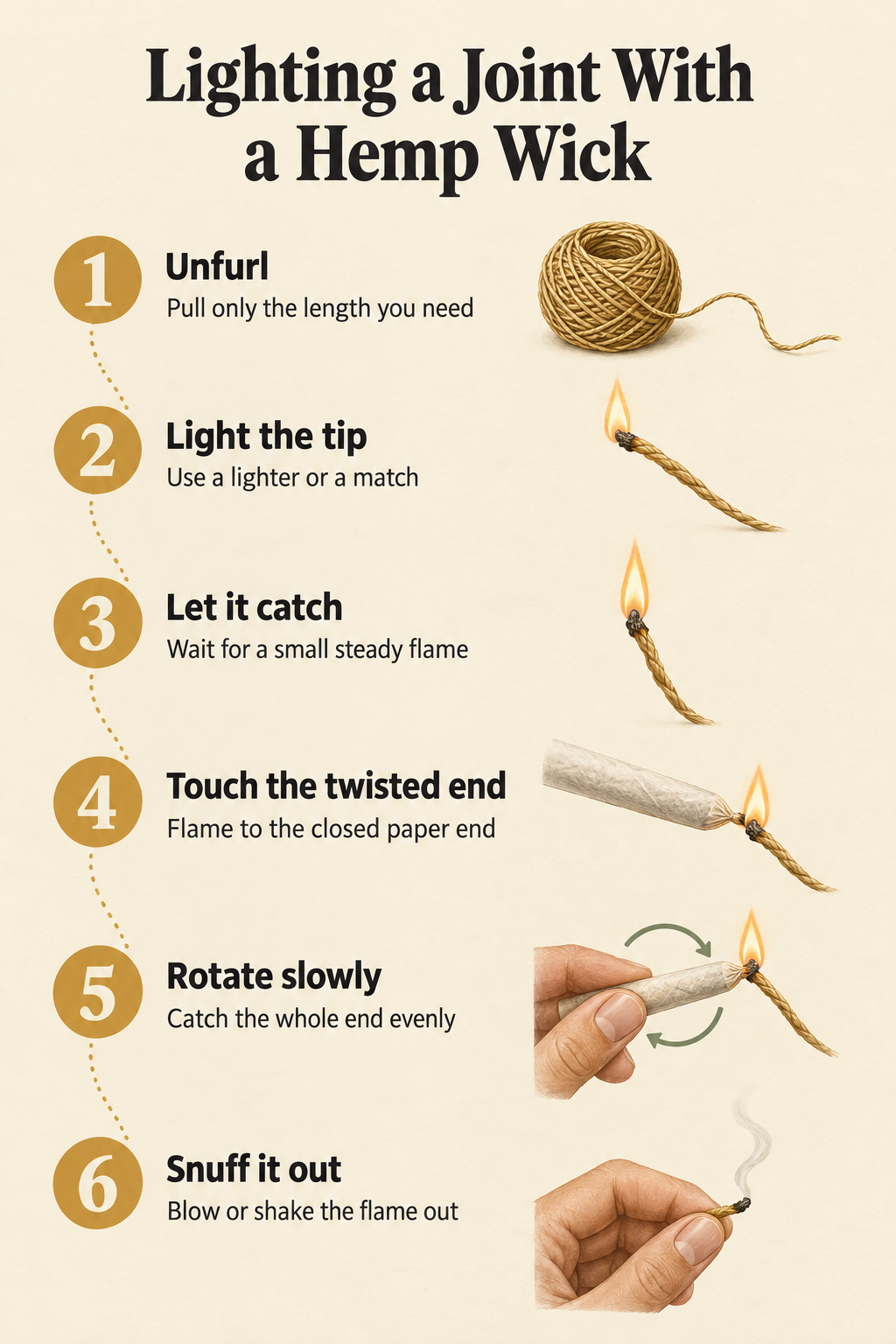
The sequence is short, but the order matters. Most uneven lights come from rushing the rotation or skipping the wait for the flame to settle, not from the wick itself [7]. Work through it in this order and the joint catches evenly the first time.
Unfurl a short length and keep the rest coiled. Six to eight inches is plenty for one session. Pulling the whole ball loose leaves you holding a sticky nest of twine that picks up pocket lint, and there is no upside to it [5].
Aim at the twisted closed end of the paper. That end is where the material sits closest to the surface, and it is the part the flame can reach without being driven into the middle of the roll [5]. Then rotate. A joint that catches on one side before the other starts burning unevenly from that first moment, and no amount of careful drawing later corrects it [7].
The roll itself decides how much of this you have to fight. A loose tuck with an open channel down one side will pull air and run hot along that edge no matter how carefully you light it, so if the fold and tuck are still the shaky part, How Do You Roll a Joint, Step by Step? walks through them step by step. Blunt wraps are a different case because the leaf is thicker and wants a longer, slower light, and How Do You Roll a Blunt Step by Step? covers that separately.
The tip is the other half of an even burn. A tip rolled too tight starves the draw, which makes people pull harder, which pulls the ember off centre. What Are Rolling Tips and Filters, and Which One Should You Use? breaks down folded paper tips against shaped filters, and the difference shows up in how the joint draws long before it shows up in how it looks.
Grind decides the rest. A mix of fine dust and coarse chunks burns at different rates along the same roll, so whichever end catches first keeps pulling ahead [7]. What Should I Look for When Buying a Weed Grinder? explains plate sizes and burr versus blade, and why that difference is visible in the burn rather than on the label.
Wraps that are not paper at all are packed rather than rolled, which is its own skill, and What Are King Palm Wraps and How Do You Pack Them? explains how that works. If you are still assembling a kit from scratch, What Rolling Accessories Do I Need and How Do I Choose the Right Ones? covers trays, papers, tips, and the small tools that make the rest of this easier. Everything described here lives in the Rolling section of the catalog.
- Unfurl six to eight inches from the ball, and leave the rest coiled so it stays dust-free.
- Light the tip with a lighter or a match and hold it still for a second or two [4].
- Let the flame settle until the fresh wax catches and the flame stops sputtering [5].
- Touch the flame to the twisted closed end of the paper, not the middle of the roll [5][9].
- Rotate the joint at a slow, consistent pace so the whole circumference catches before the first draw [9][7].
- Snuff the wick by blowing or shaking it out, then rest the charred tip away from anything it can mark [4].
What Do the Different Hemp Wick Thicknesses Mean?
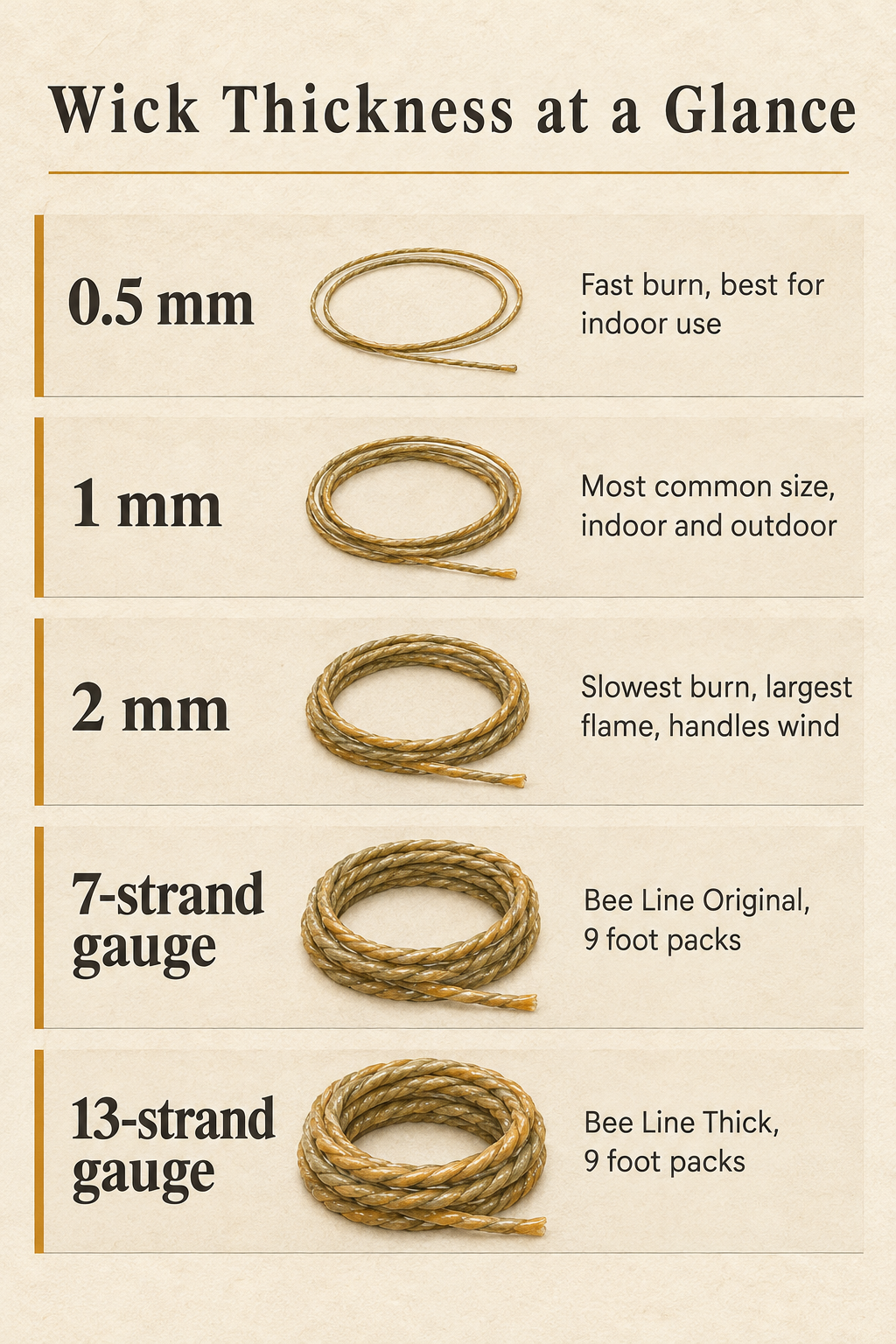
Wick is sold by thickness, and thickness controls two things at once: how fast the strand burns and how large the flame gets. Thicker twine carries more wax per inch, so it burns more slowly and throws a bigger flame. Thinner twine burns faster and produces a small, easily managed flame [3][4].
The common diameters are about 0.5 mm, 1 mm, and 2 mm. Half a millimetre is the fast-burning option, best kept indoors where there is no breeze to fight. One millimetre is the most common size sold and works both indoors and out. Two millimetres is the slowest burner with the largest flame and the best tolerance for wind [3]. Leafly applies the same rule of thumb and notes most wick is sold around 1.0 mm [4].
Some brands skip millimetres and count strands instead. Bee Line lists two gauges, Original at 7 strands and Thick at 13 strands, sold in 9-foot packs and 200-foot balls [1]. Those are not different products from the millimetre scale; they are the same physical property described a different way. More strands twisted together means a fatter strand, which means a slower, larger flame.
This is where online shopping gets confusing. One listing says 1 mm, the next says 7-strand, and a third says thick, and none of them tell you how they relate. Before deciding that one spool is heavier than another, check which unit each brand is quoting. Comparing a strand count against a millimetre number tells you nothing useful.
- 0.5 mm: fast burn and the smallest flame, best suited to indoor use with no breeze [3].
- 1 mm: the most common size sold, a middle burn rate that works indoors and outdoors [3][4].
- 2 mm: the slowest burn and the largest flame, with enough body to cope with wind [3].
- 7-strand gauge: Bee Line Original, the thinner of that brand’s two options, sold in 9-foot packs [1].
- 13-strand gauge: Bee Line Thick, the heavier option from the same brand, slower and larger-flamed [1].
| Wick thickness | Burn speed | Flame size | Best setting |
|---|---|---|---|
| 0.5 mm | Fastest | Smallest | Indoors, with no breeze |
| 1 mm | Middle | Medium | Indoors and outdoors |
| 2 mm | Slowest | Largest | Outdoor or windy use |
| 7-strand (Bee Line Original) | Thinner gauge | Smaller | Everyday rolling |
| 13-strand (Bee Line Thick) | Thicker gauge | Larger | Slower, heavier flame |
How Do You Compare Hemp Wick Formats and Spool Sizes?
Formats vary by brand, and almost all of that variation is about portability rather than quality. The twine inside a 4-foot sleeve and the twine inside a 200-foot ball can be identical; what changes is how long you go between purchases and how easily the thing travels.
Randy’s sells wick in 4, 12.5, 15.5, 100, and 250-foot sizes [2]. Bee Line sells 9-foot packs and 200-foot balls [1]. Those two line-ups overlap in the middle and diverge at both ends, which is normal for the category. There is no industry-standard increment, so the length printed on the label is the only reliable number.
The most useful piece of design in the category is the lighter sleeve. Randy’s 15.5-foot version comes on a sleeve that clips around a standard pocket lighter, so the wick and the thing that lights it travel as one object [2]. That sounds trivial until you have stood outside with a wick and no lighter, which is a mistake most people make exactly once.
Bulk only pays off after you know your size. A 200-foot ball in a thickness you do not like is a decade of twine you will not use, whereas a 9-foot pack lets you try a gauge and move on. Start with the small format, then buy the big one once the size is settled.
- Pocket sleeve, 4 to 15.5 feet: the travel format, small enough to live in a bag and cheap enough to replace [2].
- Lighter-clip sleeve, 15.5 feet: wick and ignition source in one object, which is the format most people end up carrying [2].
- Mid pack, about 9 feet: the trial format, enough to judge a gauge without committing to a ball [1].
- Bulk ball or spool, 100 to 250 feet: the daily-use format, cheapest per foot and best kept at home [2][1].
| Format | Typical length | Best for |
|---|---|---|
| Pocket sleeve | 4 to 15.5 ft | Carrying daily or travelling |
| Lighter-clip sleeve | 15.5 ft | Keeping the wick with your lighter |
| Trial pack | 9 ft | Judging a gauge before buying bulk |
| Bulk ball or spool | 100 to 250 ft | Daily use at home, lowest cost per foot |
Is Hemp Wick the Same Thing as Hemp Rolling Paper?
No, and the confusion is worth clearing up because the two products sit inches apart on the same shelf and both say hemp on the label. A wick is an ignition tool. Rolling paper is the material you roll with. You never put anything inside a wick, and you never light a wick to burn it as the thing you are consuming.
Hemp rolling paper is a paper type, sitting alongside wood pulp, rice, and bamboo in the same category [9]. It is made from hemp pulp pressed into sheets, and it is rolled around material rather than used to light it. The only thing it shares with wick is the plant on the label.
There is a third product that muddies this further: hemp paper with a fine wire running through the length of it. Randy’s sells this as its Roots line [2]. It is paper with a wire core, not a wick, and the two get mixed up because both involve hemp and both get described as wired or wick in casual conversation. The wire in that paper is a structural spine; the wick has no wire at all.
The practical test is what the product does in your hand. If you set fire to one end and carry the flame somewhere else, it is a wick. If you wrap material inside it, it is paper. If it is paper and you can feel a thin stiff line down the middle, it is wire-cored paper, and it still gets wrapped rather than lit at the tip [9][2].
Sensi Seeds makes the distinction cleanly by listing hemp wicks, lighters, and matches together as ignition equipment in a rolling kit, while treating hemp papers as one paper option among several [9]. That is the right way to file all three products in your head.
- Hemp wick: a lighting tool, beeswax-coated twine, lit at the tip and carried to the material [4].
- Hemp rolling paper: a paper type made from hemp pulp, wrapped around material, never lit at the tip [9].
- Wire-cored hemp paper: paper with a structural spine, sold as Roots, wrapped rather than lit [2].
- Hemp blunt wrap: a wrap made from hemp sheet, again the material you roll with rather than a flame source.
- The quick test: does it burn at the tip and travel, or does it hold what you put inside it?
| Product | What it is | What you do with it |
|---|---|---|
| Hemp wick | Beeswax-coated hemp twine | Light the tip, carry that flame to the material |
| Hemp rolling paper | Paper made from hemp pulp | Wrap material inside it, then light the end |
| Wire-cored hemp paper | Hemp paper with a thin wire spine | Wrap material inside it, wire holds the shape |
| Hemp blunt wrap | Sheet made from hemp | Wrap material inside it before lighting |
Does Hemp Wick Really Burn Cooler Than a Lighter?
This is the claim the whole category is built on, and it deserves a straight answer. Brands state it directly in their own product copy, and the reasoning is that a wax-coated hemp flame is preferable to a butane jet or match chemicals [1][2]. Leafly presents that same reasoning as the theory behind wick rather than as a measured finding, which is the honest framing [4].
The problem is what a wick flame actually is. A wick flame has the same zone structure as a candle flame and roughly the same peak temperature, with the yellow middle near 1,200 °C and the outer veil around 1,400 °C. A consumer butane torch is commonly quoted near 1,430 °C [6]. Those numbers sit close enough together that no published measurement establishes wick as cooler.
What is real is the shape and the delivery. A wick flame is small, soft, undirected, and usually held further from the paper than a torch would be. Those are observable differences, and they are what people are actually describing when they say the experience differs. The temperature claim is a separate thing that nobody has measured at the point of contact.
Worth adding for context: the only US rule about wicks is candle-specific. Under 16 CFR 1500.17(a)(13), metal-cored candlewicks containing lead and candles made with them are banned hazardous substances, effective October 2003 [8]. That rule is written for candles and does not certify or regulate wicks sold for smoking, so it should not be read as a quality mark on any product in this category.
If you want to hold the claim to a fair standard, run it as four checks rather than accepting or dismissing it outright.
- Read the label claim as a claim about the flame, not about the material, because that is where the comparison actually happens.
- Compare like with like: a soft wick flame and a jet torch differ in shape, so cooler only means something with a stated distance and duration.
- Notice what you can observe directly, which is flame size, how far you hold it, and how long it stays on the paper [6].
- File the temperature line under marketing until someone publishes a measurement that compares the two at the point of contact [4].
| Flame | Peak temperature often quoted | What actually differs |
|---|---|---|
| Hemp wick (candle-type flame) | About 1,200 °C yellow middle, 1,400 °C outer veil | Small, soft, undirected flame you can hold further away |
| Consumer butane torch | About 1,430 °C | A directed jet, usually used closer to the paper |
How Should You Store Hemp Wick So It Stays Usable?
Storage is a two-minute habit, but it decides whether a spool lasts a year or turns into a fuzzy mess in a drawer. The wax coating is the reason. Beeswax softens at roughly 62 to 64 °C, about 144 to 147 °F, so wick left on a dashboard or in a warm pocket goes tacky and awkward to handle [6].
Tacky wax is also a dust magnet. The same stickiness that lets you park a length on the rim of a lighter will happily collect lint, crumbs, and whatever else lives at the bottom of a bag, which is why the guidance is to keep wick clean and dry [5]. Once grit is stuck in the coating, it is in there for good, and the strand handles badly afterwards.
The routine below takes less time than finding your keys. None of it is fussy, and all of it is easier than replacing a ball that has gone soft.
- Keep the unused length coiled on its ball or spool rather than loose in a pocket.
- Store it away from heat: not a car dashboard, not a windowsill, not on top of a radiator or a warm device.
- Keep it dry, since a damp pocket or a bathroom shelf adds nothing useful to the coating.
- Unfurl only what you plan to burn in that session, so the rest never leaves the coil [5].
- Wipe the charred tip before you put it away, so soot does not transfer onto the clean length.
Which Hemp Wick Should You Buy First?
A first spool does not need much thought once you know what to check. The cheapest useful starting point is a mid-thickness pocket length, which in practice means something around 1 mm or a 7-to-13-strand gauge in a short sleeve. That size covers indoor and outdoor use, and the length is enough to judge whether you like the format before you commit to a ball.
Bulk only makes sense after the size is settled. A 200-foot ball is the best value per foot in the category, but only if you already know the thickness suits how you light things [1]. Buying bulk first is how people end up with a decade of twine they never touch.
Then read the label for the things that actually differ between brands. Lengths are not standardised, thickness is quoted in two incompatible units, and words like natural and organic are per-product claims rather than a category standard. Bee Line states that its hemp is certified organic and that it is the only globally organic-certified hemp wick, while Randy’s describes its wick only as natural hemp and beeswax [1][2]. Both statements can be true at once; neither one is a rule the whole category follows.
One last practical note before ordering: check whether the format includes a lighter sleeve. It is the single feature that changes daily use, because it keeps the wick and the ignition source in the same place [2]. And if you are stocking up alongside papers, tips, or a tray, the store runs free shipping on orders $150+.
- Check which thickness unit the listing uses, millimetres or strand count, before comparing it to another spool [3][1].
- Check the actual length in feet, since brands ship 4, 9, 12.5, 15.5, 100, 200, and 250-foot formats with no shared increments [2][1].
- Check whether a lighter holder or clip sleeve is included, because it is the feature you will notice every day [2].
- Check that an organic or natural claim names the brand making it, rather than reading like a category standard [1][2].
- Start with a short mid-thickness sleeve, then move to a bulk ball once you know the gauge you want.
Frequently Asked Questions
What is the difference between 1 mm hemp wick and 7-strand hemp wick?
They are two ways of describing thickness. Millimetre diameter measures the strand directly, and strand count describes how many hemp fibers are twisted into it. Bee Line lists its gauges as Original at 7 strands and Thick at 13 strands, while other brands quote about 0.5 mm, 1 mm, and 2 mm. A larger number in either system means a thicker wick with a slower, larger flame, so read which unit a listing uses before comparing it to another.
How long does a hemp wick last?
It depends on the length you started with and how much you burn per session. Wick is sold in lengths from pocket sizes up to bulk spools: Randy’s lists 4, 12.5, 15.5, 100, and 250-foot options, and Bee Line sells 9-foot packs and 200-foot balls. Because you only light the tip and snuff it between uses, a pocket length lasts many sessions, which is why most people start small rather than with a bulk ball.
Do you have to blow a hemp wick out, or can you just let it burn?
You can blow it out or shake it out, and either works. Leafly describes blowing or shaking the wick out after use, and the wax coating is tacky enough that a recently used length can be wrapped around a lighter or the rim of a bowl to hold it. Letting it burn between uses wastes wick and leaves a longer charred tip, so snuffing it when you set it down is the practical habit.
Is hemp wick the same as a hemp blunt wrap?
No. A hemp wick is a lighting tool made of hemp twine coated in beeswax, and you never roll material inside it. A hemp blunt wrap or hemp rolling paper is the material you roll with. The two get mixed up because both are hemp products sold in the same part of a store, and because some hemp papers are sold with a wire core, which adds to the naming confusion.
Can you use a hemp wick with a pipe or a bong as well as a joint?
Yes. The wick is simply a flame source, so the operation is the same: light the tip, let it settle into a small flame, and bring that flame to the material rather than touching a lighter flame to it. Leafly describes using wick to spark a bowl, and Weedmaps describes the same tip-lighting approach. The joint-specific part is aiming at the twisted closed end and rotating the roll as it catches.
What Should You Take Away Before You Buy a Hemp Wick?
A hemp wick is two materials doing two jobs: hemp fiber holds the shape and carries the flame, and beeswax paces the burn so the flame stays at the tip. That is the whole product. Everything else on the shelf is a variation on thickness and length.
The practical skill is reading a listing correctly. Thickness shows up as millimetres or as strand count, and a 1 mm wick and a 7-strand wick can be the same thing described twice. Lengths have no shared increments between brands, so check the number in feet. And a natural or organic claim belongs to the brand that made it, not to the category.
Use it the way the category has always used it: unfurl a short length, light the tip, let the flame settle, touch it to the twisted closed end, and rotate slowly until the whole end catches. Snuff it when you are done and store it away from heat. The cooler-burn claim behind most of the marketing remains unmeasured, but the flame you can see, small and soft and held at a distance, is real enough to work with.
Sources
- Bee Line Hemp Wick: What Is Bee Line Hemp Wick?
- Randy’s: Hempwick
- Hemptique: What Is Hemp Wick
- Leafly: Hemp wick 101: Is it a better way to burn?
- Weedmaps: How to use hemp wick
- Barney’s Farm: Lighters, Hemp Wick and Torches: What You Light It With Matters
- DaySavers: Why Do Pre-Rolls Canoe and How to Fix Them When They Do
- U.S. Consumer Product Safety Commission (Federal Register): Metal-Cored Candlewicks Containing Lead and Candles With Such Wicks
- Sensi Seeds: How to Roll a Joint – Step-by-Step Guide