
For a mini bong vs large bong choice, pick a mini when compact storage, easier movement, and simple handling matter most. Pick a full-size bong when you have a dedicated home space and want more chamber capacity or room for add-ons. Since size labels vary by seller, compare exact dimensions, base width, joint size, and cleaning access before buying. [1] [2]
What Is the Difference Between a Mini Bong and a Full-Size Bong?
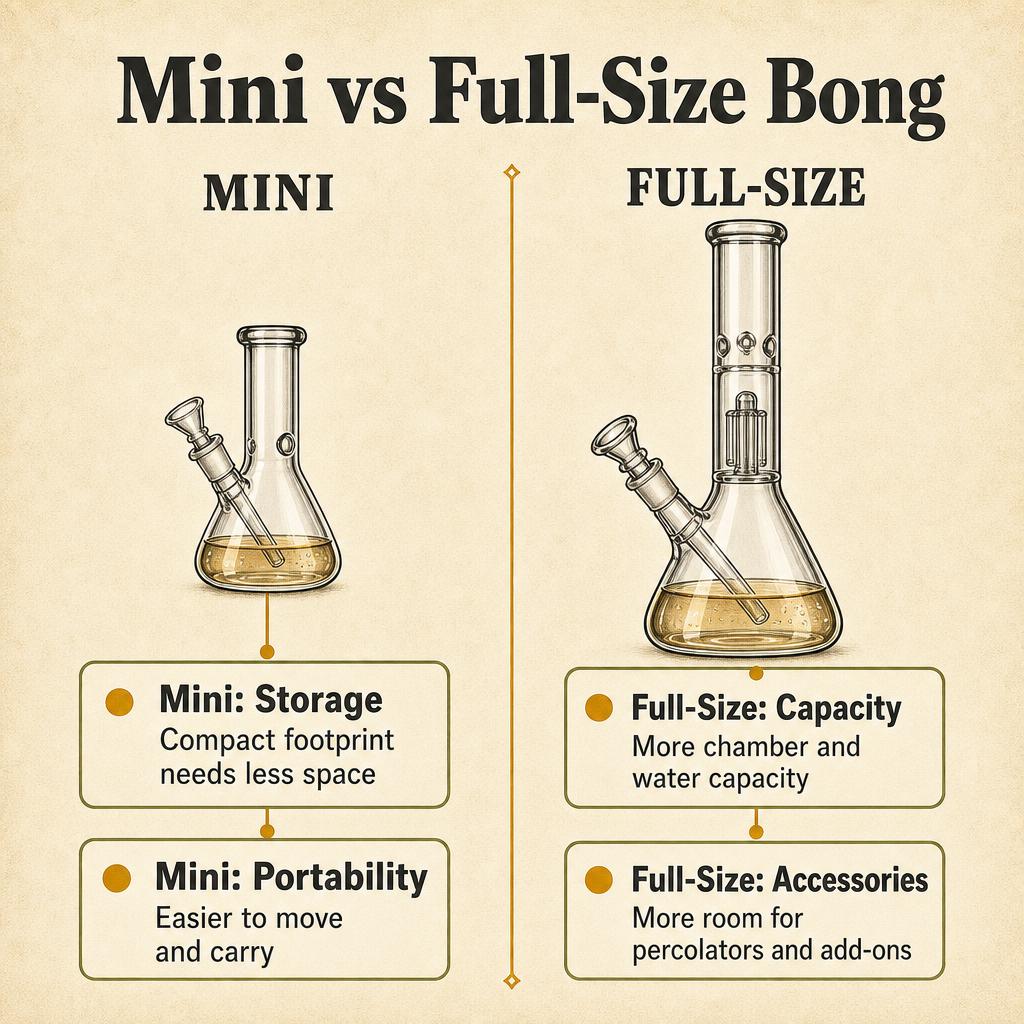
The clearest difference is the space each piece uses. A mini bong is built around a smaller footprint and easier movement, while a full-size bong usually gives you a larger chamber, more water capacity, and more room for added hardware. Those are useful general patterns, not fixed rules. Retailers use size labels in different ways, so compare the listed dimensions instead of trusting the label alone. [1] [2]
For a quick look at available compact options, browse Mini Bongs or the wider selection of Bongs. A mini design can be a sensible match for a shelf, cabinet, dorm-style room where permitted, or a setup that needs to be packed away after use. A larger piece can make more sense when it will stay in one dedicated place and you want more room around the chamber or joint area.
Height is only one part of the comparison. Base width, chamber shape, downstem position, joint size, and the way the piece sits on a table can change how practical it feels. Two pieces with similar heights may need very different amounts of shelf space.
Think about footprint before height. A tall narrow piece may occupy less table area than a short model with a wide base. Mouthpiece clearance matters too, especially inside a cabinet. Measure the space needed to lift the piece out without tilting it into a shelf.
Capacity and complexity are separate questions. A larger chamber may leave more room for built-in diffusion or add-ons, yet added parts can increase cleaning work. A compact model may have fixed hardware that keeps setup simple but limits changes later. Read the parts list instead of guessing from the photo. [3] [4]
- Mini pieces: smaller storage footprint and easier routine handling.
- Full-size pieces: more chamber and water capacity in many designs.
- Mini pieces: often simpler to move, pack, and place on a shelf.
- Full-size pieces: more room for percolators, adapters, or other add-ons.
- Both sizes: require checking exact dimensions, stability, and joint details.
| Feature | Mini bong | Full-size bong |
|---|---|---|
| Footprint | Usually compact, but measure the base | Usually larger and needs more shelf space |
| Capacity | Often more limited | Generally more chamber and water capacity |
| Portability | Usually easier to move | Better suited to a dedicated home spot |
| Add-ons | May have less room around the setup | Often offers more room for percolators and adapters |
Are Mini, Medium, and Large Bong Sizes Standardized?
No. Mini, medium, and large are retailer conventions rather than universal measurements. One published guide places mini pieces around 4–8 inches, while another uses 4–10 inches; large pieces may begin around 15 or 16 inches. Those different cutoffs show why the product specification matters more than the category name. [1] [2]
If you want background on parts and water pipes, read What Is a Bong and How Does It Work?. Then compare the exact listing details for each option. A product such as SILICONE BEAKER BONG WITH REMOVABLE GLASS BOWL may be described by its construction and shape, but its actual measurements and joint information still need to be checked before ordering accessories.
regard the size label as a starting point, not a promise about capacity or setup. A short, wide-base model may need more table room than a taller, narrow model. A compact piece with fixed hardware may also have a different setup process from one with removable parts.
Seller labels help organize a catalog, but they do not create a shared industry scale. If one store calls a 9-inch piece mini and another calls it medium, neither label tells you the base width, joint, or chamber layout. The numbers on the product page are the useful part. [1] [2]
Create a small measurement note while shopping. Record height, widest point, base diameter, joint size, orientation, and whether the downstem is fixed. Comparing the same fields across products prevents a category label from steering the whole decision.
- Record total height from the listed product dimensions.
- Check base width or diameter for shelf and cabinet clearance.
- Review chamber shape and any stated water level or capacity.
- Note fixed or removable downstems and diffusion hardware.
- Confirm joint size and orientation before choosing accessories.
What Are the Main Benefits of a Small Bong?
The main small bong benefits are practical. A compact piece can fit into a smaller storage area, take less effort to move, and suit a simple setup. That can help people who do not want a large glass item taking up a permanent place. The best result still depends on the design, not just the height. [5]
For example, GRAV lists one compact beaker at 6 inches tall with a 3.25-inch width and a 10 mm female joint. Its small wide-base water pipe is 8.25 inches tall but has a 6-inch-wide base, fixed diffusion hardware, and a 14 mm female joint. The second piece is still compact by height, yet its footprint and capacity are quite different. [3] [4]
That is why storage deserves its own check. A short piece can still need a broad, flat surface. If you are organizing a small setup, use a measured shelf or tray rather than guessing from product photos. A dedicated storage area can also keep the piece, cleaning supplies, and accessories together.
Compact size can also make routine inspection easier. You can see the water line, joint, and removable pieces without working around a tall frame. That does not mean every mini is easy to clean. Narrow chambers, fixed parts, and tight bends can still need more attention.
Base design deserves special weight. The verified 6-inch GRAV beaker is narrow compared with the 8.25-inch wide-base example, whose six-inch base takes more table space. Both count as compact products, yet they solve storage and stability in different ways. [3] [4]
- Compact storage: easier to place in a cabinet, shelf, or tray when dimensions allow.
- Simple handling: less height to manage during routine setup and cleaning.
- Portability: more convenient when the piece must be moved carefully.
- Design variety: mini models can still offer different bases, chambers, and hardware.
- Accessory planning: joint size remains important even on a small piece.
When Does a Full-Size Bong Make More Sense?
A full-size bong can make more sense when you have a stable home location and want more room in the design. Larger pieces generally provide greater chamber and water capacity and may leave more space for percolators or other add-ons. They also need more storage room and more care during transport or cleaning. [1] [2]
If you are comparing added hardware, see What Is a Percolator Bong and How Does It Work? for a related percolator guide. The important point is not that extra parts are required; it is that a larger frame may give you more physical room to consider them. Check whether a chosen piece has fixed or removable components and whether those parts are included.
A larger setup is not automatically the best bong size. If the piece will sit in a crowded area, be moved often, or be difficult to reach for cleaning, its extra capacity may not offset the daily inconvenience. Choose the footprint you can store and handle without bumping nearby objects.
A full-size model works best when its extra room serves a clear purpose. That purpose might be a larger chamber, a design with more diffusion hardware, or enough space around the joint for a planned accessory. Buying more height without a reason only adds storage and handling work.
Plan the permanent location before ordering. Check overhead clearance, the route from storage to the cleaning area, and the distance from table edges. A larger piece should not need to be shuffled around whenever the surface is used for something else.
- Dedicated home space: enough room for the base and nearby accessories.
- More chamber room: useful when the listed design calls for it.
- Accessory room: potentially more space for percolators or adapters.
- Stable placement: a level surface with clearance around the piece.
- Maintenance plan: enough access to empty, rinse, and clean the parts.
Which Bong Size Is Easier to Store, Carry, and Clean?
There is no single winner for every task. Mini pieces usually have an edge in storage and carrying, while larger pieces often need a dedicated location. Cleaning depends on openings, chamber shape, removable parts, and how easy it is to reach the interior—not simply on total height. Published size guides also point to storage, handling, maintenance, and intended use as key comparison points. [1] [2]
Before choosing, compare the ownership tasks in order.
Use the following walkthrough for any size. It keeps the decision tied to your room and routine rather than a marketing label.
For storage, the mini bong usually wins only after its widest point is measured. A wide-base compact model can use more shelf area than expected. For carrying, shorter height may be easier to manage, but removable parts still need separate protection.
For cleaning, look at access rather than category. A simple full-size beaker with removable parts may be easier to rinse than a small piece with narrow passages. Review the maker’s care directions, empty the piece before moving it, and keep small parts in one place during cleaning. [3]
Run a dry ownership test before buying: mark the listed footprint with paper, check hand clearance, and picture the trip to the sink. This simple check often reveals problems that a product photo hides.
- Measure the storage spot, including height, width, depth, and the space needed to lift the piece out.
- Check the base on a level surface and look for a footprint that fits without crowding nearby items.
- Think about how often the piece will move and how it can be carried with both hands when needed.
- Review openings and removable parts so cleaning tools can reach the areas that need attention.
- Plan a safe place for the piece while it is being emptied, rinsed, or cleaned.
What Measurements and Joint Sizes Should You Check Before Buying?
Start with the complete measurements, then check compatibility. Common bong joint sizes include 10 mm, 14 mm, and 18 mm, but a bowl, downstem, or adapter must match both the joint size and the fitting orientation. A piece that is the right height can still be the wrong match for an accessory. [1] [2]
Product specifications can make this clear. The GRAV compact examples show why: one lists a 10 mm female joint and the other a 14 mm female joint, even though both are marketed as compact designs. [3] [4]
Do not assume that a larger bong uses a larger joint, or that two pieces from the same size group use the same fitting. Read the product page and compare the accessory specification before placing an order.
Joint size is the diameter of the connection, not the overall size of the bong. Common listings use 10 mm, 14 mm, or 18 mm. Orientation matters at the same time: a male part does not replace a female part merely because the diameter matches. [1] [2]
Downstems add another layer. Check whether the downstem is fixed or removable and, when removable, whether its length is specified. An accessory can match the joint diameter yet still sit incorrectly if its length or angle does not match the piece.
When a listing is unclear, do not estimate from a photograph. Ask the seller for the exact specification or choose a product with complete measurements. Compatibility errors are far more annoying than spending another minute checking the listing.
- Height: confirm the total height and any removable top or mouthpiece section.
- Base width: make sure the footprint fits the shelf, tray, or cabinet.
- Chamber and water details: review the stated design and recommended fill level.
- Joint size: match 10 mm, 14 mm, or 18 mm parts when listed.
- Orientation: confirm whether the fitting is female, male, angled, or otherwise specified.
- Included parts: check whether bowls, downstems, or adapters come with the piece.
How Do You Choose the Best Bong Size for Your Space and Routine?
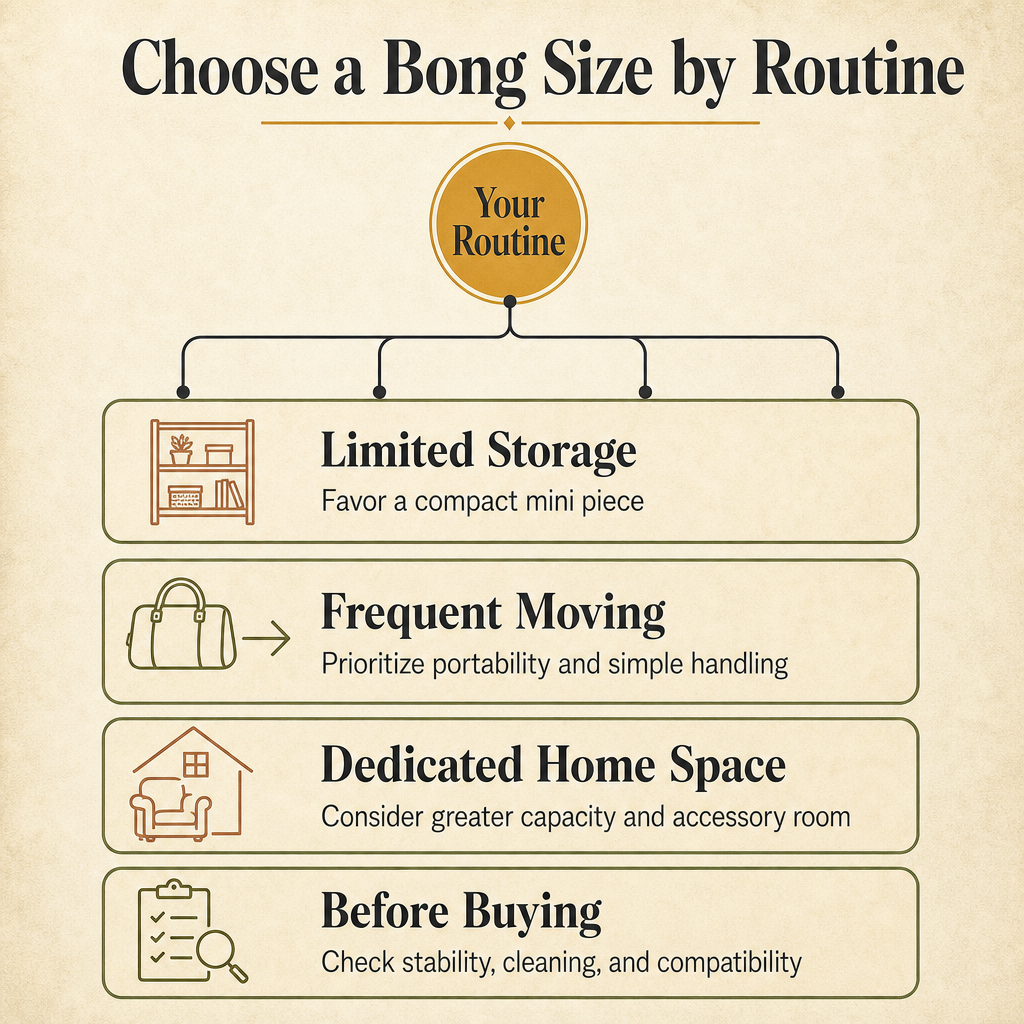
Choose the best bong size by ranking your real limits first. Available space and how often the piece will move usually matter more than chasing a particular label. Then consider base stability, cleaning access, desired complexity, chamber design, and accessory plans. This routine-first approach matches specialist guidance that regards size as a use and storage decision rather than a contest to find the largest option. [1] [2] [5]
A mini piece is a strong starting point when you need compact storage and frequent careful movement. A full-size piece is worth considering when it can stay in a dedicated home spot and its larger design matches the features you actually want. In either case, use the product measurements to make the final call.
Write down your answers before browsing. That turns a vague search for the best bong size into a short list of measurable requirements.
Start with the factor that cannot change: your available space. Next rank movement, cleaning access, and base placement. Only then compare chamber design, diffusion, and accessories. This order keeps a useful feature from distracting you from a piece that does not fit.
If two products meet the same needs, choose the simpler one to own. Fewer unnecessary parts can mean fewer compatibility checks and fewer areas to clean. If the extra hardware has a clear purpose for your setup, make sure the larger footprint still works.
A good final shortlist should contain exact facts, not labels: dimensions, base width, joint details, included parts, fixed components, and cleaning access. When those facts fit your room and routine, the mini or full-size name becomes secondary. [5]
- 1. Measure the exact storage location and keep clearance for lifting and cleaning.
- 2. Decide whether the piece will stay home or move regularly.
- 3. Choose the base footprint that gives you comfortable, level placement.
- 4. Decide how much chamber space and hardware complexity you actually want.
- 5. Match the joint size and orientation to the accessories you plan to use.
- 6. Recheck cleaning access and included parts before buying.
Frequently Asked Questions
Is a mini bong always under 10 inches tall?
Is a larger bong automatically the best bong size?
Can two mini bongs work differently even if they are close in height?
What joint sizes are common on bongs?
Should I choose a mini bong for a small space?
Which Bong Size Fits Your Routine Best?
Choose a mini bong when compact storage, easier movement, and straightforward handling are your top priorities. Choose a full-size bong when you have a dedicated home location and want more chamber room or space for add-ons. Neither label guarantees a particular design, so compare height, base width, chamber details, cleaning access, joint size, and included parts before buying. [1] [2]
The right choice is the piece you can store, handle, clean, and use responsibly within applicable laws. Measure first, check compatibility twice, and let your routine—not the biggest number—make the decision.
The best choice is not the largest or smallest option. It is the one whose measured footprint, parts, and care needs fit your real space. Use seller labels to narrow the shelf, then use verified specifications to make the decision. [1] [2]
Related Reads
Continue exploring: Mini Bongs · Bongs · What Is a Bong and How Does It Work? · What Is the Difference Between a Bubbler and a Bong? · SILICONE BEAKER BONG WITH REMOVABLE GLASS BOWL · Storage · What Is a Percolator Bong and How Does It Work? · 2-Piece vs 4-Piece Grinder: Which Is Better for You?.
Sources
- Thick Ass Glass: Bong Sizes Guide: Find the Right Bong for You
- Friends NYC: Bong Size Guide: Everything You Need to Know
- GRAV: GRAV Mini Beaker
- GRAV: GRAV Small Wide Base Water Pipe
- Daily High Club: How to Choose A Bong – Beginner’s Guide
- Centers for Disease Control and Prevention: Cannabis and Lung Health