
There is no single universal number that makes a bong tall. Most retailers count tall bongs at roughly 16 inches and up, with mini bongs around 4-8 inches, small bongs around 8-12 inches, and medium bongs around 12-16 inches[1]. Other shops place the large tier at 15-20 inches and add an XL tier above 20 inches, so the line moves from store to store[3].
What stays consistent is what height does. A taller bong gives smoke more distance to travel and more time to cool off along the way, and it usually holds more water for extra filtration, which is why tall pieces are widely described as delivering cooler hits[2].
That height also comes with real trade-offs: more storage space, trickier cleaning, a higher chance of being knocked over, and a price that generally rises with height. This guide walks through the size tiers, what height actually changes about each hit, and how to match a tall bong to your space, budget, and session style.
What counts as a tall bong?
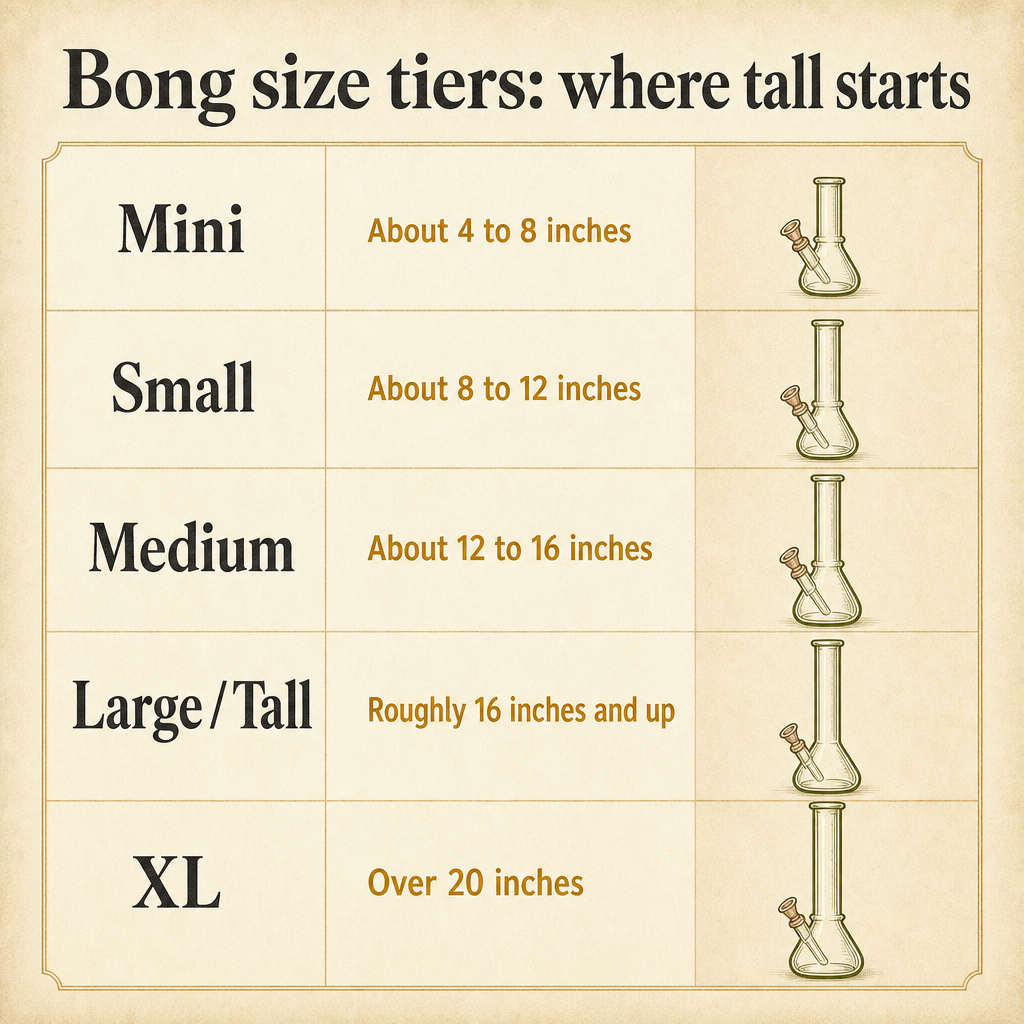
Bong sizes are classified by height, but the boundaries are not written in stone. The most common breakdown counts mini bongs around 4-8 inches, small bongs around 8-12 inches, medium bongs around 12-16 inches, and large or tall bongs at roughly 16 inches and up[1]. Other retailers place large at 15-20 inches and then add an XL tier above 20 inches[3]. There is no single official line where a bong becomes tall.
In practice, most shoppers consider tall to be anything in the large and XL range: pieces that stand around 16 inches or taller. A 12-inch piece like the Pulsar Round Ball Glass Water Pipe – 12" / 14mm F / Clear sits at the top of the medium tier, which is a good example of how the same height can land in different categories depending on the shop.
That matters when you compare listings side by side. One store can call a 15-inch bong large while another calls the same height tall, and a third might label anything below 20 inches as simply medium. Because the words differ, checking the actual measurement on the product page is the only reliable way to know what you are getting.
A good working rule is to use 16 inches as the start of tall, then adjust for the retailer’s own scale. If one shop lists a 14-inch piece as large, keep the measurements handy when you compare it with a 16-inch tall piece from another store. The number on the listing stays the same even when the label changes, and that number is what actually drives cooling, storage, and cleaning.
- Mini bongs: about 4 to 8 inches
- Small bongs: about 8 to 12 inches
- Medium bongs: about 12 to 16 inches
- Large or tall bongs: roughly 16 inches and up
- XL bongs: more than 20 inches, used by some retailers
Does bong height make the hit smoother?
Height changes how the smoke feels before it reaches you because of distance. On a taller bong, the smoke has more path to travel and more time to cool off along the way, which is why tall pieces are widely described as producing cooler hits[2]. On a shorter bong, the smoke travels less distance and arrives hotter and more direct[1]. The distance effect is why the same bowl and downstem can feel different from one piece to the next: on a 10-inch bong the smoke arrives quickly, while on an 18-inch bong it has nearly twice the column to climb.
Taller bongs also hold more smoke volume, so they can deliver bigger draws. The catch is that clearing the chamber takes deeper, longer inhalations[6]. That trade-off matters more for solo sessions, where a smaller chamber is often plenty, than for group sessions, where the extra volume gives everyone more to work with.
If you want the details on how the internal parts shape that path, our guide What Is a Percolator Bong and How Does It Work? walks through how percolators and chambers work together to affect the draw.
- You pull on the mouthpiece, and smoke fills the chamber from the bowl below
- On a tall bong, that smoke climbs a longer column, so it spends more time inside the piece
- More time in the column gives the smoke more chance to cool before it reaches the mouthpiece
- Because the chamber holds more smoke, the draw can be larger, but you inhale deeper and longer to clear it
- If the chamber is very tall, you may need to tip the piece slightly as you pull to clear the last of the smoke from the column
How does bong height change cooling and filtration?
Size sets how much water a bong can hold, and water volume drives filtration. Larger bongs hold more water and usually have room for bigger percolators or diffusion systems, which increases filtration[2]. Smaller bongs hold less water and deliver a hotter, more direct hit[5].
A wider base, such as a beaker design, holds more water, increases filtration, and makes the piece more stable at the same time[4]. That combination is a big reason beaker shapes stay popular in the tall range even though they take up more counter space.
The size of the water chamber and the kind of percolator inside are separate decisions, but they work together. If you want to see what kinds of diffusion hardware fit inside larger pieces, browse our Percolator Bongs collection to compare percolator styles side by side.
Water level matters as much as water volume. A large chamber with a low water level gives smoke more air space and less filtration, while a higher water level creates a longer bubble path but makes the draw feel heavier. Most tall bongs work best with the water just above the downstem, though the ideal fill line varies by design.
- Tall bongs: more water volume and more room for larger percolators, which increases filtration
- Small bongs: less water and simpler diffusion, which produces a hotter, more direct hit
- Beaker bases: a wider design that holds extra water and adds stability at the same time
- Straight tubes: tall and slim, with less water volume than a beaker of the same height
Tall bong vs. small bong: which is right for you?
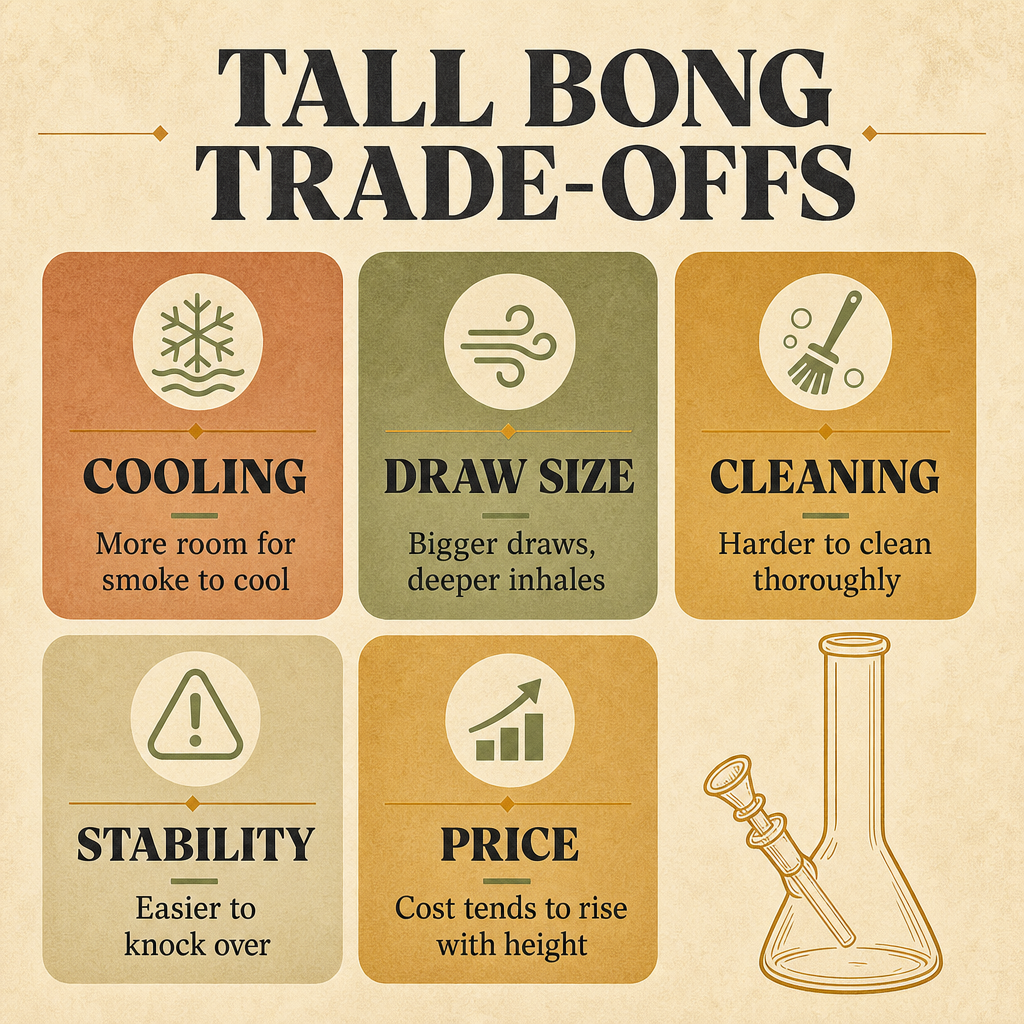
The honest trade-off list starts with what you gain and what you give up. Tall bongs cool and filter more and can hold bigger draws, but they take up more space, are harder to clean, and are easier to knock over than shorter pieces[4][5]. Price also tends to rise with height[2].
Small bongs are easier to clean and carry less tipping risk, but they give a hotter, more direct hit[5]. Unless you are hosting group sessions, a lot of extra height can turn into extra cleaning, clunky storage, and airflow you may not need[6].
That is not a knock on tall pieces, just a reminder that height is a feature you pay for in several ways. If you are weighing a more compact option entirely, our comparison of Chillum vs One-Hitter: What Is the Difference? covers another small-piece choice and how it fits into a daily routine.
Group sessions are where tall bongs earn their keep. A bigger chamber means several people can share the same piece without refilling in the middle of the rotation, and the extra cooling helps when the session runs long. If most of your sessions are solo, the added volume mostly adds cleaning time and counter space.
- Tall bong: more cooling and filtration, plus a larger draw capacity
- Tall bong: needs more storage space and more cleaning effort
- Tall bong: higher tipping risk and a higher price tag
- Small bong: easier to clean and less likely to tip over
- Small bong: hotter, more direct hits with less water volume
| Comparison | Tall bong | Small bong |
|---|---|---|
| Cooling and filtration | More water volume and room for larger percolators | Less water and simpler diffusion |
| Draw size | Bigger draws, deeper inhales to clear | Quick, easy clears |
| Cleaning | Harder to clean thoroughly | Easier to clean |
| Stability | Easier to knock over; a wide beaker base helps | Lower tipping risk |
| Price | Tends to rise with height | Usually more affordable |
| Best for | Group sessions and cooler hits | Solo sessions and small spaces |
What should you check before buying a tall bong?
Before you commit to a tall piece, run through a short checklist. The goal is to match the height to your space, your storage, and how much cleaning you are willing to take on[6].
Start with the practical measurements. A bong in the 16-inch-and-up range needs shelf or cabinet space that clears its full height, and it needs to fit in your sink or cleaning tub when it is time for a deep clean[6]. Wide or beaker bases need table room too, and they are the most stable design if you have pets, kids, or a busy counter[4]. Write the measurement down before you shop, because a 16-inch bong often looks shorter on the table than it measures on the listing.
Then check the joint. The joint size has to match your bowl and downstem, and the size usually scales with the piece[1]. If you are not sure how to measure your own glass, our guide How Do I Measure My Bong’s Joint Size? walks through it step by step. And if you plan to bundle a tall bong with new accessories, remember that Treehouse Lifestyle offers free shipping on orders $150+.
- Measure your storage space, including shelf height and cabinet depth
- Check that the piece will fit in your sink or cleaning tub
- Confirm the base is wide enough for your table or tray, and prefer a beaker design for stability
- Verify the joint size matches your bowl and downstem, whether 10mm, 14mm, or 18mm
- Set a budget and expect the price to rise with height
What joint size do tall bongs use?
Joint size tends to scale with the piece. Large bongs of 16 inches and up commonly use a wider 18mm female joint for higher airflow, while smaller pieces commonly use 10mm or 14mm female joints[1].
Bowl and downstem joints come in 10mm, 14mm, and 18mm sizes, so matching your accessories to the joint is part of the buying decision[3]. If you are buying a tall piece, plan for 18mm unless the listing says otherwise. Beaker and straight-tube designs both lean on 18mm joints, though some slim tall pieces keep a 14mm joint to cut weight, so the spec sheet matters as much as the look.
Shopping by height makes this easier. Our Tall Bongs category groups taller pieces together, so you can compare joint sizes without digging through every listing.
- 10mm female joints: common on mini and small pieces
- 14mm female joints: the standard middle size on many bongs
- 18mm female joints: common on large and tall pieces of 16 inches and up, for higher airflow
Frequently Asked Questions
What counts as a tall bong?
Most retailers count large or tall bongs at roughly 16 inches and up, but the boundaries vary. Some shops place large at 15-20 inches and add an XL tier above 20 inches, while mini, small, and medium tiers typically fall around 4-8, 8-12, and 12-16 inches[1][3]. The tier labels are guides, not laws, and the same piece can sit in different tiers at different shops.
Do tall bongs actually hit smoother?
Generally yes, when it comes to temperature. Smoke has more distance to travel on a taller bong, which gives it more time to cool before it reaches you, and larger pieces hold more water with bigger percolators for extra filtration[2]. Shorter bongs deliver a hotter, more direct hit[1]. If you are used to a small piece, give the taller chamber a few sessions to learn the deeper inhale it needs.
What are the downsides of owning a tall bong?
Taller pieces take up more space, are harder to clean, and are easier to knock over, and price tends to rise with height[4][2]. A wider base, like a beaker design, improves stability, and unless you host group sessions, much of that extra height can become extra cleaning and storage[6]. Keep it on a low, stable surface and near a sink to make the cleaning routine easier.
What size bong is best for home use?
It depends on your space and routine. Tall bongs cool and filter more and can deliver big draws, but they need deeper inhales to clear, more storage room, and more cleaning effort[6]. Small bongs are easier to clean and less likely to tip over, but they give a hotter, more direct hit[5]. Try the middle tier first if you are unsure, then size up or down based on your actual routine.
What joint size do tall bongs use?
Does bong height affect the price?
Yes. Bong price generally rises with height, so taller pieces are usually more expensive than comparable smaller ones[2]. Compare a few listings in the same height range to see how much the price changes with brand and build.
What Bong Height Is Actually Right for You?
There is no wrong answer, only trade-offs. If you want maximum cooling, bigger draws, and a piece that feels like a centerpiece, a tall bong in the 16-inch-and-up range can deliver, as long as you have the storage space, the cleaning patience, and the budget[2][6].
If you want something easier to clean and less likely to tip, a small or medium piece may serve you better[5]. Measure your space, match the joint size to your accessories, and choose the height that fits your actual routine[1].
Whatever you pick, compare measurements rather than labels, because tall means different things at different shops. The right height is the one you will actually use and take care of.
Start from the middle if you are unsure. A medium piece in the 12-16 inch range delivers many of the benefits of a tall bong with fewer storage and cleaning demands, and it leaves room to size up later once you know what your routine really needs.
Sources
- DankStop (High Tide Inc.): Bong Sizes: How to Choose the Right One for Your Session
- HEMPER: A Visual Guide to Bong Sizes: Yes Size Matters!
- Friends NYC: Bong Size Guide: Everything You Need to Know
- Friendly Stranger: Bong Sizes Explained (For Beginners)
- Stoked Progressive Smoke Shop & Glass Gallery: Small Bong vs Big Bong: Does Size Matter?
- Thick Ass Glass (TAG): Is a 12-Inch Bong the Perfect Size? Size Comparison