

An acrylic bong is a water pipe whose body is made from acrylic plastic, chemically polymethyl methacrylate (PMMA), rather than glass. It sits at the budget end of the bong market: light, hard to shatter, and usually built as a simple one-piece tube or beaker with a carb hole, a grommet-seated downstem, and a basic bowl.
What you trade for that lower price is filtration options, joint compatibility, tolerance for solvents when cleaning, and lifespan. Acrylic weighs roughly half what glass does and the manufacturer rates it far more break resistant [4], but it scratches easily, softens as it warms up, and is attacked by many solvents and alcohols [1].
This guide covers what acrylic actually is, how an acrylic bong is built, how it compares with glass, how to clean it without clouding the material, how heat affects it, which parts fit, and who should actually buy one.
What Is an Acrylic Bong Made Of?
Acrylic is a plastic, not a glass. Its chemical name is polymethyl methacrylate, usually shortened to PMMA, and it is an amorphous thermoplastic. That last word matters: thermoplastics soften gradually as they warm instead of holding their shape rigid until one single melting point [1].
The confusion comes from the trade names. The same base polymer is sold as Plexiglas, Perspex, Acrylite, Lucite, and Optix, among many others. One materials datasheet lists more than 40 commercial names for it [5]. People also say ‘acrylic glass’ because the material is transparent and looks like glass. It is not glass, and it does not behave like glass when it meets heat or a solvent.
There are two production routes, and they do not perform identically. Cast, or cell-cast, acrylic is polymerised slowly in moulds. Extruded acrylic is pushed through a die. Cast grades end up with higher molecular weight, a higher heat deflection temperature, and better resistance to chemical and stress cracking. Extruded grades cost less and hold tighter thickness tolerances, but they are more sensitive to solvent stress cracking [2].
That means two acrylic bongs on the same shelf at the same price can be made from different grades of the same polymer. Unless a retailer tells you which grade you are looking at, the price tag and the build quality are most of what you have to go on.
One label you may see on acrylic products is ‘food-grade’. In the United States that term traces back to a food-contact formulation rule, which permits semirigid and rigid acrylic plastics under prescribed conditions, including that at least half the polymer content comes from listed acrylic or methacrylic monomers [13]. It is a specification about food contact rather than a general property of the material, and a bong body is not a food-contact application.
A last piece of vocabulary: a bong is simply a water pipe, and shops and makers use the two terms interchangeably [14], so an ‘acrylic water pipe’ listing is the same product you are shopping for here. To browse what is currently stocked, the Acrylic Bongs category is the fastest place to start, and Bongs in general covers every material side by side. Material is only half the decision, though. Shape is the other half, and What Are the Different Types of Bongs? covers that side of the question.
- PMMA is the real material name behind the word ‘acrylic’.
- It is an amorphous thermoplastic, which is why it has no single melting point.
- Trade names to watch for: Plexiglas, Perspex, Acrylite, Lucite, Optix and dozens more.
- Cast acrylic: higher molecular weight, better heat deflection, better solvent resistance.
- Extruded acrylic: lower cost, tighter thickness tolerance, more prone to solvent stress cracking.
- ‘Food-grade acrylic’ describes a food-contact formulation rule, not a property of the material.
How Is an Acrylic Bong Built and What Parts Does It Have?
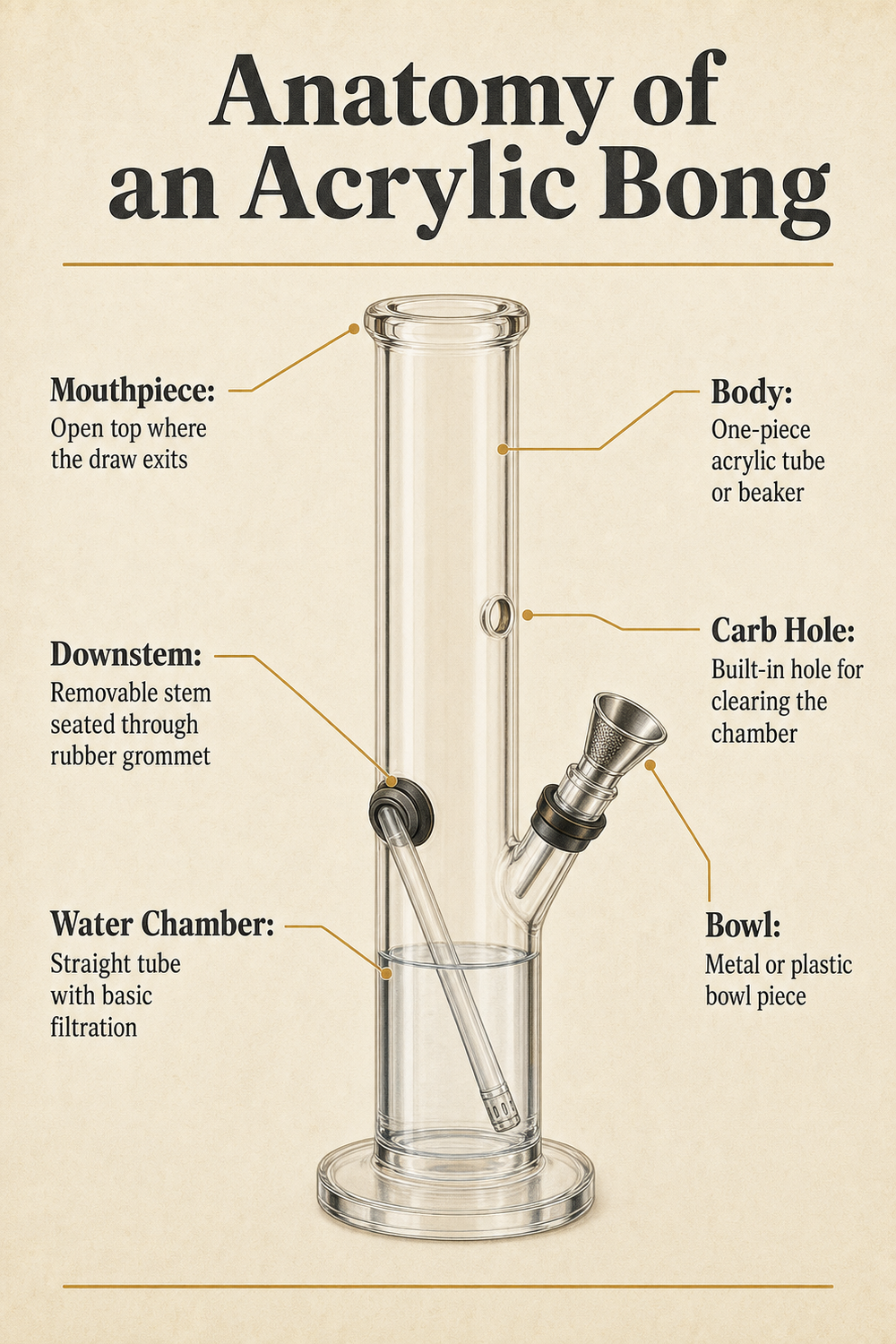
An acrylic bong is usually simpler than a glass one. The body is a single piece of acrylic tube or a beaker shape, and the working parts are a downstem and a bowl seated through a rubber grommet instead of a ground-glass taper [9]. Filtration stays basic: a straight tube, a downstem, and water. Percolator stacks and ice notches are rare because the body and fittings do not support them the way glass does [8].
Here is the path a draw takes through a typical acrylic piece, in order:
The carb hole is worth understanding because it is one of the few features acrylic pieces almost always have. The same opening gets called a carburetor, carb, choke, shotty, or kick hole depending on who you ask [14].
Two consequences follow from that grommet build. First, the downstem is usually removable but not interchangeable with standard glass parts. Second, because the body is moulded rather than assembled, you are buying the whole piece rather than a body you can upgrade over time [10]. If you want the wider material picture before committing, Glass vs Silicone Bong: Which Material Should You Actually Buy? compares the main options, and What Are the Parts of a Bong and What Does Each One Do? walks through what each component does.
- Bowl: the small metal or plastic cup at the top of the downstem, where the material sits.
- Downstem: the removable tube that carries the draw down below the water line; on most acrylic models it is held by a rubber grommet rather than a ground joint.
- Water chamber: the lower part of the one-piece body, filled to a level just above the downstem’s lower opening.
- Carb hole: a built-in hole in the side of the body, used to clear the chamber without lifting the bowl.
- Mouthpiece: the open top of the tube where the draw exits.
Acrylic vs Glass Bong: Which One Should You Buy?
This is the comparison that decides most purchases. Acrylic and glass are not the same product at two different prices. They are built differently, cleaned differently, and last different lengths of time. Here is where they actually differ.
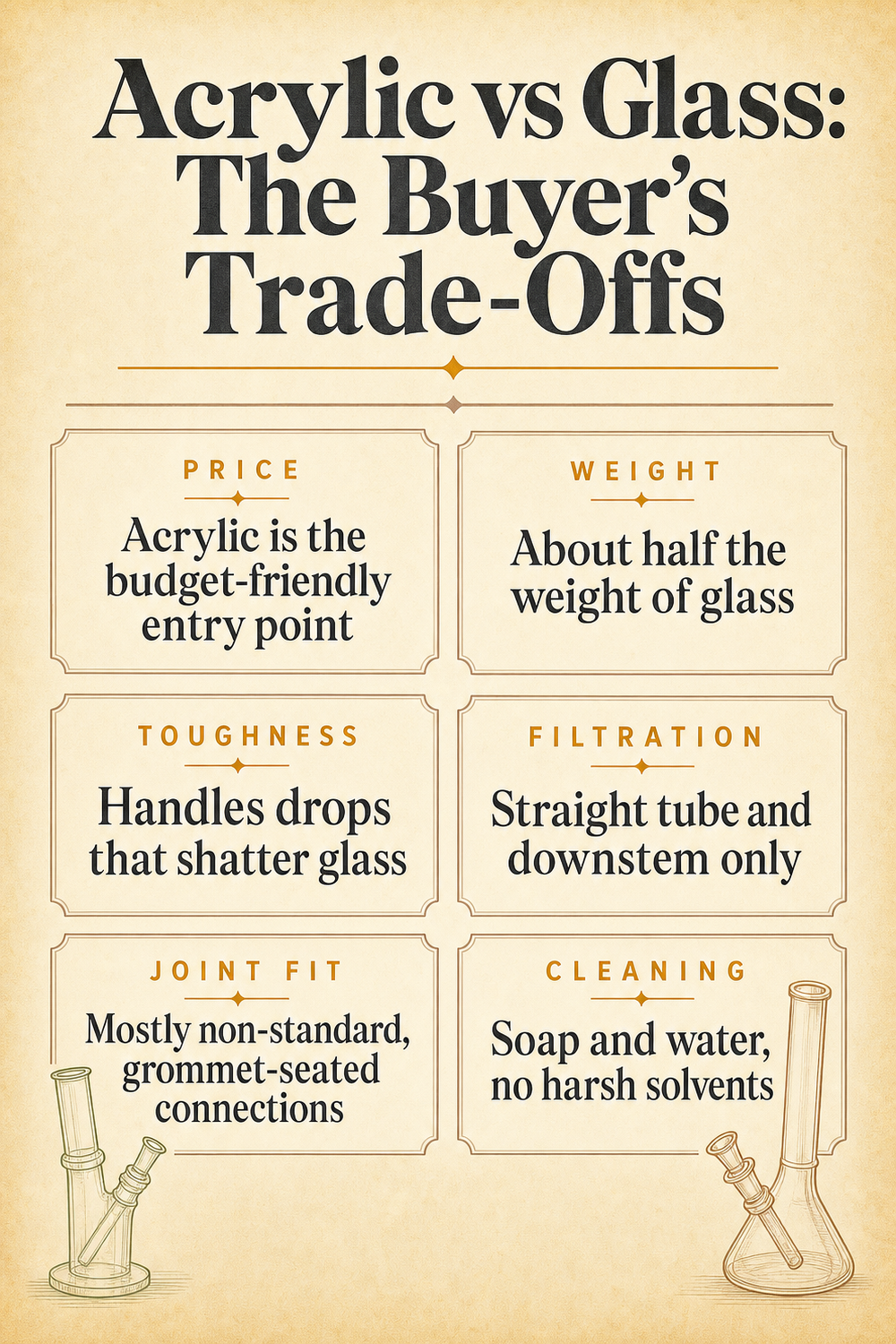
Retailers consistently place acrylic at the entry tier of the market. It gets described as almost always the more budget-friendly option and as the budget-friendly entry point, while glass spans from budget to premium depending on wall thickness and percolation [10]. Acrylic is also the lighter of the two by a wide margin; the manufacturer publishes that PMMA sheet weighs about half what glass weighs [4].
Toughness is where the two swap places with expectation. Acrylic handles the drop that would end a glass piece, which is why it gets recommended for outdoor sessions, road trips, and anywhere a hard floor is likely [11]. But it is not indestructible. It scratches easily, and hard impacts can still crack it [9].
If you want a middle path, other materials sit at similar prices. A ceramic piece with a standard 14mm ground joint, like the SeshGear Chinese Vase Ceramic Water Pipe – 5.75" / 14mm F / Bubble Base, gives you glass-compatible fitting without glass fragility. Whichever way you go, free shipping on orders $150+ applies once a basket crosses that mark, which is worth knowing if you are adding parts at the same time.
A plain recommendation: if you want maximum filtration options and the piece lives on a shelf, glass earns its price. If you want something that survives being knocked off a table and costs less, acrylic is the sensible pick. There is no single winner, only a winner for how and where you use it.
- Price: acrylic is the budget-friendly entry point; glass runs from budget to premium.
- Weight: acrylic comes in at about half the weight of glass.
- Break resistance: acrylic survives knocks and drops that shatter glass, but it can still crack.
- Filtration: acrylic is usually a straight tube and downstem; glass supports percolators and ice notches.
- Cleaning: acrylic wants mild soap and warm water; glass tolerates isopropyl alcohol and salt.
- Lifespan: specialist guides put acrylic at one to two years of regular use against years for glass.
- Parts: acrylic is rated limited for accessory compatibility, glass is rated full.
| Feature | Acrylic bong | Glass bong |
|---|---|---|
| Price tier | Budget-friendly entry point | Budget to premium depending on thickness |
| Weight | About half the weight of glass | Heavier |
| Break resistance | Survives drops that shatter glass | Shatters on hard impacts |
| Filtration | Straight tube and downstem | Percolators and ice notches available |
| Cleaning | Warm water and mild soap | Isopropyl alcohol and salt |
| Joint fit | Mostly grommet-seated, non-standard | Standard 10mm, 14mm, and 18mm ground joints |
| Typical lifespan | About one to two years | Years with careful handling |
How Tough Is Acrylic, and How Long Does an Acrylic Bong Last?
The marketing line is that acrylic is unbreakable. The engineering answer is more useful: acrylic is far tougher than glass in the specific way that matters to a bong, and still not tough in absolute terms.
The manufacturer publishes two figures that explain the appeal. PMMA sheet weighs half what glass weighs and is 11 times more break resistant than glass [4]. Materials suppliers describe the same material differently, as hard but brittle with poor impact resistance and limited abrasion resistance compared with engineering plastics [7]. Retailers land in the middle: impact-resistant, but not indestructible [9].
The practical failure modes are not dramatic cracks. They are scratches, clouding, and residue. Acrylic is soft enough that abrasive brushes and gritty cleaners mark the interior, and once scratched, the surface holds residue that is hard to rinse away [8]. Over time the body clouds, and the piece stops feeling clean no matter how carefully you wash it.
That is why specialist guides put acrylic’s working life at roughly one to two years of regular use, against years for borosilicate glass handled with care [8]. If you want to understand what you are paying for on the glass side of that comparison, Borosilicate vs Soda-Lime Glass: What Are You Actually Paying For? breaks down the difference between borosilicate and soda-lime.
- Survives: drops, knocks, and being tipped over, the accidents that end a glass piece.
- Does not survive: hard impacts at the wrong angle, which can still crack the body.
- Scratches: the surface marks easily, and scratches then trap residue.
- Clouds: repeated washing and solvent exposure dull the material over time.
- Lifespan: roughly one to two years of regular use according to specialist guides.
- Relative, not absolute: in engineering terms PMMA is still rated brittle, with poor impact resistance.
How Do You Clean an Acrylic Bong Without Ruining It?
The cleaning advice for acrylic is the opposite of the advice for glass. Isopropyl alcohol and salt is the standard glass routine, but acrylic is attacked by many solvents and alcohols, and the manufacturer says media resistance has to be checked case by case [1].
The manufacturer’s chemical resistance chart for acrylic resin rates 100 percent isopropyl alcohol as ‘Fair’, usable with caution in low-stress or short-duration exposure at ambient conditions. It rates acetone, methyl ethyl ketone, toluene, methylene chloride, and lacquer thinner as ‘Not Recommended’ [6]. Retailer guidance goes further and warns against alcohol on acrylic altogether, noting that it can cloud or craze the material [8].
Here is a routine that stays inside the material’s limits:
Two things damage acrylic more than anything else: abrasive brushes and strong solvents. Abrasives scratch the interior, and scratches then trap residue, so the next cleaning is harder than the last [8]. Solvent exposure causes stress cracking, the hairline fissures that appear where the material was under stress. The manufacturer’s own instruction is blunt: clean with soap and water, avoid abrasives, and avoid exposure to heat or aromatic solvents [6].
If you would rather own a piece you can clean with alcohol and salt out of habit, that is a reason to look at glass or Silicone Bongs instead. Silicone follows a different cleaning routine and will not cloud the way acrylic does.
- Empty the water and rinse the body with warm water as soon as a session ends.
- Wash with warm water and a mild soap, dish soap is fine, using a soft cloth or sponge.
- Run soft pipe cleaners through the downstem and around the bowl to lift residue.
- Rinse thoroughly until no soap film remains, then air dry with the downstem removed.
- Refresh the water before every use, and do not leave water sitting in the chamber for days.
Does Heat Warp or Melt an Acrylic Bong?
Acrylic does not melt at one temperature, and that is the root of a lot of bad information online. PMMA is an amorphous thermoplastic with no defined melting point, so it softens gradually across a range instead [1]. That is why ‘acrylic melting point’ figures vary so widely between sources.
The published limits are more useful than a melting point. For cast acrylic sheet: heat deflection temperature around 105 degrees C, a short-term maximum service temperature near 100 degrees C, and a long-term service range of about -40 to 80 degrees C [1]. Extruded sheet is lower across the board, with heat deflection around 95 degrees C, short-term maximum around 90 degrees C, and long-term service to about 70 degrees C [2].
The manufacturer’s own figures for solid sheet are lower again: maximum permanent service temperature of about 80 degrees C for cast sheet and about 70 degrees C for extruded sheet, with forming temperatures far higher, at 160 to 175 degrees C and 150 to 160 degrees C respectively [3]. In other words, the material is designed around permanent service temperatures well below its softening points.
In practice that means keeping the acrylic body away from flame and away from hot tools. The hot end of the process belongs to the metal bowl, not the plastic. It is also fair to say that the published record here is thin: one specialist guide notes that peer-reviewed studies specifically measuring off-gassing from acrylic bongs are scarce [8], and no government or materials standard was found that addresses heated smoking accessories. Read that as an open question rather than a settled answer either way.
- No single melting point: PMMA softens gradually because it is an amorphous thermoplastic.
- Cast sheet: deflection around 105 degrees C, permanent service limit about 80 degrees C.
- Extruded sheet: deflection around 95 degrees C, permanent service limit about 70 degrees C.
- In use: keep direct flame away from the acrylic body.
- Build detail: the bowl on most acrylic pieces is metal, so the flame is not applied to plastic.
- Evidence gap: published data specifically measuring emissions from heated acrylic pieces is thin.
Do Standard Bowls, Downstems, and Ash Catchers Fit an Acrylic Bong?
Mostly no, and the reason is the connection type. Glass bongs use ground-glass joints, often shortened to GonG, which are a frosted taper that seals without a rubber grommet. Those joints come in three standard diameters: 10mm, 14mm, and 18mm. A 14mm bowl from one brand fits a 14mm joint from any other brand, and 14mm is the most common size on mid-size pieces [12].
Basic acrylic models usually skip that standard. Instead, the downstem is seated through a rubber grommet, and the stem diameter is specific to the model rather than shared across brands. That is why retailer compatibility charts rate acrylic as limited for accessories while glass is rated full [9].
The exceptions are worth checking before you buy. Some acrylic pieces do use a standard ground joint, and those take ordinary bowls, downstems, and ash catchers in the matching size. A mismatched joint needs an adapter to seal properly, and adapters add height as well as cost [12].
If part swapping matters to you, because you want an ash catcher now and a different bowl later, check the joint size on any acrylic piece before ordering it and read ‘no joint listed’ as a sign that it is a grommet model [9].
- 10mm: found on mini pieces under roughly 8 inches tall.
- 14mm: the most common size, typical on pieces around 8 to 16 inches.
- 18mm: used on larger pieces over about 16 inches.
- Grommet fit: most acrylic downstems are sized to the model, not to a standard.
- Practical result: replacement parts for acrylic usually come from the same maker.
- Adapters: a mismatched joint can be bridged, but it adds height and cost.
Who Is an Acrylic Bong Actually Best For?
Acrylic has a clear set of buyers, and they are not the same people who should be shopping for glass. Here is the honest breakdown of who it suits.
And here is who should skip it. If part compatibility matters, swapping bowls, adding an ash catcher, upgrading the downstem, then acrylic’s grommet connections will frustrate you, and a standard ground-joint piece is the better starting point [9]. If you want percolators, ice notches, or a heavy sculpted showpiece, that is a glass job. If you clean with isopropyl alcohol and salt out of habit, glass is the material that matches your routine.
One more thing worth saying plainly: acrylic is a budget material, and that is not an insult. It does a specific job well, being light, inexpensive, and forgiving of the accidents that ruin glass. What it does not give you is filtration options, standard joints, or a long service life. If you know which of those matters to you before you buy, you will be happy with the piece you end up with.
- First-timers who are not ready to spend much and want to learn the basics without worrying about breakage.
- Outdoor and travel users, on patios, camping, and road trips, where a piece gets knocked about.
- Households with hard floors, pets, or crowded tables where a glass piece is at constant risk.
- Shoppers who expect to replace a piece in a year or two rather than maintain it for a decade.
Frequently Asked Questions
Is an acrylic bong the same thing as a glass bong?
No. Acrylic is polymethyl methacrylate, an amorphous thermoplastic, not a glass, despite trade names like Plexiglas, Perspex, Acrylite, and Lucite, and despite the phrase ‘acrylic glass’ being in common use. One materials datasheet lists more than 40 commercial names for the same base polymer, so ‘acrylic’ describes a material family rather than a single product [5].
Are acrylic bongs safe to smoke out of?
That is not a question this guide answers with a yes or no, because the published record does not support one. What it does show: acrylic’s permanent service temperature sits well below an open flame, specialist guides say to keep direct flame away from the body, and the bowl on most acrylic pieces is metal so the flame is not applied to the plastic [8]. One guide also notes that peer-reviewed data specifically measuring emissions from heated acrylic pieces is thin [8], and no standard was located that covers heated smoking accessories. Read that as an open question rather than a settled answer.
Can you clean an acrylic bong with isopropyl alcohol and salt?
It is not the recommended route. An acrylic resin maker rates 100 percent isopropyl alcohol as ‘Fair’, usable with caution in low-stress or short-duration exposure at ambient conditions, while rating acetone, methyl ethyl ketone, toluene, methylene chloride, and lacquer thinner as ‘Not Recommended’ [6]. Retailer guides advise warm water, mild soap, and soft pipe cleaners for acrylic, noting that alcohol can cloud the material [8]. Salt is an abrasive, so soap and water is the documented path.
Are acrylic bongs unbreakable?
No. The manufacturer publishes that PMMA is 11 times more break resistant than glass and about half the weight, and retailer guides say acrylic survives drops that would shatter glass [4]. But materials suppliers also describe PMMA as hard and brittle with poor impact resistance in absolute engineering terms [7], and retailers warn that it scratches easily and can still crack on hard impacts [9].
Do acrylic bongs melt or warp from heat?
Acrylic softens gradually rather than melting at one temperature, because it is an amorphous thermoplastic with no defined melting point, which is why quoted melting figures vary so much between sources [1]. Published permanent service limits sit well below any flame: about 80 degrees C for cast sheet and about 70 degrees C for extruded sheet [3]. The practical guidance is consistent: keep direct flame away from the acrylic body [11].
What should an acrylic bong cost compared with glass?
Retailers consistently place acrylic at the entry tier: almost always the more budget-friendly option, and the budget-friendly entry point. Glass spans from budget to premium depending on wall thickness and percolation [10]. Exact prices vary widely by market and brand and are not stable facts, so compare within the range a shop actually stocks rather than against a fixed number.
So, Should You Buy an Acrylic Bong?
An acrylic bong is the right purchase for one kind of buyer: someone who wants a light, low-cost water pipe that survives a drop, and who is content to replace it in a year or two. It weighs about half what glass does, it is rated far more break resistant, and it keeps a simple build, with a one-piece body, a carb hole, a grommet-seated downstem, and a basic bowl.
The trade-offs are just as concrete. Cleaning has to stay with warm water, mild soap, and soft pipe cleaners, because alcohol and harsh solvents sit outside acrylic’s comfort zone [6]. Heat limits sit well below a flame, so the flame stays at the metal bowl [11]. And standard ground joints are usually missing, which limits what you can swap onto the piece [9].
If those limits sound acceptable, acrylic delivers real value at the entry tier. If any of them sounds like a dealbreaker, glass or silicone is where your money belongs. Either way, you now know exactly what you are choosing between.
Sources
- Liedtke Kunststofftechnik (acrylic sheet distributor, Germany): Technical Data Sheet PMMA-GS (cast)
- Liedtke Kunststofftechnik (acrylic sheet distributor, Germany): Technical Data Sheet PMMA-XT (extruded)
- Rohm GmbH (manufacturer of PLEXIGLAS): Environmental Product Declaration: PLEXIGLAS Solid Sheets (Ref. 212-16)
- Rohm GmbH (manufacturer of PLEXIGLAS): Technical Information: PLEXIGLAS Textures 232-30
- Modulus Metal (materials data reference): PMMA / Acrylic Material Data Sheet (cast sheet)
- ATOFINA Chemicals / Atoglas (Plexiglas acrylic resin manufacturer): Chemical Resistance of Plexiglas V-Series Acrylic Resins (ADV# 010334)
- Industrial Specialties Mfg. (ISM): Acrylic (PMMA) Chemical Compatibility Chart
- Azarius (specialist headshop, comparison wiki): Glass vs Silicone vs Acrylic Bongs Compared
- DankStop (smoking-accessory retailer): Acrylic vs Glass Bong: Which One Should You Buy?
- Grasscity (headshop retailer and education blog): Glass vs Acrylic Bongs: Which Is Better?
- Badass Glass (smoking-accessory retailer): Acrylic Bong vs Glass: What’s the Difference Between Acrylic and Glass Bongs?
- DankStop (smoking-accessory retailer): Bong Slide Sizes Explained: 10mm, 14mm & 18mm Guide
- U.S. Government Publishing Office / eCFR (21 CFR, U.S. Food and Drug Administration regulation): 21 CFR 177.1010 – Acrylic and modified acrylic plastics, semirigid and rigid
- Wikipedia: Bong