

A dab mat is a reusable, usually silicone, non-stick surface that sits under a dab rig, tools, and concentrate jars. It gives sticky gear one clear work area, helps keep residue and water drops off the table, and keeps the basic setup within reach. [1]
Parchment paper can work as a disposable non-stick sheet, but it is not the same thing as a padded mat or a lipped tray. A mat is part of the station. It can hold the rig, dab tool, carb cap, jar, and other small items in one spot. This guide explains what dab mats do, how big to buy, when silicone makes sense, when a tray is worth it, and how to clean sticky residue without turning a small accessory into a science project.
What Does a Dab Mat Actually Do Under a Dab Rig?
A dab mat sits under your rig and nearby tools like a small work zone. Retailers commonly describe dab mats as heat-resistant, non-stick mats made for dab sessions, but the useful part is less fancy than that: the mat gives all the sticky, small, easy-to-knock-over items a single place to live. [1]
That matters because a dab setup is not just one piece of glass. It often includes a rig, dab tool, carb cap, concentrate jar, cotton swabs, and maybe a banger or other small part cooling off nearby. A mat helps you keep those items together instead of spreading them across wood, stone, glass, or a desk surface.
Think of Dab Accessories as the broader category and Dab Tools as the small gear that tends to sit on the mat. The mat is the base layer under those items. It does not need to be complicated, but it should be large enough and steady enough to make the station feel intentional.
A good mat also makes cleanup easier because sticky residue and water drops land on one washable surface. Some retailers describe silicone mats as a way to catch concentrate residue and small spills while keeping the rig area organized. [2] If you have ever searched for a carb cap that rolled behind a jar, you already understand the point.
- Surface shield: the mat gives the table, counter, or desk a separate layer under the rig and jars.
- Mess control: sticky residue, small drops, and loose debris land on the mat instead of spreading across the whole area.
- Station layout: the rig, dab tool, carb cap, and jar stay grouped so the setup feels easier to manage.
- Small-part parking: loose pieces have a defined place, which helps reduce the usual tabletop scavenger hunt.
How Big Should a Dab Mat Be for Your Rig and Tools?
The right dab mat size depends on the footprint of your whole setup, not just the base of the rig. If the mat only fits the rig, the dab tool and jar still end up on the table. That defeats half the reason to buy the mat in the first place.
Start by placing the rig, jar, carb cap, dab tool, and any usual extras on a flat surface with comfortable spacing. Then picture a rectangle around that group. That rectangle is the real mat size you need. Verilife lists size as one of the main buying criteria for dab mats, along with heat resistance and a non-stick surface. [1]
If you are building a more complete station, read What Are Dab Tools and How Do You Choose the Right One? before buying every small accessory at once. If your setup already needs cleaning attention, How Do You Clean a Dab Rig and Keep It Working Well? can help you decide whether the mat should be part of a larger reset. For smaller moving parts, What Do Terp Pearls Do, and How Do You Choose the Right Ones? is a good reminder that tiny accessories need space too.
A small mat can work for a compact rig and one tool. A medium mat is often easier if you want room for a jar and carb cap. A larger station surface makes sense when the rig is wider, when multiple tools sit nearby, or when you want a defined place for cleaning supplies after the session.
- Measure the rig base first, then add space around it so the glass is not sitting at the edge.
- Place the dab tool, carb cap, and concentrate jar beside the rig because those items usually need to fit too.
- Add room for cotton swabs or a small cleaning item if you keep cleanup supplies at the station.
- Choose the mat size after the layout is clear, not just because a design or color looks good.
- If you are torn between two sizes, pick the one that lets the tools sit on the mat without crowding the rig.
Silicone Dab Mat vs Parchment Paper: Which One Makes More Sense?
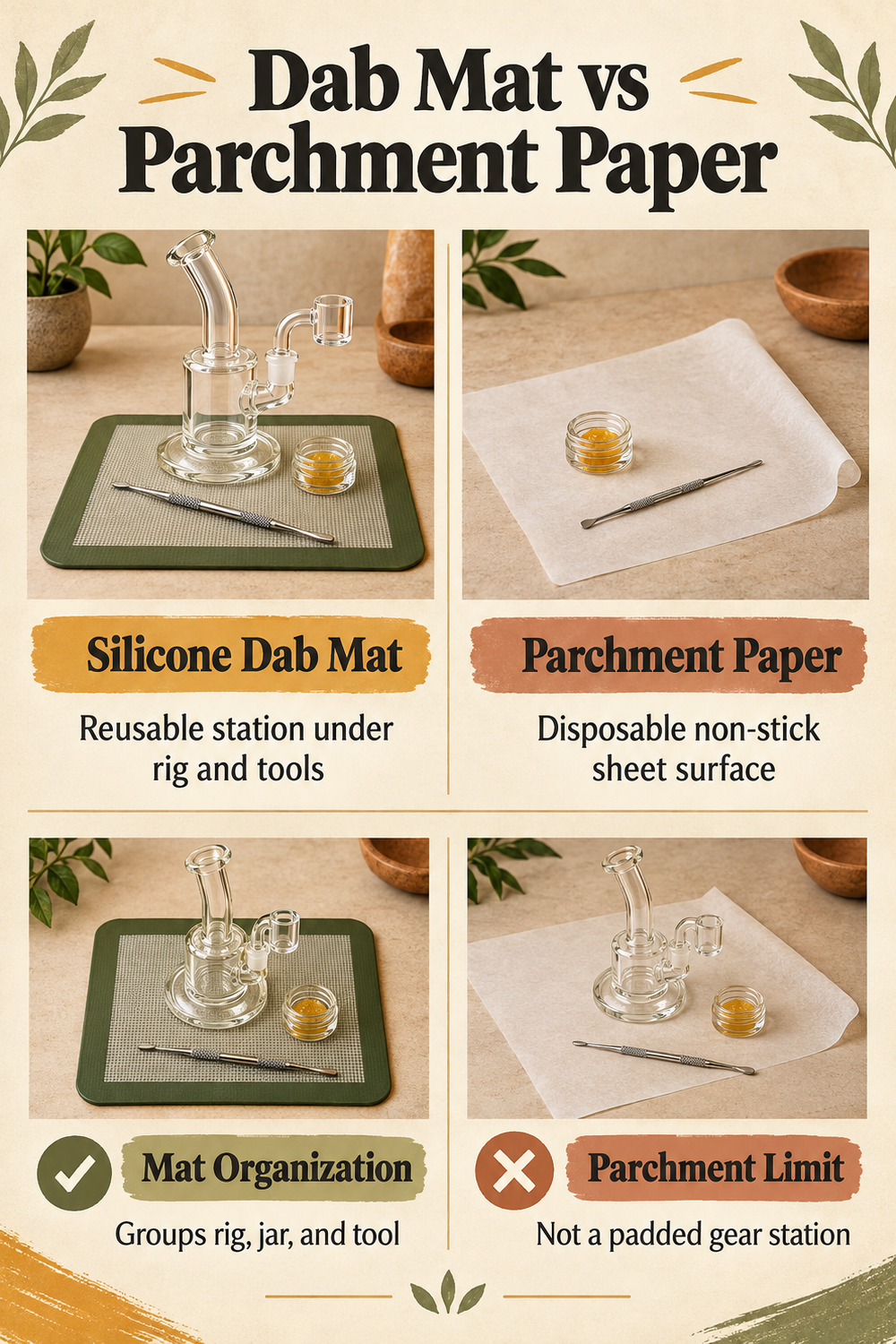
Silicone dab mats and parchment paper can both give you a non-stick surface, but they solve different problems. A silicone dab mat is a reusable station base. Parchment paper is a disposable sheet. That difference matters when you want the rig, tool, and jar organized in one place.
Reynolds Kitchens says its parchment paper is non-stick and oven safe up to 425°F, while also warning that it should not touch open flame, oven sides, broilers, or toaster ovens. [4] That makes parchment useful context for a non-stick sheet, but it does not turn it into a padded gear station or a tray with edges.
A silicone mat is usually better when you want one repeat-use surface under the setup. It can catch sticky residue, water drops, and small debris in the same area, then be washed later with simple cleaning steps. [2] Parchment is better viewed as a temporary sheet, not as the main base for glass gear.
There is also a shopping difference. A mat is something you choose by size, thickness, surface feel, and station layout. Parchment is something you tear off, use, and throw away. If your goal is only a short-term non-stick patch, parchment may be enough. If your goal is a stable station, a mat makes more sense.
Accessories like a Vessel Care Kit belong in the broader cleanup conversation, but they do not replace the choice between a reusable mat and a disposable sheet. The mat decision is about the surface under the setup. The cleaning accessory decision is about what you keep nearby after use.
- Silicone dab mat: best for a reusable station under a rig, jar, and tool.
- Parchment paper: best understood as a disposable non-stick sheet, not a padded base.
- Silicone tray: better when you want a thicker surface or raised edge around the station.
- Parchment limit: it does not organize tools or add a defined station footprint.
- Buying choice: pick based on whether you need a repeat-use setup area or a temporary sheet.
| Option | Practical Use | Main Limit |
|---|---|---|
| Silicone dab mat | Reusable station under rig and tools | Needs cleaning after sticky use |
| Parchment paper | Disposable non-stick sheet | Not padded or organized |
| Lipped silicone tray | Raised-edge station for small items | Takes more space |
Should You Buy a Flat Dab Mat or a Lipped Silicone Dab Tray?
A flat dab mat is the simple choice. It is usually a thin sheet or pad that sits under the rig and tools. It gives you a non-stick work surface without adding much height, weight, or bulk. For many people, that is enough.
A lipped silicone dab tray is different. Retailers often describe trays as thicker pieces with a raised edge around the outside. That edge helps define the station and can keep small items from sliding away as easily. [2] It also gives the setup a more contained feel.
The tradeoff is space. A tray can be easier to manage, but it also takes up more room on a desk, shelf, or rolling cart. A flat mat can be stored in a drawer or moved around more easily. If your setup is small, flat may be better. If you keep several small pieces together, a tray may be worth the extra footprint.
This is where product names can get messy. Stores may use dab mat, dab pad, silicone mat, and dab tray in overlapping ways. JointCommerce notes that shoppers may see different terms along with features like silicone material, dimensions, design, and easy cleaning. [5] Look at the photos and measurements before trusting the name alone.
One note: do not buy an unrelated silicone product only because it contains the word silicone. For example, SILICONE BEAKER BONG WITH REMOVABLE GLASS BOWL is a different kind of product, not a dab mat. Names matter less than function, but function still has to match what you need.
- Choose a flat mat if you want the lowest-profile surface under a compact rig.
- Choose a lipped tray if you want a raised edge around small parts and jars.
- Choose a larger tray if the setup includes several tools or cleaning items.
- Choose a thinner mat if you need to store it in a drawer or move it often.
- Check dimensions and product photos because names are not used the same way by every seller.
What Features Matter Most When Shopping for a Silicone Dab Mat?
The right dab mat is not always the loudest design. Artwork is fun, but it should come after the basics: size, surface, thickness, edge style, and cleaning needs. A great-looking mat that is too small will still leave half the station on the table.
Heat resistance is often listed as a key feature, but shoppers should still read the seller’s details. Do not assume every silicone product has the same limits. If a listing makes a material claim, check the packaging or seller documentation instead of treating a short phrase as universal proof.
That is especially true for phrases like food-grade silicone. Federal rules for rubber articles intended for repeated food-contact use include composition and extractives requirements, so product-specific claims matter. [3] For a dab mat, the practical move is to verify what the seller actually says about that exact item.
Size should come next. A mat should hold the rig and the pieces that naturally sit near it. If it only fits the rig base, you may still need a second surface for the tool, jar, cap, and cleanup items.
Commercially, dab mats are also easy add-ons when you are already buying concentrate gear or tools. If you are building a bigger order, free shipping on orders $150+ can make it easier to add low-cost station items without treating them like a separate shopping trip. Just do not buy a mat only to chase shipping; buy it because it fits your setup.
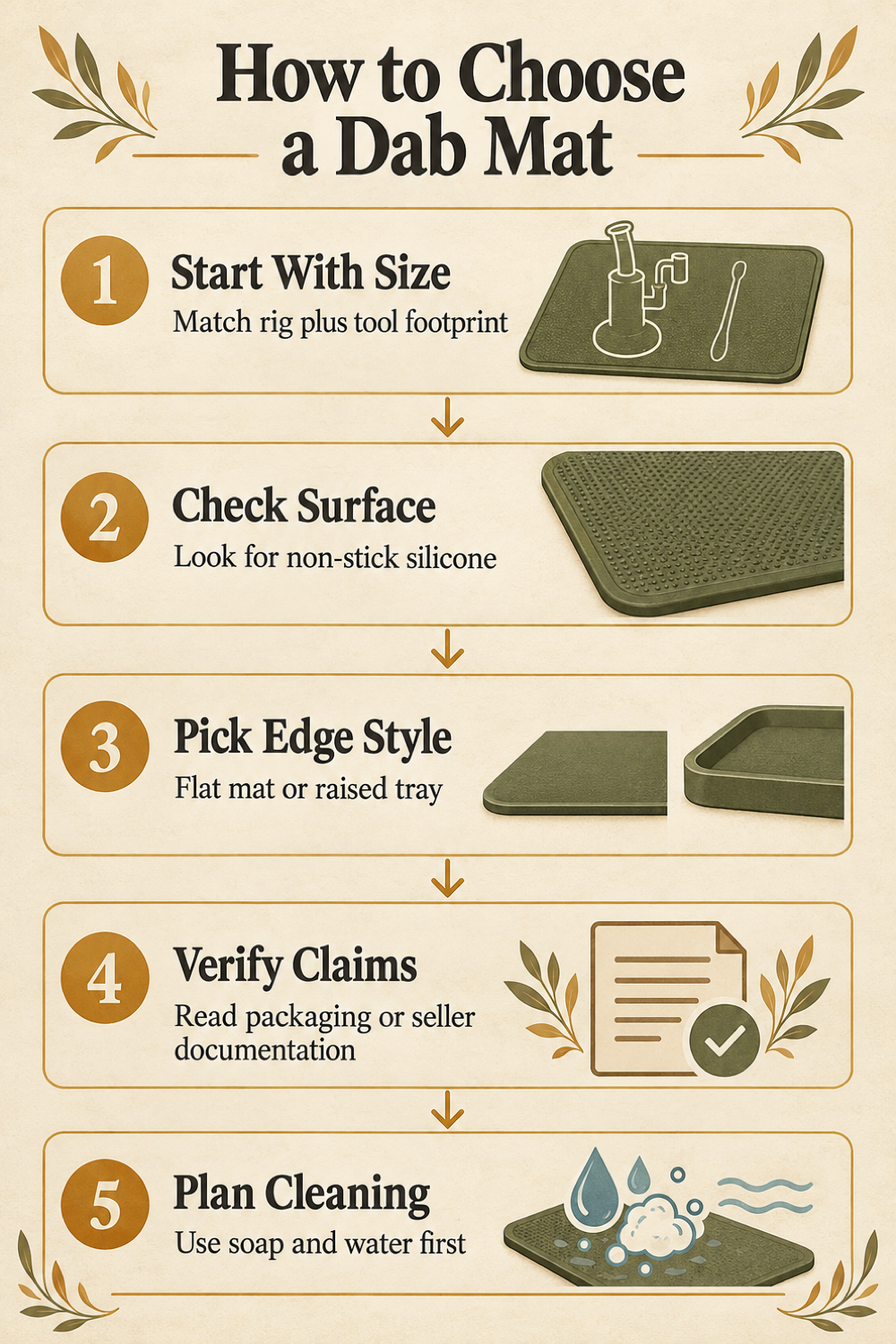
- Start with size: make sure the rig, jar, carb cap, and tool can fit without crowding.
- Check the surface: look for a non-stick silicone surface that matches the seller’s description.
- Review heat details: read product information instead of guessing from the material name alone.
- Pick the edge style: choose flat for simple setups or lipped for a more contained station.
- Confirm cleaning guidance: know whether soap and water are enough before using stronger products.
- View design as secondary: color and artwork are bonuses after the practical features are right.
How Do You Clean Sticky Residue From a Dab Mat?
Cleaning a dab mat is usually simple if you do it before residue builds into a stubborn layer. Smooth non-stick silicone surfaces are commonly cleaned with soap and water, while stronger cleaners should follow the product maker’s directions. [1]
Start with the lowest-drama method. Remove loose items, wipe away easy debris, wash the surface, rinse it well, and let it dry fully before putting the rig and tools back. This keeps the station ready without using a harsh product every time something sticky lands on the mat.
If residue does not lift with basic washing, pause and check the product directions. Different mats may have different printed artwork, coatings, or care notes. A strong cleaner that works on one surface may not be the right move for another, and the seller’s instructions should lead the decision.
This is also a good moment to reset the station. Put only the items you actually use back on the mat. Extra jars, old swabs, and random small pieces make the area feel messy again before you even start. A dab mat works best when it stays a clear work zone, not a storage junk drawer in rubber form.
- Remove the rig, jar, tool, carb cap, and any loose pieces from the mat.
- Wipe away loose debris or drops before adding water so the mess does not spread.
- Wash the surface with soap and water when the product directions allow it.
- Rinse the mat well so soap residue does not stay on the work surface.
- Dry the mat fully before setting glass or small tools back on top.
- Check the maker’s directions before using stronger cleaners on stuck residue.
Frequently Asked Questions
Is a dab mat worth it if I already use parchment paper?
A dab mat is worth considering if you want a reusable station for your rig, tool, and jar instead of a disposable non-stick sheet. Parchment paper is non-stick and oven safe up to 425°F according to Reynolds Kitchens, but it is not a padded mat or a lipped tray for organizing gear. [4]
What is the difference between a dab mat, dab pad, and dab tray?
Retailers use these terms differently. In general, dab mats and dab pads are usually flatter silicone sheets or pads, while silicone dab trays are often thicker and may have a raised lip around the edge. Check product photos and dimensions instead of relying on the name alone.
What size dab mat should I buy?
Choose a mat based on the footprint of your full setup, not just the rig. Make sure there is room for the rig, dab tool, carb cap, concentrate jar, and any other items you want on the same work surface.
How do you clean a silicone dab mat?
Most smooth non-stick silicone dab mats can be cleaned with soap and water. For stronger cleaners or stuck residue, follow the product maker’s directions so you do not rely on one cleaning rule for every mat.
Does food-grade silicone mean every dab mat is the same?
No. Federal rules for rubber articles intended for repeated food-contact use include composition and extractives requirements, so shoppers should check the specific packaging or seller documentation for any material claim. View the phrase as product-specific, not universal. [3]
Which Dab Mat Should You Choose for Your Setup?
Choose the dab mat that fits the way your station actually works. If you use a compact rig and one tool, a simple flat silicone mat may be enough. If you keep a jar, carb cap, tool, cleaning items, and small parts together, a larger mat or lipped tray will probably feel more useful.
The main idea is practical: buy for footprint, surface, edge style, and cleaning needs before buying for artwork. Parchment paper can act as a disposable non-stick sheet, but it does not replace a reusable station under your rig and tools. A good mat is not the star of the setup. It is the quiet little base layer that keeps the rest of the gear from turning the table into a sticky obstacle course.
Sources
- Verilife: What is a Dab Mat & Do You Need One?
- E-Nail.com: What is a Dab Mat and what are Silicone Dab Mats used for?
- Electronic Code of Federal Regulations / Food and Drug Administration: 21 CFR 177.2600 — Rubber articles intended for repeated use
- Reynolds Brands: Non-Stick Parchment Paper Rolls
- JointCommerce: What is Dab mat?