

A reclaim catcher is an adapter that installs between your dab rig’s joint and your banger, so the banger mounts on the catcher instead of on the rig itself [1] [2]. Vapor that recondenses inside it drips into a drop-down chamber or a removable jar or dish, and whether the piece earns a spot on your setup comes down to joint fit, cleanup routine, and the drag it adds [4] [6].
What Does a Reclaim Catcher Actually Do for a Dab Rig?
A reclaim catcher is a small glass or silicone adapter that sits in the vapor path. One end connects to your rig’s joint, the other holds your banger, and the vapor travels through the catcher and on into the main chamber [1] [2] [6].
Its job is to give condensing vapor a surface to land on before it reaches the rest of the rig. The mechanism is passive, with no filter and no moving part. Vapor cools as it moves through the extra glass or silicone, part of it recondenses on the walls, and gravity pulls that residue down into a collection chamber [4] [1].
Where the residue lands depends on the design. A drop-down catcher has a U-shaped glass chamber below the joint. A jar-style catcher has a removable silicone or glass jar fitted underneath. Either way the idea is the same: the material gathers in one spot you can detach and empty, instead of spreading through the inside of the rig [2] [6].
The material itself is reclaim. Reclaim is condensed concentrate residue, the part of a dab that cools back into a liquid or waxy form and settles on the nearest surface. It is not ash, and it is not spent plant material [5] [1].
Keeping that residue in one place has a practical payoff at cleanup time. Reclaim that gathers in a jar is reclaim you can detach, warm, and scoop out in a few minutes. Reclaim that coats the inside of a rig takes an alcohol rinse and a longer session to remove. The catcher does not change what your dab is made of. It changes where the leftovers end up [4] [2].
A reclaim catcher belongs to the same family of small hardware as bowls, Replacement Parts, and downstems. If you are still learning how the parts of a rig fit together, that category covers the joints and adapters involved, and What Are Ash Catchers and Do You Actually Need One? answers the same basic questions for ash catchers.
- It installs between the rig’s joint and the banger, so the banger mounts on the catcher rather than directly on the rig [1] [2].
- The mechanism is passive: vapor cools inside the adapter, recondenses on the walls, and gravity drops the residue into a collection chamber [4] [1].
- Where it lands depends on the design, whether that is a U-shaped drop-down chamber or a removable silicone or glass jar [2] [6].
- What it captures is reclaim, condensed concentrate residue rather than ash or spent plant matter [5].
- Bong resin is a different material: a mix of ash, tar, and plant material rather than concentrate alone [5] [1].
What Is the Difference Between a Reclaim Catcher and an Ash Catcher?
Ash catchers and reclaim catchers can look almost identical, and they sometimes get sold under the same listing, but they are built around different kinds of residue. An ash catcher is designed primarily for a flower bowl. Its job is to catch ash and plant debris before that material drops into the main water chamber [3] [4].
A reclaim catcher is aimed at dabbing. Concentrate vapor recondenses as it cools, and the catcher gives that condensed residue somewhere to gather. There is no ash to trap in a dab setup, so the two attachments end up solving different problems even when the shape looks familiar [3] [4].
The terminology overlaps in practice. Some retailers market a single attachment as both an ash catcher and a reclaim catcher, and some people run one on a setup the other was designed for. That does not make the two labels interchangeable. It just means the hardware world is loose about naming [3].
The place it gets genuinely blurry is bong resin versus reclaim. Bong resin is what builds up in a rig used with flower: a mix of ash, tar, and plant material. Reclaim is what builds up from concentrate: condensed residue that never had ash in it to begin with [5] [1].
The practical way to decide is to start from the setup rather than the label. If you load flower bowls, you want the attachment built for ash. If you dab from a banger, you want the attachment built for condensed residue. Many people keep both, because the two pieces are not competing for the same slot. They are matched to different sessions [3] [6].
If you are shopping for the flower side, the Ash Catchers category is the place to start, and What Is an Ash Catcher and How Do You Choose the Right One for Your Bong? covers how those pieces are sized and fitted. A flexible silicone body like the SILICONE BEAKER BONG WITH REMOVABLE GLASS BOWL shows how the same joint logic carries over to the rig itself.
- An ash catcher is built primarily for flower bowls, where it catches ash and debris before it reaches the main chamber [3] [4].
- A reclaim catcher is built for dabbing, where the residue that builds up is condensed concentrate rather than ash [3] [4].
- Some products are marketed and used interchangeably, so the names overlap even though the intended setups differ [3].
- Reclaim is not bong resin: resin carries ash, tar, and plant material, while reclaim comes from concentrate vapor alone [5] [1].
- The two attachments are not strictly one-or-the-other for every setup, and many people keep both for different sessions [3] [6].
| Feature | Reclaim catcher | Ash catcher |
|---|---|---|
| Built for | Concentrate dabs taken from a banger | Flower bowls loaded with herb |
| What it traps | Condensed concentrate residue | Ash and plant debris |
| Where it mounts | Between the rig’s joint and the banger | Between the bowl and the rig’s joint |
| Residue left behind | Reclaim, which carries no ash | Bong resin, a mix of ash, tar, and plant material |
What Types of Reclaim Catchers Are There?
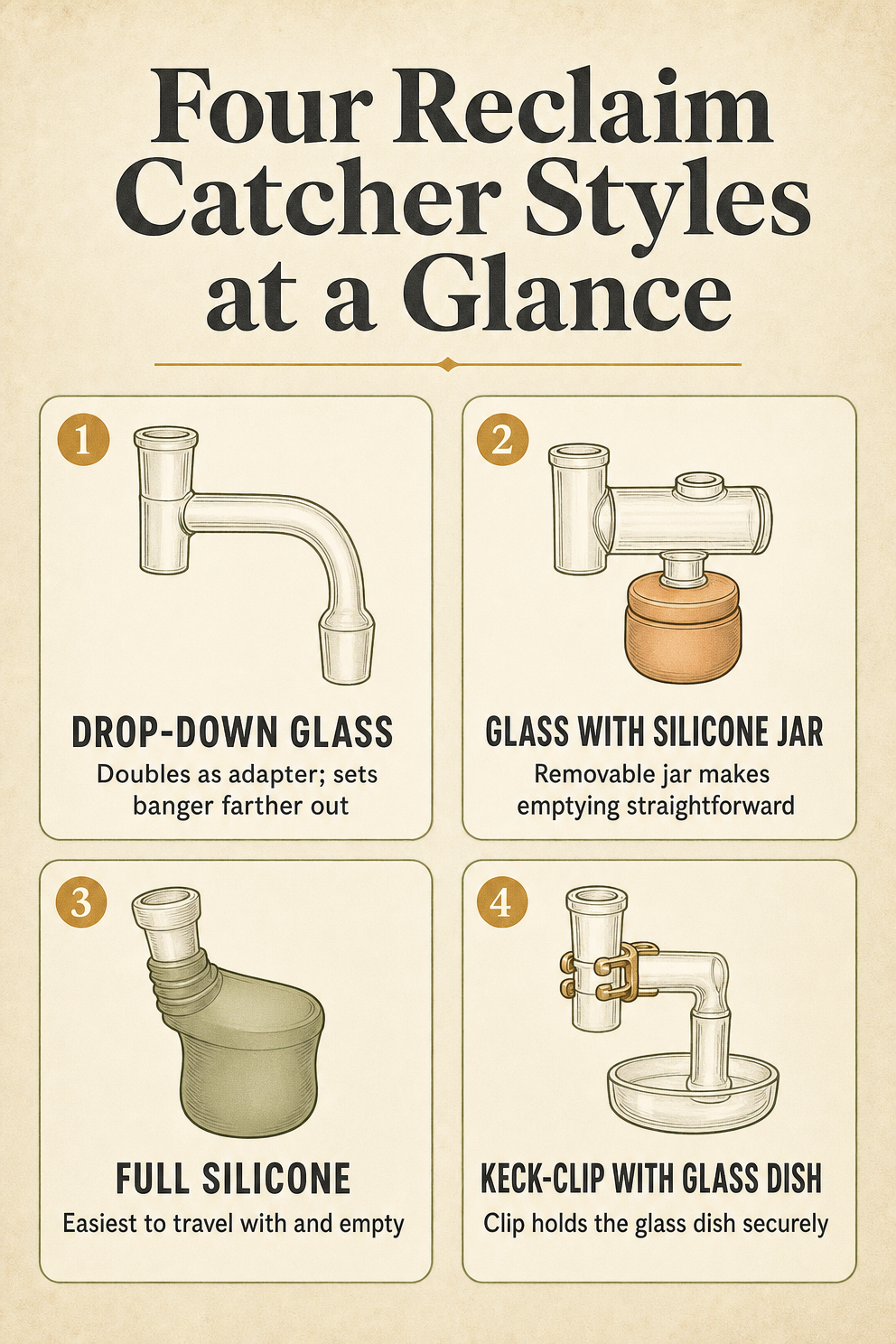
Reclaim catchers come in four designs that cover most of what is sold, plus a few hybrids. The differences come down to material, how the residue is stored, and how easy the piece is to empty [2] [6].
A drop-down glass catcher is a single glass piece with a chamber that hangs below the joint. Because the glass itself provides the drop, a drop-down also works as an adapter, and it sets the banger farther away from your face than a direct mount would. Residue stays in one glass chamber with no removable insert [2] [6].
A glass catcher with an attached silicone jar keeps the glass body but adds a removable jar underneath. That jar is the part that matters day to day. You detach it, empty it, and put it back without taking the catcher off the rig [2] [6].
A full silicone catcher replaces the glass body with silicone. These are the easiest to travel with and the easiest to empty, because you can flex the material to release what has collected. They trade some of the rigidity and heat spacing of glass for that convenience [2].
A keck-clip style catcher holds a glass dish in place with a clip. The clip keeps the dish seated, which matters on a rig that gets bumped or carried between rooms [2] [6].
Attachment methods vary as well. Some catchers mount the way an ash catcher does, some use an inner tube, and some are drop-downs. A growing number of newer dab rigs also ship with a built-in reclaim catcher attachment, so a separate purchase is not always required [7].
If you are picking a rig to begin with rather than an attachment for one you already own, What Are the Different Types of Dab Rigs? breaks down how the main rig styles differ, which is a useful frame before choosing what goes on the joint.
- Drop-down glass catchers double as adapters and set the banger farther out, holding residue in a glass chamber below the joint [2] [6].
- Glass catchers with a removable silicone jar are the easiest glass option to empty, because the jar detaches from the body [2] [6].
- Full silicone catchers are the easiest to travel with and empty, trading some glass rigidity for that convenience [2].
- Keck-clip catchers hold a glass dish securely, which helps on a rig that gets moved around [2] [6].
- Some newer dab rigs ship with a built-in reclaim catcher, so check your rig before buying an add-on [7].
What Joint Size, Gender, and Angle Does Your Rig Need?
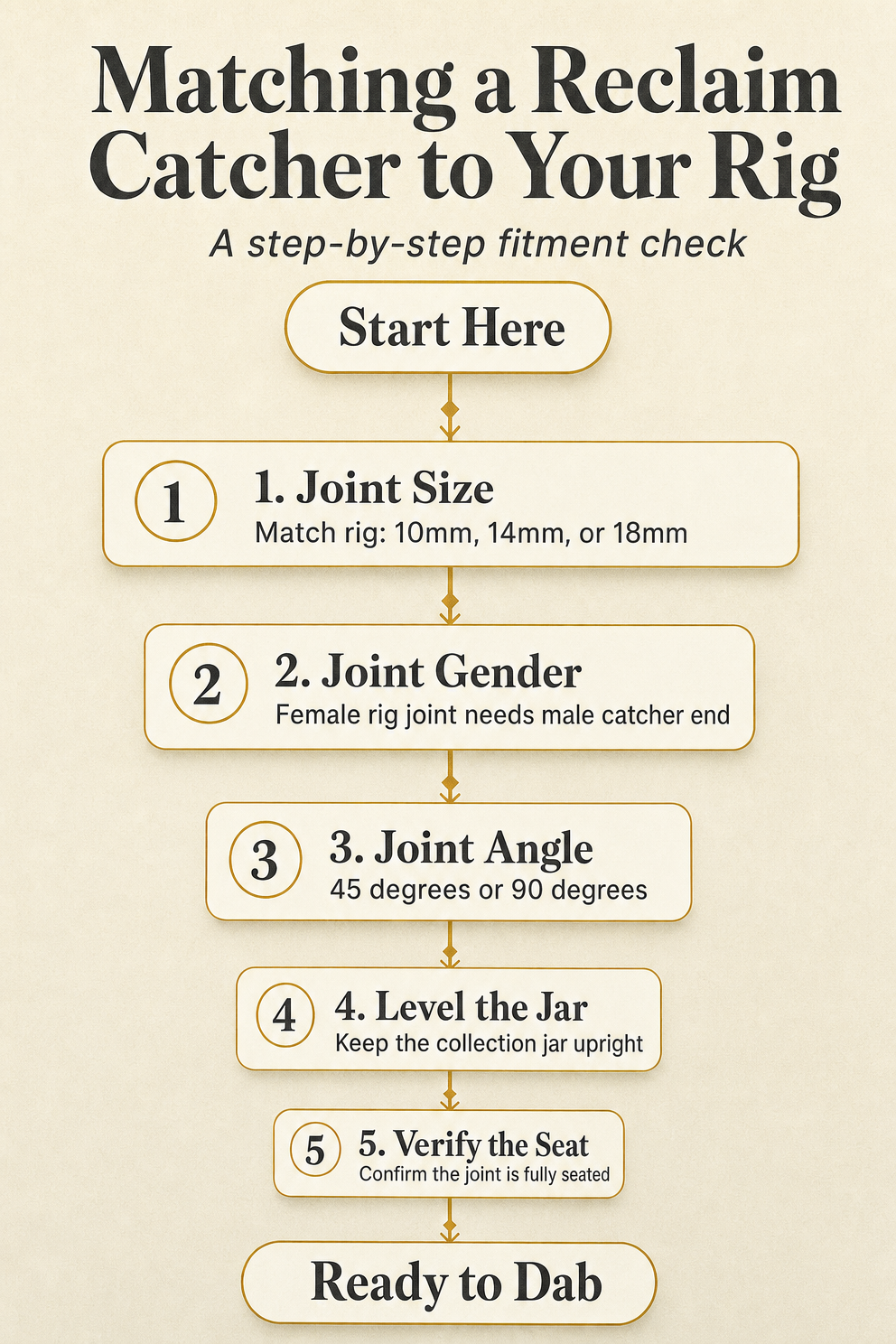
Fitment is where most reclaim catcher purchases go wrong. Three specs have to line up at the same time: joint size, joint gender, and joint angle. Miss one and the catcher will not seat, no matter how good the rest of it is [2] [3] [4].
Joint size is measured at the taper. Common sizes are 10mm, 14mm, and 18mm, and 14mm is described as the default for many dab rigs. The number has to match your rig’s joint, because the catcher’s lower end has to seat into it [2] [3] [4].
Joint gender is about which side is male and which is female. The two ends have to be complementary. If your rig has a female joint, you need a catcher whose lower end is male. The catcher’s upper end then has to accept whatever your banger uses, so both ends matter [3] [4].
Joint angle comes in two common values: 45 degrees and 90 degrees. A 90-degree catcher is used on a vertical joint. A 45-degree catcher is used on a diagonal joint. Matching the angle keeps the banger and the collection jar sitting level and upright instead of leaning to one side [3] [2] [1].
Dedicated dab rigs most often use 90-degree joints, because the joint continues the vertical line of the piece. Many bongs and rig-bong hybrids use 45-degree joints, because the joint grows out of an angled neck. Think of that as a starting point rather than a rule, and check your own rig before ordering [3] [1].
Checking your own rig is easier once you know what you are looking at. A piece like the Pulsar Double Chamber Bubble Glass Water Pipe – 14" / 14mm F / Clear lists its size and gender in the product name, which is exactly the information you need to match an attachment to it.
- Check joint size first. Look for 10mm, 14mm, or 18mm, and note that 14mm is described as the default on many dab rigs [2] [3].
- Check joint gender second. A female rig joint needs a male catcher end, and the catcher’s other end has to accept your banger [3] [4].
- Check joint angle third. A vertical rig joint takes a 90-degree catcher, and a diagonal joint takes a 45-degree catcher [3] [2].
- Confirm the angle with the rig in front of you rather than assuming, since dedicated rigs tend toward 90 degrees and many bongs tend toward 45 [3] [1].
- Dry-fit the catcher before committing, so the banger and the collection jar both sit level and upright [2] [1].
How Do You Set Up and Use a Reclaim Catcher?
Setup is short, and it does not change how you dab. The catcher simply takes the place of the rig’s joint, and the banger moves onto the catcher. From there the routine is the same as it has always been [1] [2] [6].
Seat the catcher with a gentle twist rather than a push. Glass joints are tapered, so a small rotation seats them better than force does. Forcing a joint that does not want to go in is how pieces chip, and it is worth stopping to recheck the size and gender rather than pressing harder [1] [2].
Once the catcher is on, check the collection jar or dish. Jar-style catchers need the jar fitted on squarely. Keck-clip catchers need the clip seated so the glass dish is actually held in place [2] [6].
After that, dab the way you normally would. The reclaim builds up on its own. There is no lever to pull and no step to remember mid-session, which is the main appeal of a passive accessory [1] [6].
If your normal routine already leans on low-temperature technique, the walkthrough in What Is a Cold Start Dab and How Do You Do One? is worth pairing with this setup, since both affect how much residue is left behind.
- Attach the catcher to your rig’s joint, using the size, gender, and angle you confirmed earlier [1] [2].
- Attach your banger to the catcher’s open joint instead of to the rig directly [1] [6].
- Seat the collection jar or dish, and if the catcher uses a keck clip, make sure the clip is holding the dish [2] [6].
- Confirm the joint is fully seated with a gentle twist, since a partial seat can let air past it and wobble [1] [2].
- Dab as usual. The reclaim collects on its own, and the routine otherwise stays the same [1] [6].
How Do You Collect and Clean Out the Reclaim?
Collection is routine maintenance rather than a special project. Reclaim builds up in the jar or dish over a number of sessions, and when the layer gets thick enough you detach it and empty it [1] [2] [5].
Silicone is the easy case. Reclaim does not cling to silicone the way it clings to glass, so you can often scoop it straight out with a dab tool and be done [1] [2].
Glass takes a little warmth. Gentle heat loosens the residue, and a hair dryer pointed at the jar or a soak in hot water usually does it. You want warm rather than hot, because sudden temperature changes are hard on glass. Once the residue softens, a dab tool scrapes it out [1] [2] [5].
If you have been running without a catcher, the cleanup is different. Reclaim that has already coated the inside of a rig comes out with high-percentage isopropyl alcohol. You fill the rig enough to cover the coated areas, plug the openings, agitate it so the alcohol reaches everywhere, pour the solution out, and let it evaporate [5].
One retailer caution worth repeating: if you plan to keep the material the alcohol pulled out, the alcohol has to be fully purged beforehand. That means letting it evaporate completely, not just until the surface looks dry [5].
Emptying the jar on a regular schedule is easier than deep-cleaning a coated rig. A jar that gets emptied every few sessions never builds up the layer that makes a full alcohol soak necessary [1] [2].
- Detach the collection jar or dish from the catcher [1] [2].
- Scoop directly from silicone, since reclaim releases from it without much help [1] [2].
- For glass, warm the jar gently with a hair dryer or a hot-water soak to loosen the residue first [1] [2] [5].
- Scrape the softened residue out with a dab tool, then reattach the jar or dish [2] [5].
- For a rig already coated inside, cover the coated areas with high-percentage isopropyl alcohol, plug the openings, agitate, pour the solution out, and let it evaporate fully before any reuse [5].
Does a Reclaim Catcher Change Airflow or Balance, and Is One Worth It?
A reclaim catcher is not free of trade-offs, and the biggest one is airflow. Adding an adapter adds volume and one more restriction to the path, plus more cool surfaces for vapor to condense on. The first thing most people notice is extra drag and a slower clearing pull [3].
That drag is more noticeable on small rigs, because a small piece has less volume to begin with. It also shows up more on setups that already depend on open airflow, such as terp slurpers. On a larger rig with more chamber volume, the same catcher is easier to live with [3].
Balance is the second trade-off. A heavy catcher with a full jar adds weight out past the joint, and that weight acts like a lever on a small rig. Retailer guidance describes a rig weighing under roughly 250 to 300 grams paired with a catcher around 150 grams as more prone to tipping, and a crowded dab station makes that more likely rather than less [3].
Cleaning is a third consideration, and it cuts both ways. You gain a container that holds the residue, and you take on one more piece that needs emptying on a schedule. For someone who dabs often, that is usually a good trade. For someone who dabs occasionally, it is added routine with less payoff [3] [7].
Price is the last factor. Retailers commonly report three tiers: roughly $20 to $35 for a budget borosilicate glass option, $35 to $70 for a midrange piece in thicker glass, and $70 to $140 or more for heavy glass with tighter tolerances and a wider range of angle and gender combinations. The higher tiers mostly buy fit and durability rather than a different function [3].
Before buying anything, check whether your rig already has a catcher built in. Some newer dab rigs ship with one, and if yours does, adding a second adapter only adds the volume and drag described above [7].
If you are adding a catcher alongside a new banger or bowl, free shipping on orders $150+ applies at checkout, which makes it cheaper to bring the whole setup in together.
- A catcher adds volume, restriction, and condensation surfaces, so extra drag and a slower clearing pull are the first things users notice [3].
- That extra drag is more noticeable on small rigs and on setups like terp slurpers that already depend on open airflow [3].
- Weight matters too: retailer guidance describes a rig under roughly 250 to 300 grams with a catcher around 150 grams as more prone to tipping [3].
- Common price tiers run about $20 to $35 for budget glass, $35 to $70 for midrange, and $70 to $140 or more for heavy glass with tighter tolerances [3].
- Some newer rigs ship with a built-in reclaim catcher, so check your rig before buying an add-on [7].
Frequently Asked Questions
What is a reclaim catcher and what does it do?
A reclaim catcher is an adapter that installs between your dab rig’s joint and your banger, so the banger mounts on the catcher instead of directly on the rig. Condensed concentrate gathers in a drop-down chamber or a removable silicone jar or dish while the vapor path continues into the main chamber [1] [2] [4].
What is the difference between a reclaim catcher and an ash catcher?
An ash catcher is designed primarily for flower bowls, catching ash and debris before it reaches the main chamber. A reclaim catcher is aimed at condensed concentrate residue from dabbing. Terminology overlaps, since some products are marketed and used interchangeably, and the two attachments are not strictly one-or-the-other for every setup [3] [4].
What joint size do I need for a reclaim catcher?
How do you get the reclaim out of the catcher?
Detach the jar or dish and scoop straight from silicone, or gently warm a glass jar or dish with a hair dryer or a hot-water soak to loosen the residue before scraping it out with a dab tool. If reclaim has already coated the inside of the rig, high-percentage isopropyl alcohol covering the coated areas is the usual alternative [1] [2] [5].
Does a reclaim catcher add drag to a dab?
Yes. A catcher adds extra volume, extra restriction, and extra condensation surfaces, and the first thing users tend to notice is added drag and a slower clearing pull. That is more noticeable on small rigs and on setups such as terp slurpers that already depend on open airflow [3].
Do some dab rigs come with a reclaim catcher built in?
Some newer dab rigs ship with a built-in reclaim catcher attachment, so a separate purchase is not always required. It is worth checking your rig’s joint and design first, because if a catcher is already built in, adding another adapter just adds volume and drag [7].
So Do You Actually Need a Reclaim Catcher?
A reclaim catcher earns its place when three things line up: your rig’s joint matches a catcher on size, gender, and angle; you would rather have residue gather in one removable spot than spread through the inside of your rig; and the extra drag a catcher adds still suits the way you dab [2] [3].
If any of those do not hold, the answer is often no. A 90-degree catcher will not seat on a 45-degree rig. A light rig paired with a heavy catcher and a full jar is more prone to tipping. A terp slurper setup that depends on open airflow will feel the added restriction the most [3].
If they do hold, the payoff is straightforward: less residue coating the inside of your rig, an easier emptying routine, and a piece that costs anywhere from about $20 to $140 or more depending on how tight the fit is and how thick the glass [2] [3].
Start by checking your rig: joint size, joint gender, joint angle, and whether a catcher is already built in. That one check settles most of the decision before price ever comes up [7].
Sources
- Thick Ass Glass: Reclaim Catcher | How To Use Them
- Roots Glass: What Is a Reclaim Catcher? Types, Sizing, and How to Use One
- Oil Slick: Reclaim and Ash Catchers for Dab Rigs (2026)
- Mood: What Is a Reclaim Catcher and Should You Get One
- Yo Dabba Dabba: What Is Reclaim and How Do I Collect and Use It?
- Honeybee Herb: What Is Reclaim Catchers And Their Functionality?
- Quartz Banger: What is a Reclaim Catcher?