

A hot knife is a heated loading tool, not a vaporizer. It looks like a slim pen with a ceramic tip. You scoop concentrate onto that tip, hold it over the chamber of your rig or e-rig, and press the button. The tip warms and the concentrate drops off into the chamber. That is the whole job.
The problem it solves is easy to miss until you have run into it. Sticky rosin or badder clings to a plain metal tool. When you try to scrape it into a chamber, it smears onto the walls instead of landing in the middle. A heated tip lets the material let go on its own, right where you point it [1].
The name has a second life. In the 1970s, the same phrase described a do-it-yourself method that used two heated knife blades. Modern electric tools borrowed the name as a nod to that history, so a search for the term can land you in either place [7] [8].
This guide covers what a hot knife does and how it differs from a plain dab tool and from a torch. It also walks through loading without smearing the chamber, which designs fit which devices, and how to keep the ceramic tip releasing material.
What Is a Hot Knife Dab Tool and What Is It Used For?
A hot knife is a small battery-powered tool that heats its own tip. You use it to move concentrate from a jar into a chamber. That is the entire purpose. The tool never heats the chamber itself and it never produces vapor on its own. Puffco is direct about this: it lists the Hot Knife as a loading accessory for devices such as the Peak, Proxy, and Peak Pro, and states plainly that it does not vaporize concentrates [1].
Think of it as the last six inches of the loading step. Everything before it, including picking a texture and heating a banger, still happens the way it always did. The hot knife only changes how the material leaves your tool.
Naming is the confusing part. There is no shared vocabulary for this category, so one brand’s product page looks nothing like another’s. You will see all of these labels in the same aisle:
On a shop page these tools are usually filed under Accessories, while a few models turn up in Vaporizers only as part of a kit rather than as a stand-alone item. That bundling detail matters when you shop, because a docked mini knife may not charge without its host device [5] [6].
- Hot knife: the most common name, and the one Puffco uses for its heated loading tool.
- Heated loading tool: the descriptive name, and the one that tells you what the item actually does.
- Electric heated dab tool: the phrase a shop uses when it needs to separate this from a plain metal dab tool.
- Dab knife or electric dab knife: a shortened form you will see in product titles and search results.
- Mini hot knife: a smaller unit built to dock inside a specific vaporizer, such as the one that ships with the Pulsar Chorus.
- Whatever the label says, the shape is the same: a slim body, a ceramic working end, one button, and a charging input.
How Is an Electric Hot Knife Different From a Plain Metal Dab Tool?
Both tools pick concentrate up. The difference is what happens next. A plain metal dab tool depends on the material letting go: gravity, the warmth of your hand, and the texture of the concentrate all decide whether it drops or stays put. A heated tool releases on command, because you press a button and the tip warms [1].
That one change matters because of where a dab goes. On a torch and banger setup you load into a bucket that is already hot, so a metal tool dragged across that surface leaves a trail. On an e-rig or a portable concentrate vaporizer you load cold, so the material has to fall into the middle of the chamber instead of being pushed against the wall [5].
Texture decides more than the tool does. Rosin, live resin, badder, and similar extracts are made for dabbing hardware, while distillate oils built for cartridges are a separate format and are not interchangeable with dab-ready concentrates [9]. Soft, tacky material is where a heated tip earns its place.
Where the tool fits into a session depends on your hardware. How Do You Load a Dab Rig Step by Step? covers the loading order from the top, and What Is a Dab Rig and How Do You Use One? explains the rig itself. For the heating side of a torch setup, read How Do You Choose the Right Torch for a Dab Rig?.
If you would rather skip the flame, Torchless Dab Rigs: How Do They Work Without a Torch? covers rigs that build heat into the device. For the hardware behind that approach, read What Is an E-Nail and How Do You Choose the Right One?. For the hand tools themselves, What Are Dab Tools and How Do You Choose the Right One? is the place to start.
- Soft, tacky rosin or badder: a heated tip wins here, because the material drops in one motion instead of leaving a film behind.
- Firm, waxy extracts: either tool handles them, since a solid piece lifts off without much coaxing.
- Cold jar versus warm jar: the same concentrate behaves differently on two different days, which is why release is worth controlling.
- Distillate oil built for cartridges: a separate format from dab-ready concentrate, and not what this tool is made to move [9].
- Plain metal tool: still the right pick when your material scoops and drops on its own, or when you want something that never needs charging.
- Heated tool: worth the battery when you load cold chambers often and the material keeps clinging to metal.
| What you are comparing | Plain metal dab tool | Electric hot knife |
|---|---|---|
| Release | Waits for the material to let go on its own | Warms the tip so material releases on command |
| Best for | Firm, waxy material that scoops cleanly | Soft, tacky rosin or badder that clings to metal |
| Power | None | Rechargeable battery, charged over USB-C |
| Placement | Can drag material across the chamber wall | Places material, then lifts away |
| Upkeep | A few dollars, never needs charging | Battery to charge and a ceramic tip to swab |
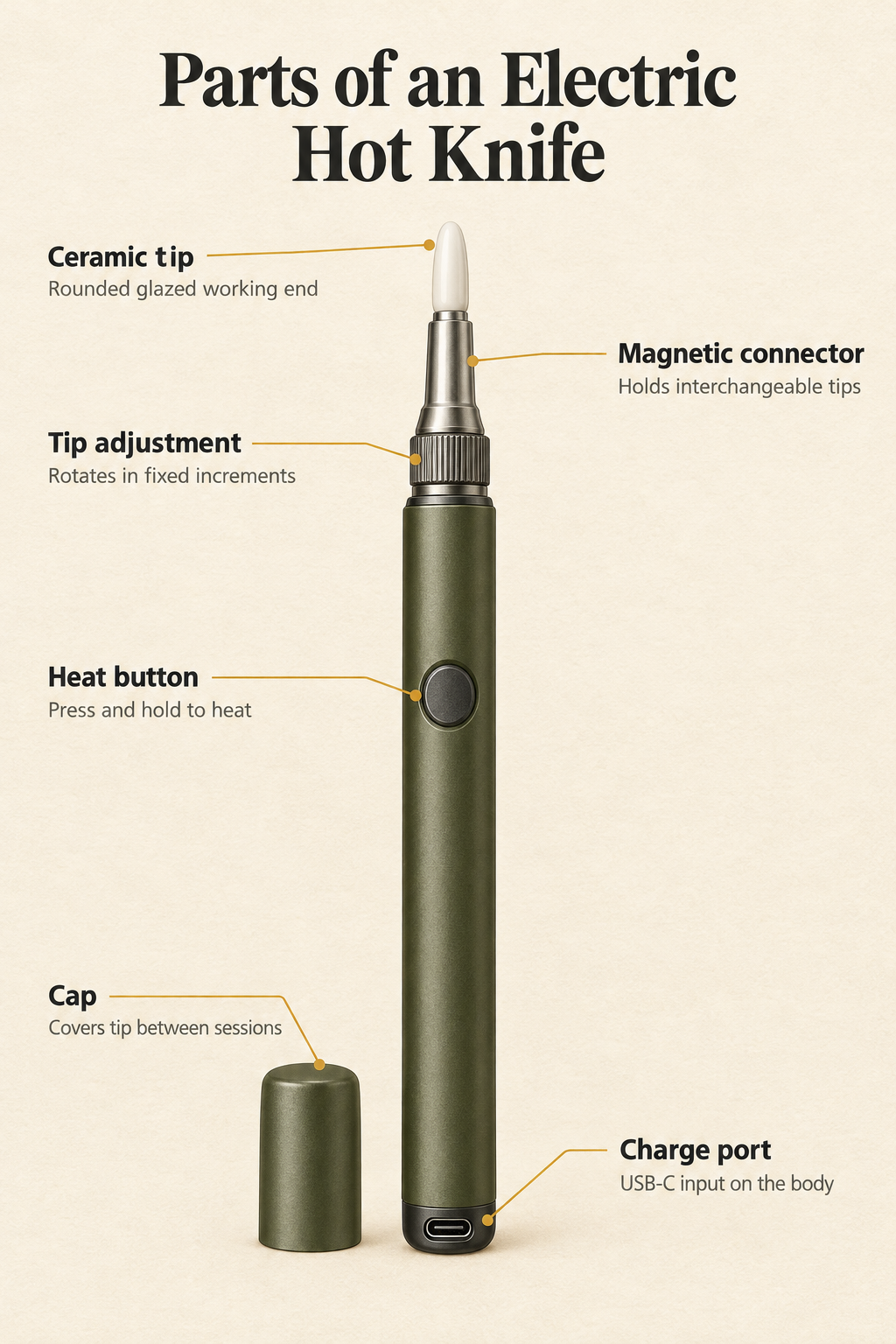
What Are the Parts of an Electric Hot Knife?
These tools look alike from across a room, but they break down into the same small set of parts. Walking from the working end back to the charging port is the easiest way to compare two models side by side.
Two details deserve a second look on any spec sheet. The first is the tip. Puffco’s current version uses a rounded, glazed ceramic tip, while the Yocan Dirk ships a rounded K1 tip for scooping and a pointed K2 tip for harder material on a magnetic connector [2] [4].
The second is power. Puffco lists about 25 minutes from empty to full over USB-C plus a triple-click battery check, and the Dirk lists a 400 mAh battery, 5V/1A Type-C input, and roughly half an hour to charge [2] [3].
- Ceramic tip: the working end. It is the only part that touches your concentrate, and the part you swab.
- Magnetic connector: holds interchangeable tips. The Dirk uses this to swap between its rounded and pointed tips [3].
- Tip adjustment: some bodies let the tip rotate in 90-degree steps so you can angle it into an awkward chamber [4].
- Heat button: press and hold to warm the tip. On some models the same button reports battery level on a triple-click [2].
- Body and battery: a slim handle that holds the cell. The Dirk lists a 400 mAh battery in a 14.2 mm body [3].
- Cap: a secure lid with a lanyard loop on the Puffco model, so the tip is covered between sessions [2].
- Charge port: a USB-C input on the body, or in the case of a docked mini knife, a charging connection inside the host device [5].
Are Hot Knives the Old Knife-Hits Method, or Something New?
Search the phrase and you will find two different things wearing one name. One is the modern accessory described on this page. The other is a method that goes back to the 1970s, when people heated the tips of two knife blades and pressed hash or hash oil between them [7].
That older method collected a long list of nicknames over the decades, which is part of why the search results look so scattered. The method itself was simple: two blades on a stove coil, material sandwiched in the middle, and a funnel or a cup to catch what came off [8].
If you searched for the technique and landed on a product page, the mix-up is understandable: the two share a name, a heat source, and a slice of history, and almost nothing else.
The practical difference is what the heat touches. In the older method the heat met the material directly, pressed between two blades. The electric tool heats only its own tip, long enough for the concentrate to slide off into a separate chamber that handles the heating. That is why one of these is a technique you learn and the other is a product you buy.
- Spots, spotting, or dots: the most common names for the older two-blade method.
- Knifers, knife hits, or knife tokes: the names used when the blades were passed around a group.
- Blades or bladers: shorthand that referred to the knives themselves rather than the material.
- The old method: two blades heated on a stove coil, with concentrate pressed between them and vapor caught above [8].
- The modern tool: one battery-powered unit with a ceramic tip that heats only enough to release concentrate into a chamber.
- Why the name stuck: Puffco says its heated loading tool is named as a tribute to that earlier do-it-yourself method [1].
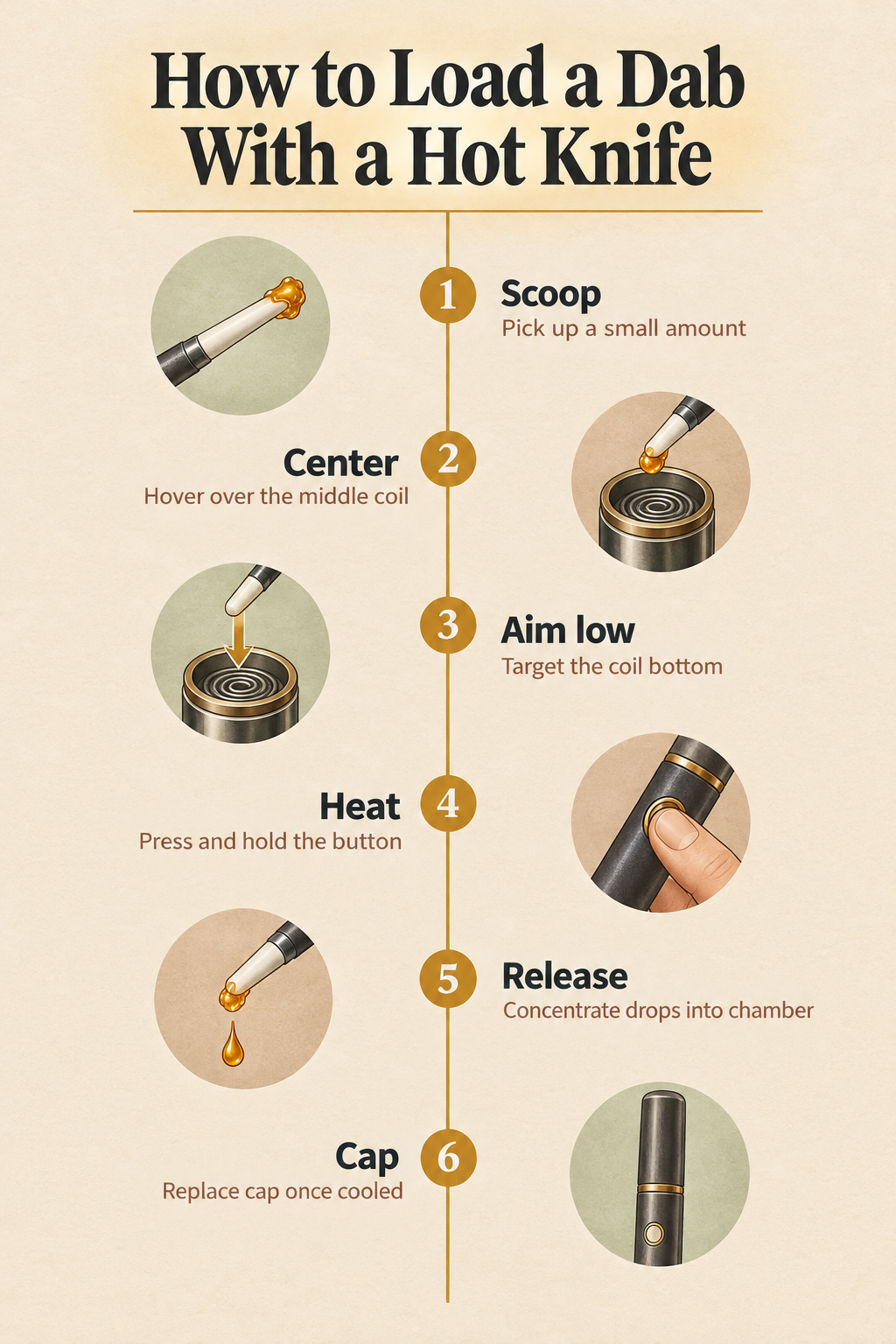
How Do You Load a Dab With a Hot Knife Step by Step?
The sequence is short and the same across brands. What separates a tidy load from a messy one is where the tip sits when you press the button.
The step people skip is the aiming step. Putting material on the side or rim of a coil is the most common way to end up with concentrate where it does not belong, and the manuals point at the middle for a reason [5].
Two pre-flight checks save a wasted scoop. Confirm the knife is out of any dock, because a docked mini knife will not activate at all [5]. Then confirm the chamber is cool if you are loading cold, so the material does not start to run before you are ready.
Scoop size is the other habit worth building. A small amount releases in a second or two, while a heavy scoop sits on the tip and starts to run down the side while you wait. If you are loading for more than one person, take two small scoops instead of one large one.
- Check the battery before you start. A triple-click usually reports the level, and a half-charged tip makes for a slow drop [2].
- Scoop a small amount onto the tip. More material means a longer drop and a bigger mess on the way down.
- Center the tip over the chamber so the material falls into the middle rather than the wall.
- Aim low: hover over the middle of the coil and target the bottom of it, not the side or the rim [5].
- Press and hold the button until the tip warms and the concentrate lets go.
- Lift the tip away once the material drops. Do not wipe the tip on the chamber wall to hurry it along.
- Replace the cap once the tip has cooled, and put the tool back where it lives [1] [5].
Hot Knife vs Torch: Which Tool Does Which Job?
A torch and a hot knife both involve heat, which is why people assume they compete for the same job. They do not. They sit at opposite ends of the same session.
The label on the product tells you which end you are buying. A torch is sold as a heating tool. A hot knife is sold as a loading accessory [1].
If you are choosing a heat source for a quartz banger, that is a separate decision with its own trade-offs, and a hot knife does not shorten it. It only makes the last step tidier.
They also feel different in the hand. A torch has a fuel supply to fill and a flame to watch, while a hot knife is a battery tool with a button and a cap.
- Torch and banger setup: you want both tools. The torch heats the quartz, and the knife places the material without dragging it.
- E-rig or portable concentrate vaporizer: skip the torch and add a loading tool, because the device builds heat in and you load cold [5].
- Desktop e-nail: the heat is already built into the hardware, so the decision in front of you is a loading tool, not a torch.
- Dab pen or cartridge: a hot knife has no job there, because the oil is already packaged for its own hardware [9].
- Buying one first: if you only dab from an e-rig, a loading tool changes your session more than a second heat source would.
- What neither tool does: neither one vaporizes the dab by itself, and a hot knife cannot stand in for a banger or a coil.
| Job in the session | Torch | Hot knife |
|---|---|---|
| Brings a quartz banger up to temperature | Yes | No |
| Heats the chamber | Yes | No |
| Moves concentrate into the chamber | No | Yes |
| Fits an e-rig or portable vaporizer | Not needed | Optional add-on |
| Part of the session | Heat cycle | Loading step |
Which Hot Knife Works With Which Device, and What Should You Check Before Buying?
Three heated loading tools are in stock as of this writing, and they sit at very different points on the range. Comparing them is a quick way to see what the extra money buys.
The Puffco Hot Knife is the simplest of the three: one rounded glazed ceramic tip, USB-C charging, a press-and-hold button, and a cap with a lanyard loop. The Yocan Dirk gives you the most to adjust, with three voltage levels, a ten-second preheat, interchangeable K1 and K2 tips, and a tip that rotates in fixed steps. The Pulsar Chorus Mini Hot Knife is the docked option, built into the Chorus housing with its own 180 mAh battery [6].
Two of the three list at $150 or more, which puts them inside our free shipping on orders $150+ threshold. The least complicated of the three also carries the lowest price, and fewer parts plus one fixed tip explain most of that gap.
The check that people skip is the warranty. Puffco covers its Hot Knife for two years against defects in materials and workmanship, and excludes normal wear, accidental damage, and misuse [2]. A dropped tool or a chipped tip is not a defect, so the handling habits in the next section are what actually keep the purchase working.
- Charging path: a USB-C cable of its own, or a dock that charges inside the host device [5].
- Standalone use: a docked mini knife will not activate while it sits in its host, so confirm it works free of the dock.
- Battery readout: a triple-click level check is more useful than a light that only shows up when the cell is nearly empty [2].
- Tip shapes and spares: one rounded tip suits most material, while interchangeable rounded and pointed tips cover a wider range [4].
- Cut-off and preheat: short automatic shut-offs and a preheat stage change how long you hold the button [3].
- Adjustability: a tip that rotates in fixed increments helps you aim into a chamber that sits at an odd angle [3].
- Warranty terms: read what is covered and, more importantly, what is excluded before you pay.
How Do You Clean and Maintain a Hot Knife?
Every brand manual says the same thing in different words: wipe the tip after each session, not when it finally stops working. Residue that sits hardens, and a hardened tip stops releasing material, which is the one job you bought it for [1].
Never submerge the tool. It is a battery-powered electronic item, and the manuals are explicit that liquid should stay away from the internals and the charging port. A swab on the tip is the whole routine [5].
Handle the tip like a tool, not a scraper. Pressing it hard against a chamber wall to chase a stubborn bit of material is how tips chip and how connectors loosen. If material will not release, warm it again instead of adding force.
Build the habit into the end of a session rather than the start of the next one. A tool that goes back in its dock with a coated tip has already started to set, and a tip that has set takes a longer swab to bring back. Thirty seconds at the end beats five minutes the next day.
- Let the tool cool completely before you touch the tip with anything.
- Swab the ceramic tip with a cotton swab dipped in isopropyl alcohol [1].
- Keep liquid away from the electrical parts and the charging port at all times [5].
- Wipe the blade before the tool goes back into its dock, every single time [5].
- Work through a deep clean if the blade starts sticking; Pulsar’s manual includes a procedure for exactly that [5].
- Store it capped and out of reach of children and pets, and never modify the electronics [5].
Frequently Asked Questions
Does a hot knife vaporize the dab for you?
No. The heated tip only warms enough to let go of the concentrate. Manufacturers are explicit about this: the tool is a loading accessory, and the vaporizer or rig chamber is what produces the dab. If a product page claims a hot knife will replace your rig, that is a different category of device wearing a similar name.
Can you use a hot knife with a torch and banger setup?
Yes, and this is one of the clearest uses for it. With a banger you are loading by hand while the bucket is already hot, so material that clings to a metal tool gets scraped against the wall instead of landing in the bucket. A heated tip lets you place the concentrate where you want it and lift away without dragging the tool across the surface.
How long does a hot knife battery last, and how does it charge?
It depends on the model. Charging is over USB-C on the units we looked at, and the published figures range from roughly half an hour to about twenty-five minutes for a full charge, depending on battery size [2] [3]. A battery-level check is usually built into the button, often on a triple-click. Small docked units charge inside the host device housing instead of on a cable of their own.
Why does the tool shut off on its own while I am holding the button?
That is a built-in cut-off on the heating element, not a fault. The timers are short by design, and some models add a preheat stage before the tip is ready. If the tip stops heating mid-load, release the button and press it again. On docked designs the tool will not activate at all while it sits in the host housing.
What is the best way to keep the ceramic tip from building up residue?
Wipe it after every session, not occasionally. Let the tool cool completely first, then swab the tip with a cotton swab dipped in isopropyl alcohol, and keep liquid away from the electrical parts and the charging port. Residue that is allowed to sit hardens and stops the tip from releasing material, which is the exact problem the tool exists to solve.
Are all hot knife tips the same shape?
No. Some brands ship a single rounded, glazed tip that handles most material. Others use a magnetic connector with interchangeable tips, including a rounded scoop-style tip for softer concentrates and a pointed tip for harder material, and some of those rotate in fixed increments so you can angle the tip toward the chamber.
What Should You Remember Before You Buy a Hot Knife?
A hot knife is a loading tool. It scoops concentrate, warms its own tip, and lets the material drop into the chamber. It does not vaporize anything, and it does not replace a banger, a coil, or a torch [1].
It earns its place when your material is soft and tacky and you are tired of scraping it off a metal tool. If your concentrates are firm and scoop cleanly, a plain dab tool still does the job for a fraction of the cost.
Before you buy, check how the tool charges, whether it works outside a dock, what tip shapes come with it, and what the warranty actually covers. Then wipe the tip after every session, because a tip that releases material on demand is the entire point.
Sources
- Puffco: How to Use a Hot Knife for Dabs
- Puffco: Puffco Hot Knife: Heated Electric Dab Tool
- Yocan: Yocan Dirk User Manual Download
- Yocan Vaporizer: Yocan Dirk Hot Knife
- Pulsar: Pulsar Chorus Instruction Manual (PU-0745-24)
- Pulsar: Pulsar Chorus Concentrate Vaporizer
- Wikipedia: Spots (cannabis)
- GreenState: An ode to hot knives: honoring the OG dab
- Puffco: Distillate Oil vs Concentrates: What’s the Difference?