

A mushroom pipe is not a separate kind of pipe. It is a familiar format — a spoon hand pipe, a bubbler, a water pipe or a dab rig — with mushroom styling worked into the glass. Treehouse lists 11 mushroom and shroom pieces, 10 in stock now, running from 2.5 to 15.25 inches tall and $19.99 to $123.45.
So the useful question is not whether a mushroom pipe works differently. It is which format the mushroom shape is sitting on. This guide walks through the formats, the sizes, the working parts, the decorative techniques behind names like wig wag and reversal, and the shelf pricing, so you can match a piece to the way you actually plan to use it.
Is a mushroom pipe a real pipe style, or just a novelty shape?
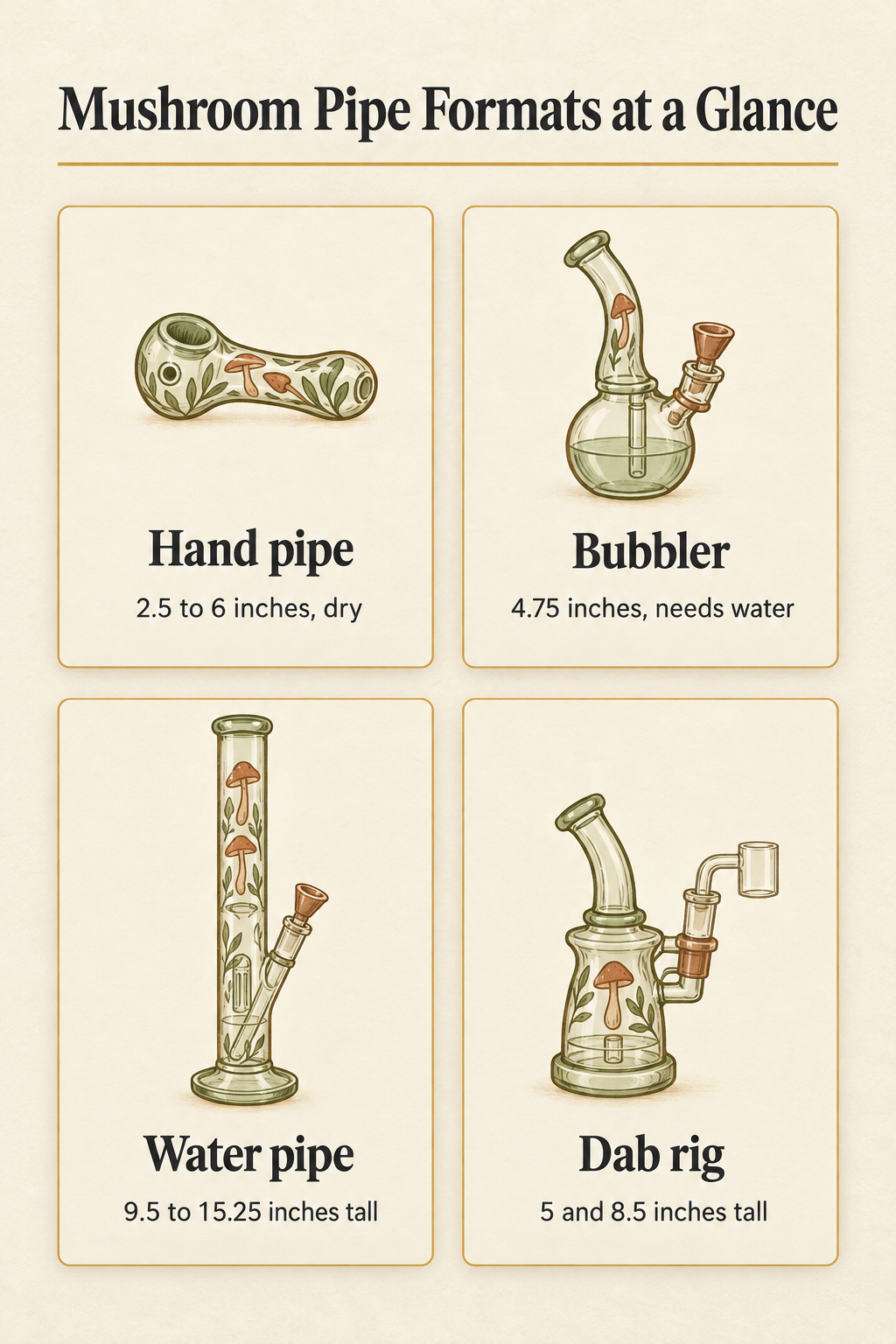
The word mushroom describes the outside of the piece, not the way it works. Every mushroom item on the Treehouse shelf is an ordinary format underneath: 2.5-inch and 6-inch spoon hand pipes, a 4.75-inch bubbler, 9.5-inch and 15.25-inch water pipes, and 5-inch and 8.5-inch dab rigs.[1][9][2] Once you know the format, you know the layout, the parts and the kind of use the piece is built for. The shape word tells you almost none of that.
The vocabulary around these pieces is loose, and the same object turns up under several names. A shopper browsing Hand Pipes might meet the exact same piece filed under Bongs or under a dab rig heading somewhere else, because categories are a merchandising decision rather than a specification. If you want the narrowest view of the dry forms, Glass Hand Pipes is the aisle where most of them land.
Glassworkers have a more useful set of labels. GRAV’s glossary separates scientific glass, where the focus is the air and water path, from heady glass, where the embellishments — colour, marbles and structures on the outside — do not contribute to function, and notes that heady pieces often take on recognizable forms like an animal, a face or a robot.[15] Tako Glass adds that no certification, minimum price or particular glassblowing technique turns a pipe into a heady piece, and that the line between production work and sculptural work is not absolute.[16]
That is the honest way to read a mushroom pipe. It is decorative work sitting on a standard format, and the price difference usually tracks the glasswork rather than any change in how the piece is used.
- Mushroom pipe, shroom pipe and mushroom glass pipe — the generic terms used across most listings
- Shroom bong and mushroom water pipe — the same water piece described two different ways
- Mushroom hand pipe and shroom spoon — dry pieces with a sculpted cap, a sprayed finish or a printed wrap
- Novelty glass pipe — a catch-all term for sculpted shapes filed outside the standard categories
- Mushroom bubbler — a small water piece that often sits in the hand pipe category anyway
Which kinds of mushroom pipes can you actually buy?
The shelf splits into four formats, and each one is a different job. If you are still learning the dry shapes, What Are the Different Types of Hand Pipes? walks through them, What Is a Spoon Pipe and How Does It Work? breaks down the spoon layout on its own, and What Are Specialty Pipes and How Do You Choose the Right One? puts sculpted and specialty pieces in the wider picture. Here is what is in stock.
The one water piece sitting in the hand pipe aisle is SeshGear Electroplated Mushroom Glass Bubbler – 4.75" / 14mm F, a 4.75-inch borosilicate bubbler at $33.90 with a 14mm female joint and a fixed perforated downstem, which needs water before use.[2]
Most of these pieces use the mushroom as decoration: a decal, a sculpted cap, an electroplated coating or a vinyl wrap that plays no part in the air or water path.[3][8] There is one exception. On the Pulsar Shroom Shenanigans the mushroom-shaped dome is a working percolator. Smoke passes through it after the mini inline percolator in the lower chamber, and a bullet-hole ice catcher sits in the neck.[11] That is the only piece on the shelf where the mushroom shape does a job.
HEMPER publishes the fullest spec sheet of the group for the Trippy Shroom XL: 9.5 inches tall, 4.5-inch diameter, showerhead percolator, 5 mm glass thickness, a scalloped body with an iridescent finish, and a matching 14 mm shroom bowl in the box.[13]
One listing is not currently buyable. The Mushroom Glass Clay Hand Pipe at $14.99 is out of stock, and its description calls the material hand-formed glass clay without stating a borosilicate composition the way the other mushroom pipes do.[25] If you want a piece you can use this week, count the rest of the shelf as the real choice.
- Dry hand pipes — Toadstool at 2.5 in for $19.99, Mushroom Character in 2.5 in and 6 in for $19.99, Reversal Shroom at about 5 in for $35.99, and the Wig Wag Mushroom 4-count bundle at 4 in for $79.90.[1][9][7][6]
- Bubbler — the SeshGear electroplated mushroom bubbler at 4.75 in for $33.90, the only water piece filed under hand pipes.[2]
- Water pipes — Pulsar Shroom Shenanigans at 15.25 in for $69.90, HEMPER Trippy Shroom XL at 9.5 in for $123.45, and the Mushroom Skull Tentacle at 10.5 in for $49.90.[3][4][8]
- Dab rigs — Pulsar Bioluminescence Mini at 5 in for $39.99, and the Pulsar Shroom Rig Set at 8.5 in with a carb cap for $103.90.[10][5]
- Not buyable right now — the Mushroom Glass Clay Hand Pipe at $14.99, out of stock and described as glass clay rather than borosilicate.[25]
| Format | Mushroom pieces on the shelf | Height | Price |
|---|---|---|---|
| Dry hand pipe | Toadstool, Mushroom Character, Reversal Shroom, Wig Wag 4-count | 2.5 to 6 in | $19.99 to $79.90 |
| Bubbler | SeshGear Electroplated Mushroom (filed under Hand Pipes) | 4.75 in | $33.90 |
| Water pipe | Pulsar Shroom Shenanigans, HEMPER Trippy Shroom XL, Mushroom Skull Tentacle | 9.5 to 15.25 in | $49.90 to $123.45 |
| Dab rig | Pulsar Bioluminescence Mini, Pulsar Shroom Rig Set | 5 and 8.5 in | $39.99 to $103.90 |
How big are mushroom pipes, and which size fits where you’ll use it?
Published heights are the fastest way to sort this shelf, because on these pieces height maps almost directly to a place to keep the thing. Group them by size band and the decision gets simple.
What changes with scale is the published detail, not just the number. The 15.25-inch Pulsar carries a 14mm female joint at a 90-degree angle, a mini inline percolator in the lower chamber, the mushroom dome percolator above it and a bullet-hole ice catcher in the neck, and it ships with a matching 14mm male herb slide.[11][3] The 9.5-inch HEMPER carries a 4.5-inch diameter, a showerhead percolator, 5 mm thickness and a scalloped body.[13] The 10.5-inch Mushroom Skull Tentacle is a straight-mouthpiece tube with a removable diffuser downstem.[8]
Wall thickness is the spec most often missing, and it is the one buyers ask about first. HEMPER publishes 5 mm. Pulsar and SeshGear listings give height, joint size and percolator type but no thickness figure, so you cannot compare thickness across brands from the published data.[14][11] Ask before you assume.
Borosilicate shows up in most of these listings, and the reason is practical rather than promotional. It expands and contracts less than ordinary soda-lime glass for the same temperature change — roughly a third as much — which is why it is used for glass that has to take repeated heat cycles.[19] It is also what glassworkers call hard glass: worked at the torch from tubes and rods, then kiln-heated and cooled evenly to prevent cracking.[20] None of that turns a pipe into something unbreakable. ONGROK describes its own borosilicate bubbler as drop-resistant rather than drop-proof, and suggests holding a pipe nearer the mouthpiece because the bowl end is the hot part.[18]
- 2.5 inches — the Toadstool and the small Mushroom Character spoon: a pocket piece that lives in a bag or a drawer
- 4 to 5 inches — the Wig Wag 4-count bundle at 4 in, the SeshGear bubbler at 4.75 in, the Reversal Shroom at about 5 in, and the Pulsar Bioluminescence rig at 5 in
- 6 inches — the larger Mushroom Character spoon, the biggest dry hand pipe on the mushroom shelf
- 8.5 to 10.5 inches — the Pulsar Shroom Rig Set at 8.5 in, the HEMPER Trippy Shroom XL at 9.5 in and the Mushroom Skull Tentacle at 10.5 in
- 15.25 inches — the Pulsar Shroom Shenanigans, the tall tube with the ice catcher in the neck
Where is the carb on a mushroom hand pipe, and how do you use it?
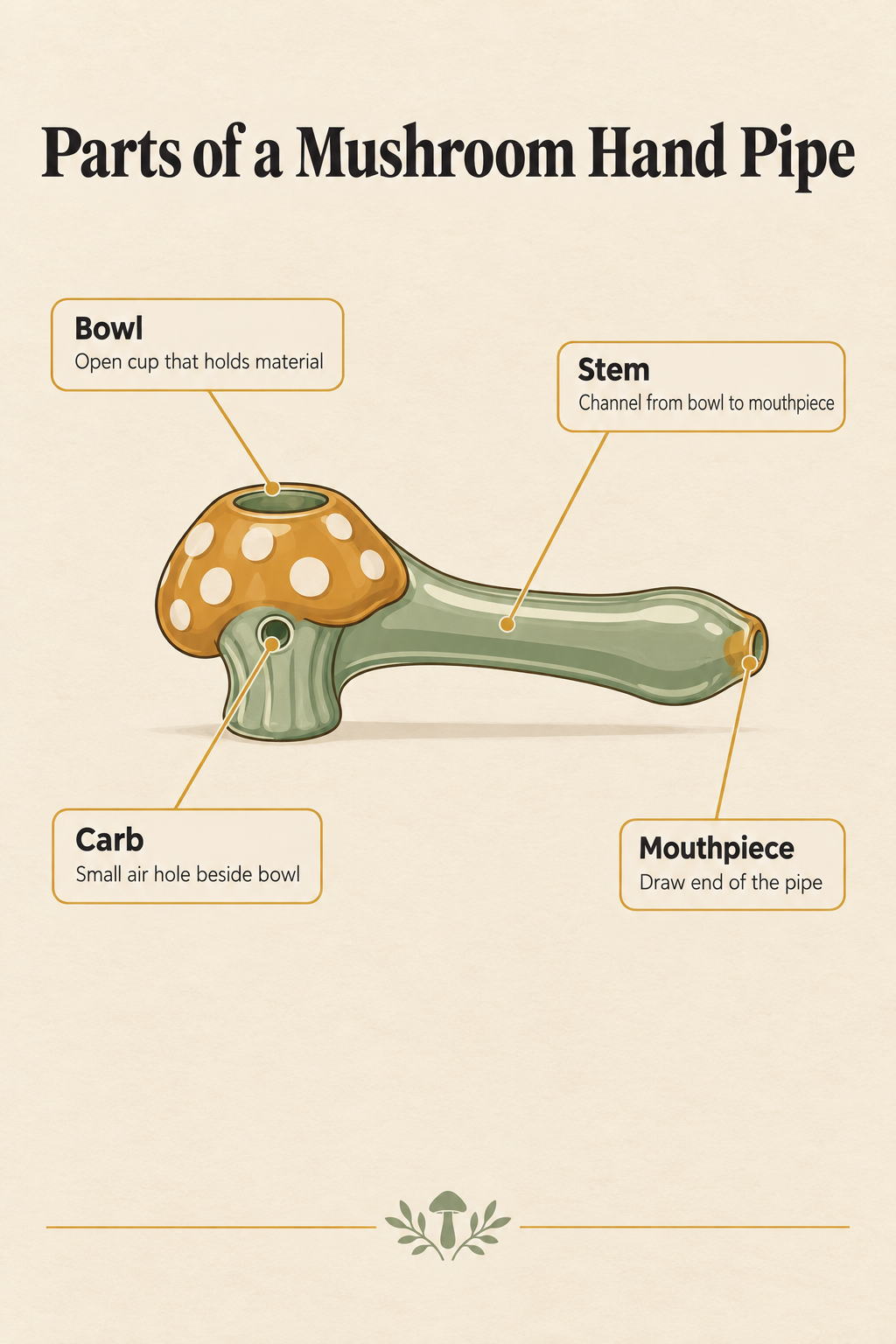
A spoon hand pipe has four working parts, and the carb is the one shoppers ask about most. Read them in the order air moves through the piece, because that order is what the carb controls.
The carb is about control rather than decoration. You cover it while you light, then release it to clear the stem. In practice that reads as five steps: pack the bowl loosely, cover the carb with a finger, bring the flame to the edge of the bowl rather than the centre, draw while the carb stays covered, then lift your finger to clear the piece.[18]
Carb presence and placement are a style choice, not a rule. Simple Glass Pipe’s table lists carbs as often present on spoon pipes, Sherlocks and bubblers, usually absent on chillums and one-hitters, and often absent on water pipes that use a removable bowl and ground joint instead; on a Sherlock the layout depends on the exact glasswork.[17] On the Toadstool mushroom hand pipe the listing specifies a left-side mounted carb hole.[1]
Sculpted glass makes this harder to read from a photo. On a plain spoon the bowl, stem and side opening are easy to pick out; on a mushroom cap the four parts are worked into the shape, so read the listing rather than assume a layout. A bubbler works the same way with one extra step first: fill it with water, then cover the carb, light the edge of the bowl, draw and release to clear.[18][2]
- Bowl — the open cup at the front of the piece where the material sits
- Carb — the small secondary air opening beside the bowl, usually worked into the mushroom body on these pieces
- Stem — the internal channel that carries air from the bowl back toward the mouthpiece
- Mouthpiece — the draw end of the pipe, and the part to hold when the bowl end is still hot
What do wig wag and reversal actually mean on a mushroom glass pipe?
Both words describe how the glass was worked, not what the piece does. Legacy Glassworks defines wig-wag as colour rods made into solid colour tubing and twisted back and forth, with reversal as a specific type of wig-wag in which the axis is switched during the blowing process.[20]
The geometry explains why one family of patterns shows up under several trade names. Twisting longitudinal stripes in alternating directions and then reorganising the patterned tube produces periodic wave, spiral and radiating patterns, and glassworkers have built many consistent techniques and identifiable pattern forms under these names.[21]
The Cave groups the decorative techniques used on worked pipes under headings that include colour work, linework, disc flips and drawing on glass, marbles and sculpture, and lists wig-wag, reversal, switchball, swirl, rewig and staircase as names for different ways of working lined sections.[22] In other words, the vocabulary is a craft vocabulary that leaked into product titles.
The practical point for a buyer is that two mushroom hand pipes with identical bowls can look nothing alike and cost different amounts, because one carries spiral linework worked into the glass and the other is a printed or sprayed finish. On the retail side, the Wig Wag Mushroom hand pipe ships as a 4-count bundle at $79.90 with spiral striping,[6] and the Reversal Shroom Pipe at $35.99 uses the linework term as its product name for a mushroom-style spoon with a carb in assorted vibrant colourways.[7] Neither name changes the format. Both are dry hand pipes.
- Wig wag — solid colour tubing twisted back and forth, producing repeating waves
- Reversal — a wig wag where the axis is switched during the blowing process, giving a different pattern set
- Swirl and rewig — related names for other ways of working a lined section of tubing
- Staircase and switchball — further trade names in the same family of lined patterns
- Disc flip, colour work, marbles and sculpture — the broader worked-glass techniques grouped alongside linework
How do you clean a mushroom glass pipe without wrecking the finish?
Every mushroom listing on the shelf prints the same care instruction: isopropyl alcohol and salt.[1] The routine itself is short.
Finish is where mushroom pieces differ from a plain spoon, and it is where people go wrong, because several of these SKUs are not bare glass. The SeshGear bubbler carries an electroplated iridescent metallic coating over its body.[2] The Mushroom Skull Tentacle water pipe is a borosilicate body under a vinyl exterior wrap carrying the artwork.[8] The Mushroom Character hand pipe is frosted borosilicate with a printed galaxy finish.[9] On coated, wrapped or printed pieces, skip abrasive scrubbing and keep the salt working inside the piece rather than grinding it against the outside finish.
The listing is the authority on what a given finish tolerates. When a product page says colours vary, it is also telling you the coating or colourway is applied per unit, so a second piece from the same SKU will not match the first exactly.
Two habits keep a good piece in service longer: clean it before buildup sets hard, and store it standing up so the mouthpiece and the cap are not carrying the weight of the piece.
- Empty the piece and rinse it with warm water
- Add isopropyl alcohol and a spoon of coarse salt
- Seal the openings and shake gently so the salt works the interior
- Rinse thoroughly with warm water until the salt is gone
- Air-dry the piece fully before the next use
How much do mushroom pipes cost at Treehouse, and is the 4-pack cheaper per piece?
Yes, the 4-pack is the cheapest route per piece. The Wig Wag Mushroom hand pipe bundle at $79.90 works out to about $19.98 per pipe, which is the lowest per-piece cost on the mushroom shelf, level with the $19.99 single hand pipes and well under the $35.99 Reversal Shroom single.[6][1][7] If you want four pieces for a household, a group or a set of gifts, that bundle does the job for the price of four singles.
List prices elsewhere do not match the shelf exactly, which is normal for accessories. HEMPER lists the Trippy Shroom XL at $119.99 against a $149.99 regular price while Treehouse lists the same piece at $123.45; Pulsar lists the Shroom Shenanigans at $69.99 against $69.90 here; the SeshGear bubbler is $33.99 at distributor and specialist retail against $33.90.[13][11][14] Use the Treehouse figure as the shelf price and expect small differences elsewhere.
One SKU deserves a callout. Treehouse describes the Pulsar Shroom Rig Set as an 8.5-inch rig with a showerhead percolator and a matching matrix carb cap at $103.90; Pulsar’s own Shroom Dab Rig Set page describes a mushroom-shaped disc percolator, a bent neck and a mushroom vortex carb cap at $69.99.[5][12] Percolator type, carb cap style and price do not line up, so confirm the SKU before comparing the two.
Colour is the last thing to check before you order. The Pulsar Shroom Rig Set, the Pulsar Bioluminescence mini rig and the SeshGear bubbler are all sold as colours-vary pieces, and the Reversal Shroom ships in assorted vibrant colourways.[5][10][2][7] You are picking a format and a finish family, not a specific colourway. Orders over $150 ship free — free shipping on orders $150+ — which matters if you are pairing a piece with accessories in the same cart.
- Under $25 — Toadstool at 2.5 in and the Mushroom Character at 2.5 in and 6 in, $19.99 each
- $30 to $50 — SeshGear bubbler $33.90, Reversal Shroom $35.99, Pulsar Bioluminescence mini rig $39.99, Mushroom Skull Tentacle $49.90
- $65 to $80 — Pulsar Shroom Shenanigans $69.90 and the Wig Wag Mushroom 4-count bundle at $79.90
- $100 and up — Pulsar Shroom Rig Set $103.90 and HEMPER Trippy Shroom XL $123.45
- Bundle math — four Wig Wag pipes at $79.90 is about $19.98 per piece, the lowest per-piece price on the shelf
Frequently Asked Questions
Is a mushroom pipe a real pipe style?
No. Mushroom describes the shape worked into the outside of the piece, not how the piece works. Every mushroom SKU on the Treehouse shelf is an ordinary format underneath — a 2.5-inch or 6-inch spoon hand pipe, a 4.75-inch bubbler, a 9.5-inch or 15.25-inch water pipe, or a 5-inch or 8.5-inch dab rig. Once you know the format, you know how the piece is used.
Does a mushroom bong work the same as a regular bong?
Yes, with one exception worth knowing. Most mushroom water pipes use the mushroom as a decal, a sculpted cap, a coating or a vinyl wrap that plays no part in the air or water path. The Pulsar Shroom Shenanigans is the exception: its mushroom-shaped dome is a working percolator that smoke passes through after the mini inline percolator in the lower chamber.
Where is the carb hole on a mushroom hand pipe?
It varies by piece, and sculpted glass hides the layout more than a plain spoon does. On the Toadstool Mushroom hand pipe the listing specifies a left-side mounted carb hole. Carb placement is a style choice rather than a fixed rule — Simple Glass Pipe’s table lists carbs as often present on spoons, Sherlocks and bubblers and usually absent on chillums, one-hitters and water pipes with a removable bowl.
What do wig wag and reversal mean?
Both describe how the glass was worked. Wig-wag is solid colour tubing twisted back and forth, and reversal is a specific type of wig-wag made by switching the axis during the blowing process. Twisting longitudinal stripes in alternating directions and then reorganising the tube produces the wave, spiral and radiating patterns, which is why the same family of patterns turns up under several trade names.
How much do mushroom pipes cost at Treehouse?
The shelf runs from $19.99 for a single hand pipe to $123.45 for the HEMPER Trippy Shroom XL. The 4-count Wig Wag Mushroom bundle at $79.90 works out to about $19.98 per pipe, which is the lowest per-piece cost on the mushroom shelf. Mid-range pieces sit at $33.90 to $69.90, and the Pulsar Shroom Rig Set is $103.90.
Are all mushroom pipes made from borosilicate glass?
Most of the shelf states borosilicate, and one listing does not. The Toadstool, Wig Wag, Reversal Shroom, Mushroom Character, SeshGear bubbler, Pulsar water pipes and both Pulsar rigs all describe borosilicate or heat-resistant glass. The Mushroom Glass Clay Hand Pipe at $14.99 is described as hand-formed glass clay with no borosilicate composition stated, and it is currently out of stock.
Which mushroom pipe fits how you plan to use it?
Match the format to the use rather than the mushroom to the mushroom. A 2.5-inch spoon like the Toadstool is the pocket option at $19.99. The 4.75-inch SeshGear bubbler puts water in a small package for $33.90. A 9.5 to 15.25-inch water pipe — the HEMPER Trippy Shroom XL or the Pulsar Shroom Shenanigans — is the tabletop setup, and if you dab, the 5-inch Pulsar Bioluminescence mini rig or the 8.5-inch Pulsar Shroom Rig Set is the right shape.[1][2][4][3][10][5] If you are still weighing one format against another, How Do You Choose a Hand Pipe That’s Right for You? compares them side by side.
If cost per piece decides it, the 4-count Wig Wag Mushroom bundle is the cheapest route at about $19.98 per pipe.[6][13] Before you order, check the listing for three things: current stock, whether the piece is colours-vary, and the published specs. Wall thickness is only published by HEMPER, and one $14.99 piece is out of stock right now.
Sources
- Treehouse Lifestyle: TOADSTOOL MUSHROOM GLASS HAND PIPE
- Treehouse Lifestyle: SeshGear Electroplated Mushroom Glass Bubbler – 4.75 in / 14mm F
- Treehouse Lifestyle: Pulsar Shroom Shenanigans Glass Water Pipe – 15.25 in / 14mm F
- Treehouse Lifestyle: HEMPER – Trippy Shroom XL Bong 9.5 in
- Treehouse Lifestyle: Pulsar Shroom Rig Set w/ Carb Cap – 8.5in / 14mm F / Colors Vary
- Treehouse Lifestyle: Wig Wag Mushroom Glass Hand Pipe – 4 in / 4ct
- Treehouse Lifestyle: Reversal Shroom Pipes (Various Colors)
- Treehouse Lifestyle: Mushroom Skull Tentacle Glass & Vinyl Water Pipe – 10.5 in / 14mm F
- Treehouse Lifestyle: MUSHROOM CHARACTER GLASS HAND PIPE
- Treehouse Lifestyle: Pulsar Bioluminescence Shroom Perc Mini Glass Dab Rig – 5in / 14mm F
- Pulsar: Shroom Shenanigans Tube Bong
- Pulsar: Shroom Dab Rig Set
- HEMPER: Trippy Shroom XL Bong
- AFG Distribution: SeshGear Electroplated Mushroom Glass Bubbler – 4.75 in / 14mm F
- GRAV: Scientific Glass / Heady Glass
- Tako Glass: What Is Heady Glass? Art, Craft, and Collector Culture Explained
- Simple Glass Pipe: What Is a Carb on a Glass Pipe? Carb Hole Explained
- ONGROK: How to Use a Pipe: Pack, Light and Clear It Right
- Corning Museum of Glass: The Science Behind Pyrex Glass
- Legacy Glassworks: Glassblowing Info
- arXiv (Widmark): The Geometry of Wigwag and Reversal Linework in Blown Glass
- The Cave: Introduction to Heady Glass
- NIOSH / CDC: NIOSH Pocket Guide to Chemical Hazards: Isopropyl alcohol
- National Conference of State Legislatures: State Medical Cannabis Laws
- Treehouse Lifestyle: MUSHROOM GLASS CLAY HAND PIPE