

A splash guard for a bong is a barrier that sits above the waterline and below the mouthpiece, so droplets strike it and fall back while air passes through.[9] It stops water reaching your lips, but it only works once your water level and pull are already right. Splashback is the name for the event itself, not a broken part: chamber water climbs the neck during inhalation.[7]
A splash guard is not a percolator, which spreads the pull through water and does nothing for moisture, and it is not an ash catcher, which mounts at the joint and catches debris before it reaches the main chamber. Retail guides point to three causes of splashback: how much water sits in the piece, how hard you pull, and how much room the neck gives the water.[7] When those three are out of step, water ends up at your lips.
The order of the fix matters. Water level comes first, pull technique second, restricted airflow third, and hardware last. A guard adds margin, but it will not rescue an overfilled piece.[6] You will also see the same feature spelled a few ways: splash guard, splashguard, and splash-back or splashback for the event itself.[12]
Below is the troubleshooting order and the water-level test that works, then the difference between the three parts people confuse, and the hardware routes if you decide to change the piece.
Why Does Your Bong Keep Sending Water Into Your Mouth?
Why does your bong keep sending water into your mouth? In most cases the answer is a mismatch between water level, pull strength, and the piece itself. Most pieces that splash have two or three conditions stacked at once, which is why swapping a single component rarely settles it.
Four conditions do most of the damage, and each one is adjustable.
The naming does not help either. The same feature is sold as a splash guard, a splashguard, a splash-back guard, and plain splash protection in spec bullets.[1] Search one spelling and you miss the listings that use another, which is why reading the specification block beats reading the product title.
If you are browsing the Accessories category looking for a fix, start with pieces that mention the feature in the bullet points rather than the headline. Heavy percolation is where guards show up most often, so reading What Is a Spinner Perc and How Does It Actually Work? is worth five minutes before you blame a piece for behavior that comes from its design.
None of these is user error in the way it sounds. Each one has a specific adjustment, and the next section starts with the one that costs nothing to change.
- Too much water in the chamber. Overfilling shortens the distance water has to climb before it reaches the neck, so the excess has nowhere to go but up.[4]
- A hard, fast draw. Pulling with force creates enough negative pressure to lift the waterline, and compact pieces feel it first because the water sits close to the mouthpiece.[5]
- A short or narrow neck. Straight tubes and short necks leave almost no buffer, and a narrow neck raises air velocity so droplets travel faster once they are moving.[7]
- Restricted airflow or heavy diffusion. Resin in a downstem or a clogged perc makes you pull harder for the same draw, and high-diffusion percolators throw the water surface around.[6]
How Much Water Should You Put in a Bong to Stop Splashback?
How much water should you put in a bong to stop splashback? There is no single number, and published guidance does not agree. One retailer describes roughly half an inch to an inch of water over the downstem openings.[5] Another says to submerge the downstem or percolator just enough to function, not so much that it is drowned.[7] A third says to cover the slits without letting water climb the neck when you pull.[8] All three are describing the same test from different angles.
A generic fill line is unreliable because water volume changes with the downstem, the percolator, the ash catcher, and the base.[6] A modular piece needs a fresh check after any glass swap, and a piece that worked last month can be overfilled today if you changed a component in between.
Work through this sequence instead of guessing at a line on the glass.
Two related problems come up at this point. If the piece feels blocked even at a correct water level, the issue is airflow rather than volume, and the fixes are laid out in Why Is My Bong Not Pulling, and How Do You Fix Weak Suction?. If you want to know what the water is actually passing through, start with What Is a Percolator Bong and How Does It Work?, and What Are the Parts of a Bong and What Does Each One Do? labels every part on the glass so you can describe what you are looking at.
An add-on chamber changes the math too, because it holds its own water and needs its own fill check. What Is an Ash Catcher and How Do You Choose the Right One for Your Bong? covers which ash catcher suits which piece.
Change the water between sessions even when the level looks right. Retail guides point out that splashback brings stale chamber water to your lips, and the fix they recommend is fresh water rather than living with it.[7]
- Start with less water than you think you need. Empty the piece out, then add a small amount so the bottom of the chamber is covered and nothing more.
- Cover the diffusion points. The downstem slots or percolator holes need to sit under the water, or the pull will not engage them at all.[7]
- Test the pull slowly and watch the neck. If water climbs toward the mouthpiece, pour a little out and test again before you change anything else.
- Recheck after any swap. A new downstem, bowl, or ash catcher changes the volume the chamber needs, so the old level is no longer a known quantity.[6]
- Reset the baseline after cleaning. A wide-open downstem pulls differently than a restricted one, so a freshly cleaned piece may hold a little more water without climbing.[5]
What Pull Technique Keeps Water Out of the Mouthpiece?
What pull technique keeps water out of the mouthpiece? Three things decide it: how you hold the piece, how fast the draw starts, and how you clear the chamber at the end.
A hard, fast draw creates enough negative pressure to lift water up the neck, and compact pieces are the most sensitive because the waterline sits close to the mouthpiece.[5] Tilting the piece too far back makes splashback easier as well, since water travels up the neck more readily at an angle.[8]
Run this sequence on the next session and change one variable at a time.
Recycler and multi-chamber designs change how water moves during a pull. A rhythm that works on a simple tube will feel different in one of those, and What Is a Recycler Bong and How Does It Work? covers the flow path in pieces that recirculate. If the draw fights you at any step, stop and check the water level before you add force. Force is what turns a small water problem into a mouthful.
The clear is the step people get wrong. Snapping the whole chamber through at maximum force can drag loose droplets along with the air, so a controlled clear beats an aggressive one every time.[6]
- Hold the piece close to upright, with the mouthpiece angled slightly forward rather than tipped back.[8]
- Start the draw gently for the first second so the water settles into its diffusion points instead of surging.
- Keep the pull steady rather than spiking it. A hard draw is what lifts the waterline on a piece that is otherwise filled correctly.[7]
- Clear in one confident motion. Maximum-force clears drag droplets along with the air.[6]
- Set the piece back down upright. Resting it at an angle between pulls lets water pool against the neck.
Is a Splash Guard the Same Thing as a Percolator or an Ash Catcher?
Is a splash guard the same thing as a percolator or an ash catcher? No, and mixing them up is a common reason people buy the wrong part. Each one solves a different problem, and only one of them is about moisture.
A splash guard manages water. It sits above the waterline and below the mouthpiece, so droplets hit it and fall back while air passes through.[9] It does not cool vapor or filter anything chemically, and it cannot stand in for a percolator. A percolator does the opposite job: it spreads the pull through water, which agitates the surface and can actually increase the need for a guard.[3]
The practical difference shows up when something goes wrong. If water is reaching your lips, the guard or the water level is the variable. If debris is reaching the water, the ash catcher is the part doing that work. If the pull feels flat or the piece is hard to clear, the percolator and its water level are where to look.
Fit is the gate on every add-on. Bong joints commonly come in 10mm, 14mm, and 18mm, so an attachment has to match the piece you already own before any of this matters.[3] Beaker bases with a wide footprint also leave more room to run an add-on, a design note GRAV makes on its larger beaker model.[2]
- Splash guard: a physical barrier above the waterline and below the mouthpiece. Its single job is moisture management.[9]
- Percolator: spreads the pull through water to break up the flow. Heavy diffusion agitates the surface, so it can raise the need for a guard rather than lower it.[3]
- Ash catcher: a separate glass attachment that seats between the bowl and the joint, catches ash before it reaches the main chamber, and adds a chamber plus a buffer.[14]
- Joint size: 10mm, 14mm, and 18mm are the common sizes, so the add-on has to match the piece you own.[3]
- Combination pieces: a geometric pinch in the tube can serve as guard and ice catcher at once, which is why spec sheets list both features in one line.[1]
- What none of them do: no guard, perc, or catcher substitutes for the right water level in the main chamber.[6]
| Part | Job | Sits where | Does not |
|---|---|---|---|
| Splash guard | Blocks droplets | Above the waterline, below the mouthpiece | Cool vapor or filter smoke |
| Percolator | Spreads the pull through water | In the chamber | Stop splashback |
| Ash catcher | Catches ash | At the joint, between bowl and bong | Replace the right water level |
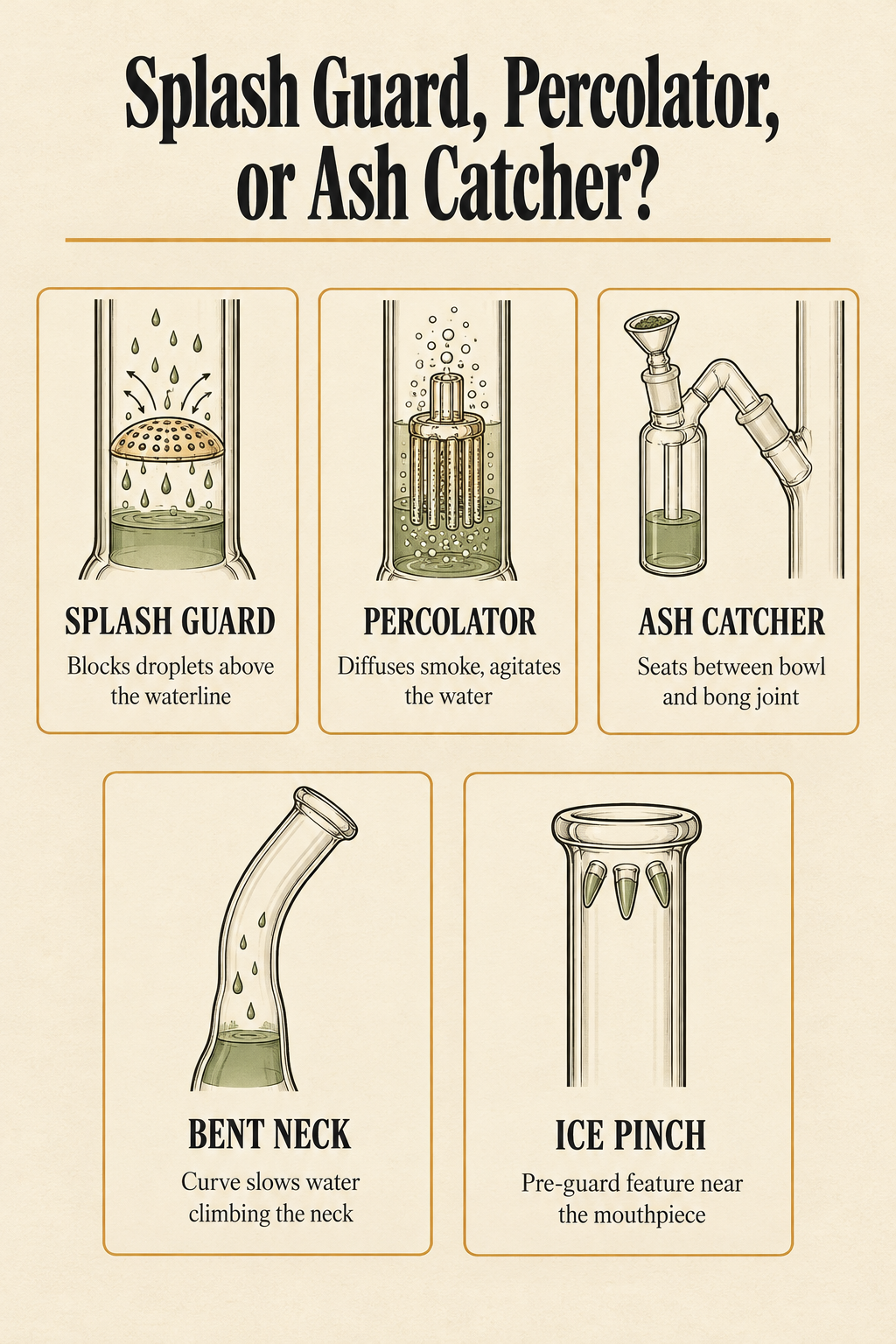
What Does a Splash Guard Actually Look Like Inside a Bong?
What does a splash guard actually look like inside a bong? Wherever it sits, the principle is the same: put something in the path of the droplets that air can pass through. The idea is borrowed from laboratory glassware, where splash heads and splash adapters keep liquid from bumping upward into a distillation product.[9]
The forms you will see fall into a few families, and the differences matter mostly for airflow and cleaning.
History explains some of the confusion. Before dedicated guards existed, the ice pinch was the only feature near the mouthpiece on most bongs, and it worked as a barrier by accident rather than design.[3] Newer guards look like small dome percolators just below the mouthpiece, which is exactly why shoppers mistake one for the other on a product photo.
There is always an airflow trade-off. More obstruction means better splash protection and slightly more draw resistance, so guard design is a balance between stopping water and not choking the pull.[9] A guard with very small openings runs drier and stiffer; a guard with generous openings is the reverse. If a piece feels tight after you add something to the neck, that is the trade-off showing up, not a defect.
- Perforated dome: the most common production form, sitting just below the mouthpiece and reading almost like a small percolator in photos.[3]
- Slotted disc: a flat plate with openings, pressed into a neck or fitted inside a joint.
- Pinched glass ridges: the tube narrows into ridges droplets cannot easily pass, and the same pinch can hold ice cubes.[1]
- Beads and mesh inserts: loose glass beads or stainless mesh added as an aftermarket barrier.[9]
- Removable adapters: screw-in or friction-fit guards that list a joint size, with 14mm and 18mm the most common.[9]
- Kinked neck: the bend itself acts as a passive guard on acrylic and bent-neck glass pieces.[12]
- Where it sits: above the waterline and below the mouthpiece. A feature below the waterline is diffusion, not a guard.[9]
Which Bong Shape Splashes Least: Straight Tube, Beaker, or Bent Neck?
Which bong shape splashes least: straight tube, beaker, or bent neck? Neck length and neck width decide most of it. Short necks leave very little buffer between the chamber and your mouth, and narrow necks raise air velocity so droplets reach the mouthpiece faster.[7]
One retailer’s shape table rates beaker bases and bent or curved necks as low splashback tendency, and straight tubes as higher.[5] That lines up with the physics: the more distance and direction change between water and lips, the more chances water has to fall back down.
Size alone does not settle it. The idea that a bigger bong never splashes is listed as a myth, because a large straight tube with a short mouthpiece section still splashes when it is overfilled.[7] Height only helps when the extra height is in the neck rather than the chamber.
If you are choosing a shape rather than fixing a piece, browse Bongs with the neck in mind. A bent neck with a pinch does more for moisture than a tall straight tube with nothing above the waterline. A piece that markets its curved neck as the splash feature is telling you where the design work went.[13]
- Bent or curved neck: the bend is harder for water to travel through, so it behaves like a passive guard.[3]
- Beaker base: a wide base holds volume low in the piece, keeps the waterline further from the mouth, and leaves room for an add-on.[2]
- Straight tube: the most direct path from water to mouthpiece, and the shape most likely to need technique or a guard.[5]
- Short compact pieces: the smallest buffer of all, which is why minis and small rigs splash first at a strong pull.[6]
- Neck width: a narrow neck speeds the air up, so the same pull moves more water than it would in a wide neck.[7]
- Ice catcher plus high water: a shape feature that people assume fixes splash but does not replace the right level.[8]
| Shape | Splash tendency | Why |
|---|---|---|
| Bent or curved neck | Low | The bend is harder for water to travel through |
| Beaker base | Low | Wide base keeps the waterline further from the mouth |
| Straight tube | Higher | The most direct path from water to mouthpiece |
| Short compact piece | Highest | The smallest buffer between water and mouth |
Why Did Your Bong Start Splashing When Nothing Else Changed?
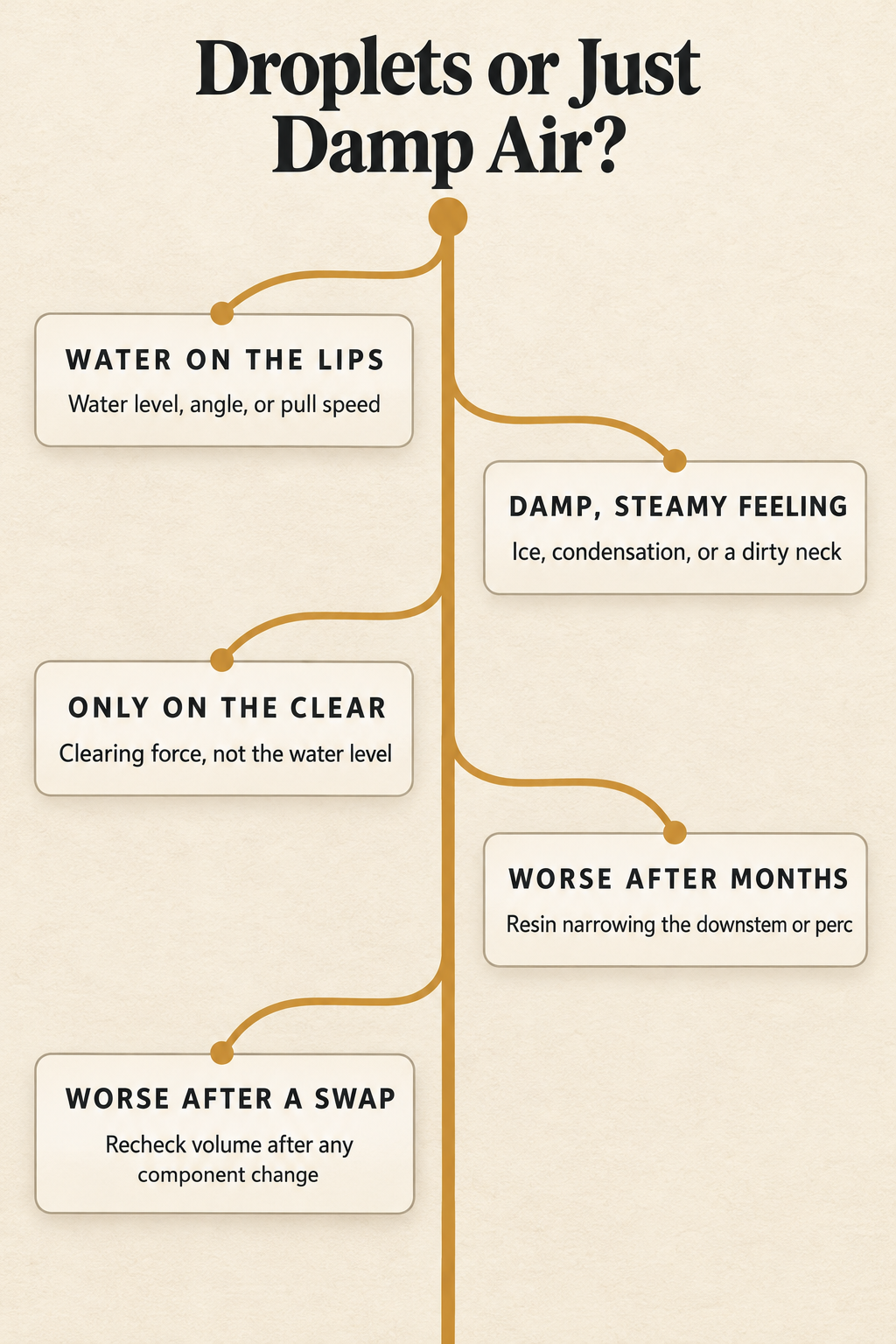
Why did your bong start splashing when nothing else changed? Something did change, even if it happened slowly. The usual culprits are buildup inside the piece, a component you swapped a while back, or ice and water drifting out of balance.
Start by separating two different complaints, because they point at different fixes. Water on your lips is a water problem. A damp, steamy feeling with no droplets is a condensation problem, and chasing it with water level will not help.[8]
Work the checks in this order and stop as soon as one produces a match.
One part gets blamed unfairly: the ash catcher. An overfilled ash catcher can spit water into the main chamber, which makes the bong look like the problem when the add-on is.[6] Check the level in the attachment before you take the main chamber apart.
Ice is the other false lead. Ice catcher plus a high water level is a common cause of wet pulls, and ice does not substitute for correct water level and technique.[8] If the neck is wet and the water is at the right height, pull the ice out and test again before you buy anything.
- Droplets on your lips mean water level, holding angle, or pull speed. Go back to the fill sequence.[8]
- A damp or steamy feeling without droplets points at ice, condensation, or a dirty neck instead.[8]
- Splashback that only happens on the clear points at clearing force rather than the water level.[6]
- A gradual decline over months points at resin narrowing the downstem, percolator, or bowl, which forces a harder pull to compensate.[6]
- A change right after a swap points at volume, because the new component changed how much water the piece needs.[6]
- Water that smells or looks stale points at the simplest fix of all: change it between sessions.[7]
Can You Add a Splash Guard to a Bong That Does Not Have One?
Can you add a splash guard to a bong that does not have one? Sometimes, but there are two routes and they are not equal. Most shoppers either buy a piece with the feature built into the glass, or add an ash catcher. A universal drop-in guard is a niche product rather than a standard one.
Built-in is the simpler route, since the feature is designed into the neck rather than retrofitted onto it. The examples below are in-stock pieces and add-ons, with the specs that matter for fit.
Upkeep is the part people skip. A guard catches exactly the grime it is designed to stop, so it soils faster than the glass around it.[9] A soak in isopropyl alcohol with coarse salt works for glass guards. The perforations need a pipe cleaner or a cotton swab, because the openings clog before the rest of the piece does.
Isopropyl alcohol carries a real handling hazard. It is a highly flammable liquid and vapor, and it causes serious eye irritation, so keep it away from flame and heat and let glass dry completely before the next session.[10]
If you are weighing a twenty-five dollar add-on against a fifty dollar piece, the gap is smaller than it looks once you count the glass you would still be using. Treehouse Lifestyle includes free shipping on orders $150+, which is worth knowing if you are already filling a cart with a bowl or a downstem.
- Integrated guard: a 6-inch mini egg dab rig with a UFO splash guard built into the neck, 14mm female, $48.99.[11]
- Kinked neck: an acrylic kink neck pipe at $24.00 that markets the curved neck itself as the splashguard.[12]
- Bent neck beaker: an angled bent neck with a 3-pinch ice catcher at $25.90 that keeps water out of the mouthpiece.[13]
- Add-on ash catcher: a 5-arm tree percolator elbow with a 90-degree bend at $32.99 that adds a chamber and a buffer at the joint.[14]
- Aftermarket insert: a removable guard, which lists a joint size, with 14mm and 18mm the most common.[9]
- Joint fit first: none of these seat unless the joint matches, so confirm 10mm, 14mm, or 18mm on your piece before ordering.[3]
- Cleaning kit: isopropyl alcohol, coarse salt, a pipe cleaner, and a swab for the perforations.[9]
Frequently Asked Questions
What is a splash guard on a bong?
It is a barrier that sits above the waterline and below the mouthpiece: a perforated dome, a slotted disc, or pinched glass ridges. Droplets thrown upward strike it and fall back, while air passes through the openings. Its only job is moisture management. It does not cool vapor or filter anything the way a percolator does.[9]
Does a splash guard actually stop splashback?
It adds margin, not a guarantee. A guard gives droplets something to hit before your lips, so a steady pull on a properly filled piece stays dry. It will not rescue an overfilled bong, because the water still has to go somewhere when the chamber is packed too high.[6]
Should I lower the water level or buy a splash guard first?
Lower the water first. Too much water in the chamber is the most commonly cited cause, and it costs nothing to fix. Published guidance differs. One retailer says roughly half an inch to an inch of water over the downstem openings.[5] Another says enough to cover the percolator slits, without water climbing the neck on a pull. Check hardware after that.
Will a splash guard or ash catcher make the pull harder?
Slightly. More obstruction means better splash protection and a bit more draw resistance, which is why guard design is a balance.[9] An ash catcher adds a chamber and a buffer at the joint, which can reduce splash as a side effect. It is there to catch ash, not to fix the water level.
Can you add a splash guard to a bong that does not have one?
Sometimes. Aftermarket inserts exist and typically list compatible joint sizes, with 14mm and 18mm most common, so the bong has to match.[9] The more common add-on is an ash catcher, which seats at the joint and adds a chamber. Many shoppers instead choose a piece that builds the feature in, like a bent neck or a pinched tube.
Do bent neck bongs splash less than straight tubes?
Retail shape tables rate beaker bases and bent or curved necks as low splashback tendency and straight tubes as higher.[5] The bend is harder for water to travel through, so it behaves like a passive guard. Neck length and neck width matter too, and a short narrow straight tube leaves the least buffer of all.
What Is the Fastest Way to Stop Splashback for Good?
Drain a little water, hold the piece upright, start the pull slowly, and clear it without slamming it. That four-step reset fixes most splashback without spending anything, and it is the order that costs the least money and time. A splash guard, a bent neck, or an ash catcher is the next step, not the first one.
When you do shop for hardware, match the joint first and read the spec block for the word guard, since listings name the feature three different ways.[1] Then keep the piece clean, because a guard that is clogged with resin behaves like no guard at all.[9] A dry mouthpiece is mostly a matter of water level and a steady pull, and the glass only has to add margin on top of that.
Sources
- GRAV: GRAV Medium, Clear Beaker Base Water Pipe
- GRAV: GRAV Large, Clear Beaker Base Water Pipe
- High Times: Anatomy of a Bong 101: What are the different parts of a bong?
- DankGeek: Why Is My Bong Splashing Water into My Mouth?
- Encore Collection: How to Stop Bong Splashback (No More Mouth Water)
- Vitae Glass: How to Stop Bong Splashback Without Killing Flow
- Bongs Canada: How to Stop Bong Splashback (No More Mouth Water)
- The Boombox Club: Bong Splashback Fix: Stop Water Hitting Your Mouth
- Birch + Fog: Splash guard — Cannabis glossary
- PubChem / National Institutes of Health: Isopropyl Alcohol — Compound Summary, GHS Classification
- Treehouse Lifestyle: 6" Mini Egg Dab Rig with Crown Perc | Croia Glass
- Treehouse Lifestyle: Acrylic Kink Neck Bong 9-12"
- Treehouse Lifestyle: Classic Bent Neck Beaker Glass Water Pipe | 14mm F
- Treehouse Lifestyle: Pulsar 5-Arm Ash Catcher | 90 Degree | 14mm Male