

A gas mask bong is a two-part smoking device: a rubber or silicone face mask with adjustable straps and eye windows, plus a water pipe that seats into the port where a filter cartridge would sit. The mask is the mouthpiece and the pipe is the smoking end. In the novelty market the pipe is almost always acrylic. [1]
What Is a Gas Mask Bong and How Is It Put Together?
The two halves do different jobs, and that is the whole design. The mask is the mouthpiece and the seal. The pipe is the smoking end, holding the bowl, the downstem, and the water chamber. [3]
The pipe detaches from the mask on every commercial design reviewed. That is not a bonus feature. Detaching is how you fill and empty the water, pack and swap the bowl, and clean both halves without working around a strap setup. [5]
Naming is where buyers get stuck. Gas mask bong, bong gas mask, and gas mask water pipe all point at the same object. So do pipe mask, mask pipe, gas mask pipe, and weed gas mask. [9] In every version the word mask describes the shape of the face piece, not a certified respirator.
It also sits in a crowded family of gear. Most shops file a mask unit under Bongs rather than with hand pipes, and you will usually find it near Acrylic Bongs and steamroller tubes. If you want a side-by-side of two water pieces, What Is the Difference Between a Bubbler and a Bong? is the short version.
- Mask shell: a rubber or silicone face piece with straps that tighten down to a snug fit.
- Eye windows: clear plastic or goggle-style lenses that close off the space in front of the face.
- Filter port: the round opening where a cartridge would go, and where the pipe seats instead.
- Pipe body: an acrylic tube with a fixed downstem and a water chamber at the base.
- Bowl and carb: a removable bowl for material, plus a carb hole on the back of the tube to control airflow.
How Does a Gas Mask Water Pipe Actually Work?
Follow the air and you have the whole device. Nothing about the mask half changes how the pipe half works. It changes where the output ends up, which is the entire trick.
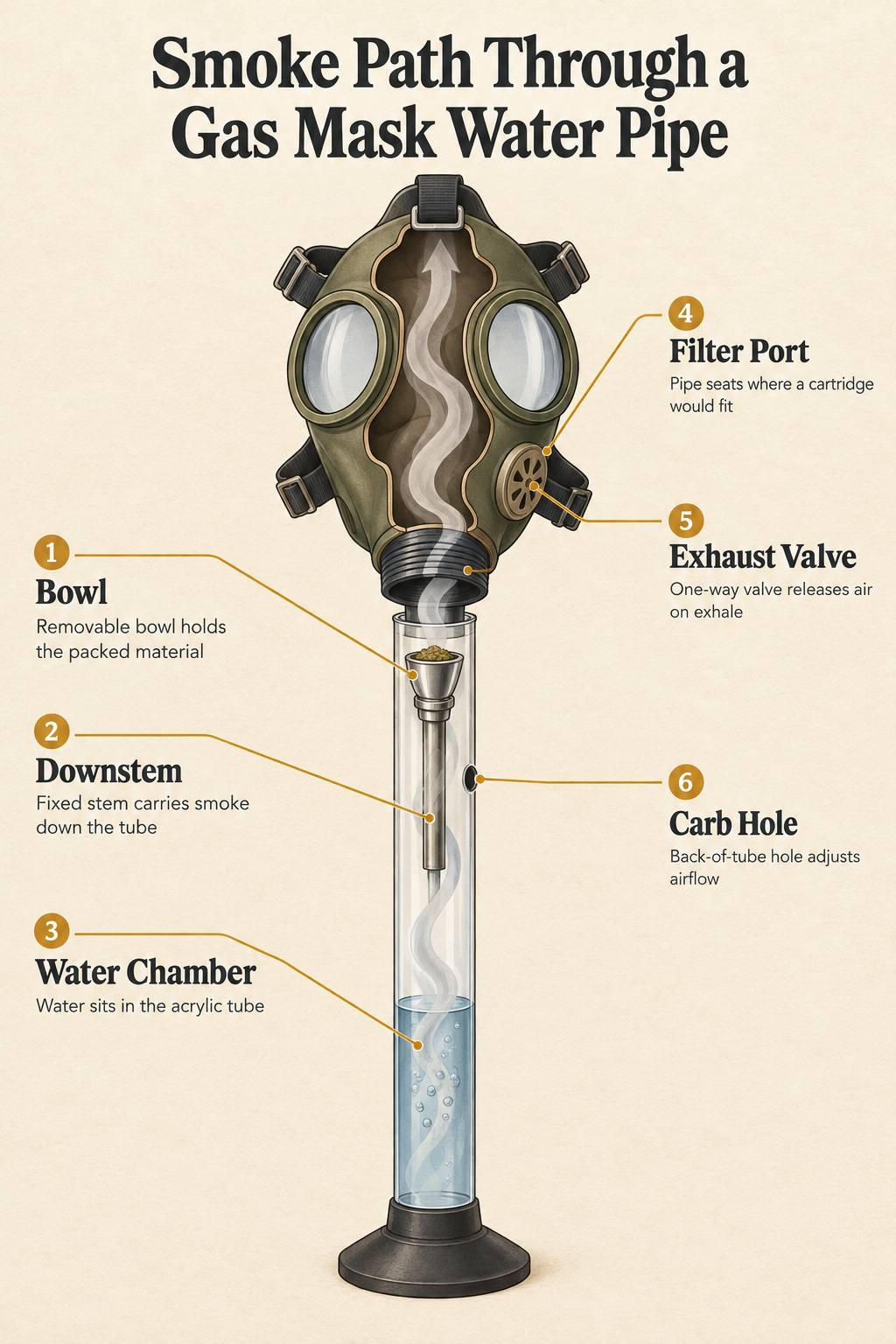
The path is short and mechanical. Smoke leaves the bowl and drops through the downstem. It then passes through the water sitting in the acrylic tube. From there it rises into the sealed space in front of the face, rather than drifting into the room. [1]
Two handling features control that path. The carb hole on the back of the tube is a finger-sized vent. Cover it and the draw goes through the bowl. Release it and the chamber clears. [4]
Some masks also carry a one-way exhaust valve near the mouthpiece. On an exhale the valve opens so air leaves the mask rather than being pushed back down the pipe. On a draw it closes again, so air comes through the water instead. [6]
A second, smaller hole on some masks is sealed at the factory. So the pipe and the valve are the only ways in or out of the sealed space. [9]
The pipe half is the same water pipe you would find anywhere else, and What Is a Bong and How Does It Work? walks through how a standard one works. If the tube you buy carries a percolator instead of a plain downstem, What Is a Percolator Bong and How Does It Work? explains what changes. Acrylic is the default material here, and Are Acrylic Bongs Worth Buying? What Should You Know First? covers what that choice means in practice. For the wider family this piece belongs to, start with What Are Specialty Pipes and How Do You Choose the Right One?.
- Smoke starts at the bowl, which holds the packed material and sits at the top of the downstem.
- It drops down the downstem, a fixed tube running from the bowl into the water chamber.
- It passes through the water at the base of the acrylic tube, which is why the tube gets filled first.
- It rises into the empty upper section of the tube, where the carb hole lets you clear that space.
- It moves through the filter port into the sealed space inside the mask, in front of the eyes and mouth. [3]
What Parts Come With a Gas Mask Bong and What Are They Made Of?
Listings for these pieces are usually thin on detail, so it helps to know what the published specs say. The common straight-tube style runs roughly eight and a half to nine inches tall. It has a fixed downstem, a removable bowl, and a carb hole on the back. The mask carries five or more straps. [5]
The bowl is the part that varies most in practice. Some units screw in, some sit in a rubber grommet, and a few are fixed. A removable bowl is easier to pack and clean, and easier to replace if it chips. [4]
The mask is rubber or silicone. Retailers describe it as more rubbery than a surplus gas mask, so it seals comfortably against a face instead of clamping down hard. The eye windows are clear plastic or goggle-style lenses, and they exist to close the space in front of the face. [3]
Variation across the category is mostly cosmetic, with a couple of splits that change handling. Skull and character themes, solid colors, and glow acrylic are looks. Percolator versus straight tubes, and fixed versus removable bowls, are the two differences you will actually notice in use. [2]
If you want the vocabulary before you shop, What Are the Parts of a Bong and What Does Each One Do? names each part of a water pipe and explains the job it does.
- Mask shell: rubber or silicone, sized to fit most heads, with five or more tightening straps.
- Eye windows: clear plastic or goggle-style lenses that keep the sealed space closed off.
- Acrylic tube: eight and a half to nine inches tall on the common straight style, with a flat base.
- Downstem: fixed on most units, running from the bowl down into the water.
- Bowl: removable on most units, either screwed in or seated in a grommet.
- Carb hole: a vent on the back of the tube for clearing the chamber.
- Exhaust valve: optional, one-way, sitting near the mouthpiece on masks that include one.
How Do You Set Up a Gas Mask Bong and Check the Seal?
Sources describe the same fit sequence, and the order is what keeps water off the floor. The usual mistake is filling the pipe first and then wrestling with the straps.
Loosen everything before anything else. Straps that are already partly tight make the mask hard to seat and easy to knock crooked. A crooked mask means a leak at the edge.
Visibility is the honest limitation. Once the mask is on you cannot see the bowl clearly, and you cannot reach it comfortably. That is why sources put packing and lighting before the mask goes on, and why reloading means taking the mask off. [9]
Bowl capacity is small on these pieces, which is why sessions read as a couple of pulls rather than a long sit. Plan for a short run and a reset in between rather than a marathon.
Check the seal twice: once before the pipe goes in, and once after. A tube that sits at an angle will feel loose at the port, and no amount of strap tightening fixes that.
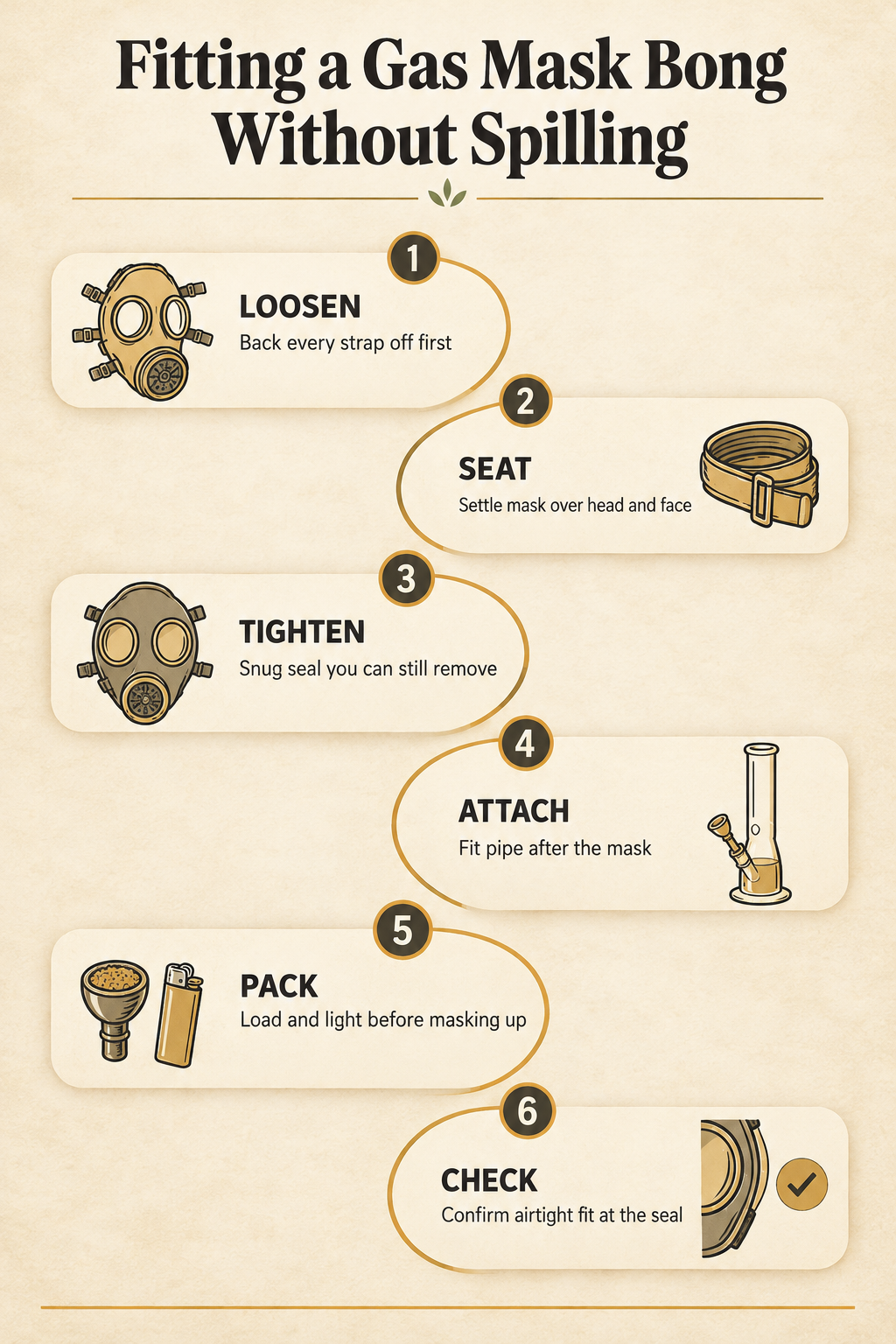
- Back every strap off until the mask is loose enough to pull on and off without effort.
- Seat the mask over the head and face, checking that the eye windows sit level and nothing is pinched.
- Tighten gradually, one strap at a time, to a snug seal you can still pull off quickly. [1]
- Fill the pipe with water, then seat it into the filter port so the tube stands square rather than cocked to one side. [5]
- Pack the bowl and light it before the mask goes on, or have someone spot you while it is on. [6]
- Check the seal at the mask edge, and confirm the tube is not leaning before you take a draw.
Why Is the Pipe on a Gas Mask Bong Almost Always Acrylic?
Acrylic dominates for two reasons: cost and survival. It costs less than glass to make. It also does not shatter when a tube strapped to a head gets knocked into something. [2]
Glass and metal versions exist. Build guides note mask-and-bong combinations in both glass and metal. Acrylic is what fills retail listings, and that is the main reason the category stays inexpensive. [3]
Research at the time of writing found prices from about thirty-four dollars to seventy-five dollars. The range depends on the retailer and the mask design. Editorial coverage puts typical shop pricing around forty to seventy-five dollars. [1] Prices move, so check current listings instead of assuming a number. If you are ordering more than one piece, free shipping on orders $150+ applies.
Acrylic has handling quirks worth knowing before you buy. It scratches and hazes more easily than glass. It also reacts badly to the wrong cleaner, which is the whole subject of the next section. It also weighs less than a glass tube of the same size, which matters on a piece that sits on your face.
- Acrylic: cheapest and lightest, but it shows scratches and haze first.
- Glass: clearest to watch the water, though a tube strapped to a head takes falls badly.
- Metal: toughest shell of the three, though you cannot check the water level through it.
- Percolator versus straight tube: the straight tube is simpler to clean and easier to dry.
| Material | Cost | Weight | Knocks and cleaning |
|---|---|---|---|
| Acrylic | Lowest | Lightest | Takes knocks, scratches and hazes, soap and water only |
| Glass | Higher | Heavier | Clearer and harder to scratch, breaks if dropped |
| Metal | Varies | Heaviest | Wipes down easily, hides the water level |
How Do You Clean an Acrylic Gas Mask Bong Without Cracking It?
Acrylic punishes the wrong cleaner, so the routine matters as much as the effort. Empty and separate first; every step after that gets easier.
The supply list is short. Mild dish soap, lukewarm water, a soft brush or pipe cleaner, and something to wipe the inside of the mask. Nothing solvent-based. [3]
Discolored water is the usual cue to change it, and a cloudy tube is the cue to clean it. Retail guides for these devices land on the same short list: soap, warm water, a brush, and no isopropyl on the acrylic parts. [2]
Skip paper towels as well. They leave fine scratches that build into haze over time, which is the same surface damage the solvent rules are trying to prevent.
- Take the pipe off the mask and pour the water out. Both halves get handled separately from here.
- Wash the acrylic tube, bowl, and downstem with mild dish soap in lukewarm water and a brush or pipe cleaner. [4]
- Wipe the inside of the mask with soapy water or an antibacterial solution, then rinse it clear.
- Skip isopropyl alcohol on the acrylic. Plastics guidance notes that alcohol above roughly seventy percent can cause crazing over time, especially on extruded acrylic. [8]
- Skip ammonia-based glass cleaner, bleach, acetone, lacquer thinner, and abrasive pads for the same reason: they damage the surface.
- Dry every part completely before reassembly, and change the water between sessions rather than topping it up.
Is a Gas Mask Bong a Real Gas Mask, and Can You Swap the Pipe?
A novelty gas mask bong is not respiratory protection, and it does not filter anything. There is no cartridge, no certification, and no approval label on the unit. The mask is a shape, not a function. [10]
A real gas mask is a different class of equipment. The CDC describes an air-purifying respirator as a facepiece plus a filter or cartridge. Such a unit only reduces exposure when the right cartridge is chosen for the hazard, the fit is good, and the unit is maintained. The same fact sheet states that no US agency tests and certifies respirators for general public use. [7]
Surplus and homemade builds add their own unknowns. Military surplus masks were not made for smoke exposure, and their plastics, rubber, and adhesives are unspecified. Homemade versions depend on an improvised seal, and published advice across sources is not uniform: at least one build guide still prints a bottle-and-mask method. [2]
The swap question has a simple answer. The acrylic tube pushes into the filter port instead of threading in. A glass tube or steamroller of similar diameter can seat in the same opening. That is also why the same device is sold and searched as a pipe mask. [6]
If you go that route, dry-fit the replacement before you put water anywhere near it. A tube that rocks in the port will leak, and a tube that is too tight will stress the acrylic collar around the opening.
- Not a respirator: no cartridge, no certification, and no filtration of any kind.
- A certified unit needs: the right cartridge for a specific hazard, a correct fit, and ongoing maintenance.
- Surplus masks: materials and adhesives were never intended for smoke exposure.
- Homemade builds: performance depends entirely on an improvised seal.
- Before swapping a tube: measure the port and the tube, and check that the piece sits square rather than at an angle.
How Does a Gas Mask Bong Compare With a Regular Bong or a Steamroller?
Against a regular bong, the differences are the face piece, the strap fit, and the smaller bowl. There is also the fact that you cannot see what you are doing once the mask is on. The pipe half is often the same acrylic tube you would buy on its own. [1]
Against a steamroller tube, the mask version adds the seal and the strap-down setup but keeps the same straight-tube airflow. A steamroller of the right diameter can even donate its tube to the mask. [6]
Against a plain hand pipe, or a pipe mask with no tube attached, the water chamber is the real addition. It also brings the water chores that come with any water piece. [3]
Editorial coverage is consistent about the trade. The device is an occasional party piece rather than a daily driver, and reviewers describe sessions as short and fiddly. [2]
The decision comes down to what you want the piece to do. Buy one if the novelty is the point and you want something to pass around at a session. Skip it if you want a pipe you can load, light, and watch while using it one-handed. Neither answer is wrong; the device is simply clear about what it is good for.
- You cannot see the bowl once the mask is on, so the bowl gets packed first or someone spots you.
- The small bowl means a reload each round, and reloading means taking the mask off.
- The strap fit is the fiddly part: a loose edge leaks, and a tight edge is hard to pull off quickly.
- The pipe half is a standard acrylic tube, so it still works on its own without the mask.
- It suits group sessions better than solo use, where the mask adds steps and blocks your view.
| Feature | Gas mask bong | Regular bong | Steamroller tube |
|---|---|---|---|
| Seal around the face | Yes | No | No |
| Bowl size | Typically small | Larger | Small |
| Visibility while using | Blocked by the mask | Clear | Clear |
| Water chamber | Yes | Yes | No |
| Cleanup | Two-part disassembly | Single piece | Single piece |
Frequently Asked Questions
Is a gas mask bong the same thing as a gas mask water pipe or a pipe mask?
Yes. The terms describe one object. High Times writes gas mask bong and bong gas mask. Marijuana Packaging sells a gas mask water pipe. Other outlets and retailers use pipe mask, mask pipe, gas mask pipe, and weed gas mask. In every case the mask refers to the face piece, and the pipe is the smoking end.
Does a gas mask bong filter anything?
No. A novelty gas mask bong ships with no filter cartridge and no certification, so it filters nothing. It is built around the shape of a gas mask rather than the function. A real air-purifying respirator needs a facepiece, the correct cartridge for a specific hazard, a proper fit, and ongoing maintenance. That is a different class of equipment entirely.
Can you put a glass pipe on a gas mask bong?
Often, yes. The acrylic tube simply pushes into the mask filter port, so a glass tube or steamroller of similar diameter can seat in the same opening. Measure the port and the tube before buying, and check that the piece sits squarely rather than at an angle. Confirm the fit with the seller if the listing does not state the opening size.
Can you clean a gas mask bong with isopropyl alcohol?
Not the acrylic parts. Acrylic suppliers warn that alcohol above roughly seventy percent can cause crazing over time, especially on extruded acrylic. Retail guides for these devices recommend warm soapy water and a brush instead. Skip ammonia-based glass cleaner, bleach, acetone, and lacquer thinner as well, and dry every part fully before reassembling.
How much does a gas mask bong cost?
Research at the time of writing found pricing from about thirty-four dollars to seventy-five dollars. The range depends on the retailer and the mask design. Editorial coverage puts typical shop pricing at roughly forty to seventy-five dollars. Acrylic construction is the main reason the category stays inexpensive. Prices change, so check current listings before buying.
So, Is a Gas Mask Bong Worth Trying?
A gas mask bong is a face mask plus a small acrylic water pipe. The two halves come apart, so you can fill, pack, and clean them. Nothing about the build is complicated once you have seen the parts laid out. The mask is a shape, not a filter of any kind.
A few plain things decide whether you enjoy one. The bowl is small enough to need a reload. The seal has to be checked rather than assumed. And you cannot see the tube while the mask is on. Acrylic keeps the price down, and it also sets the cleaning rules. Soap and lukewarm water is the whole routine, and solvents stay out of it.
Buy one for the novelty and the group-session factor, with the mask coming off between pulls. Skip it if you want a piece you can load and watch while you use it. Either way, the device is honest about what it is. It is a specialty pipe shaped like a mask, filed with the rest of the novelty pieces.
Sources
- High Times: The Gas Mask Bong: Everything You Need To Know
- Royal Queen Seeds: How to Make a Gas Mask Bong
- Smoke Cartel: Gas Mask Bong Guide: What It Is & How to Use One
- Marijuana Packaging: Gas Mask Acrylic Water Pipe | 8.5in Tall – Grommet Bowl – Black
- Vape Land Direct: Acrylic Gas Mask Bong
- Marijuana Science: Top 8 Best Gas Mask Bong Review
- Centers for Disease Control and Prevention (NIOSH): Respirator Fact Sheet, DHHS (NIOSH) Publication No. 2003-144
- American Acrylics: How to Care for and Clean Acrylic Without Scratching It
- Stoner Things: Weed Gas Mask: Worth a Try?
- Mood: Gas Mask Bong Explained Without The Hype